Tag: RTP Scholarship

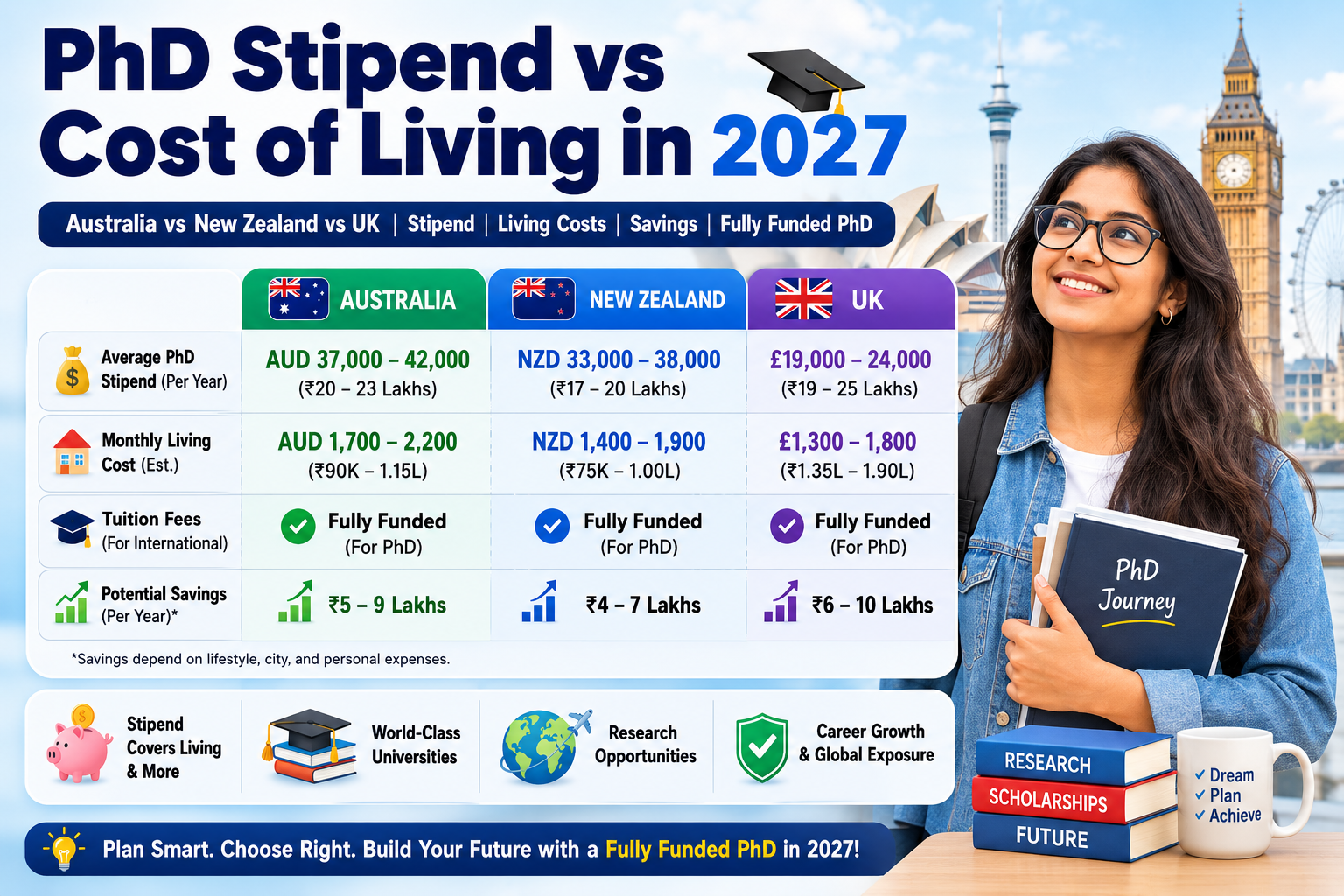
  • PhD Stipend vs Cost of Living in Australia, New Zealand and the UK 2027

    PhD Stipend vs Cost of Living in Australia, New Zealand and the UK 2027

    PhD stipend vs cost of living is one of the most important comparisons Indian students should make before accepting a fully funded PhD abroad in 2027.

    Australia, New Zealand and the United Kingdom are three of the most popular destinations for international PhD students. All three countries offer internationally recognised universities, excellent research facilities and multiple opportunities for funded doctoral study.

    But there is one question that many students overlook:

    Will your PhD stipend actually be enough to cover your cost of living?

    A scholarship of AUD 40,000 in Australia may initially appear much more attractive than a £22,000 UK PhD stipend. However, after considering accommodation, food, transport, insurance and other expenses, the financial picture can change completely.

    Likewise, a PhD student receiving a moderate stipend in Dunedin or Manchester may have more disposable income than someone receiving a higher stipend in Sydney or London.

    Therefore, the best way to compare a fully funded PhD in Australia, New Zealand and the UK is not simply by looking at the annual scholarship amount.

    If you are still at the planning stage, read our complete PhD abroad for Indian students in 2027 guide covering eligibility, scholarships, supervisors, applications and funding.

    The correct calculation is:

    Annual PhD stipend – tuition payable – accommodation – food – utilities – transport – insurance – essential expenses = real PhD purchasing power

    In this detailed EducationMESD guide, we compare PhD stipend vs cost of living in Australia, New Zealand and the UK for 2027, including monthly stipends, living expenses, tuition coverage, potential savings and the best destination for Indian PhD students.


    PhD Stipend vs Cost of Living 2027: Quick Comparison

    If you want a quick answer, New Zealand can offer an attractive stipend-to-cost-of-living ratio, Australia offers particularly strong doctoral funding potential, and the UK can provide good financial sustainability when students study outside London and receive complete international tuition coverage.

    Australia has already published its official 2027 Research Training Program stipend rates. The base RTP stipend will be AUD 35,550 per year, while the maximum RTP stipend rate will be AUD 55,537.

    The latest confirmed UKRI minimum stipend is £21,805 for 2026–27, while the London-weighted amount from October 2026 is £23,805.

    New Zealand does not have one national PhD stipend. University funding varies. The University of Auckland provides a useful benchmark: its 2026 doctoral scholarship offers a tax-free NZD 35,468 annual stipend with annual CPI adjustment, plus eligible tuition fees and single-student international health insurance.

    FactorAustraliaNew ZealandUnited Kingdom
    Major funding routeRTP + university scholarshipsUniversity doctoral scholarshipsUKRI + university studentships
    Latest key stipend benchmarkAUD 35,550 base RTP for 2027NZD 35,468 Auckland benchmark for 2026£21,805 UKRI minimum for 2026–27
    Approx. monthly amountAUD 2,963NZD 2,956£1,817
    Higher-cost locationSydneyAucklandLondon
    Tuition support availableYesYesYes, but international students must verify coverage
    Main financial challengeRentAuckland accommodationLondon accommodation
    Stipend-to-cost potentialGoodPotentially very goodGood outside London
    Key advantageHigh funding potentialStrong purchasing powerLarge research ecosystem

    Important: Never compare these stipend amounts by currency conversion alone. Purchasing power and living costs are much more important.


    What Is a PhD Stipend?

    A PhD stipend is financial support provided to doctoral researchers to help cover their living expenses while they undertake a PhD.

    It may be funded by a government agency, university, research council, supervisor’s research grant, industry partner or external scholarship provider.

    A fully funded PhD can include a stipend plus tuition-fee coverage and may also include research expenses, conference funding, insurance or other allowances.

    This distinction is important:

    PhD stipend and fully funded PhD are not necessarily the same thing.

    For example, a student may receive an annual stipend but still have to pay part of the international tuition fee.

    For Indian students, the strongest PhD funding package is normally:

    Full international tuition coverage + living stipend + research support + appropriate insurance coverage


    Why PhD Stipend vs Cost of Living Matters

    One of the biggest mistakes students make when comparing international PhD scholarships is converting everything into Indian rupees.

    A student may search for:

    AUD 35,550 in INR

    or:

    £21,805 in INR

    and assume whichever converts to the largest Indian rupee value is the best scholarship.

    That approach can be misleading.

    You will usually earn your stipend and pay your expenses in the destination country’s currency.

    A more meaningful comparison is therefore:

    PhD Purchasing Power Formula

    Annual stipend – annual living expenses – uncovered tuition – compulsory expenses = estimated disposable income

    This tells you much more about your likely financial situation during your doctorate.


    PhD Stipend in Australia 2027

    Australia is one of the leading destinations for Indian students searching for a fully funded PhD abroad in 2027.

    One of the country’s major research-degree funding mechanisms is the Australian Government Research Training Program, or RTP.

    Australia RTP Stipend 2027

    The Australian Government has confirmed the following RTP stipend rates for 2027:

    Australia RTP Rate2027 Amount
    Base stipend rateAUD 35,550
    Maximum stipend rateAUD 55,537
    Approx. base monthly stipendAUD 2,963

    According to the Australian Government Research Training Program (RTP), the 2027 full-time base stipend rate is AUD 35,550 and the maximum rate is AUD 55,537.

    However, there is an important distinction.

    AUD 55,537 is the maximum RTP stipend rate, not a guaranteed stipend for every Australian PhD student.

    Universities determine individual scholarship arrangements, and some doctoral candidates receive the base amount while others receive higher university scholarships, research-project funding or scholarship top-ups.

    Indian applicants can explore our detailed guide to a fully funded PhD in Australia for Indian students, including RTP scholarships, university funding, stipend rates and eligibility.


    What Does an Australian RTP Scholarship Cover?

    The Research Training Program can support tuition-fee offsets, stipends and allowances for eligible higher-degree research students.

    For an international applicant, the best Australian funding package will typically combine:

    100% tuition-fee coverage + annual PhD stipend + research support

    This is why Indian students should carefully read the scholarship offer.

    A stipend of AUD 38,000 combined with complete tuition coverage can be much more valuable than a higher apparent award that leaves significant fees payable.


    Cost of Living in Australia for PhD Students

    Australia offers excellent research funding, but its biggest financial disadvantage is its comparatively high cost of living.

    The Australian Department of Home Affairs currently uses AUD 29,710 as the 12-month living-cost requirement for a student visa applicant. It explicitly warns that actual living costs can be much higher and vary depending on where the student lives.

    University estimates provide a more practical picture.

    Monash University estimates that a single international student may require approximately:

    AUD 30,000–45,000 per year

    for living expenses.

    This means accommodation and lifestyle can determine whether an Australian PhD stipend feels comfortable or restrictive.


    Monthly Cost of Living in Australia for PhD Students

    Accommodation is likely to be one of the largest costs.

    Monash University currently provides indicative accommodation figures such as:

    ExpenseIndicative Cost
    Shared rentalAUD 275–380/week
    On-campus accommodationAUD 350–450/week
    Private rentalAUD 500–750/week
    Groceries/eating outAUD 150–500/week
    UtilitiesAUD 40–80/week
    Public transportAUD 25–50/week

    These estimates illustrate why two PhD students receiving exactly the same Australian stipend can have very different financial experiences.


    Australia PhD Stipend vs Cost of Living

    Using the official 2027 RTP base stipend and Monash University’s broader annual estimate:

    Australia PhD BudgetApprox. Annual Amount
    RTP base stipend 2027AUD 35,550
    Lower living-cost estimateAUD 30,000
    Illustrative remaining amountAUD 5,550
    Higher living-cost estimateAUD 45,000
    Illustrative shortfallAUD 9,450

    These figures should not be interpreted as guaranteed savings or losses.

    They demonstrate something more important:

    The financial value of an Australian PhD scholarship depends heavily on where and how you live.


    Is a PhD Stipend Enough to Live in Australia?

    Yes, an Australian PhD stipend can be enough for a single student, particularly when tuition is fully covered and accommodation is shared.

    The situation becomes more comfortable when the student receives an above-base stipend, scholarship top-up or affordable university accommodation.

    However, living alone in an expensive location could consume a large proportion of the stipend.

    This is why students searching for PhD stipend Australia 2027 should also research the cost of accommodation around the university.


    Sydney vs Melbourne vs Other Australian Cities

    The cost of living in Australia varies considerably by city and accommodation type.

    The same AUD 38,000 stipend can create very different lifestyles in different Australian locations.

    Therefore, compare:

    PhD stipend + city + accommodation + tuition coverage

    rather than only:

    university ranking + annual stipend

    An excellent supervisor and fully funded position in a lower-cost location may offer better overall value than a prestigious research opportunity where rent absorbs most of your scholarship.


    Can You Save Money During a PhD in Australia?

    Yes, it is possible to save money from an Australian PhD stipend, particularly if you receive funding above the base RTP rate and keep accommodation costs under control.

    Shared accommodation, cooking at home and avoiding unnecessarily expensive housing can significantly improve disposable income.

    However, applicants should treat potential savings conservatively.


    PhD Stipend in New Zealand 2027

    New Zealand is increasingly attractive for Indian students searching for a fully funded PhD with a good stipend-to-cost-of-living ratio.

    Unlike Australia, New Zealand does not have a single national doctoral stipend.

    Scholarship rates are determined by individual universities and funding programmes.

    Therefore, students searching for PhD stipend New Zealand 2027 should compare university-specific scholarships rather than expecting one national figure.


    University of Auckland PhD Stipend

    The University of Auckland provides a useful benchmark.

    Its University of Auckland Doctoral Scholarship offers up to:

    NZD 35,468 per year in 2026

    and the stipend is:

    tax-free with an annual CPI adjustment.

    That is approximately:

    NZD 2,956 per month

    for the 2026 scholarship value.

    The scholarship can also cover compulsory tuition fees, Student Services Fees and single-student international health insurance for eligible international recipients.

    That makes the complete funding package more valuable than the stipend figure alone suggests.


    What Is the New Zealand PhD Stipend in 2027?

    This is a high-value search query, but accuracy matters.

    There is currently no single confirmed national New Zealand PhD stipend for 2027.

    The University of Auckland’s published 2026 figure is NZD 35,468 and the university states that the stipend receives an annual CPI adjustment.

    Therefore, students starting in 2027 should check the applicable university scholarship rate when their award is issued.

    Do not rely on websites that simply label the 2026 value as the “2027 New Zealand PhD stipend” without explaining the distinction.


    Cost of Living in New Zealand for PhD Students

    Immigration New Zealand currently requires self-funded tertiary students to demonstrate:

    NZD 20,000 per year

    for living expenses, or NZD 1,667 per month if the period of study is shorter than one year.

    However, this is an immigration financial requirement rather than a complete estimate of comfortable student expenditure.

    Actual living costs depend on city, accommodation, food, transport and lifestyle.


    Cost of Living in Dunedin for PhD Students

    The University of Otago provides useful city-specific information.

    It recommends approximately:

    NZD 22,000–27,000 for 40 weeks

    of comfortable living in Dunedin, above tuition costs. The university specifically notes that a student remaining for the full 52-week year will require more.

    This provides a useful example of why New Zealand can perform well in a PhD stipend vs cost of living comparison.


    New Zealand PhD Stipend vs Cost of Living

    Consider the University of Auckland scholarship benchmark:

    New Zealand Funding FactorAmount
    Auckland doctoral stipend, 2026NZD 35,468
    Approx. monthly stipendNZD 2,956
    Immigration living-funds requirementNZD 20,000/year
    Tuition supportAvailable under scholarship conditions
    International health insuranceCovered under applicable scholarship conditions

    The difference between NZD 35,468 and NZD 20,000 should not be considered guaranteed savings because the immigration figure is a minimum funding requirement rather than a realistic full-year personal budget.

    However, a package combining a NZD 35,000+ stipend with tuition and insurance support can be financially attractive.


    Auckland vs Dunedin vs Other New Zealand Cities

    The same New Zealand scholarship can provide different purchasing power depending on location.

    Auckland generally places greater pressure on accommodation budgets than some smaller university cities.

    Dunedin offers an interesting contrast. The University of Otago’s current guidance indicates NZD 22,000–27,000 for 40 weeks of comfortable living and notes that a full calendar year requires additional funding.

    For Indian students, a funded PhD outside the highest-cost areas can therefore provide particularly strong financial value.


    Is New Zealand Good for a Fully Funded PhD?

    Yes. New Zealand can be an excellent option for a fully funded PhD, particularly when the scholarship combines tuition coverage with a tax-free stipend.

    Its main limitation is scale.

    New Zealand has fewer universities than Australia or the UK, so students may find fewer funded positions in very specialised research fields.

    However, where the research fit and funding package are strong, New Zealand deserves serious consideration.


    PhD Stipend in the UK 2027

    The United Kingdom remains one of the world’s major destinations for doctoral research.

    Common searches from international applicants include:

    UK PhD stipend 2027

    UKRI PhD stipend

    fully funded PhD UK for international students

    and:

    is a UK PhD stipend enough to live on?

    The most important national benchmark is the stipend set by UK Research and Innovation.


    UKRI PhD Stipend 2026–27

    The confirmed UKRI minimum stipend for the 2026–27 academic year is £21,805.

    That is approximately:

    £1,817 per month

    UKRI also lists a London-weighted stipend of:

    £23,805 from 1 October 2026

    or approximately:

    £1,984 per month.

    Students commencing later in 2027 should verify whether a subsequent academic-year stipend has been published before finalising their financial plans.


    UKRI Stipend Increase

    The UKRI minimum increased from:

    £20,780 in 2025–26

    to:

    £21,805 in 2026–27

    which represents an increase of £1,025 per year.

    This demonstrates why applicants should always check the latest UKRI rate rather than relying on older PhD funding articles.


    Does UKRI Cover International PhD Tuition Fees?

    Indian students need to pay particular attention to this issue.

    UKRI’s published minimum fee level for 2026–27 is £5,238. UKRI’s support framework does not mean that every international student’s full overseas tuition difference will automatically be covered.

    Before accepting an offer, international applicants should therefore confirm:

    Does this studentship cover 100% of my international PhD tuition fee for every funded year?

    Do not assume that the words “UKRI-funded” automatically mean you will personally pay zero international tuition.


    Cost of Living in the UK for PhD Students

    The cost of living in the UK depends heavily on location.

    Current UK Student visa maintenance requirements are:

    LocationMonthly Requirement
    London£1,529
    Outside London£1,171

    These amounts apply for up to nine months under the relevant financial-evidence rules.

    These figures are immigration requirements rather than guarantees of realistic monthly expenditure.

    University-specific estimates are more useful for understanding actual living costs.


    Cost of Living in Manchester for PhD Students

    The University of Manchester estimates 2026–27 living expenses for a postgraduate student at £18,188 for 52 weeks.

    That is approximately:

    £1,510 per month.

    Its estimate includes accommodation, groceries, transport, social expenditure, phone costs, health and wellbeing, course materials and other typical costs.

    This provides an excellent case study for comparing a UK PhD stipend vs cost of living.


    UK PhD Stipend vs Cost of Living

    UK PhD BudgetAnnual Amount
    UKRI minimum stipend 2026–27£21,805
    Manchester estimated postgraduate living costs£18,188
    Illustrative difference£3,617
    Illustrative monthly differenceAround £301

    This does not mean every student in Manchester will save £3,617.

    However, it indicates that a UKRI-level stipend can provide a workable financial position in some UK university cities outside London.


    Is a UK PhD Stipend Enough to Live On?

    Yes, a UKRI-level PhD stipend can be sufficient for many single students, particularly outside London and when international tuition is fully covered.

    Financial pressure increases when rent is high or the student supports family members.

    Location therefore matters almost as much as the stipend.


    London PhD Stipend vs Outside London

    London deserves separate consideration.

    The London-weighted UKRI rate from October 2026 is £23,805 compared with the standard £21,805 minimum.

    However, the UK Student visa maintenance benchmark is also significantly higher in London:

    £1,529 per month in London

    versus:

    £1,171 outside London.

    Therefore:

    A higher London PhD stipend does not necessarily mean higher savings.

    A £21,805 stipend in an affordable university city could potentially provide greater purchasing power than £23,805 in London.


    PhD Stipend vs Cost of Living: Australia vs New Zealand vs UK

    The following table provides the core comparison for Indian students planning a fully funded PhD abroad in 2027.

    FactorAustraliaNew ZealandUK
    Key stipend benchmarkAUD 35,550NZD 35,468*£21,805
    Approx. monthly amountAUD 2,963NZD 2,956£1,817
    Benchmark year2027Auckland 20262026–27
    Expensive locationSydneyAucklandLondon
    Tuition funding availableYesYesYes; verify overseas fee difference
    Stipend indexation/increaseRTP rates updatedAuckland CPI-adjustedUKRI rates updated
    Potential to saveCity-dependentPotentially strongBetter outside London
    Financial riskHousingHousingLondon rent
    Major advantageFunding potentialPurchasing powerResearch choice

    *University of Auckland benchmark; New Zealand has no single national PhD stipend.


    Which Country Pays the Highest PhD Stipend in 2027?

    For applicants specifically searching for the highest PhD stipend, Australia has an especially strong published funding range.

    The Australian Government lists the 2027 RTP range at:

    AUD 35,550 base

    to:

    AUD 55,537 maximum.

    However, the AUD 55,537 maximum should not be treated as a standard scholarship amount.

    Some universities and projects may pay higher than the RTP base rate, but applicants should verify the exact scholarship associated with their offer.


    Which Country Has the Best PhD Stipend-to-Cost-of-Living Ratio?

    There is no mathematically universal winner because students live in different cities and have different lifestyles.

    However, a broad financial assessment produces useful conclusions.

    New Zealand: Strong Stipend Purchasing Power

    New Zealand can offer an excellent financial balance when a university scholarship provides a stipend around the mid-NZD 30,000 range, tuition coverage and affordable accommodation.

    Australia: Strongest Funding Potential

    Australia offers a particularly strong funding ecosystem and higher stipend potential.

    Its primary financial challenge is accommodation.

    UK: Strong Value Outside London

    The UK can provide good financial sustainability when a studentship fully covers international tuition and the student lives outside London.


    Which Country Is Best for a Fully Funded PhD for Indian Students?

    The best country depends on your priorities.

    Your Main PriorityBest Option to Explore
    High PhD funding potentialAustralia
    Strong stipend purchasing powerNew Zealand
    Largest research ecosystemUK
    RTP funding opportunitiesAustralia
    Tax-free university scholarship exampleNew Zealand
    Large number of universitiesUK
    Better UK financial balanceOutside London
    Maximum possible savingsFully funded PhD in an affordable city
    PhD with familyCompare individual funding packages
    Best overall choiceStrong supervisor + full funding + affordable city

    Which Country Is Best for Saving Money During a PhD?

    The answer depends more on the university city and funding package than on the country itself.

    The most financially attractive combination is:

    Full tuition coverage + high stipend + affordable accommodation + separately funded research expenses

    A student receiving a smaller stipend in a lower-cost city may save more than a student with a larger stipend in Sydney, Auckland or London.

    That is why the PhD stipend after cost of living is more useful than the headline stipend.


    Fully Funded PhD vs Partially Funded PhD

    Indian applicants should also understand what “fully funded” actually means.

    A strong fully funded PhD should ideally include both:

    Tuition-fee coverage

    and:

    Living stipend

    Some funding packages also include insurance, conference support, research travel or project expenses.

    If your scholarship covers living costs but requires you to pay a large international tuition fee, it should not be evaluated in the same way as a comprehensive fully funded offer.


    Can PhD Students Work While Receiving a Stipend?

    Many doctoral students undertake additional university work such as teaching, research assistance, laboratory demonstrating or marking.

    However, additional employment should not form the foundation of your PhD budget.

    Scholarship conditions, visa rules, research workload and university policies can affect how much paid work you can undertake.

    Your safest financial calculation is:

    Guaranteed stipend – essential expenses

    Treat any additional income as supplementary rather than guaranteed.


    PhD Abroad With Family: Is the Stipend Enough?

    A PhD stipend that is comfortable for one person can become much tighter when the candidate travels with a spouse or child.

    Australia’s current Student visa financial-capacity calculation, for example, uses AUD 29,710 for a student, plus AUD 10,394 for a partner and AUD 4,449 for a child.

    The UK also requires additional maintenance funding for eligible dependants: currently £845 per month per dependant in London or £680 outside London, for up to nine months.

    Therefore, students considering a PhD abroad with family must prepare a separate family budget.


    How to Compare Fully Funded PhD Offers Correctly

    Suppose you receive three hypothetical scholarships:

    Australia: AUD 40,000 per year

    New Zealand: NZD 35,500 per year

    UK: £22,500 per year

    Do not choose by converting all three into INR.

    Instead, compare:

    FactorAustraliaNew ZealandUK
    Annual stipend
    Tuition payable by student
    Annual rent
    Utilities
    Food
    Transport
    Insurance
    Student fees
    Research expenses
    Estimated disposable income

    After completing the financial comparison, separately evaluate supervisor expertise, research fit, publications, laboratory infrastructure, university reputation, industry collaboration and post-PhD career opportunities.

    The strongest offer is usually where:

    Research quality + supervisor fit + complete funding + financial sustainability

    come together.


    Final Verdict: PhD Stipend vs Cost of Living Australia, New Zealand and UK 2027

    The PhD stipend vs cost of living in Australia, New Zealand and the UK comparison shows that there is no single destination that wins in every category.

    Australia

    Australia offers particularly strong doctoral funding potential.

    Its confirmed 2027 RTP base stipend is AUD 35,550, while the maximum RTP stipend rate is AUD 55,537.

    However, Australian living costs can be substantial. Monash University estimates approximately AUD 30,000–45,000 in annual living expenses for a single international student.

    Best for: Students prioritising strong research funding, scholarship options and Australian university research infrastructure.

    New Zealand

    New Zealand can provide excellent stipend purchasing power when the student receives a strong university doctoral scholarship.

    The University of Auckland’s 2026 doctoral scholarship provides up to NZD 35,468 tax-free, with annual CPI adjustment, tuition support and eligible international health-insurance coverage.

    Best for: Students looking for a strong stipend-to-cost balance and a fully supported university doctoral scholarship.

    United Kingdom

    The UK offers one of the world’s broadest doctoral research ecosystems.

    The UKRI minimum stipend for 2026–27 is £21,805, increasing to £23,805 with London weighting where applicable.

    Manchester estimates postgraduate living costs at approximately £18,188 for 2026–27, illustrating why locations outside London may provide an attractive financial balance.

    Best for: Students prioritising university choice, specialised research programmes and large academic networks.

    EducationMESD Verdict

    Best for high funding potential: Australia

    Best potential stipend-to-cost-of-living balance: New Zealand

    Best for research choice and university network: United Kingdom

    But the real winner is:

    A fully funded PhD with complete tuition coverage, competitive stipend, affordable accommodation, an excellent supervisor and strong research opportunities.

    Do not ask only:

    “Which country gives the highest PhD stipend?”

    Ask:

    “After paying my actual living expenses, which PhD offer gives me the best financial and academic future?”

    That is the comparison that matters most.


    Frequently Asked Questions: PhD Stipend vs Cost of Living

    What is the PhD stipend in Australia in 2027?

    The Australian Government’s 2027 RTP base stipend is AUD 35,550 per year, while the maximum RTP stipend rate is AUD 55,537. Individual university scholarships can vary.

    What is the monthly PhD stipend in Australia in 2027?

    The AUD 35,550 RTP base stipend is equivalent to approximately AUD 2,963 per month.

    What is the PhD stipend in New Zealand in 2027?

    New Zealand does not have a single national PhD stipend. The University of Auckland offers a NZD 35,468 tax-free doctoral stipend in 2026 with annual CPI adjustment. Students starting in 2027 should verify the updated rate applicable to their award.

    What is the PhD stipend in the UK in 2027?

    The latest confirmed UKRI minimum is £21,805 for 2026–27, with a London-weighted amount of £23,805 from October 2026. Students commencing later in 2027 should check whether a subsequent UKRI rate has been announced.

    Which country pays the highest PhD stipend?

    Australia has a particularly high published funding ceiling, with the 2027 RTP maximum rate at AUD 55,537. However, this is not the stipend automatically paid to every RTP recipient.

    Which country has the best PhD stipend-to-cost-of-living ratio?

    New Zealand can offer a very strong balance when tuition and insurance are covered. Australia can be highly attractive with an above-base stipend and affordable accommodation, while the UK offers good value in many cities outside London.

    Is an Australian PhD stipend enough to live on?

    It can be. Monash University estimates that a single international student may need approximately AUD 30,000–45,000 annually for living expenses, compared with Australia’s 2027 RTP base stipend of AUD 35,550.

    Is New Zealand affordable for PhD students?

    New Zealand can be financially attractive with full funding. Immigration New Zealand currently requires tertiary students supporting themselves to demonstrate NZD 20,000 annually, although actual living costs vary according to accommodation, city and lifestyle.

    Can you live on a UK PhD stipend?

    Many students can, particularly outside London. Manchester estimates annual postgraduate living expenses of £18,188 for 2026–27 compared with the UKRI minimum stipend of £21,805.

    Is a PhD stipend tax-free?

    Tax treatment differs according to the country and funding arrangement. Some scholarships are explicitly tax-free. The University of Auckland, for example, describes its doctoral scholarship stipend as tax-free.

    Can Indian students save money from a PhD stipend abroad?

    Yes, particularly when tuition is fully covered and accommodation expenses are controlled. However, savings vary significantly by city, scholarship and lifestyle and should not be assumed before preparing a detailed budget.

    Is a fully funded PhD completely free?

    A comprehensive fully funded PhD normally provides tuition support and a living stipend. However, applicants should confirm international tuition differences, insurance, compulsory university fees, research expenses and the exact funding duration.

    Which country is best for a fully funded PhD for Indian students in 2027?

    Australia is attractive for funding potential, New Zealand for stipend purchasing power, and the UK for university and research-network choice. The best individual offer combines complete tuition coverage, an adequate stipend, an affordable location and an excellent supervisor.


    Related EducationMESD PhD Guides

    To continue planning your PhD abroad journey, read our guides on PhD Abroad for Indian Students in 2027, Fully Funded PhD in Australia for Indian Students, PhD in New Zealand for Indian Students, PhD in the UK for Indian Students, Best Fully Funded PhD Scholarships for Indian Students, How to Find and Contact a PhD Supervisor Abroad, IELTS Requirements for PhD Admission in Australia, New Zealand and the UK, PhD Abroad Without GRE, and PhD Abroad with Family: Dependant Visa, Costs and Work Rights.

  • Fully Funded PhD in Australia for Indian Students 2027: Complete Scholarship, Stipend and Eligibility Guide

    Fully Funded PhD in Australia for Indian Students 2027: Complete Scholarship, Stipend and Eligibility Guide

    Are you searching for a fully funded PhD in Australia for Indian students for the 2027 intake? Australia offers government, university and project-based PhD scholarships that may cover full international tuition fees, provide an annual living stipend and include Overseas Student Health Cover (OSHC), relocation support and research allowances.

    However, “fully funded” does not mean exactly the same thing at every university. Some institutions combine tuition and living support in one package, while others award a stipend and an international tuition scholarship separately. Applicants must therefore examine the complete scholarship offer—not only the advertised annual stipend.

    This complete EducationMESD guide explains the best fully funded PhD scholarships in Australia, current 2026 and published 2027 stipend rates, eligibility for Indian students, required documents, application deadlines and the step-by-step application process.

    Quick Answer

    Indian students can apply for a fully funded PhD in Australia through the Australian Government Research Training Program (RTP), university graduate research scholarships and funded research projects. The official full-time RTP stipend range is AUD 34,315–53,608 in 2026 and AUD 35,550–55,537 in 2027. A complete award should include both a living stipend and international tuition coverage.

    For a broader destination comparison, read EducationMESD’s guide to PhD in Australia vs New Zealand vs UK in 2027.

    Key Takeaways

    • Indian students are eligible for major Australian PhD scholarships available to international applicants.
    • A fully funded PhD in Australia should combine tuition protection with adequate living support.
    • The RTP is the most important government-backed research funding route, but universities control selection.
    • A full scholarship should cover tuition fees plus a living stipend; OSHC and relocation benefits vary.
    • Major university stipends published for 2026 are commonly around AUD 37,000–43,000 per year.
    • Admission eligibility alone is not enough—scholarship selection depends heavily on academic merit, research potential, supervisor fit and proposal quality.
    • Students targeting 2027 should ideally begin profile preparation and supervisor outreach 10–15 months before their intended start.

    Table of Contents

    1. Fully Funded PhD in Australia: Quick Overview
    2. What Does a Fully Funded PhD Include?
    3. Australian Government RTP Scholarship
    4. PhD Stipend in Australia in 2027
    5. Best Fully Funded PhD Scholarships
    6. Eligibility for Indian Students
    7. Documents Required
    8. How to Apply
    9. Application Deadlines
    10. How to Strengthen Your Scholarship Chances
    11. Common Mistakes
    12. Frequently Asked Questions

    Fully Funded PhD in Australia: Quick Overview

    ParticularWhat Indian applicants should know
    Main national funding routeAustralian Government Research Training Program (RTP)
    Eligible degreesResearch doctorate and research master’s degrees at eligible Australian universities
    International students eligible?Yes, but selection is highly competitive
    2026 RTP stipend rangeAUD 34,315–53,608 per year for full-time recipients
    2027 RTP stipend rangeAUD 35,550–55,537 per year for full-time recipients
    Typical university PhD stipend in 2026Approximately AUD 37,000–43,000 per year at several major universities
    Usual stipend durationCommonly 3 to 3.5 years; scholarship rules may permit an extension
    Tuition coverageFull tuition fee offset or international tuition scholarship in a genuinely fully funded package
    Other possible benefitsSingle OSHC, relocation allowance, thesis allowance and paid leave provisions
    Application routeApply through the university, not directly to the Australian Government

    Important: Scholarship values, benefits, rounds and deadlines can change. Always verify the current conditions on the university’s official scholarship page before applying or accepting an offer.

    What Does a Fully Funded PhD in Australia for Indian Students Include?

    A strong fully funded PhD scholarship package normally includes the following components.

    1. Full tuition fee coverage

    International PhD tuition fees can be substantial. A fee-offset or tuition scholarship removes the approved tuition liability for the scholarship period. Check whether the fee award covers the entire expected candidature and what happens if the PhD extends beyond the funded duration.

    2. Annual living stipend

    The stipend helps with rent, food, local transport and other day-to-day expenses. It is usually paid fortnightly. Under current Australian Government guidance, a full-time RTP stipend is considered tax-exempt when it meets the Australian Taxation Office’s additional criteria; part-time RTP stipends are taxable.

    3. Overseas Student Health Cover

    International students normally require OSHC for their student visa. Some full scholarship packages include single-person cover, but partner or family cover may cost extra.

    4. Additional allowances

    Depending on the award, students may receive relocation assistance, thesis-production support, paid medical or parental leave, fieldwork funding, conference support or an industry-funded top-up.

    A tuition-only scholarship is therefore not fully funded. Similarly, a stipend without an international tuition fee waiver can leave a student with a major financial liability.

    When comparing a fully funded PhD in Australia, read the tuition award and stipend conditions together. The scholarship name alone does not prove that every major expense is covered.

    Australian Government RTP Scholarship for Indian Students

    The Australian Government Research Training Program, commonly called the RTP Scholarship, is the principal funding route for higher degrees by research in Australia. The government provides block grants to eligible universities, and each university manages its own application, ranking and award process.

    RTP support can consist of:

    • an RTP Fees Offset for tuition;
    • an RTP Stipend for general living costs; and
    • RTP Allowances for approved ancillary costs.

    Indian citizens can compete as international applicants. The Australian Government confirms that international students enrolled in an accredited research doctorate or research master’s degree at an eligible Australian university may receive RTP support. However, universities may use only up to 10% of their annual RTP funding for international students. This makes research fit, academic strength and the quality of the application especially important.

    Applicants do not submit an RTP application to the Australian Government. They apply to one or more universities under each institution’s process. It is permitted to apply for RTP consideration at multiple universities.

    RTP stipend rates for 2026 and 2027

    The Australian Government publishes a minimum base rate and a maximum rate. Universities choose their actual stipend within the permitted range.

    YearFull-time base rateFull-time maximum rate
    2026AUD 34,315AUD 53,608
    2027AUD 35,550AUD 55,537

    These are national limits, not the guaranteed payment at every university. The amount in the student’s scholarship offer is the rate that matters.

    For a full-time research doctorate, RTP support may run for a minimum of three years and a maximum of four years, at the university’s discretion. Many universities initially offer the living stipend for 3.5 years.

    How Much Is the PhD Stipend in Australia in 2027?

    The official Australian Government RTP range for full-time students in 2027 is AUD 35,550 to AUD 55,537 per year. This does not mean every successful candidate will receive the maximum amount. Each university publishes its own annual rate within the government range, and project-specific or industry scholarships may add a top-up.

    Indian students should compare the stipend with accommodation and living costs in the university’s city. A scholarship worth the same amount may offer different purchasing power in Sydney, Melbourne, Brisbane, Canberra, Adelaide or a regional location.

    Do not convert the stipend into a fixed rupee amount while planning. AUD–INR exchange rates change, while most expenses will be paid in Australian dollars.

    Best Fully Funded PhD Scholarships in Australia for Indian Students in 2027

    The following are major funding routes available to international PhD applicants. The table uses official rates published for 2026, with the University of Sydney’s published 2027 rate also shown. These examples are not a ranking.

    University/scholarshipPublished stipendTuition and other key benefits
    Australian Government RTP2026 range: AUD 34,315–53,608; 2027 range: AUD 35,550–55,537RTP support may include a fee offset, stipend and allowances; the university determines the awarded package
    University of Melbourne Graduate Research ScholarshipsAUD 39,500 per year, 2026 rateFull fee offset for up to four years of a doctorate; stipend for up to 3.5 years; single OSHC and up to AUD 3,000 relocation grant for students moving from outside Australia
    University of Sydney RTP/USYDISAUD 42,754 per year in 2026; AUD 44,293 in 2027Competitive stipend; associated international fee award can cover 100% tuition for up to 14 research periods; relevant RTP package includes OSHC, with relocation and thesis allowances attached to the stipend
    Monash University RTP/MGS with international tuition supportAUD 37,145 per year, 2026 rateStipend scholarships; international candidates should confirm the associated RTP fee offset or Monash International Tuition Scholarship, which can cover course tuition and single OSHC; overseas relocation allowance may apply
    University of Queensland UQGSS, including RTPAUD 39,220 per year, 2026 rateLiving stipend, tuition fees and single OSHC; 3.5 years with a possible extension under the scholarship policy
    UNSW RTP International/UIPAAUD 39,206 per year, 2026 rateInternational scholarship packages may pair the stipend with a tuition fee scholarship; doctoral scholarship funding is generally 3.5 to 4 years under UNSW policy

    Other universities—including the Australian National University, Deakin University, Macquarie University, RMIT University, Curtin University, Griffith University, Flinders University, the University of Western Australia and Adelaide University—also offer RTP, university-funded or project-specific research scholarships. Applicants should compare the complete benefit package, supervisor fit and research environment rather than applying only by university ranking.

    Is a PhD in Australia Free for Indian Students?

    A PhD in Australia is not automatically free for Indian or other international students. It becomes tuition-free only when the student receives an international tuition fee offset or a university tuition scholarship covering the approved candidature period.

    A genuinely fully funded PhD in Australia for Indian students normally combines:

    100% Tuition Fee Coverage + Annual Living Stipend + OSHC or Health-Cover Support + Eligible Allowances

    Before accepting an offer, Indian applicants should confirm whether the words “fee offset,” “tuition scholarship” or “100% tuition coverage” appear in the scholarship documentation. Never assume that a stipend scholarship automatically removes the international tuition fee unless the university explicitly confirms it.

    Project-Based, Industry and Research-Grant PhD Scholarships

    Not every fully funded PhD in Australia appears under a university’s main annual scholarship round. Supervisors and research centres may advertise PhD projects funded through:

    • Australian Research Council grants;
    • medical and health research grants;
    • university strategic research funds;
    • industry partnerships;
    • Cooperative Research Centres;
    • philanthropic foundations; and
    • faculty or school research budgets.

    These advertised projects may include the standard university stipend, a tuition scholarship and an additional top-up. They can be excellent options when an applicant’s technical skills closely match the project. Read the project advertisement carefully because eligibility, topic, supervisor, deadline and start date may be fixed.

    Eligibility for a Fully Funded PhD in Australia for Indian Students

    There is no single admission formula for every Australian university. In general, Indian applicants must satisfy both PhD admission requirements and the more competitive scholarship selection criteria.

    PhD eligibility checklist for Indian students

    Eligibility factorTypical expectation
    Previous qualificationFour-year honours/research bachelor’s, research master’s, MPhil or a relevant master’s with substantial research
    Research preparationThesis, dissertation, research project or equivalent independent research experience
    Academic recordStrong performance in the most relevant degree; scholarship standards are higher than minimum admission standards
    Supervisor fitA suitable academic and research environment aligned with the proposed topic
    Research proposalRequired for many applicant-designed projects; format and length vary
    English proficiencyUniversity- and discipline-specific approved test score or accepted exemption
    RefereesAcademic referees able to evaluate research capability and readiness
    Full-time enrolmentCommon for international scholarship holders and usually necessary for student-visa study

    Academic qualification

    A competitive applicant will usually have one of the following:

    • a four-year bachelor’s degree with honours or a substantial research component;
    • a relevant master’s degree with a dissertation, thesis or major research project;
    • an MPhil or research master’s degree; or
    • an equivalent combination of qualifications and demonstrated research capability accepted by the university.

    The University of Sydney, for example, states that PhD applicants normally demonstrate research capability through a bachelor’s degree with first-class honours, a high-standard master’s degree containing a substantial research component or an equivalent qualification. The University of Melbourne assesses whether an international qualification is equivalent to an Australian honours degree or whether the applicant has comparable research experience.

    An Indian three-year bachelor’s degree followed by a coursework-only master’s degree is not automatically disqualifying, but the applicant may need stronger evidence of independent research. Universities assess qualification equivalence individually.

    Students considering a research-oriented master’s before a doctorate can also review EducationMESD’s comparison of MS in Australia vs New Zealand vs UK in 2027.

    Academic performance

    There is no universal CGPA or percentage that guarantees a fully funded PhD scholarship. Universities rank applicants competitively using factors such as:

    • marks in the most relevant degree;
    • performance in the thesis or dissertation;
    • class rank or institutional grading context;
    • research-methods training;
    • prizes, medals or academic distinctions; and
    • evidence of research readiness.

    Meeting the minimum PhD entry requirement does not guarantee scholarship selection.

    Minimum percentage or CGPA for a PhD scholarship in Australia

    Australian universities do not use one national minimum percentage or CGPA for all PhD scholarships. An institution may assess the final years of study, honours classification, research-subject marks, thesis result, grading scale and equivalence of the Indian qualification.

    For SEO and accuracy, students should avoid relying on claims such as “70% guarantees an RTP scholarship.” A high percentage can strengthen the application, but research quality, proposal strength, references and supervisor alignment also affect selection.

    Research experience and publications

    Journal publications are not a universal admission requirement. Nevertheless, a strong publication, conference paper, preprint, patent, research internship, funded project or high-quality master’s thesis can improve the scholarship ranking when it demonstrates genuine research capability.

    Applicants should prioritise research quality and relevance over a long list of weak or unrelated publications. Every publication claimed in the CV should be accurate and verifiable.

    Research proposal

    Many research programs require a proposal explaining the research problem, gap, objectives, methodology, expected contribution and feasibility. An advertised PhD project may instead require a statement showing how the applicant’s experience matches the predetermined project.

    The proposal should align with the prospective supervisor’s expertise and the university’s available facilities. A generic proposal sent unchanged to several departments is unlikely to be competitive.

    English-language proficiency

    Indian applicants may need IELTS Academic, TOEFL iBT, PTE Academic or another accepted form of evidence. The required test, score, section minimums and validity period vary by university, course and discipline. Some applicants may qualify through previous study, but studying in English in India does not automatically create an exemption at every institution.

    Check the exact PhD course page before booking a test. Education, law, health and communication-intensive disciplines may impose higher requirements than other fields.

    Supervisor and research fit

    A supervisor’s support is required or strongly preferred in many Australian PhD application processes. Applicants should identify academics whose current research genuinely overlaps with the proposed topic.

    Supervisor interest is important, but it is not a scholarship guarantee. Final admission and funding decisions are usually made through formal university assessment and competitive ranking.

    Documents Required for a Fully Funded PhD Application

    Indian students targeting a fully funded PhD in Australia should prepare the following documents early:

    1. Academic CV focused on research achievements
    2. Degree certificates and semester-wise academic transcripts
    3. Official grading scale or class-ranking evidence, where available
    4. Research proposal or project-specific statement
    5. Master’s dissertation abstract or research summary
    6. Writing sample, thesis or selected publication, if requested
    7. Proof of English-language proficiency
    8. Two or more academic referee reports, depending on the university
    9. Passport identity page
    10. Publication list with DOI or reliable links
    11. Evidence of research employment, internships, patents or projects
    12. Supervisor confirmation or expression of interest, where required

    Documents not issued in English generally require an acceptable certified English translation. Follow the university’s certification and upload rules exactly.

    How to Apply for a Fully Funded PhD in Australia for Indian Students

    The application process for a fully funded PhD in Australia usually combines supervisor matching, PhD admission and scholarship assessment. Follow these eight steps.

    Step 1: Define a focused research direction

    Move beyond a broad subject such as artificial intelligence, management, biotechnology or public health. Identify a specific unresolved problem, the population or system affected, the likely method and the contribution your research could make.

    Step 2: Shortlist supervisors and research groups

    Read recent publications, active projects, laboratory pages and research-centre priorities. Create a shortlist based on research alignment, supervision capacity and available infrastructure—not university ranking alone.

    Step 3: Check admission and scholarship requirements separately

    Confirm whether your qualification meets PhD entry rules and then study the scholarship selection criteria. Also check whether international tuition, stipend and OSHC are bundled or require separate consideration.

    Step 4: Contact the prospective supervisor

    Write a concise, personalised email containing:

    • your current qualification and institution;
    • your research area and specific proposed problem;
    • why the supervisor’s recent work is relevant;
    • two or three pieces of evidence of your research capability; and
    • a request to discuss supervision or a listed project.

    Attach a focused academic CV and, if appropriate, a short concept note. Avoid mass emails, exaggerated claims and unrelated attachments.

    Step 5: Prepare a tailored research proposal

    Refine the proposal after reviewing supervisor feedback and the university’s format. Show a clear research gap, feasible methods, data or resource requirements and the value of the proposed contribution.

    Step 6: Submit the admission and scholarship application

    Application systems differ. Some universities automatically consider eligible PhD applicants for research scholarships; others require a separate scholarship form or an expression of interest. Follow the exact sequence and deadline for international applicants.

    Step 7: Prepare for an interview

    Be ready to explain:

    • the research problem in simple terms;
    • what is new about the proposed study;
    • why the chosen method is appropriate;
    • why the supervisor and institution are a strong fit;
    • how your previous work prepares you for the project; and
    • possible risks, limitations and alternatives.

    Step 8: Audit the funding offer before acceptance

    Check the offer letter for tuition coverage, stipend value, indexation, payment start date, duration, extension rules, OSHC type, relocation support and conditions on outside work or additional scholarships.

    Fully Funded PhD in Australia 2027 Application Deadlines

    There is no single national deadline for a fully funded PhD in Australia. Admission and scholarship dates differ by university, faculty, project and commencement period. Some universities accept PhD expressions of interest throughout the year but assess major scholarships only during fixed rounds.

    For example, the University of Queensland has published an international scholarship-round deadline of 19 October 2026 for applicants seeking commencement in Research Quarter 4 of 2027 or early 2028. This is one institution’s schedule, not an Australia-wide deadline.

    Indian students should check four dates separately:

    1. Supervisor or project expression-of-interest deadline
    2. PhD admission deadline
    3. International scholarship deadline
    4. Latest permitted commencement date

    Apply early enough to resolve missing transcripts, referee reports, English-language results and supervisor approvals before the scholarship cut-off.

    Recommended Application Timeline for Indian Students

    Scholarship calendars differ by institution and may include several rounds. A safe preparation plan is:

    Time before the intended startRecommended action
    12–15 monthsDefine the research area, assess eligibility and identify universities
    10–12 monthsShortlist supervisors, improve the academic CV and begin contact
    8–10 monthsDevelop the proposal and arrange English testing if required
    6–9 monthsFinalise referees, transcripts, writing samples and scholarship documents
    By the official deadlineSubmit a complete admission and funding application
    After submissionPrepare for interviews and monitor document requests
    After an offerCompare total funding, accept by the deadline and begin visa preparation

    Do not assume that a university accepting PhD applications throughout the year also assesses scholarships throughout the year. For example, an expression of interest may be open continuously while scholarship ranking occurs only during specified rounds.

    How Scholarship Applications Are Usually Ranked

    Although each university uses its own process, common assessment factors include:

    • academic achievement;
    • quality and relevance of the previous research component;
    • publications and other research outputs;
    • strength and feasibility of the proposed project;
    • research fit with the supervisor and school;
    • referee reports;
    • relevant professional or research experience; and
    • the quality of the research environment and supervisory team.

    A lower-ranked university with a highly relevant funded project and committed supervisory team may offer a stronger doctoral opportunity than a famous university with weak topic alignment.

    How Indian Students Can Strengthen Their Scholarship Chances

    Quantify the research component of your degree

    State the thesis title, credits, duration, methods, dataset or fieldwork, result and examiner grade. This helps an Australian admissions team understand the research content of an Indian qualification.

    Explain the grading context

    If your institution uses strict marking, provide the official grading scale, class rank, percentile, gold medal or department position where available. Do not convert your marks into an Australian GPA unless the university specifically requests it.

    Demonstrate methodological readiness

    Show the techniques required for the proposed PhD: statistical analysis, laboratory methods, qualitative research, programming, modelling, archival research, clinical methods or fieldwork.

    Build genuine supervisor alignment

    Reference one or two recent publications by the supervisor and explain the connection to your proposed problem. Do not merely write that the academic is “renowned.”

    Use strong academic referees

    Choose referees who can evaluate your research independence, analytical ability, persistence and writing—not only confirm that you attended their classes.

    Apply across a balanced shortlist

    It is possible to apply for RTP consideration at more than one Australian university. Use a balanced list of institutions and project types, but tailor every application.

    Costs That May Not Be Fully Covered

    Even with a fully funded PhD in Australia, Indian students should plan for possible upfront or additional costs, including:

    • visa application charges and associated checks;
    • airfare and temporary accommodation;
    • rental bond and initial living expenses;
    • partner or family OSHC beyond single cover;
    • dependent living, childcare or schooling costs;
    • personal equipment not supplied by the project; and
    • fees or living costs beyond the funded candidature period.

    Relocation allowances are often reimbursements and may not cover the full cost of moving from India. Keep an emergency fund and compare the stipend with housing costs in the destination city.

    Common Mistakes to Avoid

    • Treating PhD admission and scholarship selection as the same decision
    • Applying by university ranking without checking supervisor fit
    • Assuming that every RTP offer includes tuition, stipend and OSHC
    • Sending generic emails to many supervisors
    • Submitting an unfocused or unrealistic proposal
    • Listing unverifiable publications or inflated research claims
    • Ignoring international scholarship deadlines
    • Failing to explain the research component of an Indian degree
    • Choosing referees who cannot discuss research ability
    • Accepting an offer without checking the funded duration and exclusions

    Frequently Asked Questions

    Can Indian students get a fully funded PhD in Australia?

    Yes. Indian citizens can compete for RTP scholarships, university research scholarships and project-funded PhD positions available to international applicants. Selection is based on merit, research potential, project quality and institutional criteria.

    What is the PhD stipend in Australia in 2027?

    The Australian Government’s published 2027 full-time RTP range is AUD 35,550 to AUD 55,537 per year. Each university sets its actual rate within the permitted range. The University of Sydney, for example, has published a 2027 RTP/USYDIS stipend of AUD 44,293 per year.

    Is the Australian RTP Scholarship fully funded?

    It can be, but applicants must check the components awarded. RTP support is divided into a fee offset, stipend and allowances. A fully funded international package should cover tuition and living support; OSHC and other allowances depend on the university and offer.

    Can I apply for an Australian PhD after a master’s degree from India?

    Yes, particularly when the master’s includes a substantial thesis, dissertation or research project. A coursework-only qualification may require additional evidence of research capability. The university decides equivalence.

    Are publications compulsory for an Australian PhD scholarship?

    No universal rule makes publications compulsory. Strong, relevant publications can improve a competitive application, but a high-quality thesis, research experience, methods training and excellent referee reports can also demonstrate research potential.

    Is IELTS compulsory for Indian PhD applicants?

    Not in every case. Universities may accept different English tests or approved evidence of prior study, but their exemption rules vary. Check the exact course requirements rather than assuming that an English-medium certificate will be accepted.

    Do I need GRE or GATE for a PhD in Australia?

    GRE and GATE are not standard national requirements for Australian PhD admission. A university, faculty or specialised project may request additional evidence, so applicants must review the specific course and scholarship rules.

    Can I apply for RTP scholarships at multiple Australian universities?

    Yes. Australian Government guidance permits applications at more than one university. Each institution conducts its own selection process and requires a separate, properly tailored application.

    Can I get a scholarship without contacting a supervisor?

    Processes vary. Some advertised projects and central application systems provide a defined pathway, but many PhD programs require or strongly prefer prior supervisor support. Even when support is obtained, it does not guarantee admission or funding.

    Can I apply for a PhD in Australia after BTech or BE in India?

    Possibly. A four-year engineering degree containing honours-level research or a substantial thesis may satisfy some universities, particularly when supported by strong grades and research experience. Other programs may require a research master’s or equivalent preparation. The university must assess the individual qualification.

    Is there an age limit for a fully funded PhD in Australia?

    The RTP does not impose one general age limit for all applicants. However, individual scholarships can have their own conditions, and every applicant must meet the student-visa requirements applicable at the time of application.

    How long does a funded PhD in Australia take?

    An Australian PhD commonly takes around three to four years of full-time study. The government permits full-time RTP support for a research doctorate for a minimum of three and a maximum of four years, while universities determine the exact scholarship duration.

    Is the PhD stipend enough to live in Australia?

    The answer depends on the stipend, city, accommodation and whether the student has dependants. A single student sharing accommodation may manage differently from a family paying for larger housing and family health cover. Compare the scholarship with a realistic city-specific budget before accepting.

    Is a fully funded PhD offer enough for the Australian student visa?

    No. A scholarship is valuable financial evidence, but the applicant must still meet all current Student visa requirements. International students must also maintain the required OSHC. Check the Australian Department of Home Affairs rules before applying.

    Final Verdict: Is a Fully Funded PhD in Australia Worth It for Indian Students?

    A fully funded PhD in Australia for Indian students can be an excellent option for applicants seeking strong research infrastructure, internationally recognised universities, government-backed RTP funding and opportunities for industry-linked research. However, competition for international funding is intense. The strongest application brings together five elements:

    Research interest → clear research gap → suitable supervisor → credible proposal → complete scholarship application

    Start early, compare the total funding package and build your shortlist around research alignment. Do not rely only on university rankings or stipend size. The right PhD is the one that offers rigorous supervision, appropriate resources, secure funding and a research environment in which your project can succeed.

    EducationMESD can support students with PhD profile assessment, supervisor shortlisting, academic CV preparation, research proposal development, statement of purpose review and application planning.

    Related EducationMESD Guides

    Official Sources

  • PhD in Australia vs New Zealand vs UK in 2027: Ultimate Guide to Eligibility, Funding, Stipend & Career Opportunities

    PhD in Australia vs New Zealand vs UK in 2027: Ultimate Guide to Eligibility, Funding, Stipend & Career Opportunities

    PhD in Australia vs New Zealand vs UK in 2027—which country offers the best combination of PhD eligibility, fully funded scholarships, stipend, affordable tuition fees, research opportunities, post-study work rights and career prospects?

    For Indian and international students planning a PhD abroad in 2027, Australia, New Zealand and the United Kingdom are three of the most attractive research destinations. However, the best country for a PhD depends on much more than university rankings.

    Australia stands out for the Australian Government Research Training Program (RTP) and industry-linked research. New Zealand offers an important financial advantage because eligible international PhD students generally pay the same doctoral tuition fees as domestic students. The UK offers a large research ecosystem supported by universities, research councils and UKRI-funded PhD studentships.

    For students searching for a fully funded PhD abroad in 2027, this EducationMESD guide provides a detailed comparison of:

    • PhD eligibility
    • Academic requirements
    • PhD scholarships
    • Fully funded PhD opportunities
    • Annual PhD stipend
    • Tuition fees
    • Research proposal requirements
    • Best research areas
    • Post-study work visa
    • Career opportunities after PhD
    • Best country for Indian students
    • PhD application process for 2027
    • Documents required
    • Frequently asked questions

    PhD in Australia vs New Zealand vs UK in 2027: Quick Comparison

    FactorAustraliaNew ZealandUnited Kingdom
    Typical PhD DurationAround 3–4 yearsAround 3–4 yearsAround 3–4 years
    Master’s Compulsory?Not alwaysNot alwaysDepends on programme
    Research ExperienceVery importantVery importantVery important
    Major Funding RouteRTP + University ScholarshipsUniversity Doctoral ScholarshipsUKRI + University Studentships
    Key Stipend BenchmarkAUD 35,550 RTP base in 2027Major current scholarships around NZD 34,128–35,468£21,805 UKRI minimum from Oct 2026
    Tuition AdvantageRTP may provide fee offsetInternational PhD students generally pay domestic feesFunded studentships may cover fees
    Fully Funded PhD AvailableYesYesYes
    Post-Study WorkStrongUp to 3 years for eligible doctoral graduates3 years for doctoral graduates
    Major StrengthFunding + Industry ResearchAffordable PhDResearch Network + UKRI
    Suitable For Indian StudentsExcellentExcellentExcellent

    Australia’s official 2027 RTP base stipend is AUD 35,550, with a published maximum rate of AUD 55,537. UKRI’s confirmed minimum stipend rises to £21,805 from 1 October 2026. In New Zealand, scholarship amounts are university-specific: current examples include NZD 35,468 at the University of Auckland for 2026 and NZD 34,128 at the University of Otago.


    Which Is Better for PhD in 2027: Australia, New Zealand or UK?

    Quick Answer

    Australia may be best for students prioritising strong research funding, industry collaboration and applied STEM research. New Zealand can be an excellent option for affordable doctoral tuition and university scholarships. The UK is particularly attractive for students seeking a large research ecosystem, UKRI-funded studentships and specialised academic networks.

    There is therefore no universal winner in the Australia vs New Zealand vs UK PhD comparison.

    Your decision should ideally be based on:

    Research Topic → Supervisor → Funding → Research Facilities → University → Career Opportunities → Country

    For a PhD, the quality of your supervisor and research environment can be more important than simply choosing the highest-ranked university.


    Why Study a PhD Abroad in 2027?

    A PhD is fundamentally different from a taught Master’s programme.

    Instead of primarily completing coursework, doctoral candidates spend several years investigating a specialised research problem and producing an original contribution to knowledge.

    A PhD abroad in 2027 can provide access to:

    • International research supervisors
    • Advanced laboratories
    • High-performance computing infrastructure
    • Industry-sponsored projects
    • Research grants
    • International conferences
    • Global academic collaborations
    • Research publications
    • University teaching experience
    • Postdoctoral opportunities
    • International R&D careers

    Students interested in academia, research, artificial intelligence, engineering, medicine, biotechnology, environmental science, business research, economics, public policy or advanced technology may particularly benefit from international doctoral training.


    PhD Eligibility in Australia vs New Zealand vs UK in 2027

    One of the most important questions asked by prospective doctoral students is:

    What is the eligibility for PhD abroad in 2027?

    Although requirements vary by university and department, applicants generally need to demonstrate strong academic ability and sufficient preparation for independent research.

    Typical requirements include:

    • Relevant Bachelor’s qualification
    • Master’s or Honours qualification where required
    • Good academic record
    • Previous research experience
    • Research proposal or research statement
    • Academic CV
    • Recommendation letters
    • English-language proficiency
    • Suitable research-supervisor match

    PhD Eligibility in Australia 2027

    Students applying for a PhD in Australia in 2027 are generally expected to demonstrate substantial research preparation.

    Common entry pathways include:

    • Bachelor’s degree with Honours
    • Master’s by Research
    • Master’s degree containing a substantial dissertation
    • Equivalent postgraduate research experience
    • Significant professional research experience

    A Master’s degree is therefore not universally compulsory for PhD admission in Australia.

    A candidate with an appropriate four-year honours qualification and significant research component may be eligible for doctoral study.

    For Indian applicants, however, a Master’s degree containing a dissertation or thesis can significantly strengthen the overall research profile.


    PhD Eligibility in New Zealand 2027

    For a PhD in New Zealand in 2027, universities typically look for evidence that applicants have successfully completed advanced study with a significant research component.

    Relevant preparation may include:

    • Master’s degree with thesis
    • Honours degree
    • Research dissertation
    • Academic publications
    • Research assistantship
    • Relevant professional research experience

    Research ability and supervisor alignment are particularly important in doctoral admissions.


    PhD Eligibility in UK 2027

    Entry requirements for a PhD in UK in 2027 vary considerably between institutions and research programmes.

    Depending on the field, universities may ask for:

    • Strong Bachelor’s degree
    • Upper Second-Class equivalent or above
    • Relevant Master’s degree
    • MPhil or research Master’s qualification
    • Previous research experience

    Some UK PhD programmes accept students directly from a Bachelor’s degree, while highly competitive programmes may prefer or require Master’s-level preparation.


    Is a Master’s Degree Required for PhD Abroad?

    No, a Master’s degree is not compulsory for every PhD programme.

    Students with a strong Honours degree or equivalent research-intensive qualification may qualify for direct PhD admission at some universities in Australia, New Zealand and the UK.

    However, having a Master’s degree can strengthen an application because it may demonstrate:

    • Advanced subject knowledge
    • Research methodology skills
    • Dissertation experience
    • Academic writing ability
    • Independent research capability

    For competitive fully funded PhD scholarships in 2027, a strong research-based Master’s profile can be particularly valuable.


    Minimum Percentage or CGPA Required for PhD Abroad

    There is no single minimum percentage or CGPA that applies to every university.

    Applicants should distinguish between:

    Minimum Admission Eligibility

    The lowest academic requirement needed to submit or qualify for admission.

    Competitive Scholarship Profile

    The academic and research profile normally required to win funding.

    A student may meet the minimum eligibility requirement but still face strong competition for a fully funded PhD scholarship.

    Students should therefore aim to strengthen:

    • Academic grades
    • Master’s dissertation
    • Publications
    • Conference presentations
    • Research experience
    • Research proposal
    • Recommendation letters

    Is Research Experience Required for PhD Abroad?

    Research experience is one of the strongest components of a PhD application.

    Relevant experience can include:

    • Master’s thesis
    • Undergraduate dissertation
    • Research internship
    • Journal publication
    • Conference paper
    • Patent
    • Research assistantship
    • Funded research project
    • Laboratory research
    • Industry R&D project
    • Independent research project

    Is Publication Compulsory for PhD Admission?

    No.

    A research publication can make an application stronger, particularly for highly competitive scholarships, but publication is not universally mandatory for PhD admission.

    A high-quality thesis, strong methodology skills and a well-developed research proposal can also demonstrate research capability.


    IELTS Requirement for PhD in Australia, New Zealand and UK

    International applicants may need to demonstrate English-language proficiency unless they qualify for an exemption.

    Common tests include:

    • IELTS Academic
    • TOEFL iBT
    • PTE Academic
    • Other university-approved tests

    An IELTS score around 6.5–7.0 is common across many postgraduate research programmes, although some subjects may require higher scores.

    Applicants should always check the exact English-language requirements of their chosen university.


    PhD Research Proposal for 2027 Admission

    A strong PhD research proposal is one of the most important parts of a doctoral application.

    Your proposal should demonstrate that you understand:

    • The research problem
    • Existing literature
    • The research gap
    • Appropriate methodology
    • Potential contribution of your research

    What Should a PhD Research Proposal Include?

    1. Proposed Research Title

    Create a specific and academically meaningful title.

    2. Research Background

    Explain the broader context of the research problem.

    3. Problem Statement

    Clearly identify the problem your PhD will investigate.

    4. Research Gap

    Explain what existing studies have not adequately addressed.

    5. Research Questions

    State precisely what the research intends to answer.

    6. Research Objectives

    Define measurable research objectives.

    7. Literature Review

    Summarise important existing research.

    8. Research Methodology

    Explain how you will conduct the study.

    9. Expected Contribution

    Explain how the PhD could contribute new knowledge.

    10. Research Timeline

    Provide an indicative timeline for completing the research.

    A strong proposal should clearly communicate:

    Problem → Literature Gap → Research Question → Methodology → Original Contribution


    PhD in Australia 2027

    Australia is a leading destination for students seeking a fully funded PhD abroad, particularly in STEM, health, sustainability and applied research.

    One of Australia’s biggest advantages is the Research Training Program (RTP).


    Fully Funded PhD in Australia 2027

    Australian Government Research Training Program — RTP

    The RTP provides funding to eligible Australian higher education providers to support research Master’s and doctoral students.

    Depending on the university award, RTP support may include:

    • Tuition-fee offset
    • Living-cost stipend
    • Research-related allowances

    Students normally apply through participating universities rather than directly to the Australian Government.


    Australia PhD Stipend 2027

    The Australian Government has already published the official RTP stipend rates for 2027.

    2027 RTP Base Stipend

    AUD 35,550 per year

    2027 RTP Maximum Stipend

    AUD 55,537 per year

    These rates are effective from 1 January 2027. Universities determine the actual stipend offered under their scholarship arrangements within the applicable RTP framework.

    This makes the following searches highly relevant for prospective students:

    • Fully funded PhD Australia 2027
    • Australia PhD stipend 2027
    • RTP scholarship 2027
    • PhD scholarship Australia 2027
    • PhD scholarship Australia for Indian students
    • Australian Government PhD scholarship
    • Fully funded PhD Australia international students

    Other PhD Scholarships in Australia 2027

    Apart from RTP funding, candidates can search for:

    • Graduate Research Scholarships
    • University Doctoral Scholarships
    • Faculty Scholarships
    • Industry PhD Scholarships
    • Supervisor-Funded PhD Projects
    • Research Centre Scholarships
    • Research Project Studentships
    • Top-Up Scholarships

    Australia also operates a National Industry PhD Program designed to strengthen university-industry research collaboration.


    Best Research Areas for PhD in Australia

    Popular research areas include:

    • Artificial Intelligence
    • Machine Learning
    • Data Science
    • Cybersecurity
    • Computer Science
    • Engineering
    • Robotics
    • Healthcare
    • Biomedical Engineering
    • Biotechnology
    • Public Health
    • Renewable Energy
    • Environmental Science
    • Climate Change
    • Agriculture
    • Mining
    • Advanced Materials

    Applicants should prioritise universities and supervisors with strong research activity in their specific topic.


    Career Opportunities After PhD in Australia

    PhD graduates may explore careers such as:

    • Postdoctoral Research Fellow
    • University Lecturer
    • Research Scientist
    • AI Research Scientist
    • Machine Learning Researcher
    • Data Scientist
    • R&D Engineer
    • Biomedical Researcher
    • Research Consultant
    • Policy Researcher
    • Innovation Specialist
    • Industry Research Scientist

    Industry-linked research experience can be especially valuable for candidates planning to move from academia into corporate R&D.


    Post-Study Work After PhD in Australia

    Australian Temporary Graduate visa arrangements distinguish doctoral graduates and also contain specific provisions for Indian nationals.

    Under the current Australia-India arrangements, eligible Indian nationals with doctoral degrees may receive up to four years under the relevant Temporary Graduate visa settings. Because immigration policy may change before a 2027 entrant completes a three-to-four-year doctorate, applicants should verify the rule again closer to graduation.


    PhD in New Zealand 2027

    New Zealand is particularly attractive to international PhD candidates because of its doctoral tuition policy, research environment and university scholarship opportunities.


    Biggest Advantage of PhD in New Zealand for International Students

    One of New Zealand’s strongest advantages is its doctoral fee structure.

    International PhD students generally pay the same tuition fees as New Zealand domestic PhD students.

    Official Study with New Zealand guidance currently estimates PhD tuition at approximately:

    NZD 6,500–7,500 per year for most subjects.

    This can make New Zealand highly competitive for international students who do not initially secure full scholarship funding.


    Fully Funded PhD in New Zealand 2027

    Unlike Australia’s RTP framework, New Zealand does not use one universal national PhD stipend.

    Universities offer their own doctoral scholarships.

    University of Auckland Doctoral Scholarship

    For 2026, the University of Auckland has published a stipend of:

    NZD 35,468 per year

    with annual CPI adjustment under the scholarship terms.

    University of Otago Doctoral Scholarship

    The University of Otago currently lists:

    NZD 34,128 per year

    plus a domestic tuition-fee waiver for 36 months, subject to scholarship conditions.

    These should be treated as current benchmarks rather than guaranteed 2027 values because scholarship amounts may be revised before the 2027 intake.


    Best Research Areas for PhD in New Zealand

    New Zealand can be particularly attractive for research in:

    • Environmental Science
    • Climate Change
    • Sustainability
    • Agriculture
    • Food Technology
    • Marine Science
    • Biotechnology
    • Healthcare
    • Public Health
    • Artificial Intelligence
    • Data Science
    • Engineering
    • Earth Sciences
    • Renewable Energy
    • Public Policy

    Career Opportunities After PhD in New Zealand

    Possible roles include:

    • Research Scientist
    • Postdoctoral Researcher
    • University Lecturer
    • Environmental Scientist
    • Agricultural Researcher
    • Biotechnology Researcher
    • Data Scientist
    • Policy Analyst
    • R&D Specialist
    • Engineering Researcher
    • Research Consultant

    Students should evaluate the size and demand of their specific employment sector because New Zealand’s labour and academic markets are smaller than those of Australia or the UK.


    Post-Study Work Visa After PhD in New Zealand

    Eligible students who complete a Master’s or doctoral-level qualification in New Zealand after studying there for at least 30 weeks can currently receive a Post Study Work Visa for three years. Immigration New Zealand also states that doctoral candidates can apply after submitting their thesis, subject to the applicable eligibility conditions.

    This makes New Zealand attractive for students searching for:

    • PhD in New Zealand for Indian students
    • New Zealand PhD scholarships 2027
    • PhD in New Zealand with stipend
    • Fully funded PhD New Zealand
    • New Zealand post-study work after PhD

    PhD in UK 2027

    The United Kingdom remains an important destination for doctoral research because of its extensive university sector, specialised research groups, doctoral training structures and UKRI-supported funding ecosystem.


    Fully Funded PhD in UK 2027

    Students searching for a fully funded PhD in UK for international students should investigate multiple funding routes.

    These include:

    • UKRI-funded Studentships
    • Doctoral Training Partnerships
    • Centres for Doctoral Training
    • University Scholarships
    • Departmental Studentships
    • Industry-Sponsored PhDs
    • Supervisor-Funded Projects
    • Research Council Projects
    • Charitable Foundation Funding

    UKRI PhD Stipend 2027

    UKRI has confirmed that its minimum full-time stipend will increase from £20,780 to £21,805 from 1 October 2026.

    For applicable London-weighted awards, the figure becomes:

    £23,805 per year

    UKRI also states that the minimum fee level for the 2026–27 academic year is £5,238.

    Therefore, students searching for:

    • UK PhD stipend 2027
    • UKRI stipend 2027
    • UKRI PhD scholarship 2027
    • Fully funded PhD UK 2027
    • PhD studentships UK international students
    • UK PhD funding for Indian students

    should use £21,805 as the confirmed UKRI minimum applicable from October 2026, while checking individual studentships for higher funding.


    Important UK PhD Funding Rule for International Students

    International students should carefully distinguish between:

    Stipend Funding

    Money provided for living expenses.

    and

    Tuition Fee Funding

    Money provided toward university fees.

    UKRI currently contributes to tuition fees up to the home-fee level. Therefore, depending on the university and studentship, an international applicant may need additional university funding to cover the difference between home and overseas tuition.

    Before accepting a UK PhD studentship, check specifically whether the offer states:

    Full international tuition fees covered.


    Best Research Areas for PhD in UK

    The UK offers opportunities across disciplines including:

    • Artificial Intelligence
    • Computer Science
    • Machine Learning
    • Engineering
    • Medicine
    • Biotechnology
    • Pharmaceutical Research
    • Data Science
    • Economics
    • Finance
    • Business and Management
    • Tourism and Hospitality
    • Psychology
    • Sociology
    • Law
    • Public Policy
    • Climate Science
    • Physics
    • Advanced Materials

    Career Opportunities After PhD in UK

    Potential careers include:

    • Postdoctoral Researcher
    • Research Fellow
    • University Lecturer
    • Research Scientist
    • AI Research Scientist
    • Data Scientist
    • Quantitative Researcher
    • Pharmaceutical Researcher
    • Policy Analyst
    • R&D Specialist
    • Research Consultant
    • Academic

    UK Post-Study Work Visa After PhD in 2027

    This is particularly important for prospective doctoral students because the UK Graduate visa rules change for many non-doctoral graduates from 1 January 2027.

    Under current official UK rules:

    Bachelor’s and Master’s graduates applying from 1 January 2027 generally receive 18 months.

    PhD and other doctoral graduates continue to receive 3 years.

    Therefore, the shorter 18-month Graduate visa does not currently apply to PhD graduates.


    PhD Stipend in Australia vs New Zealand vs UK 2027

    CountryStipend BenchmarkFunding Source
    AustraliaAUD 35,550 base RTP rate for 2027Australian Government / University
    New ZealandNZD 34,128–35,468 in current major university examplesUniversity Scholarships
    UK£21,805 UKRI minimum from Oct 2026UKRI / Research Organisation

    The Australian figure is an official 2027 RTP rate. The New Zealand figures are current university scholarship benchmarks rather than one national rate, while the UK figure is UKRI’s confirmed minimum from October 2026.


    Which Country Has the Highest PhD Stipend?

    Simply converting AUD, NZD and GBP into Indian Rupees does not provide a meaningful comparison.

    Instead calculate:

    Effective PhD Funding

    Annual Stipend − Tuition Not Covered − Accommodation − Food − Transport − Insurance − Other Compulsory Costs

    For example, living costs can differ substantially between:

    • Sydney and Adelaide
    • Auckland and Dunedin
    • London and smaller UK university cities

    The best scholarship is therefore not always the scholarship with the highest headline stipend.


    PhD Tuition Fees: Australia vs New Zealand vs UK

    Australia

    International PhD tuition can be substantial without funding. However, RTP and university scholarships may include tuition-fee offsets.

    New Zealand

    Eligible international PhD students generally pay the same doctoral fees as domestic students, currently estimated by the official Study with New Zealand portal at approximately NZD 6,500–7,500 annually for most subjects.

    United Kingdom

    International tuition can be considerably higher than domestic fees. UKRI-funded students should verify whether their university covers any international fee difference because UKRI itself contributes only up to the home-fee rate.


    Which Country Is Cheapest for PhD in 2027?

    For a student without full funding, New Zealand can be especially attractive because international PhD students generally receive domestic-level tuition treatment.

    For a student with a fully funded offer, however, tuition becomes less important.

    In that situation compare:

    • Stipend
    • Tuition waiver
    • Research funding
    • Health insurance
    • Conference funding
    • Relocation allowance
    • Cost of living

    Best Country for Fully Funded PhD in 2027

    Australia: Best for Funding + Industry Research

    Australia may be ideal for students seeking:

    • RTP scholarship
    • Strong stipend
    • Applied research
    • Industry projects
    • STEM research
    • University-industry collaboration

    New Zealand: Best for Affordable PhD Study

    New Zealand may be ideal for students seeking:

    • Domestic-level PhD tuition
    • University doctoral scholarships
    • Sustainability research
    • Agriculture and environment research
    • Smaller research communities

    UK: Best for Research Network + Specialist PhD Programmes

    The UK may be ideal for students seeking:

    • UKRI-funded PhDs
    • Specialist research groups
    • Doctoral training programmes
    • International academic networks
    • Research-intensive universities

    Best Country for PhD for Indian Students in 2027

    For Indian students, the decision between a PhD in Australia vs New Zealand vs UK in 2027 should focus on five factors.

    1. Full Funding

    A fully funded offer should generally be prioritised over an expensive self-funded PhD.

    2. Research Supervisor

    Check:

    • Supervisor publications
    • Current research grants
    • Existing PhD students
    • Research projects
    • Industry collaboration

    3. Research Infrastructure

    Evaluate:

    • Laboratory facilities
    • Datasets
    • Computing resources
    • Research centres
    • Industry partnerships

    4. Career Alignment

    Ask whether the proposed PhD topic will help you build the career you want.

    5. Post-Study Opportunities

    Current post-study arrangements differ between the three destinations and may change by the time a 2027 entrant graduates.


    Is Australia Good for PhD for Indian Students?

    Yes.

    Australia can be particularly attractive for Indian researchers in:

    • AI
    • Machine Learning
    • Data Science
    • Engineering
    • Healthcare
    • Biotechnology
    • Environment
    • Renewable Energy
    • Agriculture
    • Applied Sciences

    The AUD 35,550 RTP base stipend for 2027 and current Australia-India post-study arrangements are important advantages to evaluate.


    Is New Zealand Good for PhD for Indian Students?

    Yes.

    New Zealand is particularly attractive because international PhD candidates generally pay domestic doctoral tuition rates. Major universities also offer doctoral scholarships that can combine a living stipend with tuition support.


    Is UK Good for PhD for Indian Students?

    Yes.

    The UK can be attractive for students targeting specialist research groups and UKRI-funded doctoral opportunities.

    However, Indian and other international students should specifically confirm whether a studentship pays:

    Living Stipend + Full International Tuition Fees

    because UKRI’s standard fee contribution itself is limited to the home-fee rate.


    Fully Funded PhD vs Self-Funded PhD

    A fully funded PhD can include:

    • Tuition-fee waiver
    • Annual living stipend
    • Research expenses
    • Conference funding
    • Health insurance
    • Relocation allowance
    • Travel funding

    Students should read the scholarship terms carefully because the phrase “funded PhD” does not automatically mean every expense is covered.


    How to Get a Fully Funded PhD Abroad in 2027

    Step 1: Decide Your Research Area

    Do not begin only with:

    “Which country has the best universities?”

    Start with:

    “What research problem do I want to investigate?”


    Step 2: Identify Potential Supervisors

    Research:

    • Recent publications
    • Current projects
    • Research grants
    • PhD supervision interests
    • Industry partnerships
    • Laboratory facilities

    Step 3: Prepare a Strong Academic CV

    Highlight:

    • Academic qualifications
    • Research projects
    • Dissertation
    • Publications
    • Conferences
    • Patents
    • Technical skills
    • Research methods
    • Awards
    • Teaching experience
    • Industry research experience

    Step 4: Prepare Your PhD Research Proposal

    Your proposal must clearly show:

    Research Problem → Gap → Questions → Methodology → Contribution

    Avoid sending one generic proposal to every university.


    Step 5: Contact Potential PhD Supervisors

    Your email should explain:

    • Who you are
    • Your academic background
    • Your proposed research area
    • Your research experience
    • Why you selected that supervisor
    • How your topic aligns with their work

    Attach your academic CV and research concept where appropriate.


    Best Search Keywords for Fully Funded PhD 2027

    Students should search beyond simply typing “PhD admission 2027.”

    Use combinations such as:

    • Fully funded PhD Australia 2027
    • RTP Scholarship 2027
    • Australia PhD stipend 2027
    • PhD scholarship Australia for Indian students
    • Fully funded PhD New Zealand 2027
    • New Zealand PhD scholarship international students
    • PhD New Zealand with stipend
    • Fully funded PhD UK 2027
    • UKRI PhD studentship 2027
    • UK PhD funding international students
    • PhD scholarships for Indian students 2027
    • Funded PhD position 2027
    • Doctoral studentship international students
    • Industry PhD 2027

    Documents Required for PhD Abroad 2027

    Applicants may require:

    • Passport
    • Bachelor’s degree certificate
    • Bachelor’s transcripts
    • Master’s degree certificate
    • Master’s transcripts
    • Academic CV
    • Research proposal
    • Statement of purpose
    • Recommendation letters
    • English-language test score
    • Dissertation summary
    • Publications
    • Conference papers
    • Writing sample
    • Employment certificate
    • Research experience certificate
    • Supervisor approval where applicable
    • Scholarship application documents

    PhD Application Timeline for 2027 Intake

    10–12 Months Before Intended Start

    • Identify research field
    • Compare countries
    • Shortlist universities
    • Study scholarship options

    8–10 Months Before Start

    • Identify supervisors
    • Prepare academic CV
    • Draft research proposal

    6–9 Months Before Start

    • Contact supervisors
    • Prepare English-language test
    • Arrange recommendations

    5–8 Months Before Start

    • Submit PhD applications
    • Submit scholarship applications
    • Apply for advertised funded projects

    After Receiving an Offer

    • Review funding package
    • Accept admission
    • Complete visa formalities
    • Arrange accommodation
    • Prepare travel

    Because doctoral recruitment and scholarship deadlines vary widely, applicants should check each programme individually.


    Common Mistakes While Applying for PhD Abroad

    1. Choosing Only by University Ranking

    Research fit matters.

    2. Sending Generic Emails

    Personalised supervisor communication is more effective.

    3. Writing a Weak Research Proposal

    A proposal without a clear gap and methodology is unlikely to be competitive.

    4. Ignoring Scholarship Conditions

    Check both stipend and tuition coverage.

    5. Ignoring International Fee Differences

    This can be especially important for some UK funding offers.

    6. Comparing Only Stipend Amounts

    Living costs matter.

    7. Applying Only to Famous Universities

    The best supervisor for your topic may be located outside the most famous institutions.

    8. Applying Too Late

    Funding competitions may close significantly earlier than the intended starting date.


    Australia vs New Zealand vs UK PhD: Final Verdict for 2027

    So, which destination wins the PhD in Australia vs New Zealand vs UK in 2027 comparison?

    Choose Australia if you prioritise:

    Strong research funding + RTP scholarship + industry collaboration + applied STEM research

    The confirmed 2027 RTP base stipend of AUD 35,550 makes Australia an attractive funded-PhD destination.

    Choose New Zealand if you prioritise:

    Affordable PhD tuition + university scholarships + environment, agriculture and sustainability research

    International PhD candidates generally receive domestic tuition treatment, giving New Zealand an unusual cost advantage.

    Choose the UK if you prioritise:

    Large research ecosystem + UKRI funding + specialist research groups + international academic networks

    The confirmed UKRI minimum stipend becomes £21,805 from October 2026, and current Graduate visa rules continue to provide eligible doctoral graduates with three years.

    EducationMESD Recommendation

    Do not choose a PhD destination only by country or university ranking.

    Prioritise:

    Fully Funded Research Project + Strong Supervisor + Research Infrastructure + Publication Potential + Career Alignment

    For most doctoral candidates, this combination will matter far more than simply choosing Australia, New Zealand or the UK.


    Frequently Asked Questions: PhD in Australia vs New Zealand vs UK in 2027

    1. Which country is best for PhD in 2027?

    Australia is attractive for RTP funding and industry research, New Zealand for affordable doctoral tuition, and the UK for its extensive research ecosystem and UKRI-funded opportunities.

    2. What is the PhD stipend in Australia in 2027?

    The official Australian Government 2027 RTP base stipend is AUD 35,550 per year, with a maximum RTP rate of AUD 55,537.

    3. What is the UK PhD stipend in 2027?

    UKRI’s minimum stipend is £21,805 per year from 1 October 2026. Applicable London-weighted awards have a minimum of £23,805.

    4. What is the PhD stipend in New Zealand in 2027?

    There is no single national stipend. Current examples include NZD 35,468 at the University of Auckland for 2026 and NZD 34,128 at the University of Otago. Applicants should verify the revised values for 2027.

    5. Which country is cheapest for PhD?

    New Zealand is particularly attractive because eligible international PhD students generally pay the same doctoral tuition fees as domestic students, currently around NZD 6,500–7,500 per year for most subjects according to official guidance.

    6. Can Indian students get a fully funded PhD abroad?

    Yes. Indian students can compete for funded doctoral opportunities in Australia, New Zealand and the UK, subject to individual scholarship and university eligibility requirements.

    7. Is Master’s compulsory for PhD abroad?

    Not always. Some universities accept applicants with sufficiently strong honours-level or equivalent research preparation.

    8. Is publication compulsory for PhD admission?

    No. Publications can strengthen an application but are not universally compulsory.

    9. Is IELTS compulsory for PhD abroad?

    Not in every case. Universities may provide English-language exemptions based on their individual policies.

    10. Can I get a fully funded PhD in Australia in 2027?

    Yes. RTP, university graduate research scholarships, industry PhDs and project-based funding are important funding routes.

    11. Is PhD cheap in New Zealand for international students?

    Compared with standard international postgraduate tuition, New Zealand can be particularly attractive because international PhD candidates generally receive domestic-fee treatment.

    12. Does UKRI fund international PhD students?

    International applicants may access UKRI-funded opportunities through eligible research organisations, but they should check whether the university covers any difference between UKRI’s home-fee contribution and international tuition charges.

    13. How long can a PhD graduate stay in UK after study?

    Under current rules, eligible graduates completing a PhD or other doctoral qualification receive a three-year Graduate visa.

    14. How long can PhD graduates stay in New Zealand after study?

    Eligible Master’s and doctoral graduates who meet the study requirements can currently receive a three-year Post Study Work Visa.

    15. Which country is best for PhD for Indian students?

    Australia can be attractive for funding and industry research, New Zealand for affordable tuition, and the UK for specialist research networks. The strongest choice is normally the country offering the best-funded research project and supervisor in your field.


    Planning a PhD Abroad in 2027?

    Choosing a doctoral programme requires more than comparing university rankings.

    Students should carefully evaluate:

    Eligibility → Research Topic → Supervisor → Scholarship → Stipend → Tuition → Research Infrastructure → Post-Study Options → Career Opportunities

    EducationMESD can help students understand their PhD study-abroad options, shortlist suitable universities and develop a structured application strategy for Australia, New Zealand and the UK.