Tag: PhD for Indian Students

  • PhD Stipend vs Cost of Living in Australia, New Zealand and the UK 2027

    PhD Stipend vs Cost of Living in Australia, New Zealand and the UK 2027

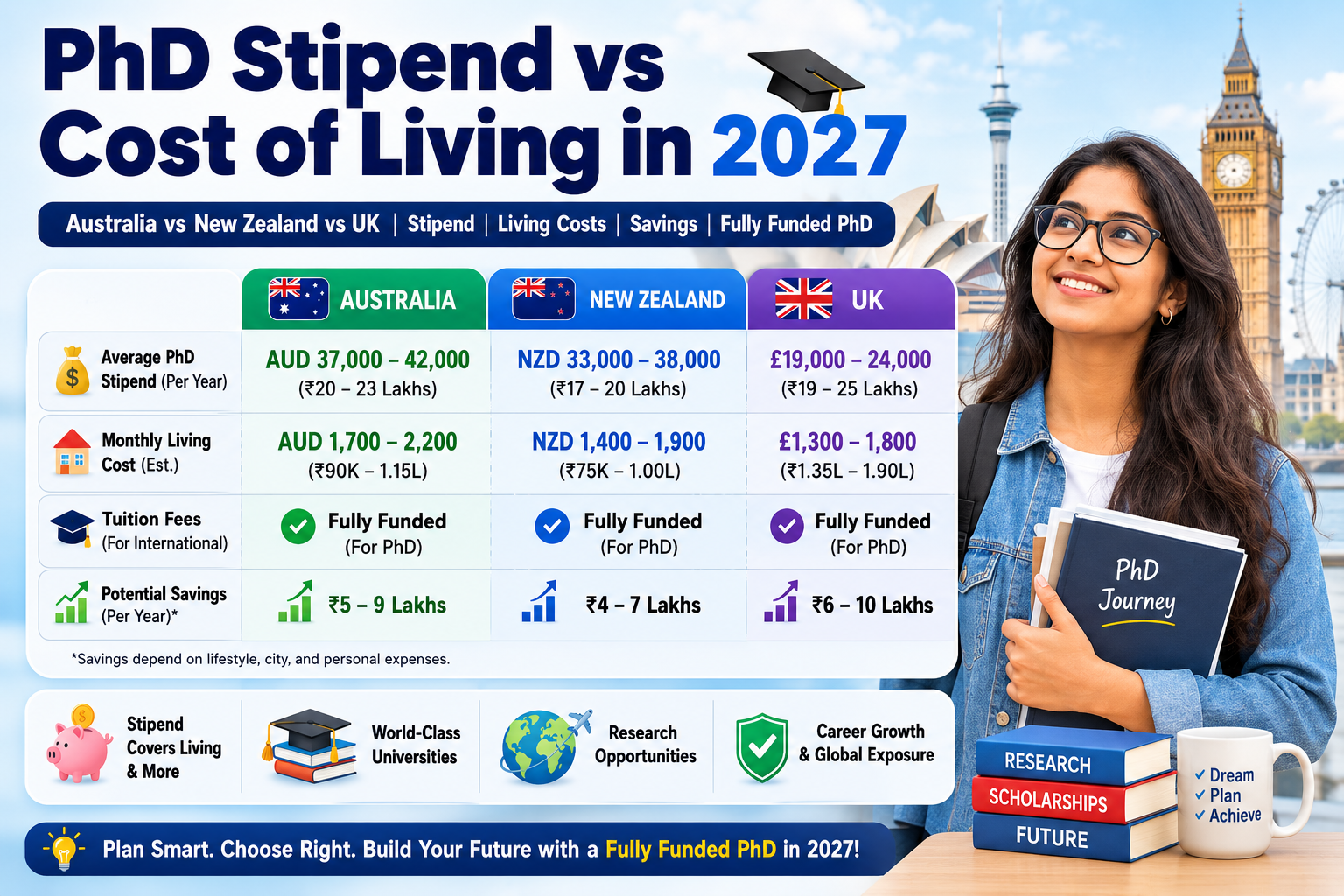
    PhD stipend vs cost of living is one of the most important comparisons Indian students should make before accepting a fully funded PhD abroad in 2027.

    Australia, New Zealand and the United Kingdom are three of the most popular destinations for international PhD students. All three countries offer internationally recognised universities, excellent research facilities and multiple opportunities for funded doctoral study.

    But there is one question that many students overlook:

    Will your PhD stipend actually be enough to cover your cost of living?

    A scholarship of AUD 40,000 in Australia may initially appear much more attractive than a £22,000 UK PhD stipend. However, after considering accommodation, food, transport, insurance and other expenses, the financial picture can change completely.

    Likewise, a PhD student receiving a moderate stipend in Dunedin or Manchester may have more disposable income than someone receiving a higher stipend in Sydney or London.

    Therefore, the best way to compare a fully funded PhD in Australia, New Zealand and the UK is not simply by looking at the annual scholarship amount.

    If you are still at the planning stage, read our complete PhD abroad for Indian students in 2027 guide covering eligibility, scholarships, supervisors, applications and funding.

    The correct calculation is:

    Annual PhD stipend – tuition payable – accommodation – food – utilities – transport – insurance – essential expenses = real PhD purchasing power

    In this detailed EducationMESD guide, we compare PhD stipend vs cost of living in Australia, New Zealand and the UK for 2027, including monthly stipends, living expenses, tuition coverage, potential savings and the best destination for Indian PhD students.


    PhD Stipend vs Cost of Living 2027: Quick Comparison

    If you want a quick answer, New Zealand can offer an attractive stipend-to-cost-of-living ratio, Australia offers particularly strong doctoral funding potential, and the UK can provide good financial sustainability when students study outside London and receive complete international tuition coverage.

    Australia has already published its official 2027 Research Training Program stipend rates. The base RTP stipend will be AUD 35,550 per year, while the maximum RTP stipend rate will be AUD 55,537.

    The latest confirmed UKRI minimum stipend is £21,805 for 2026–27, while the London-weighted amount from October 2026 is £23,805.

    New Zealand does not have one national PhD stipend. University funding varies. The University of Auckland provides a useful benchmark: its 2026 doctoral scholarship offers a tax-free NZD 35,468 annual stipend with annual CPI adjustment, plus eligible tuition fees and single-student international health insurance.

    FactorAustraliaNew ZealandUnited Kingdom
    Major funding routeRTP + university scholarshipsUniversity doctoral scholarshipsUKRI + university studentships
    Latest key stipend benchmarkAUD 35,550 base RTP for 2027NZD 35,468 Auckland benchmark for 2026£21,805 UKRI minimum for 2026–27
    Approx. monthly amountAUD 2,963NZD 2,956£1,817
    Higher-cost locationSydneyAucklandLondon
    Tuition support availableYesYesYes, but international students must verify coverage
    Main financial challengeRentAuckland accommodationLondon accommodation
    Stipend-to-cost potentialGoodPotentially very goodGood outside London
    Key advantageHigh funding potentialStrong purchasing powerLarge research ecosystem

    Important: Never compare these stipend amounts by currency conversion alone. Purchasing power and living costs are much more important.


    What Is a PhD Stipend?

    A PhD stipend is financial support provided to doctoral researchers to help cover their living expenses while they undertake a PhD.

    It may be funded by a government agency, university, research council, supervisor’s research grant, industry partner or external scholarship provider.

    A fully funded PhD can include a stipend plus tuition-fee coverage and may also include research expenses, conference funding, insurance or other allowances.

    This distinction is important:

    PhD stipend and fully funded PhD are not necessarily the same thing.

    For example, a student may receive an annual stipend but still have to pay part of the international tuition fee.

    For Indian students, the strongest PhD funding package is normally:

    Full international tuition coverage + living stipend + research support + appropriate insurance coverage


    Why PhD Stipend vs Cost of Living Matters

    One of the biggest mistakes students make when comparing international PhD scholarships is converting everything into Indian rupees.

    A student may search for:

    AUD 35,550 in INR

    or:

    £21,805 in INR

    and assume whichever converts to the largest Indian rupee value is the best scholarship.

    That approach can be misleading.

    You will usually earn your stipend and pay your expenses in the destination country’s currency.

    A more meaningful comparison is therefore:

    PhD Purchasing Power Formula

    Annual stipend – annual living expenses – uncovered tuition – compulsory expenses = estimated disposable income

    This tells you much more about your likely financial situation during your doctorate.


    PhD Stipend in Australia 2027

    Australia is one of the leading destinations for Indian students searching for a fully funded PhD abroad in 2027.

    One of the country’s major research-degree funding mechanisms is the Australian Government Research Training Program, or RTP.

    Australia RTP Stipend 2027

    The Australian Government has confirmed the following RTP stipend rates for 2027:

    Australia RTP Rate2027 Amount
    Base stipend rateAUD 35,550
    Maximum stipend rateAUD 55,537
    Approx. base monthly stipendAUD 2,963

    According to the Australian Government Research Training Program (RTP), the 2027 full-time base stipend rate is AUD 35,550 and the maximum rate is AUD 55,537.

    However, there is an important distinction.

    AUD 55,537 is the maximum RTP stipend rate, not a guaranteed stipend for every Australian PhD student.

    Universities determine individual scholarship arrangements, and some doctoral candidates receive the base amount while others receive higher university scholarships, research-project funding or scholarship top-ups.

    Indian applicants can explore our detailed guide to a fully funded PhD in Australia for Indian students, including RTP scholarships, university funding, stipend rates and eligibility.


    What Does an Australian RTP Scholarship Cover?

    The Research Training Program can support tuition-fee offsets, stipends and allowances for eligible higher-degree research students.

    For an international applicant, the best Australian funding package will typically combine:

    100% tuition-fee coverage + annual PhD stipend + research support

    This is why Indian students should carefully read the scholarship offer.

    A stipend of AUD 38,000 combined with complete tuition coverage can be much more valuable than a higher apparent award that leaves significant fees payable.


    Cost of Living in Australia for PhD Students

    Australia offers excellent research funding, but its biggest financial disadvantage is its comparatively high cost of living.

    The Australian Department of Home Affairs currently uses AUD 29,710 as the 12-month living-cost requirement for a student visa applicant. It explicitly warns that actual living costs can be much higher and vary depending on where the student lives.

    University estimates provide a more practical picture.

    Monash University estimates that a single international student may require approximately:

    AUD 30,000–45,000 per year

    for living expenses.

    This means accommodation and lifestyle can determine whether an Australian PhD stipend feels comfortable or restrictive.


    Monthly Cost of Living in Australia for PhD Students

    Accommodation is likely to be one of the largest costs.

    Monash University currently provides indicative accommodation figures such as:

    ExpenseIndicative Cost
    Shared rentalAUD 275–380/week
    On-campus accommodationAUD 350–450/week
    Private rentalAUD 500–750/week
    Groceries/eating outAUD 150–500/week
    UtilitiesAUD 40–80/week
    Public transportAUD 25–50/week

    These estimates illustrate why two PhD students receiving exactly the same Australian stipend can have very different financial experiences.


    Australia PhD Stipend vs Cost of Living

    Using the official 2027 RTP base stipend and Monash University’s broader annual estimate:

    Australia PhD BudgetApprox. Annual Amount
    RTP base stipend 2027AUD 35,550
    Lower living-cost estimateAUD 30,000
    Illustrative remaining amountAUD 5,550
    Higher living-cost estimateAUD 45,000
    Illustrative shortfallAUD 9,450

    These figures should not be interpreted as guaranteed savings or losses.

    They demonstrate something more important:

    The financial value of an Australian PhD scholarship depends heavily on where and how you live.


    Is a PhD Stipend Enough to Live in Australia?

    Yes, an Australian PhD stipend can be enough for a single student, particularly when tuition is fully covered and accommodation is shared.

    The situation becomes more comfortable when the student receives an above-base stipend, scholarship top-up or affordable university accommodation.

    However, living alone in an expensive location could consume a large proportion of the stipend.

    This is why students searching for PhD stipend Australia 2027 should also research the cost of accommodation around the university.


    Sydney vs Melbourne vs Other Australian Cities

    The cost of living in Australia varies considerably by city and accommodation type.

    The same AUD 38,000 stipend can create very different lifestyles in different Australian locations.

    Therefore, compare:

    PhD stipend + city + accommodation + tuition coverage

    rather than only:

    university ranking + annual stipend

    An excellent supervisor and fully funded position in a lower-cost location may offer better overall value than a prestigious research opportunity where rent absorbs most of your scholarship.


    Can You Save Money During a PhD in Australia?

    Yes, it is possible to save money from an Australian PhD stipend, particularly if you receive funding above the base RTP rate and keep accommodation costs under control.

    Shared accommodation, cooking at home and avoiding unnecessarily expensive housing can significantly improve disposable income.

    However, applicants should treat potential savings conservatively.


    PhD Stipend in New Zealand 2027

    New Zealand is increasingly attractive for Indian students searching for a fully funded PhD with a good stipend-to-cost-of-living ratio.

    Unlike Australia, New Zealand does not have a single national doctoral stipend.

    Scholarship rates are determined by individual universities and funding programmes.

    Therefore, students searching for PhD stipend New Zealand 2027 should compare university-specific scholarships rather than expecting one national figure.


    University of Auckland PhD Stipend

    The University of Auckland provides a useful benchmark.

    Its University of Auckland Doctoral Scholarship offers up to:

    NZD 35,468 per year in 2026

    and the stipend is:

    tax-free with an annual CPI adjustment.

    That is approximately:

    NZD 2,956 per month

    for the 2026 scholarship value.

    The scholarship can also cover compulsory tuition fees, Student Services Fees and single-student international health insurance for eligible international recipients.

    That makes the complete funding package more valuable than the stipend figure alone suggests.


    What Is the New Zealand PhD Stipend in 2027?

    This is a high-value search query, but accuracy matters.

    There is currently no single confirmed national New Zealand PhD stipend for 2027.

    The University of Auckland’s published 2026 figure is NZD 35,468 and the university states that the stipend receives an annual CPI adjustment.

    Therefore, students starting in 2027 should check the applicable university scholarship rate when their award is issued.

    Do not rely on websites that simply label the 2026 value as the “2027 New Zealand PhD stipend” without explaining the distinction.


    Cost of Living in New Zealand for PhD Students

    Immigration New Zealand currently requires self-funded tertiary students to demonstrate:

    NZD 20,000 per year

    for living expenses, or NZD 1,667 per month if the period of study is shorter than one year.

    However, this is an immigration financial requirement rather than a complete estimate of comfortable student expenditure.

    Actual living costs depend on city, accommodation, food, transport and lifestyle.


    Cost of Living in Dunedin for PhD Students

    The University of Otago provides useful city-specific information.

    It recommends approximately:

    NZD 22,000–27,000 for 40 weeks

    of comfortable living in Dunedin, above tuition costs. The university specifically notes that a student remaining for the full 52-week year will require more.

    This provides a useful example of why New Zealand can perform well in a PhD stipend vs cost of living comparison.


    New Zealand PhD Stipend vs Cost of Living

    Consider the University of Auckland scholarship benchmark:

    New Zealand Funding FactorAmount
    Auckland doctoral stipend, 2026NZD 35,468
    Approx. monthly stipendNZD 2,956
    Immigration living-funds requirementNZD 20,000/year
    Tuition supportAvailable under scholarship conditions
    International health insuranceCovered under applicable scholarship conditions

    The difference between NZD 35,468 and NZD 20,000 should not be considered guaranteed savings because the immigration figure is a minimum funding requirement rather than a realistic full-year personal budget.

    However, a package combining a NZD 35,000+ stipend with tuition and insurance support can be financially attractive.


    Auckland vs Dunedin vs Other New Zealand Cities

    The same New Zealand scholarship can provide different purchasing power depending on location.

    Auckland generally places greater pressure on accommodation budgets than some smaller university cities.

    Dunedin offers an interesting contrast. The University of Otago’s current guidance indicates NZD 22,000–27,000 for 40 weeks of comfortable living and notes that a full calendar year requires additional funding.

    For Indian students, a funded PhD outside the highest-cost areas can therefore provide particularly strong financial value.


    Is New Zealand Good for a Fully Funded PhD?

    Yes. New Zealand can be an excellent option for a fully funded PhD, particularly when the scholarship combines tuition coverage with a tax-free stipend.

    Its main limitation is scale.

    New Zealand has fewer universities than Australia or the UK, so students may find fewer funded positions in very specialised research fields.

    However, where the research fit and funding package are strong, New Zealand deserves serious consideration.


    PhD Stipend in the UK 2027

    The United Kingdom remains one of the world’s major destinations for doctoral research.

    Common searches from international applicants include:

    UK PhD stipend 2027

    UKRI PhD stipend

    fully funded PhD UK for international students

    and:

    is a UK PhD stipend enough to live on?

    The most important national benchmark is the stipend set by UK Research and Innovation.


    UKRI PhD Stipend 2026–27

    The confirmed UKRI minimum stipend for the 2026–27 academic year is £21,805.

    That is approximately:

    £1,817 per month

    UKRI also lists a London-weighted stipend of:

    £23,805 from 1 October 2026

    or approximately:

    £1,984 per month.

    Students commencing later in 2027 should verify whether a subsequent academic-year stipend has been published before finalising their financial plans.


    UKRI Stipend Increase

    The UKRI minimum increased from:

    £20,780 in 2025–26

    to:

    £21,805 in 2026–27

    which represents an increase of £1,025 per year.

    This demonstrates why applicants should always check the latest UKRI rate rather than relying on older PhD funding articles.


    Does UKRI Cover International PhD Tuition Fees?

    Indian students need to pay particular attention to this issue.

    UKRI’s published minimum fee level for 2026–27 is £5,238. UKRI’s support framework does not mean that every international student’s full overseas tuition difference will automatically be covered.

    Before accepting an offer, international applicants should therefore confirm:

    Does this studentship cover 100% of my international PhD tuition fee for every funded year?

    Do not assume that the words “UKRI-funded” automatically mean you will personally pay zero international tuition.


    Cost of Living in the UK for PhD Students

    The cost of living in the UK depends heavily on location.

    Current UK Student visa maintenance requirements are:

    LocationMonthly Requirement
    London£1,529
    Outside London£1,171

    These amounts apply for up to nine months under the relevant financial-evidence rules.

    These figures are immigration requirements rather than guarantees of realistic monthly expenditure.

    University-specific estimates are more useful for understanding actual living costs.


    Cost of Living in Manchester for PhD Students

    The University of Manchester estimates 2026–27 living expenses for a postgraduate student at £18,188 for 52 weeks.

    That is approximately:

    £1,510 per month.

    Its estimate includes accommodation, groceries, transport, social expenditure, phone costs, health and wellbeing, course materials and other typical costs.

    This provides an excellent case study for comparing a UK PhD stipend vs cost of living.


    UK PhD Stipend vs Cost of Living

    UK PhD BudgetAnnual Amount
    UKRI minimum stipend 2026–27£21,805
    Manchester estimated postgraduate living costs£18,188
    Illustrative difference£3,617
    Illustrative monthly differenceAround £301

    This does not mean every student in Manchester will save £3,617.

    However, it indicates that a UKRI-level stipend can provide a workable financial position in some UK university cities outside London.


    Is a UK PhD Stipend Enough to Live On?

    Yes, a UKRI-level PhD stipend can be sufficient for many single students, particularly outside London and when international tuition is fully covered.

    Financial pressure increases when rent is high or the student supports family members.

    Location therefore matters almost as much as the stipend.


    London PhD Stipend vs Outside London

    London deserves separate consideration.

    The London-weighted UKRI rate from October 2026 is £23,805 compared with the standard £21,805 minimum.

    However, the UK Student visa maintenance benchmark is also significantly higher in London:

    £1,529 per month in London

    versus:

    £1,171 outside London.

    Therefore:

    A higher London PhD stipend does not necessarily mean higher savings.

    A £21,805 stipend in an affordable university city could potentially provide greater purchasing power than £23,805 in London.


    PhD Stipend vs Cost of Living: Australia vs New Zealand vs UK

    The following table provides the core comparison for Indian students planning a fully funded PhD abroad in 2027.

    FactorAustraliaNew ZealandUK
    Key stipend benchmarkAUD 35,550NZD 35,468*£21,805
    Approx. monthly amountAUD 2,963NZD 2,956£1,817
    Benchmark year2027Auckland 20262026–27
    Expensive locationSydneyAucklandLondon
    Tuition funding availableYesYesYes; verify overseas fee difference
    Stipend indexation/increaseRTP rates updatedAuckland CPI-adjustedUKRI rates updated
    Potential to saveCity-dependentPotentially strongBetter outside London
    Financial riskHousingHousingLondon rent
    Major advantageFunding potentialPurchasing powerResearch choice

    *University of Auckland benchmark; New Zealand has no single national PhD stipend.


    Which Country Pays the Highest PhD Stipend in 2027?

    For applicants specifically searching for the highest PhD stipend, Australia has an especially strong published funding range.

    The Australian Government lists the 2027 RTP range at:

    AUD 35,550 base

    to:

    AUD 55,537 maximum.

    However, the AUD 55,537 maximum should not be treated as a standard scholarship amount.

    Some universities and projects may pay higher than the RTP base rate, but applicants should verify the exact scholarship associated with their offer.


    Which Country Has the Best PhD Stipend-to-Cost-of-Living Ratio?

    There is no mathematically universal winner because students live in different cities and have different lifestyles.

    However, a broad financial assessment produces useful conclusions.

    New Zealand: Strong Stipend Purchasing Power

    New Zealand can offer an excellent financial balance when a university scholarship provides a stipend around the mid-NZD 30,000 range, tuition coverage and affordable accommodation.

    Australia: Strongest Funding Potential

    Australia offers a particularly strong funding ecosystem and higher stipend potential.

    Its primary financial challenge is accommodation.

    UK: Strong Value Outside London

    The UK can provide good financial sustainability when a studentship fully covers international tuition and the student lives outside London.


    Which Country Is Best for a Fully Funded PhD for Indian Students?

    The best country depends on your priorities.

    Your Main PriorityBest Option to Explore
    High PhD funding potentialAustralia
    Strong stipend purchasing powerNew Zealand
    Largest research ecosystemUK
    RTP funding opportunitiesAustralia
    Tax-free university scholarship exampleNew Zealand
    Large number of universitiesUK
    Better UK financial balanceOutside London
    Maximum possible savingsFully funded PhD in an affordable city
    PhD with familyCompare individual funding packages
    Best overall choiceStrong supervisor + full funding + affordable city

    Which Country Is Best for Saving Money During a PhD?

    The answer depends more on the university city and funding package than on the country itself.

    The most financially attractive combination is:

    Full tuition coverage + high stipend + affordable accommodation + separately funded research expenses

    A student receiving a smaller stipend in a lower-cost city may save more than a student with a larger stipend in Sydney, Auckland or London.

    That is why the PhD stipend after cost of living is more useful than the headline stipend.


    Fully Funded PhD vs Partially Funded PhD

    Indian applicants should also understand what “fully funded” actually means.

    A strong fully funded PhD should ideally include both:

    Tuition-fee coverage

    and:

    Living stipend

    Some funding packages also include insurance, conference support, research travel or project expenses.

    If your scholarship covers living costs but requires you to pay a large international tuition fee, it should not be evaluated in the same way as a comprehensive fully funded offer.


    Can PhD Students Work While Receiving a Stipend?

    Many doctoral students undertake additional university work such as teaching, research assistance, laboratory demonstrating or marking.

    However, additional employment should not form the foundation of your PhD budget.

    Scholarship conditions, visa rules, research workload and university policies can affect how much paid work you can undertake.

    Your safest financial calculation is:

    Guaranteed stipend – essential expenses

    Treat any additional income as supplementary rather than guaranteed.


    PhD Abroad With Family: Is the Stipend Enough?

    A PhD stipend that is comfortable for one person can become much tighter when the candidate travels with a spouse or child.

    Australia’s current Student visa financial-capacity calculation, for example, uses AUD 29,710 for a student, plus AUD 10,394 for a partner and AUD 4,449 for a child.

    The UK also requires additional maintenance funding for eligible dependants: currently £845 per month per dependant in London or £680 outside London, for up to nine months.

    Therefore, students considering a PhD abroad with family must prepare a separate family budget.


    How to Compare Fully Funded PhD Offers Correctly

    Suppose you receive three hypothetical scholarships:

    Australia: AUD 40,000 per year

    New Zealand: NZD 35,500 per year

    UK: £22,500 per year

    Do not choose by converting all three into INR.

    Instead, compare:

    FactorAustraliaNew ZealandUK
    Annual stipend
    Tuition payable by student
    Annual rent
    Utilities
    Food
    Transport
    Insurance
    Student fees
    Research expenses
    Estimated disposable income

    After completing the financial comparison, separately evaluate supervisor expertise, research fit, publications, laboratory infrastructure, university reputation, industry collaboration and post-PhD career opportunities.

    The strongest offer is usually where:

    Research quality + supervisor fit + complete funding + financial sustainability

    come together.


    Final Verdict: PhD Stipend vs Cost of Living Australia, New Zealand and UK 2027

    The PhD stipend vs cost of living in Australia, New Zealand and the UK comparison shows that there is no single destination that wins in every category.

    Australia

    Australia offers particularly strong doctoral funding potential.

    Its confirmed 2027 RTP base stipend is AUD 35,550, while the maximum RTP stipend rate is AUD 55,537.

    However, Australian living costs can be substantial. Monash University estimates approximately AUD 30,000–45,000 in annual living expenses for a single international student.

    Best for: Students prioritising strong research funding, scholarship options and Australian university research infrastructure.

    New Zealand

    New Zealand can provide excellent stipend purchasing power when the student receives a strong university doctoral scholarship.

    The University of Auckland’s 2026 doctoral scholarship provides up to NZD 35,468 tax-free, with annual CPI adjustment, tuition support and eligible international health-insurance coverage.

    Best for: Students looking for a strong stipend-to-cost balance and a fully supported university doctoral scholarship.

    United Kingdom

    The UK offers one of the world’s broadest doctoral research ecosystems.

    The UKRI minimum stipend for 2026–27 is £21,805, increasing to £23,805 with London weighting where applicable.

    Manchester estimates postgraduate living costs at approximately £18,188 for 2026–27, illustrating why locations outside London may provide an attractive financial balance.

    Best for: Students prioritising university choice, specialised research programmes and large academic networks.

    EducationMESD Verdict

    Best for high funding potential: Australia

    Best potential stipend-to-cost-of-living balance: New Zealand

    Best for research choice and university network: United Kingdom

    But the real winner is:

    A fully funded PhD with complete tuition coverage, competitive stipend, affordable accommodation, an excellent supervisor and strong research opportunities.

    Do not ask only:

    “Which country gives the highest PhD stipend?”

    Ask:

    “After paying my actual living expenses, which PhD offer gives me the best financial and academic future?”

    That is the comparison that matters most.


    Frequently Asked Questions: PhD Stipend vs Cost of Living

    What is the PhD stipend in Australia in 2027?

    The Australian Government’s 2027 RTP base stipend is AUD 35,550 per year, while the maximum RTP stipend rate is AUD 55,537. Individual university scholarships can vary.

    What is the monthly PhD stipend in Australia in 2027?

    The AUD 35,550 RTP base stipend is equivalent to approximately AUD 2,963 per month.

    What is the PhD stipend in New Zealand in 2027?

    New Zealand does not have a single national PhD stipend. The University of Auckland offers a NZD 35,468 tax-free doctoral stipend in 2026 with annual CPI adjustment. Students starting in 2027 should verify the updated rate applicable to their award.

    What is the PhD stipend in the UK in 2027?

    The latest confirmed UKRI minimum is £21,805 for 2026–27, with a London-weighted amount of £23,805 from October 2026. Students commencing later in 2027 should check whether a subsequent UKRI rate has been announced.

    Which country pays the highest PhD stipend?

    Australia has a particularly high published funding ceiling, with the 2027 RTP maximum rate at AUD 55,537. However, this is not the stipend automatically paid to every RTP recipient.

    Which country has the best PhD stipend-to-cost-of-living ratio?

    New Zealand can offer a very strong balance when tuition and insurance are covered. Australia can be highly attractive with an above-base stipend and affordable accommodation, while the UK offers good value in many cities outside London.

    Is an Australian PhD stipend enough to live on?

    It can be. Monash University estimates that a single international student may need approximately AUD 30,000–45,000 annually for living expenses, compared with Australia’s 2027 RTP base stipend of AUD 35,550.

    Is New Zealand affordable for PhD students?

    New Zealand can be financially attractive with full funding. Immigration New Zealand currently requires tertiary students supporting themselves to demonstrate NZD 20,000 annually, although actual living costs vary according to accommodation, city and lifestyle.

    Can you live on a UK PhD stipend?

    Many students can, particularly outside London. Manchester estimates annual postgraduate living expenses of £18,188 for 2026–27 compared with the UKRI minimum stipend of £21,805.

    Is a PhD stipend tax-free?

    Tax treatment differs according to the country and funding arrangement. Some scholarships are explicitly tax-free. The University of Auckland, for example, describes its doctoral scholarship stipend as tax-free.

    Can Indian students save money from a PhD stipend abroad?

    Yes, particularly when tuition is fully covered and accommodation expenses are controlled. However, savings vary significantly by city, scholarship and lifestyle and should not be assumed before preparing a detailed budget.

    Is a fully funded PhD completely free?

    A comprehensive fully funded PhD normally provides tuition support and a living stipend. However, applicants should confirm international tuition differences, insurance, compulsory university fees, research expenses and the exact funding duration.

    Which country is best for a fully funded PhD for Indian students in 2027?

    Australia is attractive for funding potential, New Zealand for stipend purchasing power, and the UK for university and research-network choice. The best individual offer combines complete tuition coverage, an adequate stipend, an affordable location and an excellent supervisor.


    Related EducationMESD PhD Guides

    To continue planning your PhD abroad journey, read our guides on PhD Abroad for Indian Students in 2027, Fully Funded PhD in Australia for Indian Students, PhD in New Zealand for Indian Students, PhD in the UK for Indian Students, Best Fully Funded PhD Scholarships for Indian Students, How to Find and Contact a PhD Supervisor Abroad, IELTS Requirements for PhD Admission in Australia, New Zealand and the UK, PhD Abroad Without GRE, and PhD Abroad with Family: Dependant Visa, Costs and Work Rights.
  • PhD Abroad with a Low CGPA: Admission Possibilities, Best Countries, Scholarships & Strategies for Indian Students 2027

    PhD Abroad with a Low CGPA: Admission Possibilities, Best Countries, Scholarships & Strategies for Indian Students 2027

    Are you worried that a low CGPA will stop you from pursuing a PhD abroad?

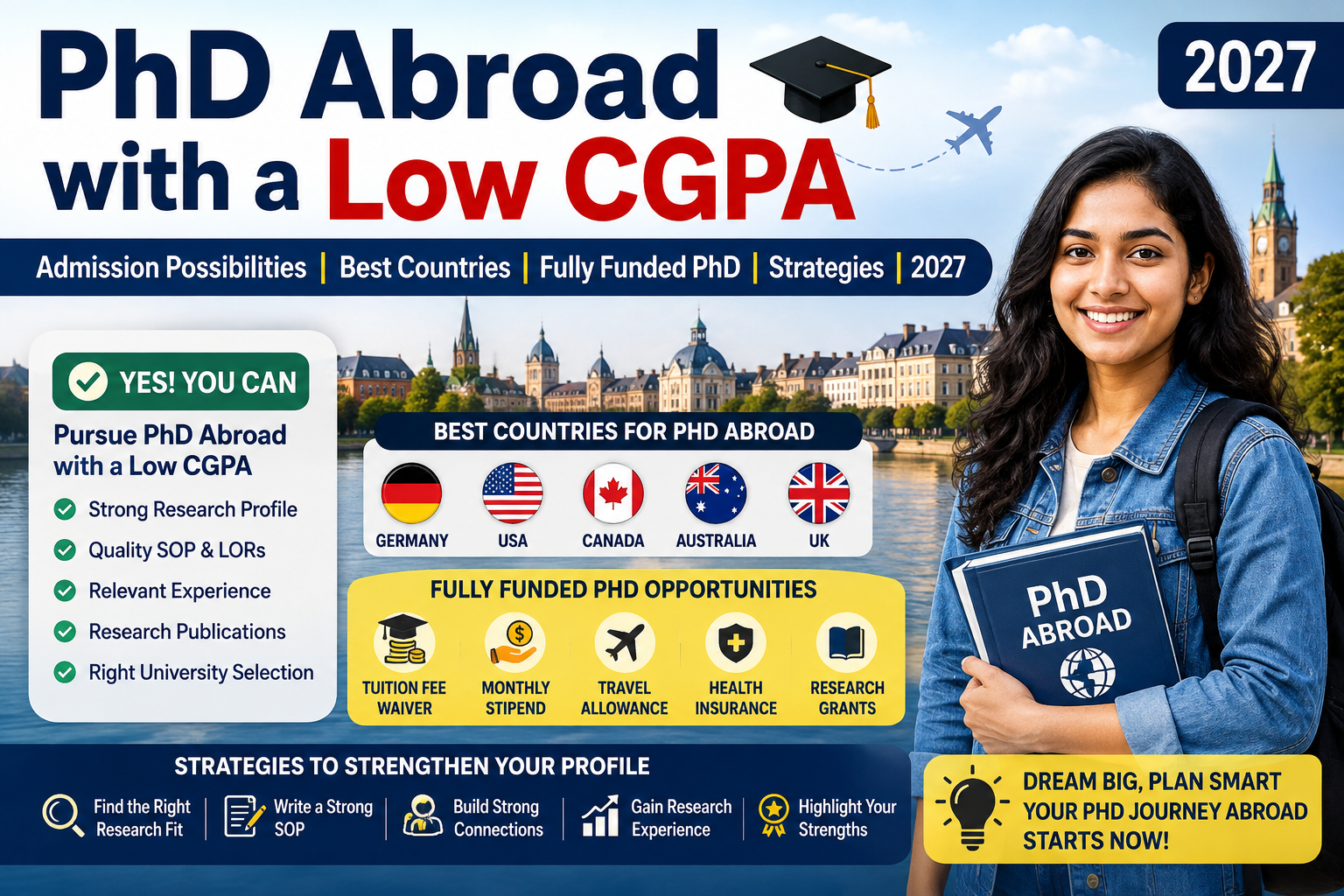
    The good news is that a PhD abroad with a low CGPA may still be possible, depending on the university, country, doctoral program, research experience and overall strength of your profile.

    Many Indian students believe that having a CGPA below 7.0 means they cannot apply for PhD programs in countries such as the UK, Australia, New Zealand, USA, Germany or other European destinations.

    That is not always correct.

    PhD admission is different from admission to many taught undergraduate or postgraduate programs because a doctorate is primarily a research degree. Universities may therefore examine your academic grades alongside your:

    • research experience
    • master’s dissertation
    • journal publications
    • conference papers
    • research proposal
    • Statement of Purpose
    • Letters of Recommendation
    • professional experience
    • technical expertise
    • academic improvement
    • supervisor compatibility
    • research-project fit

    A lower CGPA may certainly make admission and scholarship competition more difficult, particularly at highly selective universities.

    However, a strong research profile can sometimes make your application considerably more competitive.

    The right question is therefore not:

    “Can I do a PhD abroad with a low CGPA?”

    Instead, ask:

    “How can I build enough evidence of research ability to overcome a weaker academic record?”

    This comprehensive PhD abroad with a low CGPA guide for Indian students in 2027 explains admission possibilities, CGPA ranges, country-wise opportunities, scholarship strategies and practical ways to strengthen your PhD profile.

    PhD abroad for Indian students


    Quick Answer: Can I Pursue a PhD Abroad with a Low CGPA?

    Yes, pursuing a PhD abroad with a low CGPA can be possible if you meet the university’s minimum eligibility requirements and demonstrate strong research potential.

    Your chances can improve when your application includes:

    • strong postgraduate performance
    • a research-intensive master’s degree
    • a high-quality dissertation
    • research publications
    • relevant research experience
    • strong academic recommendations
    • an excellent research proposal
    • a focused SOP
    • relevant professional or R&D experience
    • strong alignment with a potential supervisor

    However, remember:

    PhD admission eligibility and fully funded PhD scholarship competitiveness are not the same thing.

    You may qualify for admission but still face intense competition for funding.


    What Is Considered a Low CGPA for PhD Abroad?

    There is no universal CGPA requirement for PhD admission abroad.

    Indian universities commonly use a 10-point CGPA system, while overseas institutions may use:

    • 4.0 GPA scales
    • percentage systems
    • UK degree classifications
    • honours classifications
    • institution-specific international equivalency systems

    For planning purposes, Indian applicants can use the following broad framework.

    Indian CGPAGeneral PositionSuggested PhD Strategy
    8.0–10.0StrongTarget competitive universities and scholarships
    7.0–7.9Generally competitiveFocus on research quality and supervisor fit
    6.5–6.9ModerateStrengthen publications and research experience
    6.0–6.4ChallengingTarget flexible programs and research-heavy pathways
    5.5–5.9DifficultConsider MRes, MPhil or strong research experience
    Below 5.5Very challengingBuild a stronger postgraduate/research record first

    These ranges are not official admission criteria.

    Universities evaluate international qualifications differently, so always check the exact PhD entry requirements on the official university website.


    Can I Do a PhD Abroad with 5.5 CGPA?

    A PhD abroad with 5.5 CGPA can be difficult, particularly if the university has a strict academic cut-off.

    However, this does not necessarily mean the end of your PhD plans.

    A better pathway may be:

    Low Bachelor’s CGPA → Research Master’s/MRes/MPhil → Strong Dissertation → Publications → PhD

    You can also strengthen your profile through:

    • research assistant positions
    • university research projects
    • peer-reviewed publications
    • industry R&D experience
    • technical research projects
    • conference presentations
    • strong postgraduate academic performance

    Applicants below standard eligibility thresholds should avoid spending money on applications before confirming formal eligibility.


    Can I Do a PhD Abroad with 6 CGPA?

    Yes, a PhD abroad with 6 CGPA may be possible at some universities, but university selection becomes extremely important.

    Compare these two profiles:

    Candidate A

    CGPA: 6.0
    Publications: None
    Research Experience: None
    Master’s Thesis: Average

    Candidate B

    CGPA: 6.0
    Master’s CGPA: 8.3
    Publications: 3
    Research Experience: 3 years
    Master’s Thesis: Strong
    Supervisor Match: Excellent

    Although both applicants have the same undergraduate CGPA, Candidate B presents much stronger evidence of doctoral readiness.

    That is why research performance after your bachelor’s degree matters.


    Can I Get a PhD Abroad with 6.5 CGPA?

    A 6.5 CGPA can potentially be sufficient for some PhD programs abroad, depending on:

    • the university
    • degree equivalency
    • postgraduate performance
    • research experience
    • publications
    • supervisor support
    • research proposal
    • funding requirements

    Students with a CGPA between 6.5 and 7.0 should concentrate strongly on research fit rather than applying randomly based on university rankings.


    Can I Get a PhD Abroad with 7 CGPA?

    Yes. A 7 CGPA may satisfy the academic requirements of some international PhD programs, although requirements differ.

    Applicants around this range can improve their chances by developing:

    • peer-reviewed publications
    • a strong dissertation
    • relevant research projects
    • international conference exposure
    • a high-quality research proposal
    • strong recommendations
    • a carefully targeted supervisor list

    A 7 CGPA alone does not guarantee admission, but it can provide a workable foundation when combined with a strong research profile.


    Does CGPA Matter for PhD Admission Abroad?

    Yes, CGPA matters for PhD admission abroad, but it is not always the only selection criterion.

    Doctoral admissions committees are trying to determine whether you can:

    1. identify an original research problem,
    2. review existing academic literature,
    3. formulate research questions,
    4. design an appropriate methodology,
    5. analyse complex evidence,
    6. conduct independent research,
    7. publish scholarly work, and
    8. complete a doctoral thesis.

    Your CGPA provides evidence of academic performance.

    Your research portfolio provides evidence of research readiness.

    For PhD admission, both can matter.


    What Can Compensate for a Low CGPA in PhD Admission?

    Several factors can strengthen a weak-CGPA PhD application.

    1. Strong Master’s Degree

    Strong postgraduate performance can demonstrate academic improvement.

    For example:

    B.Tech CGPA: 6.2

    followed by:

    M.Tech CGPA: 8.6

    shows a significant upward academic trend.


    2. Research Publications

    Peer-reviewed publications can demonstrate:

    • academic writing ability
    • methodology skills
    • literature knowledge
    • data-analysis capability
    • research independence
    • familiarity with peer review

    Quality is more important than quantity.


    3. Strong Master’s Thesis

    Your master’s dissertation may become one of the strongest pieces of evidence showing your research potential.

    Highlight:

    • research problem
    • methodology
    • findings
    • publications generated
    • technical contribution

    4. Research Experience

    Experience as a:

    • Research Assistant
    • Junior Research Fellow
    • project researcher
    • laboratory researcher
    • industry R&D professional

    can significantly strengthen your profile.


    5. Strong Research Proposal

    A well-developed proposal demonstrates that you understand:

    • research gaps
    • research questions
    • methodology
    • theoretical foundations
    • feasibility
    • potential contribution

    6. Strong PhD Supervisor Fit

    A potential supervisor may be more interested in your profile if your technical or research expertise aligns closely with their current research.

    Research fit can therefore become strategically important for lower-CGPA applicants.

    find and contact a PhD supervisor abroad


    Best Countries for PhD Abroad with a Low CGPA

    Students often search for countries accepting low CGPA for PhD admission.

    There is no country where low grades automatically guarantee admission.

    However, differences in doctoral systems create different opportunities.


    1. PhD in USA with Low GPA

    The USA can be worth considering for applicants with strong research profiles because doctoral admission practices vary between universities and departments.

    Some programs impose minimum GPA requirements.

    Others use broader holistic assessment.

    Students targeting a PhD in USA with low GPA should strengthen:

    • Statement of Purpose
    • research experience
    • publications
    • Letters of Recommendation
    • faculty alignment
    • quantitative skills
    • technical research expertise

    SEO Tip for Students

    Do not search only:

    “Universities accepting low GPA for PhD USA.”

    Also search:

    “PhD faculty working in [your research field] USA.”

    Research fit often provides a better application strategy than GPA filtering alone.


    2. PhD in UK with Low CGPA

    The UK remains a popular destination for Indian PhD applicants.

    UK doctoral opportunities generally fall into two broad categories:

    Student-Proposed PhD

    You develop your research proposal and identify a supervisor.

    Advertised PhD Project

    You apply for an existing research project, often with predefined funding.

    For lower-CGPA applicants, advertised projects can sometimes be attractive when your technical expertise closely matches the project requirements.

    Strengthen your application through:

    • strong master’s performance
    • MRes or MPhil experience
    • publications
    • research assistantships
    • dissertation quality
    • relevant industry experience
    • supervisor alignment

    3. PhD in Australia with Low CGPA

    Australia can be particularly attractive for candidates with a strong postgraduate research background.

    Australian PhD applications may place considerable emphasis on:

    • research components in previous degrees
    • honours research
    • master’s thesis
    • publications
    • research proposal
    • supervisor availability

    An applicant with a weaker undergraduate record but a strong research master’s degree may therefore have a more competitive profile.

    However, fully funded PhD scholarships in Australia can be significantly more competitive than basic admission.

    Australian Government Department of Education


    4. PhD in New Zealand with Low CGPA

    Students can also explore a PhD in New Zealand with low CGPA, particularly when their postgraduate research and proposed doctoral project are strong.

    Popular areas include:

    • Artificial Intelligence
    • Computer Science
    • Engineering
    • Management
    • Business
    • Agriculture
    • Sustainability
    • Environmental Science
    • Education
    • Healthcare

    A strong supervisor match can be especially important.


    5. PhD in Germany with Low CGPA

    Germany offers several doctoral pathways:

    • individual PhD supervision
    • structured doctoral programs
    • funded university projects
    • research institute positions
    • doctoral researcher vacancies

    For project-specific doctoral positions, employers and research teams may pay close attention to:

    • relevant research experience
    • technical skills
    • publications
    • programming knowledge
    • methodological expertise
    • project fit

    This can benefit applicants whose professional and research capabilities are stronger than their historical grades.

    DAAD Germany


    6. PhD in Europe with Low CGPA

    Other European destinations worth exploring include:

    • Netherlands
    • Sweden
    • Norway
    • Denmark
    • Finland
    • France
    • Belgium
    • Austria
    • Switzerland

    In some European systems, doctoral positions operate similarly to research jobs.

    Applicants are selected for a particular funded research project.

    This means specialised knowledge can become particularly valuable.


    Which Country Is Best for PhD with Low CGPA?

    There is no single best country for PhD applicants with low CGPA.

    Your best destination depends on:

    • academic eligibility
    • master’s performance
    • research experience
    • publications
    • subject area
    • funding needs
    • research proposal
    • supervisor availability
    • technical skills

    A student with strong AI research experience may find an excellent funded project in Germany or the Netherlands, while another candidate in management may find stronger supervisor-led opportunities in the UK or Australia.

    Choose based on research fit—not just country rankings.


    How to Get PhD Admission Abroad with Low CGPA: 15 Effective Strategies

    1. Build a Strong Research Profile

    Research experience is one of the best ways to reduce the emphasis on old grades.

    Gain experience through:

    • research assistantships
    • master’s projects
    • research laboratories
    • academic collaborations
    • research internships
    • industry R&D

    2. Publish High-Quality Research Papers

    Aim for credible publications in your research area.

    Relevant outputs include:

    • journal articles
    • conference papers
    • systematic reviews
    • methodological papers
    • reputable book chapters

    Never publish solely to increase paper count.


    3. Develop a Strong PhD Research Proposal

    A high-quality proposal should answer:

    What is the research problem?

    Clearly define the problem.

    What is the research gap?

    Explain what existing studies have not addressed.

    Why does the research matter?

    Show academic and practical significance.

    What are your research questions?

    Define measurable or investigable questions.

    What methodology will you use?

    Explain data, experiments, models, participants or analytical techniques.

    What is the expected contribution?

    Demonstrate potential originality.

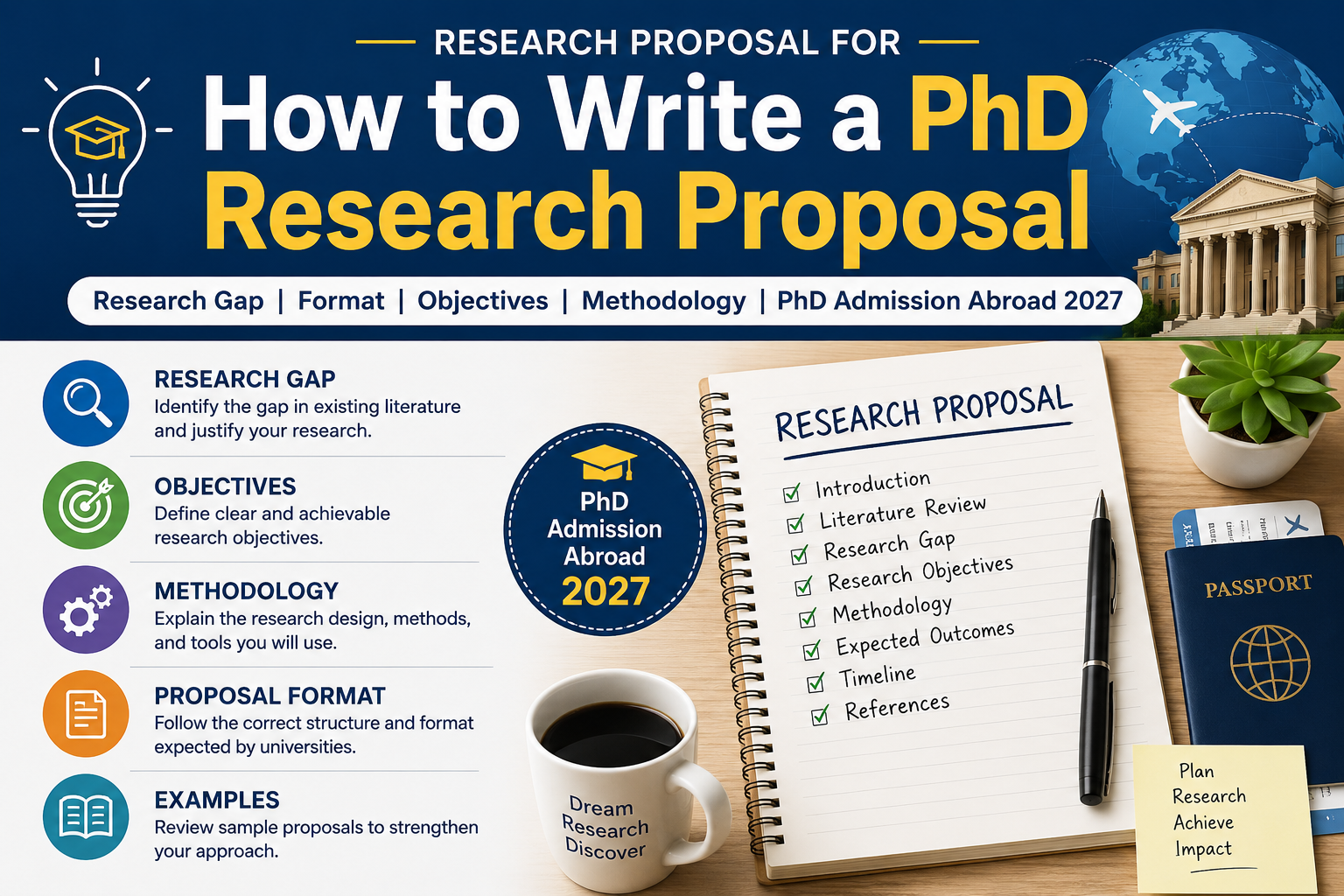
    how to write a PhD research proposal


    4. Find the Right PhD Supervisor

    Supervisor matching can be particularly important for students pursuing a PhD abroad with a low CGPA.

    Identify professors based on:

    • recent publications
    • research interests
    • funded projects
    • laboratory focus
    • research methodology
    • current PhD opportunities

    Do not send the same email to 100 professors.

    Personalised outreach is much more effective.


    5. Write a Powerful Statement of Purpose

    Your SOP should focus primarily on your research journey and future potential.

    Use this structure:

    Academic Background → Research Experience → Research Gap → Proposed Research → Supervisor Fit → Long-Term Goal

    If your CGPA needs explanation, keep it short.

    Then emphasise your subsequent achievements.


    6. Demonstrate Academic Improvement

    An upward trajectory can strengthen your narrative.

    For example:

    Bachelor’s: 6.1 CGPA

    Master’s: 8.5 CGPA

    Dissertation: Excellent

    Research Papers: 4

    Research Experience: 3 Years

    This demonstrates that your current research ability is not accurately represented by your earlier academic performance.


    7. Get Strong Letters of Recommendation

    A strong LOR should provide specific examples of your:

    • research aptitude
    • analytical ability
    • technical competence
    • independence
    • writing ability
    • academic maturity
    • persistence
    • doctoral potential

    Choose referees who actually know your research.


    8. Build an Academic Research CV

    Your PhD CV should include:

    • research interests
    • education
    • thesis/dissertation
    • publications
    • conference presentations
    • research projects
    • research experience
    • technical skills
    • awards
    • patents
    • professional experience

    A PhD CV should present you as a researcher, not simply as a job applicant.


    9. Use Your Master’s Degree Strategically

    A strong master’s degree can help reposition an applicant with weaker undergraduate grades.

    Highlight:

    • master’s CGPA
    • dissertation
    • research methods
    • technical contribution
    • papers generated from the project

    10. Gain Relevant Professional Experience

    Industry experience can be valuable when directly related to your proposed PhD.

    Examples:

    AI Engineer → PhD in Artificial Intelligence

    Data Scientist → PhD in Machine Learning

    Marketing Manager → PhD in Marketing

    Teacher → PhD in Education

    Biomedical Engineer → PhD in Medical Imaging


    11. Apply for Research Assistant Positions

    A research assistant role can help you develop:

    • publications
    • laboratory experience
    • methodologies
    • academic references
    • international collaboration

    It can be an excellent bridge between a weak academic record and a competitive PhD application.


    12. Target Advertised Funded PhD Projects

    Search for projects where your skills directly match the research requirements.

    For example:

    “Federated Learning + Medical Imaging + PyTorch”

    will be more valuable for a project requiring those exact capabilities than for a generic computer science PhD.


    13. Create an Ambitious–Target–Realistic University List

    A strong application portfolio should include:

    Ambitious Universities

    Highly competitive programs.

    Target Universities

    Programs where you reasonably meet academic and research requirements.

    Strong Research-Fit Opportunities

    Projects where your expertise closely matches the supervisor’s requirements.

    Do not rely solely on global university rankings.


    14. Consider an MPhil, MRes or Research Master’s

    If your CGPA does not meet direct PhD entry requirements, consider:

    Low CGPA → MRes/MPhil → Strong Research Performance → Publications → PhD

    This can provide a much stronger recent academic record.


    15. Apply Early

    Funding deadlines may be earlier than general admission deadlines.

    Starting early gives you time to:

    • contact supervisors
    • improve your proposal
    • prepare SOP
    • request LORs
    • take IELTS/TOEFL if required
    • identify scholarships
    • revise your academic CV

    Can a Master’s Degree Compensate for Low Bachelor’s CGPA?

    A strong master’s degree can significantly strengthen your PhD application, particularly when the postgraduate program contains substantial research.

    Example:

    Bachelor’s CGPA: 6.2
    Master’s CGPA: 8.7
    Publications: 3
    Research Experience: 2 years
    Strong Dissertation: Yes

    This indicates substantial academic progression.

    However, postgraduate performance cannot automatically override a compulsory eligibility threshold.


    Can Research Publications Compensate for Low CGPA?

    Publications can help demonstrate research capability, but they usually cannot replace formal academic eligibility.

    Publications are particularly useful when they are:

    • peer-reviewed
    • relevant
    • credible
    • methodologically strong
    • connected to your proposed research

    One strong paper is usually more valuable than several weak publications.


    Can Work Experience Compensate for Low CGPA?

    Relevant work experience can strengthen your profile, especially for applied PhDs.

    Examples include professional experience in:

    • AI and Data Science
    • Engineering
    • Healthcare
    • Management
    • Finance
    • Marketing
    • Education
    • Sustainability

    The closer the professional experience is to your proposed PhD, the more valuable it becomes.


    Can GRE Compensate for Low CGPA?

    A strong GRE score may provide additional academic evidence where the test is accepted.

    However:

    GRE cannot normally override mandatory academic requirements.

    Many doctoral programs have also made GRE scores optional or unnecessary.

    Always check the latest program-specific policy.

    PhD abroad without GRE


    Can IELTS Compensate for Low CGPA?

    No.

    IELTS, TOEFL and PTE demonstrate English-language proficiency.

    They do not replace academic eligibility requirements.

    A high IELTS score is useful for satisfying language requirements but does not directly compensate for poor academic grades.


    Can You Get a Fully Funded PhD Abroad with a Low CGPA?

    Yes, a fully funded PhD abroad with a low CGPA may be possible, but funding is generally more competitive than admission.

    Possible funding sources include:

    • university PhD scholarships
    • government scholarships
    • supervisor research grants
    • research assistantships
    • research-council projects
    • industry-funded PhDs
    • project-specific doctoral positions

    Applicants with lower CGPA should particularly consider funded projects where their specialist research skills provide a strong match.

    fully funded PhD scholarships for Indian students


    PhD Admission vs PhD Scholarship: Understand the Difference

    PhD Admission

    The university determines whether you are academically and academically/research-ready for the doctoral program.

    PhD Funding

    A separate scholarship or funding competition may rank candidates based on:

    • academic performance
    • publications
    • awards
    • research experience
    • proposal quality
    • supervisor support
    • project relevance

    Therefore:

    PhD Admission ≠ Fully Funded PhD

    Students must plan for both separately.

    UK Research and Innovation


    How to Find Fully Funded PhD Opportunities with Low CGPA

    Use specific search queries instead of generic searches.

    Examples:

    • Fully funded PhD UK international students 2027
    • Fully funded PhD Australia Indian students 2027
    • PhD scholarship New Zealand international students
    • Doctoral researcher Germany machine learning
    • Funded PhD Netherlands artificial intelligence
    • PhD studentship UK data science
    • Fully funded PhD management Europe

    Then verify eligibility on the official university or funding website.


    Low CGPA but Strong Research Profile: Example

    Consider this hypothetical profile:

    CriteriaApplicant Profile
    Bachelor’s CGPA6.4/10
    Master’s CGPA8.5/10
    Journal Publications3
    Conference Papers2
    Research Experience3 Years
    Master’s DissertationStrong
    Technical SkillsStrong
    Supervisor FitExcellent

    The bachelor’s CGPA is relatively weak.

    But the overall research profile is significantly stronger.

    The applicant should not write:

    “Please overlook my low CGPA.”

    A better positioning is:

    “My subsequent postgraduate performance, publications and research experience demonstrate my readiness for doctoral-level research.”


    Documents Required for PhD Abroad with a Low CGPA

    Prepare a complete application package containing:

    • Academic CV
    • Statement of Purpose
    • Research Proposal
    • Bachelor’s transcripts
    • Master’s transcripts
    • Degree certificates
    • Thesis/dissertation abstract
    • Research publications
    • Conference papers
    • Letters of Recommendation
    • IELTS/TOEFL/PTE score where required
    • Research portfolio
    • Work-experience documents
    • Scholarship application documents
    • Passport
    • University-specific forms

    Common Mistakes to Avoid When Applying for PhD with Low CGPA

    Applying Only to Top-Ranked Universities

    Rankings should not be the only selection factor.

    Searching Only for “Low CGPA Universities”

    Search for research fit and project compatibility instead.

    Sending Generic Emails to Professors

    Personalise every serious supervisor approach.

    Hiding Low Grades

    Your transcript will show them.

    Writing an SOP Only About Low CGPA

    Your SOP should primarily communicate research ability.

    Publishing in Predatory Journals

    Low-quality publications can reduce your credibility.

    Assuming Supervisor Interest Guarantees Admission

    Formal eligibility requirements still apply.

    Assuming Admission Means Full Funding

    Scholarship decisions may be separate.


    PhD Abroad Strategy Based on Your CGPA

    CGPARecommended Strategy
    8.0+Target highly competitive PhDs and scholarships
    7.0–7.9Strong research-fit applications
    6.5–6.9Publications + proposal + supervisor targeting
    6.0–6.4Research-heavy profile strengthening
    5.5–5.9Consider MRes/MPhil or RA experience
    Below 5.5Build a stronger postgraduate research record first

    Step-by-Step Plan for PhD Abroad with a Low CGPA

    Step 1: Evaluate Your Academic Profile

    Analyse:

    • bachelor’s CGPA
    • master’s CGPA
    • dissertation
    • research experience
    • publications

    Step 2: Identify Your Research Area

    Avoid overly broad topics.

    Step 3: Select Suitable Countries

    Compare:

    • eligibility
    • funding
    • research facilities
    • supervisor availability

    Step 4: Check Formal PhD Requirements

    Do this before paying application fees.

    Step 5: Identify Potential Supervisors

    Create a targeted shortlist.

    Step 6: Read Their Recent Publications

    Understand their current research direction.

    Step 7: Develop Your Research Proposal

    Align it with the research group where appropriate.

    Step 8: Create an Academic CV

    Prioritise research achievements.

    Step 9: Prepare Your SOP

    Explain your research journey clearly.

    Step 10: Obtain Strong LORs

    Approach research supervisors and academics early.

    Step 11: Identify Funding

    Research university, government and project-based scholarships.

    Step 12: Apply Strategically

    Quality applications are better than random mass applications.


    Frequently Asked Questions: PhD Abroad with a Low CGPA

    Can I pursue a PhD abroad with a low CGPA?

    Yes. It may be possible if you meet the university’s minimum requirements and build a strong research profile.

    Is 5.5 CGPA enough for PhD abroad?

    Direct admission can be difficult. A research master’s, MPhil, MRes or substantial research experience may improve your options.

    Is 6 CGPA enough for PhD abroad?

    Some programs may consider applicants around this range, depending on their qualifications, postgraduate record and research profile.

    Can I get a PhD abroad with 6.5 CGPA?

    Yes, potentially. Research publications, a strong master’s degree and supervisor alignment can improve your chances.

    Is 7 CGPA enough for PhD abroad?

    It may satisfy the requirements of some programs. Always check university-specific criteria.

    Which country is best for PhD with low CGPA?

    There is no universally best country. The UK, Australia, New Zealand, USA, Germany and other European destinations all have different PhD admission models.

    Can I get a fully funded PhD with low CGPA?

    Potentially, but funding is competitive. Strong research experience, publications and project alignment can help.

    Can master’s CGPA compensate for low bachelor’s CGPA?

    A strong master’s performance can significantly improve your profile, particularly when accompanied by high-quality research.

    Can publications compensate for low CGPA?

    Publications strengthen your application but usually do not replace mandatory academic eligibility requirements.

    Can work experience compensate for low CGPA?

    Relevant research or professional experience can strengthen the overall application.

    Can GRE improve my chances with low CGPA?

    Where accepted, a strong GRE result can provide additional evidence of academic ability but cannot usually override formal requirements.

    Does IELTS compensate for low CGPA?

    No. IELTS measures English-language proficiency rather than academic performance.

    Should I mention my low CGPA in my SOP?

    Mention it briefly only when clarification is genuinely useful. Focus primarily on your academic improvement and research achievements.

    Should I contact a professor before applying?

    For many research-focused PhDs, contacting an appropriate supervisor can be beneficial or required. Follow the university’s specific application procedure.

    Can I pursue PhD abroad after M.Tech with low CGPA?

    Yes, depending on eligibility. A strong M.Tech dissertation, research publications and technical experience may strengthen your application.

    Can I pursue PhD abroad after MSc with low CGPA?

    Potentially. Your MSc research performance, dissertation and proposed doctoral topic will be important.

    Can I pursue PhD abroad after MCA with low CGPA?

    Potentially, especially for Computer Science, IT and related areas if the program accepts your qualification and you have adequate research preparation.

    Can I pursue PhD abroad after MBA with low CGPA?

    Potentially, particularly in areas such as management, marketing, finance, entrepreneurship and organisational studies.

    Is research experience more important than CGPA for PhD admission?

    Both can matter. Research experience can substantially strengthen an application, but it does not automatically override mandatory academic entry requirements.

    Can a professor accept me despite low CGPA?

    A supervisor may support your application, but the university’s formal academic eligibility requirements still apply.


    Final Verdict: Is PhD Abroad with a Low CGPA Possible in 2027?

    Yes, PhD abroad with a low CGPA can be possible for Indian students in 2027, but success requires strategic profile building and careful university selection.

    A lower CGPA does not have to define your entire academic future.

    The strongest strategy is to build evidence of your current research capability through:

    Strong Master’s Performance + Research Experience + Publications + Excellent Proposal + Supervisor Fit + Strong LORs + Relevant Technical Skills

    Do not focus exclusively on finding:

    “Universities accepting low CGPA for PhD.”

    Instead, identify:

    “PhD supervisors, funded projects and universities where my research expertise is a strong match.”

    That research-first approach can give you a much more realistic and effective PhD application strategy.


    Start Your PhD Abroad Journey with EducationMESD

    Planning a PhD abroad with a low CGPA requires more than submitting applications to multiple universities.

    You need a structured strategy covering:

    • country selection
    • university eligibility
    • research-profile evaluation
    • supervisor identification
    • proposal development
    • SOP preparation
    • scholarship targeting
    • funded PhD identification
    • application planning

    EducationMESD supports prospective research scholars in understanding international PhD admissions and developing a realistic application pathway based on their academic and research profiles.Whether you are planning a PhD in Australia, New Zealand, UK, USA, Germany or Europe, the right research fit, supervisor and application strategy can make a significant difference.

  • IELTS Requirements for PhD Admission in Australia, New Zealand and the UK 2027: Complete Guide for Indian Students

    IELTS Requirements for PhD Admission in Australia, New Zealand and the UK 2027: Complete Guide for Indian Students

    Planning a PhD abroad in 2027? If you are considering Australia, New Zealand or the United Kingdom, understanding the IELTS requirements for PhD admission should be part of your application strategy from the beginning.

    For many international and Indian students, questions such as “What IELTS score is required for a PhD?”, “Is IELTS 6.5 enough for PhD admission?”, “Can I apply for a PhD without IELTS?” and “Is MOI accepted instead of IELTS?” become important while shortlisting universities.

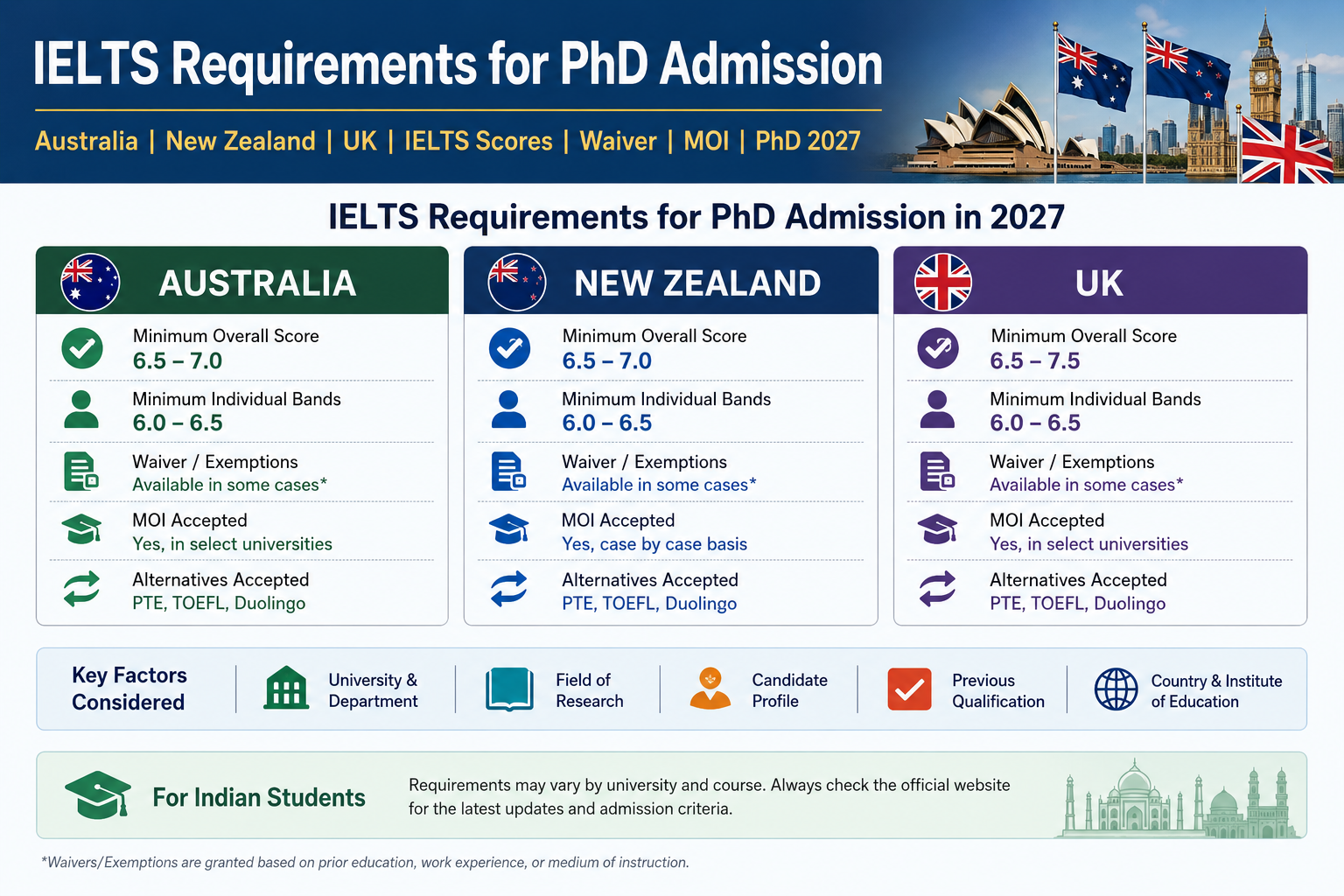
    There is no single IELTS score applicable to every doctoral programme. However, IELTS Academic 6.5 overall with no band below 6.0 is a common benchmark at a number of universities, particularly in Australia and New Zealand. Requirements in the UK can be higher, with some competitive programmes requiring IELTS 7.0 or 7.5 overall.

    For example, the University of Auckland currently states IELTS Academic 6.5 overall with no band below 6.0 for its PhD programme. Oxford’s graduate English requirements are 7.0 overall with at least 6.5 in each component at Standard level and 7.5 overall with at least 7.0 in each component at Higher level.

    Cambridge demonstrates why students should check programme-specific requirements rather than relying on country averages. Its PhD in Computer Science currently requires IELTS Academic 7.5 overall and 7.0 in every component.

    This EducationMESD guide explains the IELTS requirements for PhD admission in Australia, New Zealand and the UK for 2027, including minimum scores, individual band requirements, IELTS waivers, MOI, alternatives such as TOEFL and PTE, and practical guidance for Indian PhD applicants.

    PhD abroad for Indian students


    IELTS Requirements for PhD Admission: Quick Answer

    If you are searching for the minimum IELTS score for PhD admission, use the following figures only as general planning benchmarks:

    CountryCommon IELTS Range for PhDTypical Individual Band ExpectationIs IELTS 6.5 Often Enough?
    Australia6.5–7.0+Around 6.0–6.5+Often
    New Zealand6.5–7.0+Around 6.0+Often
    UK6.5–7.5+Around 6.0–7.0+Programme-dependent

    Important: IELTS requirements vary by university, faculty, discipline and individual doctoral programme. Applicants should always verify the latest requirements on the official programme page.

    Key takeaway

    For students applying across several universities, a practical IELTS target can be:

    IELTS Academic 7.0 overall with no band below 6.5

    This is not a universal admission requirement, but it may provide broader application flexibility than aiming only for 6.5.


    What IELTS Score Is Required for PhD Admission?

    There is no universal IELTS requirement for PhD admission abroad.

    Universities establish their own English-language requirements, and individual faculties may impose scores higher than the university-wide minimum.

    Students may therefore encounter requirements such as:

    • IELTS 6.5 overall with no band below 6.0;
    • IELTS 7.0 overall with minimum 6.5 components;
    • IELTS 7.5 overall with minimum 7.0 components;
    • higher Writing requirements for selected disciplines.

    Your required IELTS score may depend on:

    • university;
    • country;
    • research discipline;
    • faculty;
    • doctoral programme;
    • previous education;
    • professional accreditation;
    • English-language exemption rules.

    This means two PhD programmes at different universities—or even within different faculties of the same university—may have different English-language requirements.


    Why Is IELTS Required for PhD Admission Abroad?

    A doctoral degree requires extensive academic communication.

    PhD researchers may need to:

    • read hundreds of research papers;
    • conduct systematic or critical literature reviews;
    • write a research proposal;
    • communicate with supervisors;
    • prepare research reports;
    • submit journal manuscripts;
    • present research at international conferences;
    • participate in academic seminars;
    • write a doctoral thesis;
    • defend research through an oral examination or viva.

    Universities therefore need evidence that international applicants have sufficient academic English proficiency to undertake advanced research.

    For PhD admission, applicants normally need IELTS Academic, rather than IELTS General Training.

    official IELTS Academic test


    IELTS Requirements for PhD in Australia 2027

    Australia continues to attract international doctoral students because of its research-intensive universities, funding opportunities, global academic reputation and strong doctoral research ecosystem.

    For many students researching the IELTS requirements for PhD in Australia, a useful starting benchmark is:

    IELTS Academic 6.5 Overall with No Band Below 6.0

    However, this is not a national rule.

    Individual universities and faculties may require:

    • IELTS 7.0 overall;
    • 6.5 in individual components;
    • higher Writing scores;
    • additional professional language requirements.

    Therefore, students should verify the English-language requirement for the specific PhD programme, not simply the university’s general postgraduate requirement.

    PhD in Australia for Indian students


    Is IELTS 6.5 Enough for PhD in Australia?

    For many Australian doctoral programmes, IELTS 6.5 can be sufficient, particularly where the requirement is 6.5 overall with no individual score below 6.0.

    However, IELTS 6.5 does not make an applicant eligible for every programme.

    Consider this example.

    Applicant A

    ComponentScore
    Listening6.5
    Reading6.5
    Writing6.0
    Speaking6.5
    Overall6.5

    If the programme requires 6.5 overall with no band below 6.0, the applicant meets the language threshold.

    Applicant B

    ComponentScore
    Listening7.0
    Reading7.0
    Writing5.5
    Speaking6.5
    Overall6.5

    Despite achieving an overall 6.5, Applicant B may not satisfy a programme requiring no component below 6.0.

    The lesson is important:

    For PhD admission, your overall IELTS score and your individual band scores both matter.


    IELTS Requirements for PhD in New Zealand 2027

    New Zealand has become an increasingly attractive option for international doctoral students seeking research-intensive universities and internationally recognised PhD qualifications.

    A commonly encountered benchmark for PhD admission in New Zealand is:

    IELTS Academic 6.5 Overall with No Band Below 6.0

    The University of Auckland currently specifies exactly this requirement for its PhD programme: 6.5 overall with no band below 6.0. It also states that students must meet its English-language requirements as a condition of entry.

    Typical Planning Benchmark

    IELTS ComponentIndicative Score
    Overall6.5
    Listening6.0+
    Reading6.0+
    Writing6.0+
    Speaking6.0+

    These scores should be treated as a planning reference rather than a guarantee of eligibility.

    PhD in New Zealand for Indian students


    Is IELTS 6.5 Enough for PhD in New Zealand?

    For many doctoral programmes, IELTS 6.5 may be enough, provided the applicant also satisfies the minimum individual component requirements.

    The University of Auckland is a clear example, requiring IELTS Academic 6.5 overall and no component below 6.0 for its PhD.

    However, applicants should still check:

    University requirement → Faculty requirement → Programme requirement

    If the programme-specific requirement is higher, the higher threshold applies.


    IELTS Requirements for PhD in the UK 2027

    The IELTS requirements for PhD in the UK can be more variable than many students expect.

    Applicants may encounter requirements ranging approximately from:

    IELTS Academic 6.5 to 7.5+

    Highly competitive institutions and programmes requiring substantial academic writing or advanced communication may set higher standards.

    Oxford currently uses two graduate English-language levels:

    Oxford English LevelIELTS OverallMinimum Per Component
    Standard7.06.5
    Higher7.57.0

    Cambridge provides another strong example. Its current PhD in Computer Science requires:

    • IELTS Academic 7.5 overall
    • Listening: 7.0
    • Reading: 7.0
    • Writing: 7.0
    • Speaking: 7.0

    Its PhD in English similarly lists IELTS 7.5 overall with 7.0 in each component.

    This illustrates why students should avoid assuming that IELTS 6.5 will be sufficient for all UK PhD programmes.

    PhD in the UK for Indian students


    Is IELTS 6.5 Enough for PhD in the UK?

    Sometimes, but not always.

    Some UK doctoral programmes may accept IELTS 6.5, whereas others require:

    • 7.0 overall;
    • 7.5 overall;
    • minimum 6.5 components;
    • minimum 7.0 components.

    For applicants targeting multiple UK universities, the safest strategy is to determine the highest IELTS requirement among all shortlisted programmes.

    For example:

    Shortlisted ProgrammeIELTS Requirement
    Programme A6.5
    Programme B7.0
    Programme C7.0
    Programme D7.5

    In this situation, aiming for 7.5 gives the student the greatest flexibility.

    UK Student visa English-language requirements


    Australia vs New Zealand vs UK IELTS Requirements for PhD

    Here is a simplified comparison for students planning a PhD abroad in 2027.

    FactorAustraliaNew ZealandUK
    Common IELTS Range6.5–7.0+6.5–7.0+6.5–7.5+
    IELTS AcademicUsuallyUsuallyUsually
    IELTS 6.5 Often EnoughYesYesDepends
    Programme-Specific RequirementsYesYesYes
    Individual Bands ImportantYesYesYes
    Higher Writing Requirement PossibleYesYesYes
    IELTS Waiver May Be AvailableUniversity-dependentUniversity-dependentUniversity-dependent
    Alternative Tests May Be AcceptedYesYesYes

    Which country has the easiest IELTS requirement for PhD?

    There is no reliable country-wide answer.

    English-language requirements are primarily established by universities and individual programmes rather than by a single national PhD admissions standard.

    Applicants should therefore select universities based on research fit, supervisor availability, funding and programme requirements, not IELTS score alone.


    IELTS Overall Score vs Individual Band Score

    One of the most common mistakes in a PhD application is checking only the overall IELTS score.

    Suppose your IELTS result is:

    ComponentScore
    Listening7.5
    Reading7.0
    Writing5.5
    Speaking7.0
    Overall7.0

    If your university requires:

    IELTS 6.5 overall with no component below 6.0

    you may still fail to meet the requirement because your Writing score is only 5.5.

    Therefore:

    A higher overall IELTS score cannot necessarily compensate for an individual component below the programme minimum.


    Why Is IELTS Writing Important for PhD Students?

    Writing is particularly important at doctoral level.

    A PhD student may need to prepare:

    • research proposals;
    • literature reviews;
    • methodology chapters;
    • research reports;
    • journal manuscripts;
    • conference papers;
    • thesis chapters;
    • responses to peer reviewers.

    Universities may therefore impose stricter Writing requirements for programmes involving substantial academic writing.

    Students preparing for IELTS should not focus exclusively on their overall band.


    IELTS Academic or IELTS General for PhD Admission?

    For university-level doctoral admission, students should normally take:

    IELTS Academic

    IELTS Academic is intended for higher-education and academic contexts.

    IELTS General Training is mainly associated with migration, workplace communication and certain non-degree study purposes.

    Therefore:

    PhD Admission → IELTS Academic

    Before booking the examination, confirm which IELTS format your target university accepts.

    IELTS test types


    Can You Apply for a PhD Without IELTS?

    Yes, it may be possible to pursue a PhD without submitting IELTS, depending on university policy.

    However, “PhD without IELTS” does not generally mean that the English-language requirement disappears.

    Instead, a university may allow another form of evidence such as:

    • previous qualifying education conducted in English;
    • TOEFL;
    • PTE Academic;
    • Cambridge English qualifications;
    • another recognised test;
    • an approved exemption or waiver;
    • institution-specific evidence of English proficiency.

    Eligibility varies considerably.


    PhD Without IELTS for Indian Students

    Indian students frequently search for PhD abroad without IELTS because many have completed undergraduate or postgraduate degrees entirely in English.

    Some universities may recognise prior English-medium education under specific circumstances.

    However:

    Studying in English does not automatically guarantee an IELTS waiver.

    Universities can consider:

    • country of previous education;
    • institution attended;
    • degree level;
    • duration of study;
    • when the qualification was completed;
    • whether teaching and assessment were both conducted in English;
    • faculty-specific rules.

    Applicants should therefore obtain confirmation from their target university before assuming that IELTS will be waived.


    Is MOI Accepted for PhD Admission Abroad?

    MOI, or Medium of Instruction, is a document issued by a previous educational institution confirming that a programme was taught in a particular language.

    Indian students often use an MOI certificate to demonstrate that their Bachelor’s or Master’s degree was taught in English.

    Some universities may recognise previous English-medium education.

    Others may still require an approved English test.

    Therefore:

    MOI acceptance is university-specific and should never be assumed.

    Before relying on MOI, check whether the university accepts:

    • Indian English-medium qualifications;
    • your specific type of degree;
    • your institution;
    • the date your degree was completed;
    • MOI as formal evidence.

    What Is an IELTS Waiver for PhD Admission?

    An IELTS waiver means an applicant is permitted to satisfy the English-language requirement through another recognised route.

    This could be based on:

    • previous education;
    • an approved qualification;
    • country of study;
    • institutional policy;
    • another English-language test.

    A waiver is different from having no English-language requirement.

    Universities may still require evidence that applicants possess sufficient academic English proficiency.


    Alternatives to IELTS for PhD Admission

    Depending on the university, applicants may be able to submit other approved English tests.

    Common possibilities include:

    TOEFL iBT

    TOEFL is accepted by many universities worldwide.

    PTE Academic

    PTE Academic is recognised by many institutions, particularly in Australia, New Zealand and the UK.

    Cambridge C1 Advanced

    Some universities accept Cambridge C1 Advanced.

    Cambridge C2 Proficiency

    Cambridge C2 Proficiency may also satisfy university English-language requirements.

    Oxford, for example, currently lists IELTS Academic, Cambridge C1 Advanced and Cambridge C2 Proficiency among its accepted English qualifications, subject to specified score requirements.

    Acceptance and scores vary by university.


    Can You Contact a PhD Supervisor Before IELTS?

    In many cases, yes.

    You generally do not need to delay your supervisor search simply because you have not yet completed IELTS.

    A practical process is:

    Research Area → University → Potential Supervisor → Research Fit → Initial Contact → Research Proposal → IELTS → Formal Application

    When contacting a potential PhD supervisor, focus primarily on:

    • research alignment;
    • academic qualifications;
    • research experience;
    • publications;
    • proposed research idea;
    • methodology;
    • why you want to work with that supervisor.

    Your English-language qualification can then be handled according to the formal admissions requirements.

    how to find a PhD supervisor abroad

    official IELTS preparation resources


    Is IELTS Required Before Submitting a PhD Application?

    Not necessarily in every case.

    Some universities may allow students to apply before satisfying the English-language requirement and subsequently make an offer conditional on meeting it.

    For example, Cambridge’s Centre of Development Studies states that applicants requiring English-language evidence can initially receive a conditional offer before supplying the required result, although the requirement must ultimately be satisfied.

    Policies vary, so always check your specific programme.


    What Is a Good IELTS Score for PhD Admission?

    There is an important difference between:

    Minimum IELTS score

    and

    Strategic IELTS target

    If your shortlisted programmes require between 6.5 and 7.0, targeting:

    IELTS 7.0 Overall with No Band Below 6.5

    may provide a useful buffer.

    For programmes with higher requirements, applicants may need:

    IELTS 7.5 Overall with 7.0 in Each Component

    Oxford’s Higher level currently uses exactly this benchmark, while several Cambridge doctoral programmes also list 7.5 overall with 7.0 per component.


    Is IELTS 7.0 Good for PhD Admission?

    Yes. IELTS 7.0 is a strong score for many doctoral programmes, although it does not satisfy every programme.

    For example, it meets Oxford’s current Standard level requirement if each component is at least 6.5. However, it would not meet Oxford’s Higher level requirement or Cambridge’s current PhD in Computer Science requirement.

    This reinforces an important principle:

    The right IELTS score is the score required by your target programme—not an arbitrary global benchmark.


    IELTS Score Strategy for Indian PhD Applicants

    Students can follow this process before booking IELTS.

    Step 1: Select Your Research Area

    Define your broad and narrow research interests.

    Step 2: Choose Target Countries

    Consider Australia, New Zealand, the UK or a combination.

    Step 3: Shortlist Universities

    Create a shortlist of approximately 5–10 suitable institutions.

    Step 4: Identify Potential Supervisors

    Assess research alignment by reviewing:

    • faculty profiles;
    • recent publications;
    • ongoing research;
    • funded projects;
    • research groups.

    Step 5: Check IELTS Requirements

    Record:

    • overall IELTS requirement;
    • Writing minimum;
    • Reading minimum;
    • Listening minimum;
    • Speaking minimum.

    Step 6: Check IELTS Waiver Rules

    Determine whether your previous education may qualify.

    Step 7: Check Alternative Tests

    Look for:

    • TOEFL;
    • PTE;
    • Cambridge English;
    • other approved evidence.

    Step 8: Choose the Highest Requirement

    If your shortlist ranges from IELTS 6.5 to 7.5, prepare for the highest score.


    Recommended IELTS Target for Multiple PhD Applications

    Suppose you have the following shortlist:

    UniversityIELTS OverallMinimum Component
    University A6.56.0
    University B6.56.0
    University C7.06.5
    University D7.06.5
    University E7.57.0

    If you genuinely intend to apply to all five, your strategic target should be:

    IELTS 7.5 Overall with No Component Below 7.0

    Preparing according to the highest requirement reduces the risk of needing another IELTS attempt later.


    Does IELTS Score Affect PhD Scholarships?

    Usually, IELTS functions mainly as an eligibility requirement, rather than the primary criterion for scholarship selection.

    After satisfying the required English threshold, scholarship competitiveness is more likely to depend on:

    • academic performance;
    • research experience;
    • publications;
    • research proposal;
    • research novelty;
    • supervisor alignment;
    • recommendation letters;
    • academic CV;
    • methodology skills;
    • scholarship-specific criteria.

    Therefore:

    IELTS 8.0 does not automatically make an applicant more competitive for a PhD scholarship than an applicant with IELTS 7.0 who has a stronger research profile.


    IELTS Requirements for Fully Funded PhD Abroad

    Students looking for a fully funded PhD in Australia, New Zealand or the UK should evaluate English-language eligibility alongside funding eligibility.

    A competitive application usually requires alignment between:

    Research Interest → Research Gap → Supervisor → University → Funding → English Requirement → PhD Application

    Potential funding routes may include:

    Australia

    • Research Training Program-related funding;
    • university doctoral scholarships;
    • faculty-funded projects;
    • externally funded research projects.

    New Zealand

    • university doctoral scholarships;
    • research project funding;
    • faculty or school scholarships.

    UK

    • research council-funded opportunities;
    • UKRI-associated doctoral funding;
    • doctoral training programmes;
    • departmental studentships;
    • university scholarships;
    • funded research projects.

    Meeting IELTS requirements alone does not guarantee funding.


    When Should You Take IELTS for PhD Admission 2027?

    Students planning a 2027 PhD intake should ideally start checking IELTS requirements early in the application cycle.

    9–12 Months Before Applying

    Focus on:

    • research area;
    • country selection;
    • university shortlist;
    • potential supervisors;
    • scholarship research.

    6–9 Months Before Applying

    Work on:

    • supervisor communication;
    • research proposal;
    • academic CV;
    • IELTS preparation.

    4–6 Months Before Applying

    Complete:

    • IELTS test;
    • research proposal;
    • academic documents;
    • recommendation planning;
    • scholarship documentation.

    2–4 Months Before Deadlines

    Focus on:

    • IELTS retake if required;
    • final applications;
    • scholarship submissions;
    • remaining supporting documents.

    Starting early gives applicants sufficient time to address a low individual band.


    Common IELTS Mistakes PhD Applicants Should Avoid

    1. Assuming IELTS 6.5 Works Everywhere

    Requirements differ considerably.

    2. Looking Only at the Overall Score

    Individual component scores are equally important.

    3. Ignoring Faculty Requirements

    A faculty may require more than the university-wide minimum.

    4. Taking IELTS General Training

    IELTS Academic is normally the relevant test for doctoral admission.

    5. Assuming MOI Guarantees an IELTS Waiver

    It does not.

    6. Preparing Only for the Minimum Score

    Targeting a slightly higher score provides flexibility.

    7. Ignoring Writing

    Writing requirements can be particularly important at PhD level.

    8. Booking IELTS Before Shortlisting Universities

    Check your target programmes first.

    9. Confusing Admission and Visa Requirements

    University admissions requirements and immigration requirements are not necessarily identical.

    10. Depending on Old Information

    IELTS policies can change. Always verify current requirements before applying.


    Frequently Asked Questions About IELTS Requirements for PhD Admission

    What is the minimum IELTS score for PhD admission?

    There is no universal minimum. Students commonly encounter requirements from approximately IELTS 6.5 to 7.5 overall, depending on the university and PhD programme.

    Is IELTS 6.5 enough for PhD admission?

    It can be sufficient for many programmes, particularly in Australia and New Zealand, but not for all universities.

    What IELTS score is required for PhD in Australia?

    A common benchmark is IELTS Academic 6.5 overall with no band below 6.0, although individual programmes can require higher scores.

    What IELTS score is required for PhD in New Zealand?

    Many students encounter requirements around IELTS 6.5 overall with minimum 6.0 components. The University of Auckland currently uses this requirement for its PhD programme.

    What IELTS score is required for PhD in the UK?

    Requirements vary. Some programmes may accept around 6.5, while highly selective programmes can require 7.0–7.5 or higher.

    Is IELTS 7.0 enough for a UK PhD?

    For some programmes, yes. Oxford’s current Standard English level is 7.0 overall with 6.5 per component, but its Higher level is 7.5 overall with 7.0 per component.

    Can I pursue a PhD abroad without IELTS?

    Possibly, if your university accepts another recognised English qualification, previous qualifying education or an approved exemption.

    Can Indian students get an IELTS waiver?

    Potentially. Eligibility depends entirely on the university’s English-language policy.

    Is MOI accepted instead of IELTS?

    Some institutions may accept qualifying English-medium education, but MOI is not universally accepted.

    Which IELTS is required for PhD admission?

    Normally IELTS Academic.

    Can I take PTE instead of IELTS for a PhD?

    Many universities accept PTE Academic, but acceptance and minimum scores vary.

    Can TOEFL replace IELTS for PhD admission?

    Many universities accept TOEFL, subject to their current English-language rules.

    Can I contact a PhD supervisor without IELTS?

    Generally, yes. Supervisor outreach can often begin before completing the English-language test.

    Is IELTS required before applying for a PhD?

    Not always. Some institutions may issue conditional offers subject to later completion of the English-language requirement.

    Does IELTS affect PhD scholarship chances?

    IELTS mainly demonstrates language eligibility. Research quality, academic performance, proposal strength and supervisor fit generally matter much more after the English threshold is met.


    IELTS Requirements for PhD Admission: Final Comparison

    QuestionAustraliaNew ZealandUK
    Common IELTS starting benchmark6.56.56.5–7.5
    6.5 may be acceptedFrequentlyFrequentlyDepends
    7.0 may be requiredYesYesFrequently in some institutions
    7.5 possibleYesYesYes
    IELTS AcademicUsuallyUsuallyUsually
    Individual bands matterYesYesYes
    Waiver possibleInstitution-specificInstitution-specificInstitution-specific
    MOI may be consideredSometimesSometimesSometimes

    Final Verdict: What IELTS Score Should You Target for a PhD in 2027?

    For students planning a PhD in Australia, New Zealand or the UK in 2027, there is no single IELTS score that guarantees admission.

    As a broad planning guide:

    Australia: commonly around IELTS 6.5–7.0+

    New Zealand: commonly around IELTS 6.5–7.0+

    United Kingdom: approximately IELTS 6.5–7.5+, depending strongly on the programme.

    A score of IELTS 6.5 overall with no band below 6.0 can satisfy the English requirement for a number of doctoral programmes, particularly in Australia and New Zealand.

    However, students applying to several competitive universities should consider aiming for:

    IELTS 7.0 Overall with No Band Below 6.5

    Applicants targeting universities or programmes with higher English-language requirements may need:

    IELTS 7.5 Overall with No Band Below 7.0

    Instead of asking only “What is the minimum IELTS score for PhD admission?”, ask:

    “What is the highest IELTS requirement among the PhD programmes that match my research interests?”

    That question produces a far more effective application strategy.

    Your complete PhD roadmap should be:

    Research Interest → Research Gap → University → Supervisor → Research Proposal → Funding → IELTS Requirement → Application → Interview → Admission


    Planning a PhD Abroad in 2027?

    EducationMESD provides guidance for Indian students and research aspirants planning doctoral study internationally.

    Explore our detailed resources on:

    • PhD Abroad for Indian Students in 2027
    • PhD in Australia for Indian Students
    • Fully Funded PhD in Australia
    • PhD in New Zealand for Indian Students
    • PhD in the UK for Indian Students
    • PhD in Australia vs New Zealand vs UK
    • PhD Abroad Without GRE
    • How to Find and Contact a PhD Supervisor Abroad
    • How to Write a Research Proposal for PhD Admission Abroad

    A successful PhD application is not built around IELTS alone.

    how to write a PhD research proposal

    It is built around:

    Strong Research Fit + Right Supervisor + Strong Research Proposal + Academic Profile + Funding Strategy + Correct Application Timing

  • PhD Abroad Without GRE: Australia, New Zealand and UK Options for Indian Students 2027

    PhD Abroad Without GRE: Australia, New Zealand and UK Options for Indian Students 2027

    Can Indian students pursue a PhD abroad without GRE in 2027?

    Yes. Many research-based PhD programs in Australia, New Zealand and the UK do not require GRE scores as a standard part of doctoral admission.

    Instead, universities usually assess candidates based on:

    • Academic performance
    • Research experience
    • Master’s thesis or dissertation
    • Research proposal
    • PhD supervisor alignment
    • Academic references
    • Publications, where applicable
    • English-language proficiency
    • Interview performance

    For Indian students planning doctoral studies, this makes Australia, New Zealand and the UK some of the best destinations for PhD without GRE.

    However, one important distinction must be understood:

    A PhD without GRE is not the same as an easy PhD admission.

    Highly ranked universities and fully funded PhD positions remain competitive. When GRE is not required, universities may place even greater emphasis on your research capability, proposal quality and supervisor fit.


    PhD Abroad Without GRE 2027: Quick Answer

    Students looking for a quick comparison can use the table below.

    FactorAustraliaNew ZealandUK
    GRE usually required for PhDNoNoNo
    Research proposalImportantImportantOften important
    Supervisor fitCriticalCriticalCritical
    Research experienceVery importantVery importantVery important
    Fully funded PhD optionsStrongAvailableStrong
    ScholarshipsMultiple optionsUniversity-focusedMultiple studentships
    IELTS/English requirementUsually required unless exemptUsually required unless exemptUsually required unless exempt
    Suitable for Indian studentsYesYesYes

    Best Countries for PhD Without GRE

    The strongest options include:

    Australia → New Zealand → United Kingdom

    The right country depends on your:

    Research Area + Supervisor + Funding + Academic Profile + Career Goals


    What Does PhD Without GRE Mean?

    A PhD without GRE means that the university or doctoral program does not require Graduate Record Examination scores as part of its normal admission process.

    Instead of standardized test performance, universities evaluate your potential to conduct independent research.

    This evaluation may include:

    • Bachelor’s degree
    • Master’s degree
    • Academic transcripts
    • Research dissertation
    • Research experience
    • Research proposal
    • Academic CV
    • Statement of purpose
    • Recommendation letters
    • Publications
    • Research projects
    • English proficiency
    • PhD interview

    For doctoral admission, universities are primarily asking:

    Can this applicant identify a meaningful research problem and complete original doctoral-level research?


    Why Choose a PhD Abroad Without GRE?

    A GRE-free PhD program can offer several advantages for Indian students.

    No GRE Preparation Required

    GRE preparation can take several weeks or months.

    Students targeting PhD programs without GRE can use this time to improve:

    • Research proposal
    • Literature review
    • Research-gap analysis
    • Academic CV
    • Supervisor communication
    • Scholarship applications

    These components often have more direct relevance to research-based admissions.


    Lower Cost of Applying Abroad

    Avoiding GRE may reduce expenses related to:

    • GRE registration
    • Test preparation
    • Coaching
    • Practice materials
    • Score reporting

    This can make the PhD application process more affordable.


    Greater Emphasis on Research Ability

    A research PhD evaluates your potential as a researcher.

    Universities may therefore focus more on:

    Research Experience → Proposal → Supervisor Fit → Expected Research Contribution

    rather than standardized test scores.


    Better for Students With Research Experience

    A PhD abroad without GRE can be particularly attractive if you already have:

    • Master’s dissertation
    • Research thesis
    • Journal papers
    • Conference publications
    • Research assistant experience
    • Industry R&D experience
    • Strong research projects

    Fully Funded PhD Without GRE Is Possible

    Students frequently ask:

    Can I get a fully funded PhD without GRE?

    The answer is yes.

    GRE requirements and scholarship requirements are separate.

    If neither the PhD program nor the funding scheme requires GRE, students can compete for fully funded PhD opportunities without GRE.


    Best Countries for PhD Without GRE for Indian Students in 2027

    Indian students searching for GRE-free PhD programs abroad should particularly explore:

    Australia

    Australia offers internationally recognized universities, research-intensive PhDs, university scholarships and project-funded doctoral positions.

    New Zealand

    New Zealand offers strong research supervision, doctoral scholarships and a research-focused PhD structure.

    United Kingdom

    The UK offers a very large number of universities, studentships, research council opportunities and advertised funded PhD projects.


    PhD in Australia Without GRE for Indian Students

    A PhD in Australia without GRE is one of the most attractive options for Indian students.

    Australian doctoral admissions usually focus heavily on academic performance and research capability.

    Applicants may be evaluated based on:

    • Academic qualifications
    • Research thesis
    • Master’s research component
    • Research experience
    • Proposed research topic
    • PhD supervisor
    • Research proposal
    • English proficiency

    Best Universities for PhD in Australia Without GRE

    Indian students can explore PhD opportunities at:

    • Australian National University
    • University of Melbourne
    • University of Sydney
    • University of Queensland
    • Monash University
    • UNSW Sydney
    • University of Adelaide
    • University of Western Australia
    • University of Technology Sydney
    • RMIT University
    • Deakin University
    • Macquarie University

    Admission policies can vary by faculty and research project, so always verify the exact requirements.


    Eligibility for PhD in Australia Without GRE

    Academic Qualification

    Applicants may qualify through:

    • Research master’s degree
    • Master’s degree with significant research
    • Bachelor’s degree with honours
    • Equivalent international qualification
    • Relevant research or professional experience

    PhD entry requirements in Australia


    Research Experience

    Evidence of research experience may include:

    • Master’s dissertation
    • Honours thesis
    • Journal paper
    • Conference publication
    • Research assistantship
    • Industry research
    • Technical reports
    • Independent research project

    Research Proposal

    A strong proposal should clearly establish:

    Research Background → Research Problem → Gap → Questions → Objectives → Methodology → Contribution

    Do not submit a generic proposal to multiple universities.

    Customize it according to:

    • Supervisor
    • Department
    • Research facilities
    • Research expertise

    PhD Supervisor in Australia

    Finding an appropriate supervisor is often one of the most important stages of the PhD application process.

    A strong supervisor match should connect:

    Your Research Interest ↔ Supervisor Expertise ↔ Current Projects ↔ Funding


    Fully Funded PhD in Australia Without GRE

    Students searching for a fully funded PhD in Australia without GRE should explore several types of funding.

    Research Training Program Scholarships

    Australian universities may offer research scholarships supported through national research funding mechanisms.

    University PhD Scholarships

    Scholarships may include:

    • Tuition fee coverage
    • Living stipend
    • Research allowance
    • Relocation support
    • Health-cover assistance in some cases

    Project-Funded PhD Positions

    Research grants may fund doctoral students for predefined projects.

    These opportunities can already include:

    Topic + Supervisor + Research Funding

    making them highly attractive for international applicants.

    Australian Government Research Training Program (RTP)


    PhD in New Zealand Without GRE for Indian Students

    A PhD in New Zealand without GRE is another strong option for Indian researchers.

    New Zealand universities typically emphasize:

    • Academic performance
    • Research experience
    • Research proposal
    • Supervisor availability
    • English-language proficiency

    instead of standardized graduate tests.

    apply for a PhD at the University of Auckland


    Universities for PhD in New Zealand Without GRE

    Indian students can explore:

    • University of Auckland
    • University of Otago
    • Victoria University of Wellington
    • University of Canterbury
    • University of Waikato
    • Massey University
    • Lincoln University
    • Auckland University of Technology

    Eligibility for PhD in New Zealand Without GRE

    Strong Academic Record

    Applicants should generally demonstrate strong performance in a relevant qualification.

    Significant Research Experience

    Evidence can include:

    • Master’s thesis
    • Dissertation
    • Honours research
    • Journal articles
    • Conference papers
    • Research projects
    • Research reports

    Research Proposal

    A strong proposal should explain:

    Problem → Existing Research → Research Gap → Methodology → Expected Contribution

    Supervisor Availability

    Supervisor availability is critical.

    A good academic profile alone may not be sufficient if appropriate supervision is unavailable.

    English-Language Requirement

    Indian students may need IELTS, TOEFL, PTE Academic or another accepted qualification unless an exemption applies.

    University of Auckland doctoral entry requirements

    Fully Funded PhD in New Zealand Without GRE

    Students can investigate:

    • University doctoral scholarships
    • Faculty scholarships
    • Research centre scholarships
    • Project-funded PhDs
    • Supervisor-funded opportunities
    • External scholarships

    Selection may be based on:

    Academic Excellence + Research Potential + Proposal Quality + Supervisor Fit


    PhD in UK Without GRE for Indian Students

    The UK is one of the best destinations for PhD without GRE for Indian students.

    Many UK PhD programs do not require GRE scores.

    Instead, universities focus on:

    • Academic qualifications
    • Research capability
    • Research proposal
    • Supervisor alignment
    • Academic references
    • English proficiency
    • Interview

    Best Universities for PhD in UK Without GRE

    Students can explore opportunities at:

    • University of Oxford
    • University of Cambridge
    • Imperial College London
    • University College London
    • University of Edinburgh
    • King’s College London
    • University of Manchester
    • University of Bristol
    • University of Warwick
    • University of Glasgow
    • University of Birmingham
    • University of Leeds
    • University of Sheffield
    • University of Nottingham
    • University of Southampton

    Individual requirements vary by course and department.


    Eligibility for PhD in UK Without GRE

    Academic Qualifications

    Depending on the program, universities may expect:

    • Strong bachelor’s qualification
    • Master’s degree
    • Research master’s
    • Relevant research experience

    Research Proposal

    For a self-designed PhD, the proposal is often one of the most important application documents.

    A strong UK PhD research proposal should contain:

    1. Research title
    2. Background
    3. Research problem
    4. Literature review
    5. Research gap
    6. Research questions
    7. Research objectives
    8. Theoretical framework
    9. Research methodology
    10. Expected contribution
    11. Research timeline
    12. References

    Fully Funded PhD in UK Without GRE

    Indian students searching for a fully funded PhD in UK without GRE can explore:

    • UKRI-funded studentships
    • University scholarships
    • Departmental funding
    • Doctoral Training Partnerships
    • Doctoral Training Centres
    • Project-funded PhDs
    • Supervisor-funded projects
    • External scholarships
    • Commonwealth-related opportunities where eligible

    Before accepting any scholarship, check exactly what it covers.

    Ideally, a fully funded package should include:

    Tuition Fees + Living Stipend + Research Costs

    International students should also verify whether any international tuition fee difference is covered.


    Australia vs New Zealand vs UK for PhD Without GRE

    CriteriaAustraliaNew ZealandUK
    GRE normally requiredNoNoNo
    Research qualityExcellentExcellentExcellent
    Supervisor fitCriticalCriticalCritical
    Research proposalHigh importanceHigh importanceHigh importance
    Fully funded opportunitiesStrongAvailableStrong
    Project-based PhDsCommonAvailableVery common
    Number of universitiesHighSmallerVery high
    Scholarship varietyStrongModerateVery strong
    Best for Indian studentsYesYesYes

    Which Country Is Best for PhD Without GRE?

    The best destination depends on your profile.

    Australia May Be Best If You Want

    • Large research-intensive universities
    • Strong research scholarship ecosystem
    • Project-funded doctoral opportunities
    • High-quality laboratories and research centres

    New Zealand May Be Best If You Want

    • Research-focused doctoral study
    • Strong supervisor engagement
    • University doctoral scholarship opportunities
    • Smaller research communities

    UK May Be Best If You Want

    • Large number of universities
    • Advertised funded PhD projects
    • Doctoral Training Partnerships
    • Research council studentships
    • Extensive research group choice

    The best sequence is:

    Research Area → Research Gap → Supervisor → Funding → University → Country


    What Replaces GRE in PhD Admission?

    When GRE is not required, universities may place greater emphasis on other evidence.

    Academic Record

    Strong bachelor’s and master’s results demonstrate academic readiness.

    Research Proposal

    The proposal proves your ability to formulate an original research problem.

    Research Experience

    Research experience demonstrates that you understand the practical process of conducting research.

    Master’s Thesis

    A dissertation provides direct evidence of independent research capability.

    Publications

    Publications can strengthen an application but are not compulsory everywhere.

    Academic References

    Your referees should ideally provide evidence of:

    • Research ability
    • Analytical thinking
    • Academic independence
    • Motivation
    • Doctoral potential

    Supervisor Fit

    Supervisor alignment can be decisive.

    A strong application should demonstrate:

    Why this topic + Why this supervisor + Why this department + Why you


    Can Indian Students Get a Fully Funded PhD Without GRE?

    Yes. Indian students can obtain a fully funded PhD abroad without GRE when neither the program nor the scholarship requires the test.

    Fully funded packages may include:

    • Tuition fees
    • Living stipend
    • Research allowance
    • Conference funding
    • Health insurance
    • Relocation support

    Always read the funding conditions carefully.


    PhD Without GRE and IELTS: Is It Possible?

    Students often search for PhD without GRE and IELTS.

    These are separate requirements.

    GRE

    Measures graduate-level reasoning and analytical ability.

    IELTS

    Measures English-language proficiency.

    Therefore:

    No GRE does not automatically mean no IELTS.

    Some universities may accept:

    • TOEFL
    • PTE Academic
    • Other approved English tests
    • Previous English-medium education under specific rules

    Check the exact policy before applying.


    PhD Without GRE and Without Master’s: Is It Possible?

    In some cases, yes.

    Certain universities allow direct PhD admission after a strong honours bachelor’s degree.

    However, candidates usually need to demonstrate substantial research preparation.

    A competitive profile may include:

    • Strong bachelor’s grades
    • Honours thesis
    • Research experience
    • Publications
    • Strong proposal
    • Excellent references

    PhD Without GRE and Without Publications: Is It Possible?

    Yes. Publications are not compulsory for every PhD program.

    Students can compensate through:

    • Strong dissertation
    • Research projects
    • Excellent academic performance
    • Research assistant experience
    • Strong research proposal
    • High-quality references

    Publications can strengthen scholarship competitiveness, but they should be credible and relevant.


    Documents Required for PhD Abroad Without GRE

    DocumentImportance
    Academic CVVery High
    Research ProposalVery High
    Bachelor’s TranscriptHigh
    Master’s TranscriptHigh
    Degree CertificatesHigh
    Dissertation/ThesisVery High
    Statement of PurposeHigh
    Academic ReferencesVery High
    Research Experience EvidenceVery High
    PublicationsHelpful
    English Test ResultIf Required
    PassportRequired
    GRE ScoreOften Not Required

    How to Apply for PhD Abroad Without GRE in 2027

    Step 1: Select a Specific Research Area

    Avoid saying:

    “I want to research Artificial Intelligence.”

    Instead, narrow your interest:

    Artificial Intelligence → Healthcare AI → Federated Learning → Privacy-Preserving Medical Imaging

    Specificity makes the next steps much easier.


    Step 2: Conduct a Literature Review

    Read recent:

    • Journal papers
    • Review articles
    • Systematic reviews
    • Meta-analyses
    • Conference papers

    Step 3: Identify a Research Gap

    Look for:

    • Theoretical gaps
    • Methodological gaps
    • Contextual gaps
    • Data gaps
    • Population gaps
    • Contradictory findings
    • Technology gaps

    Step 4: Find PhD Supervisors

    Shortlist supervisors based on:

    Research Alignment + Publications + Current Projects + Funding + Availability


    Step 5: Read Their Recent Publications

    Before contacting a supervisor, read several relevant papers.

    Understand:

    • Their research questions
    • Methods
    • Recent projects
    • Future research direction

    Step 6: Prepare an Academic CV

    Your PhD CV should prioritize:

    Research Experience → Thesis → Publications → Projects → Research Methods → Academic Experience


    Step 7: Write a Strong Research Proposal

    Your proposal must answer:

    What will you study?

    Why does it matter?

    What is missing from existing research?

    How will you study it?

    What will the study contribute?


    Step 8: Contact Potential Supervisors

    A strong supervisor email should include:

    Introduction → Academic Background → Research Interest → Research Gap → Research Fit → Request

    Avoid sending mass emails.


    Step 9: Search for Fully Funded PhD Opportunities

    Funding should be researched simultaneously with admission.

    Look for:

    • University scholarships
    • Studentships
    • Research grants
    • Project-funded PhDs
    • Doctoral training programs
    • External scholarships

    Step 10: Check English-Language Requirements

    Verify whether you need:

    • IELTS
    • TOEFL
    • PTE Academic
    • Another accepted test
    • English-language exemption

    Step 11: Submit a Tailored PhD Application

    Your application should be customized for:

    Supervisor + Research Group + Department + University + Funding Opportunity


    PhD Abroad Without GRE 2027 Application Timeline

    Time Before Intended StartAction
    12–15 monthsSelect research area
    10–14 monthsComplete literature review
    9–12 monthsIdentify research gap
    9–12 monthsFind supervisors
    9–12 monthsPrepare academic CV
    8–12 monthsDevelop research proposal
    8–11 monthsContact supervisors
    8–12 monthsSearch scholarships
    6–10 monthsComplete English test
    As per deadlineSubmit applications
    After shortlistingAttend interview
    After offerConfirm funding and visa

    How to Find Fully Funded PhD Programs Without GRE

    Students should search in multiple places.

    University Research Pages

    Look for doctoral scholarship sections.

    Department Websites

    Departments may publish advertised PhD projects.

    Supervisor Profiles

    Researchers may advertise grant-funded vacancies.

    Research Institutes

    Research centres often recruit doctoral researchers.

    Funding Bodies

    Search national and international doctoral funding programs.


    Common Mistakes When Applying for PhD Without GRE

    Avoid these mistakes:

    1. Assuming no GRE means easy admission.
    2. Selecting universities only based on ranking.
    3. Sending generic supervisor emails.
    4. Applying without reading recent research.
    5. Writing a broad proposal.
    6. Failing to identify a genuine research gap.
    7. Ignoring scholarship deadlines.
    8. Assuming admission includes funding.
    9. Confusing GRE requirements with IELTS requirements.
    10. Using a corporate CV for academic applications.
    11. Applying too late.
    12. Contacting unsuitable supervisors.
    13. Submitting weak references.
    14. Publishing in questionable journals.
    15. Applying to only one university.

    How to Improve Your Chances of a Fully Funded PhD Without GRE

    Focus on six areas.

    Strong Academic Record

    Competitive funding usually requires academic excellence.

    Excellent Research Proposal

    Your proposal should demonstrate originality and feasibility.

    Research Experience

    Show that you already understand academic research.

    Relevant Publications

    Good-quality publications can add credibility.

    Strong Supervisor Fit

    A supervisor who sees clear research alignment is more likely to support your application.

    Strategic Scholarship Applications

    Apply to several appropriate funding opportunities rather than relying on one scholarship.


    Best Profile for PhD Abroad Without GRE

    A competitive applicant usually demonstrates:

    Strong Academics + Research Thesis + Relevant Experience + Clear Gap + Strong Proposal + Supervisor Alignment + Funding Strategy

    This combination is considerably more important than simply finding a university that does not ask for GRE.


    PhD Abroad Without GRE FAQs

    Can I do PhD abroad without GRE?

    Yes. Many research PhD programs in Australia, New Zealand and the UK do not require GRE as a standard admission requirement.

    Which countries offer PhD without GRE?

    Australia, New Zealand and the United Kingdom are strong options for Indian students.

    Can Indian students apply for PhD without GRE?

    Yes. Indian students can apply to GRE-free PhD programs if they satisfy academic, research and English-language requirements.

    Can I get a fully funded PhD without GRE?

    Yes. Fully funded opportunities are available where GRE is not required by the university or scholarship.

    Is GRE required for PhD in Australia?

    GRE is generally not a standard requirement for many research PhD programs in Australia.

    Is GRE required for PhD in New Zealand?

    GRE is generally not a standard requirement for research doctoral admission at many New Zealand universities.

    Is GRE required for PhD in UK?

    GRE is not universally required for UK PhD programs.

    Can I study PhD without GRE and IELTS?

    Possibly. GRE and IELTS are separate requirements. You may still need approved proof of English proficiency.

    Can I apply for PhD without master’s?

    Some universities allow direct PhD entry from a sufficiently strong honours bachelor’s qualification.

    Can I apply for PhD without publications?

    Yes. Publications are helpful but are not universally compulsory.

    Which country is best for PhD without GRE?

    Australia, New Zealand and the UK are all strong. The best option depends on research fit, funding and supervisor availability.

    Is PhD without GRE easier?

    No. Admission can remain highly competitive.

    When should I start applying for PhD 2027?

    Start planning approximately 9–15 months before your intended PhD start date, especially if you need scholarship funding.

    Can Indian students get fully funded PhD scholarships abroad?

    Yes. Indian students can compete for university scholarships, research studentships and funded doctoral projects subject to eligibility.

    What matters most if GRE is not required?

    Research experience, academic performance, proposal quality and supervisor fit become especially important.


    Final Verdict: Is PhD Abroad Without GRE Worth It?

    For Indian students planning doctoral study in 2027, a PhD abroad without GRE can be an excellent option.

    Australia, New Zealand and the UK provide strong doctoral research environments where many PhD programs focus primarily on research potential rather than GRE performance.

    However, students should not search only for:

    “Universities without GRE.”

    A better approach is:

    Research Area → Research Gap → Supervisor → Funding → University → Country

    Students targeting a fully funded PhD without GRE should build an application around:

    Academic Excellence + Research Experience + Strong Proposal + Supervisor Fit + Funding Strategy

    The best PhD opportunity is not necessarily the university with the highest ranking.

    It is the opportunity where your research interest, supervisor expertise, funding and career goals align most strongly.


    Planning a PhD Abroad in 2027?

    EducationMESD helps aspiring researchers understand important stages of their PhD abroad journey, including:

    • Country shortlisting
    • University shortlisting
    • Research area selection
    • Research-gap identification
    • PhD supervisor search
    • Research proposal planning
    • Academic CV preparation
    • Scholarship and funding exploration
    • PhD application planning

    Whether you are considering a PhD in Australia without GRE, PhD in New Zealand without GRE or PhD in UK without GRE, start with a research-first approach.

    Build your PhD application around research fit—not simply university ranking.

  • How to Write a Research Proposal for PhD Admission Abroad in 2027: Format, Sample, Examples & Complete Guide

    How to Write a Research Proposal for PhD Admission Abroad in 2027: Format, Sample, Examples & Complete Guide

    Are you planning to apply for a PhD abroad in 2027? Writing a strong research proposal for PhD admission abroad can be one of the most important parts of your doctoral application.

    A PhD research proposal explains what you want to research, why the topic matters, what research gap exists, how you plan to conduct the study, and what original contribution your research could make.

    For students applying for PhD programmes in the UK, Australia, New Zealand, Germany, Canada, Europe and other international destinations, the proposal can also help universities determine whether your research fits the expertise of a potential PhD supervisor.

    In this complete EducationMESD guide, you will learn:

    • How to write a research proposal for PhD admission abroad
    • Correct PhD research proposal format
    • How to identify a research gap
    • How to write research aims and objectives
    • How to develop research questions
    • How to write the research methodology
    • PhD research proposal examples
    • Research proposal template
    • Common mistakes to avoid
    • How to make your PhD proposal stand out
    • FAQs about PhD research proposals

    Students who are still planning their overall application can first read our PhD abroad for Indian students in 2027 guide.


    Quick Answer: How Do You Write a Research Proposal for PhD Admission Abroad?

    To write a strong research proposal for PhD admission abroad, follow this sequence:

    Research Topic → Research Problem → Literature Review → Research Gap → Research Aim → Objectives → Research Questions → Methodology → Expected Contribution → Timeline

    Your proposal should demonstrate that the research is original, academically relevant, methodologically sound, feasible and aligned with a suitable PhD supervisor.


    What Is a Research Proposal for PhD Admission Abroad?

    A research proposal for PhD admission abroad is a formal academic document outlining the research project you intend to undertake during your doctoral programme.

    It should clearly answer five questions:

    1. What do you want to research?
    2. Why is the research important?
    3. What is missing from existing literature?
    4. How will you conduct the research?
    5. What new knowledge could your research contribute?

    A research proposal is therefore not simply a description of an interesting topic.

    It should demonstrate your ability to:

    • Identify a significant research problem
    • Review academic literature critically
    • Identify an original research gap
    • Develop focused research questions
    • Select appropriate research methods
    • Design a feasible doctoral project
    • Explain the originality of your study
    • Demonstrate research-supervisor fit

    Research proposal requirements are not identical across universities. The University of Oxford advises applicants to check the individual course page for required content, assessment criteria and word limits before preparing the proposal.

    University of Oxford – Research Proposal Guidance


    Why Is a PhD Research Proposal Important?

    A strong PhD research proposal allows universities and prospective supervisors to evaluate your readiness for doctoral research.

    Your proposal can demonstrate:

    Academic Knowledge

    Do you understand the major concepts, theories and debates within your proposed research area?

    Research Capability

    Can you identify a research problem and transform it into a structured academic investigation?

    Originality

    Does the proposed research have the potential to contribute new knowledge?

    Methodological Understanding

    Do you know how to answer your research questions using appropriate research methods?

    Research Feasibility

    Can the proposed project realistically be completed within the available time and resources?

    Supervisor Fit

    Is there a faculty member whose expertise aligns with your proposed research?

    These factors make the research proposal particularly important for students targeting a research-based PhD abroad.

    A strong proposal should align with an appropriate academic; see our guide on how to find and contact a PhD supervisor abroad.


    PhD Research Proposal Format

    Although individual universities may have their own requirements, a standard PhD research proposal format generally includes:

    SectionWhat to Include
    Research TitleClear and focused proposed topic
    AbstractShort overview of the study
    IntroductionBackground and importance
    Research ProblemSpecific problem being investigated
    Literature ReviewExisting research and academic debate
    Research GapWhat remains unanswered
    Research AimOverall purpose
    Research ObjectivesSpecific research activities
    Research QuestionsQuestions the research will answer
    HypothesesWhere applicable
    Theoretical FrameworkRelevant theories or concepts
    MethodologyResearch design and analysis
    EthicsEthical considerations
    Expected ContributionOriginality and value
    TimelineProposed research schedule
    ReferencesAcademic sources cited

    Always follow the exact research proposal guidelines given by the university or department.

    University of Edinburgh guidance recommends that research proposals address areas such as the title and abstract, existing literature, objectives, methodology, ethical considerations and the overall significance of the proposed research.

    University of Edinburgh – How to Write a Good Postgraduate Research Proposal


    How to Write a Research Proposal for PhD Admission Abroad Step by Step

    Step 1: Select a Focused PhD Research Topic

    Start with an area that genuinely interests you and matches your academic or professional background.

    However, avoid extremely broad topics.

    Weak Topic

    Artificial Intelligence in Healthcare

    This is a research area rather than a focused PhD topic.

    Better Topic

    Explainable Artificial Intelligence for Medical Diagnosis

    More Focused PhD Topic

    Explainable Federated Deep Learning for Privacy-Preserving Brain Tumour Segmentation Using Multi-Institutional MRI Data

    A strong topic should indicate:

    • Main concept or technology
    • Research problem
    • Context
    • Population or dataset where relevant
    • Expected direction of investigation

    Step 2: Write a Strong PhD Research Proposal Title

    Your research title should be concise, informative and academically meaningful.

    A useful title formula is:

    Main Concept + Research Problem/Relationship + Context

    AI Research Example

    Explainable Federated Learning for Privacy-Preserving Brain Tumour Segmentation

    Marketing Research Example

    Brand Activism and Consumer Purchase Intention: The Mediating Role of Brand Authenticity

    Education Research Example

    Explainable Machine Learning for Predicting Student Dropout in Online Higher Education

    Finance Research Example

    Machine Learning-Based Credit Risk Prediction for Digital Lending Platforms

    Your PhD proposal title does not necessarily have to remain unchanged throughout your doctorate.


    Step 3: Write the Research Proposal Abstract

    If required, the abstract should summarise the proposed research in a few concise paragraphs.

    Use this structure:

    Research Problem → Research Gap → Aim → Methodology → Expected Contribution

    PhD Research Proposal Abstract Template

    This proposed research investigates [research problem]. Although previous studies have examined [existing knowledge], limited research has addressed [research gap]. Therefore, the study aims to [research aim]. Using [research methodology], the research will analyse [population/data]. The findings are expected to contribute to [theoretical, methodological, empirical or practical contribution].

    Avoid adding information in the abstract that does not appear in the main proposal.


    Step 4: Write a Strong Introduction

    The introduction should establish the importance of the proposed study.

    A useful structure is:

    Broad Research Context → Specific Problem → Existing Knowledge → Limitation → Research Gap → Proposed Study

    Avoid generic statements such as:

    Technology is developing rapidly.

    Instead, move directly toward the research issue.

    Example

    Deep-learning models have demonstrated substantial potential in medical-image analysis. However, conventional centralised approaches often require healthcare institutions to transfer sensitive patient information, creating concerns regarding privacy, data governance and regulatory compliance.

    This immediately establishes a meaningful research context.


    Step 5: Define the Research Problem

    A research topic and a research problem are different.

    Topic

    Federated Learning in Healthcare

    Research Problem

    Centralised medical AI systems may require hospitals to pool sensitive patient data, while federated-learning alternatives can experience reduced performance when participating institutions have highly heterogeneous datasets.

    Your research problem should answer:

    • What is happening?
    • What is problematic?
    • Why does the problem matter?
    • What remains unresolved?
    • Why should researchers investigate it?

    Step 6: Conduct a Critical Literature Review

    The literature review shows that you understand the existing academic research surrounding your topic.

    Avoid simply describing one paper after another.

    Weak Approach

    Author A studied artificial intelligence. Author B examined machine learning. Author C investigated deep learning.

    Better Approach

    Existing studies demonstrate that deep-learning architectures can achieve high diagnostic accuracy in medical-image analysis. However, most conventional approaches rely on centralised data, while evidence regarding privacy-preserving distributed learning remains inconsistent across heterogeneous healthcare environments.

    The stronger version:

    • Synthesises previous findings
    • Identifies patterns
    • Highlights limitations
    • Creates a pathway toward the research gap

    The University of Cambridge recommends that a research proposal clearly explain the research questions and aims, how the project fits within the field, why the research is important, the proposed methodology, scope and timescale. Cambridge also stresses that the project should be valuable, achievable and compatible with available supervision or research groups.

    University of Cambridge – Writing a Research Proposal


    What Should a PhD Literature Review Cover?

    Your literature review should examine:

    Existing Knowledge

    What is already known?

    Major Theories

    Which theoretical frameworks have been used?

    Existing Methods

    What research methodologies dominate the literature?

    Contradictory Findings

    Where do previous studies disagree?

    Contexts

    Which countries, populations, industries or datasets have been examined?

    Limitations

    What weaknesses repeatedly appear?

    Future Research Directions

    What remains unresolved?


    Step 7: Identify a Strong Research Gap

    The research gap for PhD admission is one of the most important parts of your proposal.

    A research gap describes:

    An important theoretical, empirical, methodological, contextual or practical issue that existing research has not adequately resolved.


    Types of Research Gaps for PhD Research

    Theoretical Gap

    Existing theories do not adequately explain a phenomenon.

    Example

    Traditional technology-adoption theories may explain intention to use AI but may not sufficiently capture trust in autonomous decision-making systems.


    Empirical Gap

    Existing results are insufficient, inconsistent or contradictory.

    Example

    Some studies report that brand activism improves purchase intention, while others identify negative consumer reactions.


    Methodological Gap

    Previous research may rely heavily on one methodological approach.

    Example

    Most existing studies use cross-sectional surveys, while experimental and longitudinal evidence remains limited.


    Contextual Gap

    Existing theories or findings may not have been adequately examined within a theoretically important context.

    Example

    Research conducted primarily in developed Western markets may not fully explain consumer responses within rapidly digitalising emerging economies.


    Population Gap

    Important groups may remain under-researched.

    Examples include:

    • International students
    • Rural populations
    • Older adults
    • Healthcare professionals
    • Small-business owners
    • First-generation university students

    Technological Gap

    Emerging technologies can create new unanswered research questions.

    Examples include:

    • Generative AI
    • Large Language Models
    • Explainable AI
    • Federated Learning
    • Digital Twins
    • Edge AI
    • Autonomous Systems

    Practical Gap

    Academic research exists, but a significant real-world problem remains unresolved.

    Example

    Medical AI models may achieve high accuracy but still face limited clinical adoption because healthcare professionals cannot adequately interpret model predictions.


    How to Find a Research Gap for PhD Admission

    Follow this research process:

    Search → Read → Compare → Categorise → Identify Limitations → Identify Contradictions → Validate the Gap

    Start with:

    • Recent journal articles
    • Systematic literature reviews
    • Meta-analyses
    • Review papers
    • Highly cited research
    • Recent conference papers
    • Limitations sections
    • Future-research sections
    • Conflicting empirical findings

    Do not simply copy statements such as:

    More research is required.

    Ask:

    What exactly remains unknown, and why does it matter?

    That question can help transform a simple literature limitation into a meaningful doctoral research gap.


    Step 8: Write the Research Aim

    Your research aim states the overall purpose of the proposed study.

    Usually, one overarching aim is sufficient.

    Example

    To develop and evaluate an explainable federated deep-learning framework for privacy-preserving brain tumour segmentation across heterogeneous healthcare institutions.

    A strong research aim should be:

    • Specific
    • Clear
    • Achievable
    • Researchable
    • Connected to the research gap

    Step 9: Write Research Objectives for Your PhD Proposal

    Research objectives divide the research aim into specific tasks.

    Good verbs include:

    • Analyse
    • Assess
    • Compare
    • Develop
    • Determine
    • Evaluate
    • Examine
    • Explore
    • Investigate
    • Test
    • Validate

    Example PhD Research Objectives

    The proposed study aims to:

    1. Develop a federated deep-learning framework for brain tumour segmentation.
    2. Examine the impact of heterogeneous data on segmentation performance.
    3. Compare alternative federated aggregation strategies.
    4. Integrate explainable AI techniques into the proposed framework.
    5. Evaluate the framework in terms of accuracy, efficiency and interpretability.

    How Many Research Objectives Should a PhD Proposal Have?

    There is no universal rule.

    However, three to five focused research objectives can often provide a manageable structure for a PhD proposal.

    More important than the number is the relationship:

    Research Gap → Aim → Objectives → Research Questions → Methodology

    Every section should logically connect.


    Step 10: Develop Strong Research Questions

    Research questions should emerge directly from the gap and objectives.

    Examples

    RQ1: How does heterogeneous client-data distribution affect federated brain tumour segmentation performance?

    RQ2: Which federated aggregation strategy provides the strongest balance between segmentation accuracy and computational efficiency?

    RQ3: To what extent can explainable AI improve the interpretability of federated medical-image segmentation models?

    Good research questions should be:

    • Clear
    • Specific
    • Researchable
    • Original
    • Relevant
    • Answerable using the proposed methodology

    Step 11: Develop Research Hypotheses Where Required

    Not all PhD proposals require hypotheses.

    Hypotheses are common in quantitative research areas such as:

    • Marketing
    • Management
    • Finance
    • Economics
    • Psychology
    • Information systems
    • Behavioural sciences

    Example

    H1: Perceived brand authenticity positively influences consumer trust.

    H2: Consumer trust positively influences purchase intention.

    H3: Consumer trust mediates the relationship between brand authenticity and purchase intention.

    Qualitative research may rely primarily on research questions.


    Step 12: Develop the Theoretical or Conceptual Framework

    A PhD proposal may need to identify the theories underpinning the research.

    Depending on your discipline, examples include:

    • Social Identity Theory
    • Signalling Theory
    • Stakeholder Theory
    • Technology Acceptance Model
    • UTAUT
    • Diffusion of Innovation Theory
    • Institutional Theory
    • Resource-Based View
    • Stimulus-Organism-Response Framework

    Do not simply list theories.

    Explain:

    1. What the theory proposes
    2. Why it is relevant
    3. What relationships it explains
    4. How previous studies have used it
    5. How your research may test, extend or challenge it

    Step 13: Write the PhD Research Methodology

    The research methodology for a PhD proposal explains how the research questions will be answered.

    Depending on your discipline, the methodology may include the following.

    Research Philosophy

    Where relevant:

    • Positivism
    • Interpretivism
    • Pragmatism
    • Critical Realism

    Research Approach

    • Deductive
    • Inductive
    • Abductive

    Research Design

    • Quantitative
    • Qualitative
    • Mixed Methods
    • Experimental
    • Cross-sectional
    • Longitudinal
    • Case Study
    • Computational Research

    Step 14: Define the Research Population or Dataset

    Clearly explain who or what will be investigated.

    Examples include:

    • Students
    • Consumers
    • Employees
    • Healthcare professionals
    • Organisations
    • Medical images
    • Financial records
    • Social-media data
    • IoT sensor data
    • Public datasets

    Step 15: Select the Sampling Method

    Depending on your research design, you may use:

    • Simple random sampling
    • Stratified sampling
    • Cluster sampling
    • Purposive sampling
    • Convenience sampling
    • Snowball sampling
    • Respondent-driven sampling
    • Multi-stage sampling

    Explain why the selected sampling method is appropriate.


    Step 16: Determine the Sample Size

    Avoid selecting a sample size arbitrarily.

    Possible approaches include:

    • Statistical power analysis
    • Population-based calculations
    • Methodological requirements
    • Data saturation for qualitative research

    For computational research, explain:

    • Dataset size
    • Training-validation-test split
    • Number of experiments
    • External validation
    • Number of federated clients where relevant

    Step 17: Explain Data Collection

    Possible methods include:

    • Questionnaires
    • Interviews
    • Focus groups
    • Experiments
    • Observations
    • Secondary datasets
    • Clinical datasets
    • Organisational records
    • Government databases
    • Sensors
    • Digital platforms

    Your proposal should demonstrate that the required data is realistically accessible.


    Step 18: Explain Data Analysis

    Choose analytical techniques according to your research questions.

    Quantitative Research

    Possible methods include:

    • Descriptive statistics
    • Correlation
    • Regression
    • ANOVA
    • Structural Equation Modelling
    • PLS-SEM
    • Time-series analysis
    • Statistical hypothesis testing

    Qualitative Research

    Possible methods include:

    • Thematic analysis
    • Content analysis
    • Narrative analysis
    • Grounded theory
    • Discourse analysis

    AI and Computer Science Research

    Possible methods include:

    • Machine learning
    • Deep learning
    • Federated learning
    • Benchmarking
    • Ablation studies
    • Explainable AI
    • Statistical significance testing
    • Computational efficiency analysis

    The core principle is:

    Every major research question should have a clear method through which it can be answered.


    Step 19: Address Validity, Reliability and Research Quality

    Where applicable, explain how you will ensure methodological quality.

    Quantitative Research

    Consider:

    • Reliability
    • Construct validity
    • Convergent validity
    • Discriminant validity
    • Internal validity
    • External validity

    Qualitative Research

    Consider:

    • Credibility
    • Dependability
    • Confirmability
    • Transferability

    AI and Computational Research

    Consider:

    • Cross-validation
    • External validation
    • Statistical testing
    • Generalisability
    • Robustness
    • Reproducibility

    Step 20: Address Research Ethics

    Research ethics are particularly important when research involves:

    • Human participants
    • Children
    • Patients
    • Personal information
    • Medical records
    • Sensitive datasets
    • Biometric information
    • Social-media users

    Ethical considerations may include:

    • Informed consent
    • Confidentiality
    • Anonymity
    • Secure data storage
    • Participant withdrawal
    • Data protection
    • Ethical approval
    • Responsible AI use

    Step 21: Explain the Expected Contribution to Knowledge

    A PhD should normally make an original contribution to knowledge.

    Ask:

    What will researchers understand after this PhD that they do not adequately understand now?

    Your contribution might be:

    Theoretical Contribution

    Testing, extending, integrating or challenging existing theory.

    Methodological Contribution

    Developing a new:

    • Algorithm
    • Framework
    • Model
    • Measurement scale
    • Research technique

    Empirical Contribution

    Providing new evidence about an unresolved problem.

    Contextual Contribution

    Examining an important theoretical relationship within a new context.

    Practical Contribution

    Providing useful findings for:

    • Governments
    • Policymakers
    • Businesses
    • Universities
    • Healthcare organisations
    • Engineers
    • Communities

    Step 22: Demonstrate Research Feasibility

    Your proposed project must be ambitious enough for doctoral research but realistic enough to complete.

    Consider:

    • Data availability
    • Participant access
    • Research facilities
    • Ethical approval
    • Computational resources
    • Funding
    • Software
    • Equipment
    • Research skills
    • Supervisor expertise
    • Available time

    A focused and feasible research project is generally stronger than an extremely broad project.


    Step 23: Prepare a PhD Research Timeline

    A timeline demonstrates that you have considered how the project can be completed.

    Example 3-Year PhD Research Timeline

    PeriodProposed Activity
    Months 1–6Literature review and research-gap refinement
    Months 7–9Theoretical framework and methodology
    Months 10–12Pilot study and ethics approval
    Months 13–20Data collection or experimentation
    Months 21–25Data analysis
    Months 26–29Validation and interpretation
    Months 30–33Thesis chapters and research papers
    Months 34–35Thesis revision
    Month 36Final submission and viva preparation

    Adapt this timeline according to the university and programme duration.


    Step 24: Add Strong Academic References

    Prioritise:

    • Peer-reviewed journal articles
    • Systematic reviews
    • Meta-analyses
    • Seminal theoretical studies
    • Recent high-quality research
    • Academic books
    • Reputable conference proceedings
    • Authoritative institutional reports

    Avoid relying primarily on blogs or unverified websites.

    Most importantly:

    Never include a reference that you have not personally verified.


    PhD Research Proposal Template

    Here is a simple template applicants can follow.

    Proposed Research Title

    Write a clear working title.

    1. Abstract

    Summarise:

    Problem → Gap → Aim → Methodology → Contribution

    2. Introduction

    Introduce the research area and explain its importance.

    3. Research Problem

    Clearly define the problem.

    4. Literature Review

    Critically synthesise previous academic research.

    5. Research Gap

    Identify what remains unresolved.

    6. Research Aim

    State the overall research purpose.

    7. Research Objectives

    List focused objectives.

    8. Research Questions

    State the questions the PhD will answer.

    9. Hypotheses

    Include where appropriate.

    10. Theoretical Framework

    Explain relevant theoretical foundations.

    11. Research Methodology

    Discuss:

    • Research design
    • Population
    • Sampling
    • Data collection
    • Data analysis
    • Research quality

    12. Ethical Considerations

    Discuss relevant ethical issues.

    13. Expected Contribution

    Explain what will be new.

    14. Research Timeline

    Provide an achievable schedule.

    15. References

    Include all cited academic sources.


    PhD Research Proposal Example

    Here is a simplified example showing how the sections connect.

    Research Area

    Artificial Intelligence in Healthcare

    Research Topic

    Federated Learning for Medical Image Analysis

    Research Problem

    Centralised AI systems may require hospitals to combine sensitive patient data.

    Research Gap

    Existing federated-learning methods can experience performance degradation under heterogeneous institutional data, while model interpretability remains insufficiently explored.

    Research Aim

    To develop an explainable federated-learning framework for privacy-preserving medical-image analysis.

    Research Objectives

    1. Develop a federated-learning framework.
    2. Evaluate heterogeneous client-data distributions.
    3. Compare aggregation strategies.
    4. Integrate explainable AI.
    5. Assess model accuracy, efficiency and interpretability.

    Research Question

    How does heterogeneous client-data distribution affect federated medical-image model performance?

    Methodology

    Multi-client federated-learning experiments using medical-imaging datasets, explainability techniques and statistical model comparison.

    Expected Contribution

    A privacy-preserving and interpretable medical AI framework suitable for heterogeneous healthcare environments.

    The alignment is:

    Problem → Research Gap → Aim → Objectives → Research Questions → Methodology → Contribution


    How Long Should a PhD Research Proposal Be?

    There is no universal PhD research proposal word limit.

    The required length depends on:

    • University
    • Department
    • Discipline
    • Research programme
    • Funding scheme
    • Scholarship requirements

    Some programmes may ask for a short proposal, while others require a much more detailed document.

    Always check:

    • Word limit
    • Page limit
    • Required headings
    • Proposal template
    • Referencing style
    • Font and spacing
    • Whether references count toward the word limit
    • Whether appendices are permitted

    Research Proposal for PhD in the UK

    Students planning a PhD in the UK may be asked to submit a detailed research proposal, particularly when applying with their own research idea.

    A strong UK PhD proposal should generally demonstrate:

    • Research originality
    • Strong literature understanding
    • Clear research gap
    • Focused questions
    • Appropriate methodology
    • Feasibility
    • Supervisor alignment

    For admission, scholarships and UKRI funding, read our complete PhD in UK for Indian students guide.


    Research Proposal for PhD in Australia

    For students applying for a PhD in Australia, research-supervisor alignment is particularly important.

    Applicants should investigate:

    • Potential supervisors
    • Research centres
    • University research strengths
    • Laboratory facilities
    • Funding
    • Scholarship opportunities
    • Research Training Program opportunities

    Students targeting funding can also explore fully funded PhD in Australia for Indian students.


    Research Proposal for PhD in New Zealand

    Students targeting a PhD in New Zealand should focus on:

    • Originality
    • Research feasibility
    • Academic significance
    • Methodological quality
    • Supervisor fit
    • Funding opportunities

    Applicants can also review PhD in New Zealand for Indian students for fees, scholarships and application planning.


    Research Proposal for PhD in Germany and Europe

    European PhD structures vary.

    Students may encounter:

    • Individual PhD programmes
    • Structured doctoral programmes
    • Advertised research positions
    • Funded project-based PhDs
    • Doctoral training networks

    Some programmes require applicants to propose their own project, whereas others ask candidates to apply for an existing research position.


    Research Proposal vs Statement of Purpose

    A research proposal and Statement of Purpose (SOP) are different.

    PhD Research ProposalStatement of Purpose
    Focuses on proposed researchFocuses on the applicant
    Identifies a research problemDescribes academic background
    Identifies a research gapExplains motivation
    Includes research questionsDiscusses career goals
    Describes methodologyExplains programme interest
    Explains contributionDemonstrates applicant-programme fit

    Both documents may be important, but they serve different purposes.


    Should You Contact a PhD Supervisor Before Writing Your Proposal?

    Where the university encourages prospective-supervisor contact, doing so can be useful.

    A professor may help you understand:

    • Whether the topic fits their expertise
    • Whether the project is feasible
    • Whether facilities are available
    • Whether required data can be accessed
    • Whether they are accepting PhD students
    • Whether funding opportunities exist

    Before contacting a professor, review:

    • Faculty profile
    • Research interests
    • Recent publications
    • Current projects
    • Research laboratory or centre
    • Supervision interests

    Your approach should demonstrate:

    Your Research Interest → Professor’s Expertise → Research Fit


    Should You Use the Same PhD Proposal for Every University?

    Avoid submitting an identical generic proposal everywhere.

    Your core idea can remain similar, but adapt the proposal according to:

    • Supervisor expertise
    • Departmental research strengths
    • Available facilities
    • Research centres
    • Available datasets
    • Funding priorities
    • Programme requirements

    Customisation can demonstrate genuine research fit.

    Applicants should avoid treating one proposal as a universal document. Cambridge advises candidates applying to more than one research course to submit a proposal tailored to the requirements of each individual application.

    University of Cambridge – Supporting Documents Guidance


    Can AI Be Used to Write a PhD Research Proposal?

    AI tools may assist with:

    • Brainstorming
    • Creating initial outlines
    • Improving language
    • Organising concepts
    • Developing search terms
    • Grammar checking

    However, applicants should not use AI to replace their own academic reasoning.

    Never use AI to:

    • Fabricate references
    • Invent theories
    • Generate fake datasets
    • Fabricate results
    • Invent a research gap
    • Misrepresent existing research

    You should be able to explain and defend every section of your proposal during a PhD interview or supervisor discussion.


    Common Mistakes in a PhD Research Proposal

    Choosing a Topic That Is Too Broad

    A broad topic makes it difficult to demonstrate originality and feasibility.

    Confusing a Topic with a Research Gap

    A topic tells readers what you want to study.

    A research gap explains what is missing from existing knowledge.

    Writing a Descriptive Literature Review

    Use:

    Compare → Contrast → Synthesise → Critique → Identify Gap

    Claiming a Gap Without Evidence

    Avoid unsupported statements such as:

    Nobody has studied this topic.

    Including Too Many Objectives

    Too many objectives may make a PhD project unrealistic.

    Poor Alignment

    Your proposal should follow:

    Research Gap → Aim → Objectives → Questions → Methodology

    Weak Methodological Justification

    Explain why each method is appropriate.

    Ignoring Feasibility

    Consider time, resources, funding, data and ethics.

    Ignoring Supervisor Fit

    A good proposal still needs appropriate academic supervision.

    Using Unverified References

    Verify every source before submission.


    How to Make a PhD Research Proposal Stand Out

    A strong proposal combines the following:

    Clear Research Problem

    The problem has academic or practical importance.

    Evidence-Based Research Gap

    The gap is supported by literature.

    Originality

    The proposed research adds meaningful new knowledge.

    Focused Research Questions

    Questions are clear and answerable.

    Strong Theoretical Foundation

    Relevant academic theory supports the research.

    Appropriate Methodology

    Methods match the questions.

    Feasibility

    The project can realistically be completed.

    Strong Supervisor Fit

    The topic aligns with available academic expertise.

    A useful formula is:

    Research Problem + Research Gap + Originality + Strong Methodology + Feasibility + Supervisor Fit = Competitive PhD Proposal


    PhD Research Proposal Checklist

    Before submitting your research proposal, check:

    • Research title is focused and clear.
    • Research problem is clearly defined.
    • Literature review critically analyses previous research.
    • Research gap is evidence-based.
    • Research aim is clear.
    • Objectives are specific and achievable.
    • Research questions align with objectives.
    • Theoretical framework is appropriate.
    • Methodology is justified.
    • Sample or dataset is realistic.
    • Data-analysis methods match the research questions.
    • Ethical considerations are addressed.
    • Expected contribution is clearly stated.
    • Research timeline is realistic.
    • Proposal aligns with prospective supervisor expertise.
    • University-specific instructions are followed.
    • References are genuine and correctly formatted.
    • Proposal has been proofread.
    • You can explain every section during a PhD interview.

    Frequently Asked Questions About PhD Research Proposals

    How do I write a research proposal for PhD admission abroad?

    Choose a focused topic, review relevant literature, define the research problem, identify a meaningful research gap, develop your aim and objectives, formulate research questions, select appropriate methods, explain the expected contribution and demonstrate feasibility.


    What is the best PhD research proposal format?

    A typical format includes a title, abstract, introduction, research problem, literature review, research gap, aim, objectives, research questions, theoretical framework, methodology, ethics, expected contribution, timeline and references.


    How do I find a research gap for a PhD?

    Analyse recent journal articles, systematic reviews, meta-analyses, limitations, contradictory findings and future-research recommendations. Identify an important theoretical, empirical, methodological, contextual or practical issue that remains unresolved.


    How many research objectives should a PhD proposal have?

    There is no fixed number, but three to five focused objectives can often provide a manageable structure. The objectives should directly support the overall research aim.


    How many research questions should a PhD proposal contain?

    There is no universal rule. A small number of closely connected, researchable questions is generally stronger than many unrelated questions.


    How long should a research proposal for PhD admission be?

    The word count varies by university and programme. Applicants should always follow the exact departmental requirements.


    Is a research proposal compulsory for PhD admission abroad?

    Not always. Some universities offer predefined or funded PhD projects where candidates apply to an existing project rather than submitting an independent proposal.


    Can I use the same research proposal for different universities?

    You can retain the same core research idea, but customise the proposal to reflect each university’s requirements, supervisor expertise, facilities and research priorities.


    Should I contact a professor before applying for a PhD?

    Where the programme encourages supervisor contact, approaching a relevant professor can help establish research fit and supervision availability.


    Can a PhD research topic change after admission?

    Yes. The original proposal represents the initial direction of the project, and the topic, questions or methods may evolve as the research develops.


    What makes a PhD research proposal successful?

    A successful proposal demonstrates:

    A significant research problem + Clear gap + Original contribution + Strong questions + Appropriate methodology + Feasible research plan + Supervisor fit


    Final Thoughts: Writing a Successful Research Proposal for PhD Admission Abroad

    A strong research proposal for PhD admission abroad is not about using unnecessarily complicated academic language.

    It is about presenting a clear and convincing research argument.

    Your proposal should follow this logical pathway:

    Research Area → Research Problem → Literature Review → Research Gap → Research Aim → Objectives → Research Questions → Methodology → Contribution → Feasibility

    By the end of your proposal, a prospective supervisor should understand:

    • What you want to research
    • Why the topic matters
    • What is missing from existing research
    • How you plan to investigate the problem
    • What new knowledge your study could contribute
    • Whether the project is realistic
    • Why your proposed research fits their expertise

    Students planning PhD admission abroad in 2027 should begin developing their research proposal well before application deadlines.

    A strong proposal can also support:

    • PhD supervisor communication
    • Fully funded PhD applications
    • Scholarship applications
    • PhD interviews
    • Academic publications
    • Long-term doctoral research planning

    For research-based PhD applications, focus on achieving the strongest alignment:

    Research Interest → Research Gap → Supervisor → University → Funding → Research Proposal → PhD Application


    Related EducationMESD Guides

    To strengthen internal SEO and create a PhD Abroad topical cluster, link naturally to the following EducationMESD articles.

    PhD Abroad for Indian Students in 2027: Complete Application Guide

    Recommended Anchor:
    PhD abroad for Indian students

    How to Find and Contact a PhD Supervisor Abroad

    Recommended Anchor:
    how to find and contact a PhD supervisor abroad

    Fully Funded PhD in Australia for Indian Students

    Recommended Anchor:
    fully funded PhD in Australia

    PhD in the UK for Indian Students

    Recommended Anchor:
    PhD in UK for Indian students

    PhD in New Zealand for Indian Students

    Recommended Anchor:
    PhD in New Zealand for Indian students

    PhD in Australia vs New Zealand vs UK

    Recommended Anchor:
    Australia vs New Zealand vs UK for PhD


    EducationMESD PhD Abroad Guidance

    Applying for a PhD abroad involves more than selecting a university.

    Students need to align:

    Research Topic → Research Gap → Research Proposal → Supervisor → University → Funding → Application

    EducationMESD provides guidance for students exploring:

    • PhD admission abroad
    • Fully funded PhD programmes
    • PhD scholarships
    • Research supervisors
    • Research proposal preparation
    • International doctoral applications

    If you are preparing for a PhD abroad in 2027, start early, develop a focused research idea and prioritise research-supervisor-university fit rather than university ranking alone.

    Explore EducationMESD for more PhD abroad guides, scholarship information and international admission resources.

  • PhD in New Zealand for Indian Students: Fees, Funding and Admission Process

    PhD in New Zealand for Indian Students: Fees, Funding and Admission Process

    Are you planning a PhD in New Zealand for Indian students and looking for accurate information about fees, fully funded scholarships, stipend, eligibility and the admission process? New Zealand can be an attractive PhD destination for Indian students because eligible international doctoral candidates can pay domestic-level PhD tuition fees rather than standard international postgraduate fees.

    Funding opportunities are also substantial. Major university doctoral scholarships currently offer stipends of approximately NZ$32,000 to NZ$35,000+ per year, often together with tuition-fee coverage. For example, the University of Auckland’s 2026 doctoral scholarship rate is NZ$35,468 per year, while the University of Otago Doctoral Scholarship provides NZ$34,128 per year plus a domestic tuition-fee waiver.

    New Zealand also provides unusually flexible work rights for doctoral candidates. Immigration New Zealand states that students enrolled in a PhD or Research Master’s programme have no limit on their permitted work hours, although full-time doctoral students must continue studying full-time.

    This complete EducationMESD guide explains everything Indian applicants need to know about a PhD in New Zealand, including:

    PhD Fees → Scholarships → Stipend → Eligibility → IELTS → Research Proposal → Supervisor → Admission Process → Student Visa → Work Rights → Family → Post-Study Work


    PhD in New Zealand for Indian Students: Quick Answer

    A PhD in New Zealand can be comparatively affordable for Indian students because eligible international PhD candidates pay domestic tuition rates. Major university scholarships can also cover tuition and provide annual stipends of around NZ$32,000–NZ$35,000+. A full-time PhD commonly takes around three to four years, and doctoral students receive favourable work and family visa provisions under current New Zealand immigration rules.


    PhD in New Zealand for Indian Students: Highlights

    ParticularDetails
    DegreeDoctor of Philosophy – PhD
    Typical DurationApproximately 3–4 years
    International PhD FeesEligible international students pay domestic-level fees
    Auckland 2026 PhD FeeNZ$8,847.60 per year
    Major Scholarship StipendsApproximately NZ$32,000–NZ$35,000+ per year
    Master’s Required?Common route, but not universally compulsory
    Research ProposalUsually important
    SupervisorResearch alignment is critical
    IELTSCommon benchmark around 6.5; programme requirements vary
    GREGenerally not a standard university-wide requirement
    PhD Work RightsNo hourly limit under current rules
    PartnerPhD students can support a partner work visa, subject to eligibility
    Dependent ChildrenCan be supported for student visas
    Post-Study WorkUp to 3 years for eligible master’s/doctoral graduates

    The University of Auckland confirms a 2026 doctoral fee of NZ$8,847.60 per year, while Immigration New Zealand confirms the work, family and post-study provisions described above.


    Why Study a PhD in New Zealand for Indian Students?

    For Indian students comparing the UK, Australia, New Zealand, Canada or the USA for PhD study, New Zealand has one particularly important financial advantage: eligible international doctoral students are treated like domestic students for PhD tuition purposes.

    This can substantially reduce the cost difference between domestic and international doctoral study.

    Key Benefits of a PhD in New Zealand

    1. Domestic PhD Fees for International Students

    Eligible international PhD students can pay the same tuition rate as domestic doctoral students. The University of Auckland, for example, lists a 2026 PhD tuition fee of NZ$8,847.60 per year.

    2. Fully Funded PhD Scholarships

    New Zealand universities offer doctoral scholarships that can include:

    • annual living stipend
    • tuition-fee coverage
    • student services fees in some cases
    • health insurance in selected scholarships
    • research funding through particular projects.

    Current doctoral awards at Auckland, Otago, Waikato, Wellington, Canterbury, AUT and Massey demonstrate substantial funding opportunities for eligible candidates.

    3. Strong Work Rights for PhD Students

    Unlike the standard work-hour limits applying to many international students, New Zealand currently places no hourly work limit on students enrolled in a PhD or Research Master’s programme. Full-time doctoral students still need to maintain full-time study.

    4. Benefits for Spouse and Children

    A student undertaking a PhD at a New Zealand university can support a work visa for their partner and student visas for dependent children, subject to immigration requirements.

    5. Post-Study Work Opportunities

    Students completing an eligible master’s or doctoral qualification after at least 30 weeks of study in New Zealand can currently receive a three-year Post Study Work Visa.


    PhD Fees in New Zealand for Indian Students

    One of the most searched questions is:

    How Much Does a PhD in New Zealand Cost for Indian Students?

    Eligible international PhD students are generally able to access domestic doctoral tuition fees, making doctoral study significantly different from standard international bachelor’s or master’s tuition.

    University of Auckland PhD Fees 2026

    The University of Auckland publishes the following figures for 2026:

    Cost2026 Amount
    PhD Tuition FeeNZ$8,847.60/year
    Estimated Student Services FeeNZ$1,132.80/year

    New international PhD students who qualify under the domestic-fee policy pay the same annual tuition as New Zealand PhD students.

    Lincoln University PhD Fees 2026

    Lincoln University lists estimated 2026 PhD tuition of:

    NZ$9,060 for 120 credits

    for both domestic and international PhD candidates, subject to the applicable conditions.

    Important for Indian Applicants

    Do not estimate the cost of a New Zealand PhD by looking at the international master’s tuition rate.

    Search specifically for:

    International PhD Fees + University Name

    because doctoral fee treatment is different.


    Are PhD Fees the Same for International and Domestic Students in New Zealand?

    For eligible international PhD candidates, yes—domestic-rate tuition is one of the major advantages of doctoral study in New Zealand.

    Education New Zealand’s official study portal states that international PhD candidates can pay the same fees as New Zealand domestic students. Individual universities apply detailed eligibility conditions.

    Some institutions specifically require international candidates to remain based in New Zealand, apart from approved temporary research-related absences, to retain domestic-fee status. Lincoln University, for example, explicitly states this condition.


    Fully Funded PhD in New Zealand for Indian Students

    Yes, Indian students can compete for a fully funded PhD in New Zealand.

    A fully funded doctoral package commonly combines:

    Tuition Fee Coverage + Living Stipend

    Depending on the scholarship, additional benefits may include:

    • student services fees
    • medical insurance
    • relocation support
    • conference support
    • research expenses.

    However, the meaning of “fully funded” differs between scholarships. Applicants should check whether costs such as insurance, student levies and relocation are included.


    Best PhD Scholarships in New Zealand for Indian Students

    1. University of Auckland Doctoral Scholarship

    The University of Auckland Doctoral Scholarship provides a strong funding package.

    2026 Value

    NZ$35,468 per year + tuition fees, with additional eligible benefits depending on the award conditions.

    The stipend is adjusted under the university’s applicable scholarship provisions.


    2. University of Otago Doctoral Scholarship

    The University of Otago Doctoral Scholarship is open to eligible domestic and international doctoral candidates.

    Current PhD Funding

    NZ$34,128 per year + domestic tuition-fee waiver for 36 months

    The standard award excludes student services fees and insurance. Otago lists up to 153 doctoral scholarships annually.


    3. University of Waikato Doctoral Scholarship

    The University of Waikato Doctoral Scholarship currently offers:

    Up to NZ$33,000 per year for up to 36 months + domestic tuition fees + Student Services Fee.

    This represents one of the attractive funding options for international applicants seeking a fully funded PhD in New Zealand.


    4. Wellington Doctoral Scholarship

    Victoria University of Wellington’s main doctoral scholarship currently provides:

    NZ$32,000 per year + domestic tuition fees for up to three years.


    5. University of Canterbury Doctoral Scholarship

    The University of Canterbury lists its general doctoral scholarship at:

    NZ$32,650 per 120 points + eligible thesis-only tuition fees, up to the scholarship’s specified maximum duration.

    The standard UC Doctoral Scholarship currently has scholarship rounds associated with 15 May and 15 October closing dates. Applicants should verify the relevant year’s round before submitting.


    6. AUT Doctoral Scholarship

    Auckland University of Technology’s 2026 doctoral scholarships provide:

    NZ$34,737 per year + tuition fees + compulsory Student Services Fee for up to three years of full-time study.


    7. Massey University Doctoral Scholarship

    The Massey University Doctoral Scholarship currently lists:

    NZ$90,000 + fees over three years.

    For the current 2026 round, Massey lists applications opening on 1 August 2026 and closing on 1 October 2026.


    PhD Scholarship and Stipend in New Zealand: Comparison

    UniversityCurrent Indicative FundingTuition Support
    University of AucklandNZ$35,468/yearYes
    AUTNZ$34,737/yearYes + Student Services Fee
    University of OtagoNZ$34,128/yearDomestic tuition waiver
    University of WaikatoUp to NZ$33,000/yearTuition + Student Services Fee
    University of CanterburyNZ$32,650 per 120 pointsEligible tuition
    Victoria University of WellingtonNZ$32,000/yearDomestic tuition
    Massey UniversityNZ$90,000 over 3 yearsFees

    These are current published scholarship values and should be treated as indicative for planning because scholarship rates and regulations can change between application cycles.


    How Much Is the PhD Stipend in New Zealand?

    A competitive PhD stipend in New Zealand currently falls around NZ$32,000–NZ$35,000+ per year for several major university doctoral scholarships.

    For example:

    • Auckland – NZ$35,468
    • AUT – NZ$34,737
    • Otago – NZ$34,128
    • Waikato – up to NZ$33,000
    • Wellington – NZ$32,000.

    Applicants should compare total scholarship coverage, not only the stipend amount.

    A NZ$33,000 scholarship covering tuition, student fees and other expenses could be financially stronger than a slightly higher stipend that leaves several additional costs unpaid.


    Is PhD in New Zealand Free for Indian Students?

    Not automatically.

    International PhD students can benefit from domestic-level tuition, but they still have tuition and living expenses unless these costs are covered by a scholarship or other funding source.

    Therefore:

    Without Scholarship

    Domestic PhD Tuition + Living Expenses + Insurance + Other Costs

    With Full Scholarship

    Tuition Coverage + Annual Living Stipend + Possible Additional Benefits

    A competitive doctoral scholarship can therefore make a PhD in New Zealand effectively fully funded for an Indian applicant, depending on the precise award package.


    Cost of Living in New Zealand for Indian PhD Students

    Living expenses depend on the city, accommodation type, household size and personal lifestyle.

    Major costs include:

    • accommodation
    • food and groceries
    • electricity
    • internet
    • mobile
    • transportation
    • insurance
    • books and research expenses
    • personal costs
    • travel between India and New Zealand.

    For visa purposes, Immigration New Zealand currently requires tertiary students funding themselves to show NZ$20,000 per year for living costs, or NZ$1,667 per month for programmes shorter than a year. This immigration requirement should not be confused with a guaranteed estimate of an individual’s actual annual expenditure.


    Best Universities for PhD in New Zealand

    Indian students can explore PhD opportunities across New Zealand’s universities, including:

    1. University of Auckland
    2. University of Otago
    3. Victoria University of Wellington
    4. University of Canterbury
    5. University of Waikato
    6. Massey University
    7. Auckland University of Technology
    8. Lincoln University

    For doctoral study, university ranking should not be the only deciding factor.

    The better decision framework is:

    Research Fit → Supervisor → Funding → Facilities → Research Group → University

    A university with a highly relevant supervisor and funded research opportunity can be a much better PhD option than a higher-ranked institution without appropriate expertise.


    PhD Eligibility in New Zealand for Indian Students

    The eligibility for PhD in New Zealand for Indian students varies between universities and academic disciplines.

    Applicants generally need a strong prior academic qualification with substantial research preparation.

    Potential pathways include:

    • relevant master’s degree with research
    • master’s degree with dissertation or thesis
    • bachelor’s honours degree containing substantial research
    • another equivalent research qualification accepted by the university.

    Admission decisions may consider:

    FactorImportance
    Academic PerformanceVery High
    Master’s Thesis/DissertationVery High
    Research ExperienceVery High
    Research ProposalVery High
    Supervisor AlignmentVery High
    PublicationsAdvantageous
    Research Methodology SkillsImportant
    Academic ReferencesImportant
    English ProficiencyRequired where applicable

    Minimum admission criteria are not the same as competitive scholarship criteria.

    A student may be academically eligible for a PhD but still need a much stronger research profile to secure full funding.


    Can Indian Students Apply for PhD in New Zealand After M.Tech or M.Sc?

    Potentially, yes.

    Indian students may be considered after qualifications such as:

    • M.Tech
    • M.E.
    • M.Sc.
    • M.A.
    • M.Com.
    • MBA
    • M.Pharm.
    • M.Phil.
    • or another relevant postgraduate qualification.

    The university will assess the qualification’s academic level, relevance and research component.

    For students completing coursework-heavy postgraduate degrees, evidence such as a dissertation, published research, research projects or substantial methodological training can strengthen the application.


    Can I Apply for PhD in New Zealand Without a Master’s?

    Potentially, yes.

    A master’s degree is not universally mandatory if an applicant possesses an acceptable honours qualification or other equivalent preparation containing substantial research.

    However, for many Indian applicants, a research-based master’s degree provides the most straightforward route because it offers evidence of:

    Research Methods + Dissertation + Independent Research + Academic Writing


    IELTS Requirement for PhD in New Zealand

    English-language requirements depend on the university and programme.

    An IELTS Academic score around 6.5 overall with no band below 6.0 is a common postgraduate benchmark at major institutions, but some programmes require higher scores.

    Candidates should check the exact doctoral programme rather than assuming one IELTS requirement applies throughout New Zealand.

    Fields such as:

    • Education
    • Health
    • Law
    • Linguistics
    • clinical disciplines

    may impose higher requirements.

    Accepted alternatives can also vary by university.


    Is GRE Required for PhD in New Zealand?

    GRE is generally not a standard university-wide requirement for New Zealand PhD admission.

    Selection is normally much more research-oriented.

    Applicants should concentrate on:

    Academic Performance + Dissertation + Proposal + Publications + Research Experience + Supervisor Fit + References

    A particular programme can still impose additional requirements, so always check its admission page before applying.


    Research Proposal for PhD in New Zealand

    A strong research proposal is one of the most important parts of a competitive doctoral application.

    Your proposal should answer:

    What will you investigate?

    Why does the problem matter?

    What gap exists in current research?

    How will you investigate it?

    What new contribution could your PhD make?

    Recommended PhD Research Proposal Structure

    SectionContent
    Proposed TitlePrecise research title
    BackgroundContext of the problem
    Problem StatementProblem being investigated
    Research GapWhat existing studies have missed
    Research QuestionsQuestions to be answered
    Research ObjectivesIntended research achievements
    Literature ReviewRelevant current research
    Theoretical FrameworkApplicable theories/models
    MethodologyDesign, sample, data and analysis
    Ethical ConsiderationsResearch ethics
    Expected ContributionNew knowledge expected
    Research TimelineProposed PhD stages
    ReferencesKey scholarly literature

    Example of a Strong PhD Research Topic

    Too Broad

    Artificial Intelligence in Healthcare

    This does not clearly identify the research problem, methodology or contribution.

    More Research-Focused

    Privacy-Preserving Federated Learning for Multi-Institutional Brain Tumour Segmentation Using Lightweight Deep Neural Networks

    The second topic narrows the:

    Technology + Problem + Context + Methodological Direction

    That makes it easier to identify suitable supervisors and communicate the potential research contribution.


    How to Find a PhD Supervisor in New Zealand

    Your supervisor can be more important to doctoral success than the overall university ranking.

    Before contacting a professor, investigate:

    • current research interests
    • publications from the last few years
    • ongoing research projects
    • funded projects
    • research laboratory/group
    • methodological expertise
    • previous PhD supervision
    • industry collaborations.

    Best Supervisor Search Strategy

    Use:

    Research Topic → Keywords → Recent Papers → Authors → University Profiles → Potential Supervisor

    Do not begin with:

    University Ranking → Random Professor → Generic Email

    Research alignment should come first.


    How to Email a PhD Supervisor in New Zealand

    Your first email should be concise and academically focused.

    Include:

    1. brief academic introduction
    2. current/highest qualification
    3. previous research experience
    4. proposed research area
    5. specific reason for contacting that professor
    6. connection with their recent research
    7. request to discuss PhD supervision
    8. academic CV
    9. concise research proposal/concept note.

    Avoid generic statements such as:

    “I read your profile and am highly interested in your esteemed university.”

    Instead, demonstrate real academic alignment by referencing the professor’s relevant research theme and explaining how your proposed work connects to it.


    PhD Admission Process in New Zealand for Indian Students

    The PhD admission process in New Zealand is research-driven and should normally begin before the formal application.

    Step 1: Identify Your Research Interest

    Start with your academic field.

    Example:

    Computer Science → Artificial Intelligence → Federated Learning → Medical Imaging


    Step 2: Identify the Research Gap

    Read recent:

    • Scopus-indexed studies
    • Web of Science papers
    • systematic reviews
    • recent conference proceedings
    • papers published by potential supervisors.

    Your objective is to identify an unresolved problem—not simply a popular subject.


    Step 3: Shortlist Universities

    Evaluate universities on:

    Supervisor Expertise + Research Group + Infrastructure + Funding + Project Fit

    Do not shortlist only according to rankings.


    Step 4: Identify Potential Supervisors

    Create a targeted list of researchers whose current work genuinely overlaps with your proposal.

    A shortlist of 5–10 highly relevant potential supervisors is generally more useful than mass-emailing dozens of unrelated academics.


    Step 5: Prepare an Academic CV

    A research-oriented PhD CV should prioritise:

    • education
    • master’s dissertation
    • research experience
    • publications
    • conference presentations
    • research projects
    • patents
    • technical skills
    • research methods
    • teaching experience
    • awards.

    Step 6: Develop the Research Proposal

    Your proposal should demonstrate:

    Problem → Research Gap → Objectives → Methodology → Expected Contribution


    Step 7: Contact Supervisors

    Where supervisor contact is required or encouraged, send personalised academic emails.

    Do not send identical proposals and emails to dozens of academics.


    Step 8: Submit the Formal PhD Application

    The university may assess:

    • previous qualification
    • research preparation
    • academic grades
    • proposal
    • supervisor arrangements
    • references
    • English proficiency
    • publications and research experience.

    Step 9: Apply for PhD Scholarships

    Do not assume that:

    PhD Admission = PhD Scholarship

    Some funding is integrated with admission, while other scholarships have separate applications, rounds or nomination processes.

    Check this before submitting your university application.


    Step 10: Attend an Interview if Required

    Be prepared to explain:

    • why the problem matters
    • what the research gap is
    • proposed methodology
    • expected contribution
    • why the supervisor is suitable
    • why you selected that research group.

    Step 11: Receive Admission and Funding Decisions

    Before accepting, check:

    • tuition coverage
    • annual stipend
    • scholarship duration
    • insurance
    • student fees
    • research costs
    • supervisor
    • start date
    • scholarship conditions.

    Step 12: Apply for Your New Zealand Student Visa

    Students studying in New Zealand for more than three months normally require an appropriate student visa and an offer of place from a New Zealand education provider.


    Documents Required for PhD in New Zealand

    Indian applicants should generally prepare:

    • valid passport
    • bachelor’s degree certificate
    • bachelor’s transcripts
    • master’s degree certificate
    • master’s transcripts
    • grading-scale information where required
    • academic CV
    • research proposal
    • dissertation/thesis information
    • publication list
    • research experience documents
    • English-language test result where applicable
    • academic references
    • supervisor communication/support where applicable
    • statement of research interest if requested.

    Always follow the university’s exact document checklist.


    PhD in New Zealand Without Publications: Is It Possible?

    Yes.

    Publications can strengthen a PhD or scholarship application, but a publication record should not be treated as the only evidence of research potential.

    A candidate without journal publications can still build a strong profile through:

    Master’s Dissertation + Strong Grades + Research Proposal + Research Projects + Technical Skills + Conference Work + Strong References

    For scholarship competition, high-quality research evidence is generally more valuable than accumulating low-quality publications merely to increase the publication count.


    How to Get a Fully Funded PhD in New Zealand

    If your target is a fully funded PhD in New Zealand for Indian students, focus on six areas.

    1. Build a Research-Focused Academic Profile

    Your application should show evidence that you can conduct independent research.

    2. Identify a Strong Research Gap

    Avoid generic proposals based only on popular keywords such as AI, sustainability, tourism or healthcare.

    3. Match With the Right Supervisor

    A supervisor should have expertise directly relevant to your methodology or research problem.

    4. Demonstrate Methodological Skills

    Show that you understand the techniques required for the proposed research.

    5. Strengthen Research Outputs

    Where possible, build evidence through:

    • journal publications
    • conference papers
    • dissertation
    • research projects
    • datasets
    • software
    • patents.

    6. Apply Strategically

    Do not depend on one university.

    Create a portfolio based on:

    Excellent Fit + Good Fit + Emerging Opportunity


    New Zealand Student Visa for PhD Students

    A doctoral student will generally need an appropriate student visa to undertake full-time PhD study in New Zealand.

    For tertiary students funding their own stay, Immigration New Zealand currently requires evidence of NZ$20,000 per year for living expenses, in addition to other applicable financial requirements.

    Applicants should use the current Immigration New Zealand requirements when preparing their visa documents because immigration rules can change during an admission cycle.


    Can PhD Students Work in New Zealand?

    Yes.

    This is a particularly important benefit for doctoral candidates.

    Immigration New Zealand currently states:

    There is no limit on the hours a student can work if enrolled in a doctoral degree or Research Master’s programme at a New Zealand tertiary institution.

    A PhD student working full-time must still continue studying full-time.

    Scholarship holders should separately check whether their scholarship conditions impose restrictions on additional employment.


    Can Your Spouse Work While You Do a PhD in New Zealand?

    Potentially, yes.

    Current immigration rules allow a student studying a Level 9 or Level 10 qualification to support a work visa for their partner. For students pursuing a PhD at a New Zealand university, Immigration New Zealand also states that they can support:

    • a work visa for their partner
    • student visas for dependent children.

    This can make New Zealand particularly attractive for Indian professionals planning doctoral study with their families.


    Can Children of PhD Students Study in New Zealand?

    Eligible PhD students can support student visas for dependent children under current immigration settings.

    The official Study with New Zealand portal also highlights domestic-school treatment for children of international PhD students under applicable conditions.

    Applicants taking family members should verify current immigration and schooling rules for their specific circumstances before making financial commitments.


    Post-Study Work Visa After PhD in New Zealand

    After completing an eligible doctoral qualification, students may qualify for a Post Study Work Visa.

    Under current rules, a person who completes a master’s or doctoral-level qualification and studies in New Zealand for at least 30 weeks can work in New Zealand for three years on the Post Study Work Visa.

    Because a PhD lasts several years, Indian applicants should check the immigration policy again close to graduation rather than assuming today’s rules will remain unchanged throughout their doctorate.


    Career Opportunities After PhD in New Zealand

    Depending on the discipline and individual expertise, doctoral graduates may pursue careers in:

    • universities
    • research institutions
    • government
    • technology companies
    • engineering organisations
    • consulting
    • healthcare research
    • environmental research
    • agriculture and food technology
    • financial services
    • public policy
    • R&D.

    Potential positions include:

    Lecturer | Postdoctoral Researcher | Research Scientist | AI Researcher | Data Scientist | R&D Engineer | Research Consultant | Policy Researcher | Innovation Specialist

    For students targeting an academic career, aim to complete the PhD with more than a thesis.

    Build:

    PhD + Publications + Conferences + Teaching + Collaboration + Research Network


    Popular PhD Fields in New Zealand for Indian Students

    Artificial Intelligence and Computer Science

    Popular research directions can include:

    • artificial intelligence
    • machine learning
    • generative AI
    • data science
    • cybersecurity
    • federated learning
    • computer vision
    • natural language processing
    • robotics.

    Engineering

    Potential areas include:

    • civil engineering
    • mechanical engineering
    • electrical engineering
    • renewable energy
    • materials engineering
    • environmental engineering.

    Business and Management

    Research areas may include:

    • marketing
    • finance
    • entrepreneurship
    • tourism
    • sustainability
    • strategy
    • organisational behaviour.

    Health Sciences

    Potential research areas include:

    • public health
    • biomedical science
    • health informatics
    • healthcare analytics
    • population health.

    Agriculture and Environment

    New Zealand also provides research opportunities in areas such as:

    • agricultural technology
    • food science
    • sustainability
    • climate research
    • ecology
    • environmental management.

    When Should Indian Students Apply for a PhD in New Zealand?

    A funded PhD application should ideally begin well before the intended start date, particularly where scholarship rounds have fixed deadlines.

    Suggested PhD Application Timeline

    Time Before StartRecommended Action
    12–15 monthsDecide research field
    10–12 monthsConduct literature review
    9–12 monthsIdentify research gap
    9–10 monthsShortlist universities
    8–10 monthsIdentify supervisors
    8–9 monthsPrepare academic CV
    7–9 monthsDevelop proposal
    6–9 monthsContact supervisors
    6–8 monthsSubmit applications
    5–8 monthsApply for scholarships
    3–6 monthsFinalise offer and funding
    2–4 monthsComplete visa preparation
    Before DepartureAccommodation, insurance and travel

    University and scholarship schedules vary, so applicants should verify individual deadlines.


    PhD in New Zealand vs Australia vs UK

    Indian students often compare these three popular destinations.

    FactorNew ZealandAustraliaUK
    Research PhDYesYesYes
    Fully Funded OptionsYesYesYes
    International PhD Domestic Fee BenefitMajor NZ advantageGenerally different structureGenerally international fees
    Typical Research FocusHighHighHigh
    Supervisor ImportanceVery HighVery HighVery High
    ScholarshipsCompetitiveCompetitiveCompetitive
    Suitable for FamiliesPotentially attractiveDepends on visa rulesDepends on visa rules

    New Zealand’s most distinctive advantage in this comparison is the domestic-fee treatment available to eligible international PhD students.

    Suggested internal link:
    PhD in Australia vs New Zealand vs UK in 2027: Eligibility, Funding, Stipend and Career Opportunities


    Common Mistakes Indian Students Should Avoid

    Selecting Universities Only by Ranking

    For PhD study, supervisor alignment is usually much more important than ranking alone.

    Sending Generic Emails to Professors

    A personalised academic message demonstrates preparation and genuine research alignment.

    Choosing an Extremely Broad Topic

    “AI in Healthcare” or “Sustainability in Tourism” is a field—not yet a research problem.

    Ignoring the Master’s Research Component

    Doctoral admission is based heavily on evidence of research capability.

    Assuming Admission Automatically Includes Funding

    Always verify the scholarship process separately.

    Missing Scholarship Deadlines

    Some scholarships have fixed rounds even when doctoral admissions may be more flexible.

    Applying to Only One University

    A diversified, research-aligned application strategy can reduce unnecessary risk.

    Focusing Only on Stipend Value

    Consider the complete package:

    Stipend + Tuition + Student Fees + Insurance + Research Support


    Is a PhD in New Zealand Worth It for Indian Students?

    For many research-focused Indian applicants, yes.

    A PhD in New Zealand can be particularly attractive because of the combination of:

    Domestic-Level PhD Tuition

    Eligible international doctoral students can access domestic-level fees.

    Fully Funded Scholarships

    Several universities currently offer doctoral packages exceeding NZ$30,000 per year together with tuition support.

    PhD Work Rights

    Doctoral candidates currently have no hourly work limit while maintaining applicable study requirements.

    Family Benefits

    Eligible PhD candidates can support work visas for partners and student visas for dependent children.

    Post-Study Work

    Eligible master’s and doctoral graduates can currently access a three-year Post Study Work Visa after meeting the relevant study requirements.

    However, the final decision should not depend solely on visa benefits or fees.

    For a successful doctorate, use:

    Research Interest → Research Gap → Supervisor → University → Funding → Application


    Frequently Asked Questions About PhD in New Zealand for Indian Students

    1. How much does a PhD in New Zealand cost for Indian students?

    Eligible international PhD students can pay domestic tuition rates. The University of Auckland, for example, lists its 2026 PhD tuition at NZ$8,847.60 per year, plus an estimated Student Services Fee of NZ$1,132.80.

    2. Is a PhD in New Zealand free for Indian students?

    Not automatically. However, eligible international PhD students receive domestic-rate tuition, and successful scholarship recipients may receive both tuition coverage and a living stipend.

    3. Can Indian students get a fully funded PhD in New Zealand?

    Yes. Major universities including Auckland, Otago, Waikato, Wellington, Canterbury, AUT and Massey currently publish substantial doctoral scholarship opportunities.

    4. What is the PhD stipend in New Zealand?

    Many major university scholarships currently provide approximately NZ$32,000–NZ$35,000+ per year. Exact values and coverage vary by university.

    5. Which New Zealand university offers the highest PhD stipend?

    Among the major awards covered in this guide, the University of Auckland lists NZ$35,468 per year for 2026, while AUT lists NZ$34,737 and Otago NZ$34,128. Scholarship packages should also be compared on tuition and additional benefits, not stipend alone.

    6. Is IELTS compulsory for PhD in New Zealand?

    International candidates normally need to demonstrate English-language proficiency unless they meet another accepted pathway. Requirements vary between universities and programmes.

    7. Can I do a PhD in New Zealand after M.Tech?

    Potentially, yes, provided the qualification meets the university’s academic and research requirements.

    8. Can I apply after an Indian master’s degree?

    Yes, subject to the university accepting the qualification as suitable preparation for doctoral research.

    9. Can I apply for PhD in New Zealand without publications?

    Yes. Publications can strengthen an application but are not the only evidence of research ability. A strong dissertation, research experience, proposal and academic record can also be important.

    10. Is GRE required for a PhD in New Zealand?

    GRE is generally not a standard university-wide requirement for New Zealand PhD programmes. Check your individual programme for exceptions.

    11. Do I need to find a supervisor before applying?

    The process differs by institution and academic unit. Because supervisor alignment is central to doctoral study, applicants should investigate potential supervisors early in the process.

    12. Can PhD students work in New Zealand?

    Yes. PhD and Research Master’s students currently have no limit on their work hours, while full-time doctoral candidates must continue studying full-time.

    13. Can my spouse work while I study for a PhD?

    Eligible PhD students can support a work visa for their partner under current immigration rules.

    14. Can I take my children to New Zealand?

    Eligible PhD candidates can support student visas for their dependent children.

    15. How long does a PhD take in New Zealand?

    A full-time research doctorate commonly takes around three to four years, depending on the programme and research progress.

    16. Can I stay in New Zealand after my PhD?

    Eligible doctoral graduates who meet the relevant study requirement can currently obtain a three-year Post Study Work Visa.

    17. Is New Zealand good for a fully funded PhD?

    It can be an attractive option because international doctoral students may access domestic-level tuition and several universities offer substantial stipend-plus-fee scholarship packages.


    Final Thoughts: PhD in New Zealand for Indian Students

    A PhD in New Zealand for Indian students can offer an attractive combination of affordable doctoral fees, fully funded PhD scholarships, competitive stipends, research opportunities and favourable current work and family provisions.

    The financial advantage is particularly significant. Eligible international PhD students can receive domestic-level tuition treatment, while major university scholarships currently provide stipends of approximately NZ$32,000–NZ$35,000+ per year, often with tuition support.

    But the strongest PhD application should not begin with:

    “Which is the highest-ranked university in New Zealand?”

    It should begin with:

    Research Interest → Research Gap → Supervisor → University → Funding → Application

    Indian students targeting a fully funded PhD in New Zealand should start early, build a strong research profile, prepare a focused proposal, identify supervisors whose current work matches their research interests and apply strategically for funding.


    EducationMESD PhD Abroad Guidance

    Planning to apply for a PhD in New Zealand, Australia, the UK or another international destination?

    EducationMESD can support aspiring researchers with:

    PhD University Shortlisting | Supervisor Identification | Research Proposal Guidance | Academic CV Review | Scholarship Shortlisting | Application Strategy

    The goal should not simply be to secure a PhD admission offer—it should be to identify the right supervisor, research environment and funding opportunity.

  • PhD Abroad for Indian Students in 2027: Ultimate Application Guide, Eligibility, Scholarships & Funding

    PhD Abroad for Indian Students in 2027: Ultimate Application Guide, Eligibility, Scholarships & Funding

    Are you planning a PhD abroad for Indian students in 2027 but unsure where to begin? From finding the right research supervisor and writing a PhD research proposal to securing a fully funded PhD abroad, the doctoral application process can feel considerably more complex than applying for a master’s degree.

    For Indian students, studying for a PhD overseas can provide access to world-class research universities, advanced laboratories, international faculty, funded research projects, scholarships, global academic networks and career opportunities in academia and industry.

    However, a successful PhD application is not based only on university rankings or academic marks. Universities may evaluate your research experience, research proposal, academic CV, supervisor fit, Statement of Purpose (SOP), recommendation letters, publications, methodology skills and funding eligibility.

    If you are targeting a PhD abroad in 2027, preparation should ideally begin 12–18 months before your intended start date.

    This complete EducationMESD guide explains:

    • PhD abroad eligibility for Indian students
    • How to apply for PhD abroad from India
    • Best countries for PhD in 2027
    • Fully funded PhD opportunities
    • PhD scholarships for Indian students
    • PhD application timeline for 2027
    • How to find a PhD supervisor
    • How to write a research proposal
    • PhD SOP requirements
    • Documents required for PhD abroad
    • IELTS, TOEFL, GRE and GMAT requirements
    • PhD interview preparation
    • Common application mistakes
    • Frequently asked questions

    PhD Abroad for Indian Students in 2027: Quick Answer

    Indian students can apply for PhD programmes abroad in 2027 through universities, graduate schools, advertised research projects and funded doctoral positions. Depending on the programme, applicants may need a master’s degree or equivalent, research experience, a research proposal, academic transcripts, SOP, recommendation letters and proof of English-language proficiency.

    Students seeking a fully funded PhD abroad for Indian students in 2027 should search for university scholarships, research assistantships, teaching assistantships, government-supported research funding and project-funded PhD positions.


    PhD Abroad 2027: Quick Overview for Indian Students

    FactorTypical Requirement or Option
    DegreePhD / Doctorate
    Target Intake2027
    Typical QualificationMaster’s degree or equivalent; selected programmes accept strong 4-year bachelor’s graduates
    Research ExperienceStrongly recommended
    Research ProposalRequired for many research-led programmes
    SOPCommonly required
    Recommendation LettersUsually 2–3
    IELTS/TOEFL/PTEDepends on university
    GRE/GMATProgramme-specific
    Publication Required?Not universally
    Supervisor Required?Important or mandatory in many programmes
    FundingScholarships, studentships, RA/TA positions, research grants
    Popular CountriesUSA, UK, Australia, New Zealand, Germany, Canada
    Ideal Preparation Period12–18 months

    What Is a PhD Abroad?

    A PhD, or Doctor of Philosophy, is an advanced research degree in which a student investigates a specialised problem and produces an original contribution to knowledge.

    A PhD abroad can involve:

    • literature review;
    • theoretical development;
    • laboratory research;
    • field research;
    • experiments;
    • simulations;
    • data collection;
    • statistical analysis;
    • machine learning or computational modelling;
    • journal publications;
    • conference presentations;
    • thesis or dissertation writing.

    The exact structure varies considerably between countries.

    For example, many US programmes combine coursework and research, while doctoral programmes in the UK, Australia and New Zealand are often more directly research-focused.


    Why Pursue a PhD Abroad in 2027?

    Choosing to study a PhD abroad in 2027 can provide several academic and professional advantages.

    1. Access to Advanced Research Facilities

    International universities may provide access to:

    • advanced research laboratories;
    • high-performance computing;
    • specialised research equipment;
    • international databases;
    • research centres;
    • funded laboratories;
    • industrial research collaborations.

    These resources can be particularly valuable in fields such as artificial intelligence, biotechnology, engineering, healthcare and advanced sciences.


    2. Fully Funded PhD Opportunities

    One major reason Indian students consider doctoral study overseas is the availability of fully funded PhD opportunities abroad.

    Depending on the funding package, support may include:

    • full tuition fee coverage;
    • partial or full fee waiver;
    • annual stipend;
    • monthly living allowance;
    • research expenses;
    • conference funding;
    • health insurance;
    • relocation support.

    Funding arrangements differ substantially between programmes, so students should verify exactly what an offer covers.


    3. International Research Exposure

    A PhD abroad can allow researchers to collaborate with:

    • international faculty;
    • research laboratories;
    • multinational companies;
    • government research organisations;
    • universities in multiple countries.

    Such exposure can strengthen publications, research networks and future academic opportunities.


    4. Academic Career Opportunities

    A PhD can support careers such as:

    • Assistant Professor
    • Postdoctoral Researcher
    • Research Fellow
    • Research Scientist
    • Academic Researcher
    • Policy Researcher

    5. Industry Research Careers

    PhD graduates are also recruited outside universities.

    Possible career paths include:

    • AI Research Scientist
    • Data Scientist
    • Machine Learning Researcher
    • R&D Engineer
    • Biomedical Scientist
    • Quantitative Researcher
    • Research Consultant
    • Innovation Specialist
    • Economist
    • Consumer Researcher
    • Policy Analyst

    Best Countries for PhD Abroad for Indian Students in 2027

    The best country for PhD abroad depends on your research topic, supervisor, funding opportunities, laboratory requirements, career plans and preferred doctoral structure.

    Popular destinations for Indian students include:

    1. USA
    2. UK
    3. Australia
    4. New Zealand
    5. Germany
    6. Canada

    PhD in USA for Indian Students in 2027

    The USA is one of the leading destinations for PhD abroad for Indian students because of its extensive research university ecosystem and variety of funding models.

    US doctoral programmes commonly combine:

    • graduate-level coursework;
    • research training;
    • qualifying examinations;
    • teaching;
    • research;
    • dissertation preparation.

    EducationUSA identifies fellowships, teaching assistantships and research assistantships among the main forms of graduate financial assistance offered by US universities.

    Advantages of PhD in USA

    • Large number of research-intensive universities
    • Strong STEM research ecosystem
    • Research assistantships
    • Teaching assistantships
    • Interdisciplinary doctoral programmes
    • Strong university-industry collaboration
    • Extensive research infrastructure

    Popular PhD Fields in USA

    • Artificial Intelligence
    • Computer Science
    • Data Science
    • Engineering
    • Biotechnology
    • Biomedical Sciences
    • Economics
    • Business
    • Psychology
    • Public Policy

    PhD in UK for Indian Students in 2027

    A PhD in the UK for Indian students is usually highly research-focused.

    Applicants may enter through:

    • advertised studentships;
    • funded research projects;
    • doctoral training centres;
    • supervisor-led research;
    • university scholarships.

    For the 2026–27 academic year, UKRI lists a minimum stipend of £21,805 for UKRI-funded studentships and a published fee level of £5,238. International students should check the individual award carefully because UKRI contributes up to the home-fee level and a provider may require an international student to cover an additional fee difference.

    Advantages of PhD in UK

    • Research-intensive doctoral structure
    • Strong academic research ecosystem
    • Funded studentships
    • Doctoral training programmes
    • International research collaborations

    Best Suited For

    Students who already have:

    • a reasonably focused research topic;
    • relevant master’s research;
    • a strong research proposal;
    • clear supervisor alignment.

    PhD in Australia for Indian Students in 2027

    Australia is another major destination for fully funded PhD opportunities for international students.

    One important funding route is the Australian Government Research Training Program (RTP).

    The Australian Government confirms that RTP funding can support both domestic and international students completing research doctorates or research master’s degrees. Support may include tuition fee offsets, living-cost stipends and research-related allowances.

    For 2027, the Australian Government currently publishes a full-time RTP base stipend rate of AUD 35,550, with a maximum stipend rate of AUD 55,537. Actual awards and selection criteria are administered by individual universities.

    Advantages of PhD in Australia

    • Government-backed research funding framework
    • Strong research universities
    • Industry collaborations
    • International research ecosystem
    • Research-intensive STEM programmes

    Popular PhD Fields in Australia

    • Artificial Intelligence
    • Engineering
    • Healthcare
    • Environmental Science
    • Biotechnology
    • Agriculture
    • Sustainability
    • Business and Management

    PhD in New Zealand for Indian Students in 2027

    New Zealand can be particularly attractive to international doctoral students because of its PhD tuition framework.

    Official Study with New Zealand guidance states that international PhD candidates pay the same tuition fees as domestic New Zealand PhD students, subject to eligibility and university requirements. Current official guidance indicates approximately NZ$6,500–NZ$7,500 per year for many subjects, although fees vary by provider and programme.

    Advantages of PhD in New Zealand

    • Domestic-level PhD tuition treatment for eligible international doctoral students
    • Research-focused programmes
    • Close supervisor interaction
    • University scholarship opportunities
    • International research environment

    Popular Research Areas

    • Agriculture
    • Environmental Science
    • Sustainability
    • Engineering
    • Artificial Intelligence
    • Healthcare
    • Business
    • Social Sciences

    PhD in Germany for Indian Students in 2027

    Germany is highly attractive for students interested in:

    • engineering;
    • artificial intelligence;
    • robotics;
    • automotive research;
    • manufacturing;
    • physics;
    • natural sciences;
    • sustainability.

    Doctoral study may follow two broad models:

    Individual Doctorate

    You conduct research primarily under the supervision of a professor.

    Structured Doctoral Programme

    You join a graduate school or organised research programme.

    DAAD currently states that doctoral study at German public universities is tuition-free for at least the first six semesters, although students generally pay semester contributions and must budget separately for living expenses.

    DAAD also operates PhDGermany, where international applicants can search advertised doctoral positions from German universities and research organisations.

    Advantages of PhD in Germany

    • Low doctoral tuition at public universities
    • Excellent engineering ecosystem
    • Research institutes
    • Industry collaboration
    • Salaried doctoral opportunities
    • Strong science and technology research

    PhD in Canada for Indian Students in 2027

    Canada offers research opportunities across:

    • engineering;
    • computer science;
    • artificial intelligence;
    • healthcare;
    • natural sciences;
    • management;
    • economics;
    • social sciences.

    Canada’s official scholarship portal provides international students with information on scholarship opportunities, while individual universities may provide additional assistantships, grants and doctoral funding.

    A significant current immigration provision is that, from January 1, 2026, students entering qualifying master’s and doctoral degree programmes at public institutions generally do not need a provincial or territorial attestation letter when applying for a Canadian study permit. Eligible doctoral applicants applying from outside Canada may also qualify for faster processing.

    Advantages of PhD in Canada

    • Strong research universities
    • Interdisciplinary programmes
    • Technology and healthcare research
    • University-industry collaboration
    • International scholarship opportunities

    USA vs UK vs Australia vs New Zealand vs Germany vs Canada for PhD

    CountryTypical PhD StyleMajor Funding RouteKey Attraction
    USACoursework + ResearchRA, TA, FellowshipLarge research ecosystem
    UKResearch-intensiveStudentships, UKRI-linked fundingFocused doctoral research
    AustraliaResearch-intensiveRTP, University ScholarshipsStrong HDR funding
    New ZealandResearch-intensiveUniversity ScholarshipsDomestic-level PhD tuition treatment
    GermanyIndividual/StructuredSalaried positions, DAAD, grantsLow public-university doctoral tuition
    CanadaCoursework + Research variesAssistantships, Scholarships, GrantsStrong interdisciplinary research

    PhD Abroad Eligibility for Indian Students in 2027

    The PhD abroad eligibility for Indian students varies by university and country.

    There is no universal admission standard.

    However, universities generally evaluate the following areas.


    1. Bachelor’s and Master’s Qualifications

    Many universities expect applicants to hold a relevant:

    • Master’s degree
    • M.Tech
    • M.Sc.
    • MA
    • MBA
    • M.Phil.
    • equivalent postgraduate qualification

    Some doctoral programmes, particularly in the USA and selected other institutions, accept strong candidates directly after an appropriate four-year bachelor’s degree.

    Always check the exact programme requirements.


    2. Academic Performance

    Universities may consider:

    • bachelor’s CGPA;
    • master’s CGPA;
    • subject-specific grades;
    • dissertation performance;
    • research-methodology courses;
    • overall academic progression.

    There is no single minimum CGPA applicable to every overseas PhD.


    3. Research Experience

    Research experience can strongly influence a PhD application.

    Relevant evidence may include:

    • master’s dissertation;
    • bachelor’s thesis;
    • journal paper;
    • conference publication;
    • research internship;
    • laboratory research;
    • research assistantship;
    • funded project;
    • systematic literature review;
    • patent;
    • industrial R&D.

    Can I Apply for PhD Abroad Without Publications?

    Yes. You can apply for a PhD abroad without publications.

    Publications are not universally mandatory.

    A strong candidate may instead demonstrate research potential through:

    • dissertation work;
    • independent research;
    • strong methodology knowledge;
    • conference papers;
    • research internships;
    • research proposals;
    • technical projects.

    However, quality publications can strengthen applications for highly competitive funded PhD positions.


    Is IELTS Required for PhD Abroad?

    IELTS is not compulsory for every overseas PhD programme.

    Universities may accept:

    • IELTS Academic;
    • TOEFL iBT;
    • PTE Academic;
    • another approved English examination.

    Some institutions may provide waivers based on previous education or other conditions.

    A Medium of Instruction certificate does not automatically guarantee an IELTS waiver.

    Always check the target university’s English-language policy.


    Is GRE Required for PhD Abroad in 2027?

    GRE requirements vary considerably.

    A programme may:

    • require GRE;
    • make GRE optional;
    • recommend GRE;
    • not accept GRE.

    Some business or management programmes may accept the GRE or GMAT.

    Therefore, avoid spending money on a test until you have reviewed the requirements of your shortlisted programmes.


    Documents Required for PhD Abroad in 2027

    The following PhD abroad application documents are commonly requested:

    • Academic CV
    • Bachelor’s transcripts
    • Master’s transcripts
    • Degree certificates
    • Statement of Purpose
    • Research proposal
    • Personal statement, where required
    • Research statement
    • Letters of Recommendation
    • English-language test score
    • GRE/GMAT score where applicable
    • Passport
    • Publications
    • Dissertation abstract
    • Writing sample
    • Research portfolio
    • Employment certificates
    • Scholarship documents

    EducationMESD Tip

    Create one digital folder containing:

    Academic Documents + CV + SOP + Research Proposal + Publications + English Test + Passport + Recommendation Information

    This makes multiple applications easier to manage.


    How to Apply for PhD Abroad from India in 2027

    Here is the complete PhD application process for Indian students.


    Step 1: Choose Your Research Area

    Do not start with:

    Which university is highest ranked?

    Start with:

    What research problem do I want to investigate?

    Weak Topic

    Artificial Intelligence

    Better Topic

    Explainable Artificial Intelligence

    Stronger Research Direction

    Explainable multimodal deep-learning models for early detection of diabetic retinopathy.

    A focused research direction helps you find relevant academics.


    Step 2: Conduct a Literature Review

    Study recent research related to your proposed area.

    Depending on your discipline, useful databases may include:

    • Google Scholar
    • Scopus
    • Web of Science
    • PubMed
    • IEEE Xplore
    • ScienceDirect
    • ACM Digital Library

    Look for:

    • unresolved problems;
    • theoretical gaps;
    • inconsistent results;
    • dataset limitations;
    • methodological limitations;
    • under-researched populations;
    • emerging technologies.

    Step 3: Identify a Research Gap

    A strong research proposal should explain:

    What do we already know?

    What is missing?

    Why does that gap matter?

    How will your research address it?

    What new contribution will result?

    That is the foundation of a credible PhD proposal.


    How to Find a PhD Supervisor Abroad

    Finding the right PhD supervisor abroad can be one of the most important parts of the application.

    Search:

    • university faculty profiles;
    • recent journal articles;
    • Google Scholar profiles;
    • research-lab websites;
    • funded project pages;
    • doctoral vacancy portals.

    Evaluate potential supervisors based on:

    • research alignment;
    • recent publications;
    • funded projects;
    • methodology;
    • laboratory infrastructure;
    • doctoral students;
    • publication activity.

    Step 4: Read the Supervisor’s Recent Publications

    Before emailing a professor, read at least 2–3 recent relevant papers where possible.

    Ask yourself:

    • What is the professor currently researching?
    • Which methods do they use?
    • What datasets or contexts do they study?
    • What gaps are they exploring?
    • How does my proposed topic connect?

    Sample Email to a PhD Supervisor for 2027

    Subject: Prospective PhD Applicant 2027 – Explainable AI for Medical Imaging

    Dear Professor [Surname],

    I am planning to apply for PhD study in 2027 with a research interest in explainable artificial intelligence and medical image analysis.

    I recently studied your work on [specific research topic/paper], particularly your approach to [specific method or finding]. My current research focuses on [brief research area], and I am interested in extending this towards [specific problem].

    My academic and research background includes experience in [relevant skills/methodology].

    I would be grateful to know whether you expect to accept PhD researchers for the 2027 intake and whether my proposed research direction could align with your current projects.

    I have attached my academic CV for reference.

    Kind regards,
    [Name]


    How to Write a PhD Research Proposal for Universities Abroad

    A PhD research proposal explains what you want to investigate, why it matters and how you plan to conduct the research.

    A typical structure includes:

    Proposed Research Title

    Make the title specific and researchable.

    Background

    Explain the context of the problem.

    Problem Statement

    Define exactly what needs investigation.

    Literature Review

    Summarise the most relevant academic literature.

    Research Gap

    Identify what existing research has not sufficiently addressed.

    Research Aim

    State your overall purpose.

    Research Objectives

    Usually include 3–5 clear objectives.

    Research Questions

    Define the questions your PhD will answer.

    Methodology

    Explain:

    • research design;
    • population or dataset;
    • data collection;
    • experimental design;
    • analytical techniques;
    • algorithms;
    • statistics;
    • validation.

    Expected Contribution

    Explain the expected contribution to:

    • theory;
    • methodology;
    • policy;
    • practice;
    • industry.

    Timeline

    Provide realistic research stages.

    References

    Use recent and authoritative academic literature.


    How to Write SOP for PhD Abroad

    Your Statement of Purpose for PhD admission should demonstrate how your academic experience has developed into a clear research direction.

    A strong structure is:

    Academic Background → Research Experience → Research Problem → Proposed PhD → University Fit → Supervisor Fit → Career Goals


    Weak SOP Opening

    Since childhood, studying abroad has always been my dream.

    Stronger SOP Opening

    During my master’s dissertation on customer churn prediction, I observed that highly accurate machine-learning models frequently provided limited interpretability for managerial decision-making. This experience motivated my research interest in explainable artificial intelligence.

    The second example immediately demonstrates research motivation.


    Letters of Recommendation for PhD Abroad

    PhD programmes commonly require 2–3 Letters of Recommendation.

    Choose recommenders who can discuss your:

    • research potential;
    • academic ability;
    • analytical skills;
    • research methodology;
    • writing;
    • independence;
    • dissertation;
    • technical skills.

    A detailed recommendation from your research supervisor can be more useful than a generic letter from a senior academic who barely knows your work.


    Fully Funded PhD Abroad for Indian Students in 2027

    A fully funded PhD abroad for Indian students can significantly reduce the financial burden of doctoral study.

    A funding package may provide:

    • tuition coverage;
    • living stipend;
    • research expenses;
    • health coverage;
    • conference support;
    • relocation allowance.

    However, the meaning of fully funded differs between institutions.

    Always compare the guaranteed financial package with the actual cost of study.


    Types of PhD Funding Abroad

    University Scholarship

    A university awards doctoral funding based on academic and research merit.

    Research Assistantship

    The PhD researcher works on a funded project.

    Teaching Assistantship

    The student contributes to teaching, tutorials, assessment or laboratory instruction.

    Government Scholarship

    Funding comes from a national or government-supported programme.

    Research Council Studentship

    A research council funds selected doctoral training programmes or projects.

    Professor-Funded PhD

    A supervisor recruits researchers through external research grants.

    Salaried PhD Position

    Common in parts of Europe, the doctoral candidate may be employed as a researcher.


    Major PhD Funding Routes Worth Exploring in 2027

    Australia – Research Training Program

    Australia’s RTP can support eligible international research students through combinations of tuition offsets, stipends and related allowances.

    UK – UKRI-Linked Studentships

    UKRI-supported doctoral opportunities can include stipend and fee support. International applicants must review individual programme rules carefully because fee arrangements can differ.

    Germany – DAAD and Funded Research Positions

    Students can explore DAAD funding as well as advertised salaried doctoral positions at universities and research organisations.

    New Zealand – University Doctoral Scholarships

    New Zealand universities offer institutional doctoral scholarships alongside the country’s international PhD fee framework.

    USA – Fellowships, RA and TA Funding

    EducationUSA identifies fellowships, teaching assistantships and research assistantships among common funding routes for graduate study.

    Canada – Scholarships and University Funding

    International applicants can search Canada’s official scholarship resources while also checking individual universities for doctoral assistantships and funding packages.


    Fully Funded PhD vs Partially Funded PhD vs Self-Funded PhD

    FactorFully FundedPartially FundedSelf-Funded
    TuitionUsually largely/fully coveredPartly coveredStudent pays
    StipendUsually availableMay be limitedUsually none
    Research ExpensesMay be includedMay be limitedStudent/project dependent
    Conference SupportPossibleLimitedUsually personal/project
    Financial RiskLowerMediumHigh

    EducationMESD Funding Formula

    Before accepting a PhD offer, calculate:

    Guaranteed Funding – Tuition Liability – Living Costs – Mandatory Charges = Real Financial Position

    Never compare PhD offers using stipend alone.


    PhD Abroad 2027 Application Timeline

    Indian students targeting the 2027 PhD intake should begin early.

    January–April 2026: Build Your Research Profile

    Focus on:

    • research interests;
    • dissertation;
    • research papers;
    • literature review;
    • methodology skills;
    • research internships.

    May–August 2026: Shortlist Programmes

    Complete:

    • country selection;
    • university research;
    • supervisor shortlist;
    • academic CV;
    • initial proposal;
    • IELTS/TOEFL planning;
    • supervisor outreach.

    September–December 2026: Main Application Phase

    Prioritise:

    • final research proposal;
    • SOP;
    • recommendation letters;
    • university applications;
    • scholarship applications;
    • funded PhD vacancies.

    Students targeting programmes with fixed deadlines should verify each deadline individually.


    January–April 2027: Continue Applications

    Apply to:

    • programmes with later deadlines;
    • rolling doctoral admissions;
    • newly advertised research projects;
    • European PhD vacancies;
    • Australian HDR programmes;
    • New Zealand doctoral opportunities.

    Prepare for interviews.


    May–August 2027: Offer and Pre-Departure Stage

    After receiving an offer:

    • compare funding packages;
    • verify scholarship conditions;
    • accept the preferred offer;
    • arrange financial documents;
    • apply for the appropriate visa;
    • organise accommodation;
    • prepare for relocation.

    How Many PhD Universities Should You Apply To?

    There is no universal number.

    Instead of sending generic applications to 20–30 universities, consider approximately 6–12 highly relevant opportunities.

    For example:

    Highly Competitive

    2–3 applications

    Strong Research Match

    3–5 applications

    Additional Suitable Programmes

    2–4 applications

    The purpose is not simply to maximise the number of applications.

    For PhD admission:

    Research Fit > Application Quantity


    How to Choose the Best PhD Supervisor

    Before accepting an offer, evaluate:

    Research Alignment

    Does the professor’s recent research align with your topic?

    Publication Activity

    Are they actively publishing?

    Funding

    Does the research group have active projects?

    Supervision

    Are PhD candidates currently working with the professor?

    Laboratory Infrastructure

    Does the lab provide the resources required for your research?

    Alumni Outcomes

    Where are former PhD researchers working?

    Communication

    Does the supervisor communicate clearly about expectations and research direction?


    Best PhD Fields Abroad for Indian Students in 2027

    Artificial Intelligence and Computer Science

    Emerging research areas include:

    • Generative AI
    • Explainable AI
    • Federated Learning
    • Multimodal AI
    • Computer Vision
    • Natural Language Processing
    • Responsible AI
    • Robotics
    • Cybersecurity
    • Edge AI

    Engineering

    Popular research areas include:

    • Electrical Engineering
    • Electronics
    • Mechanical Engineering
    • Civil Engineering
    • Renewable Energy
    • Semiconductor Technology
    • Materials Science
    • Robotics
    • Smart Manufacturing

    Healthcare and Life Sciences

    Research opportunities include:

    • Biotechnology
    • Biomedical Engineering
    • Medical Imaging
    • Bioinformatics
    • Genomics
    • Public Health
    • Healthcare AI
    • Pharmaceutical Sciences

    Business and Management

    Popular doctoral research areas include:

    • Marketing
    • Consumer Behaviour
    • Artificial Intelligence in Business
    • Sustainability
    • Finance
    • Business Analytics
    • Entrepreneurship
    • Organisational Behaviour
    • Tourism
    • Digital Marketing

    Social Sciences

    Fields include:

    • Economics
    • Psychology
    • Sociology
    • Education
    • Public Policy
    • Development Studies
    • International Relations

    Common Mistakes Indian Students Make in PhD Applications

    1. Selecting Universities Only by Ranking

    A highly ranked university is not automatically the best place for your specific research.

    2. Sending Generic Supervisor Emails

    Mass emails can reduce the chance of receiving a meaningful response.

    3. Choosing an Extremely Broad Topic

    “AI in Healthcare” is an area, not a PhD research problem.

    4. Using the Same SOP Everywhere

    A strong SOP should demonstrate university and research alignment.

    5. Ignoring Research Methodology

    A good idea needs a credible methodology.

    6. Applying Without Checking Funding

    An admission offer does not automatically mean full funding.

    7. Selecting Referees Only by Designation

    Choose people who can genuinely evaluate your research ability.

    8. Applying Too Late

    Some scholarships close well before programme enrolment.

    9. Exaggerating Publications or Technical Skills

    Expect detailed questions during interviews.

    10. Ignoring Supervisor Compatibility

    Your supervisor can influence several years of your research experience.


    How to Strengthen Your PhD Profile Before 2027

    Gain Research Experience

    Work on:

    • dissertation research;
    • academic projects;
    • research internships;
    • funded projects;
    • conference papers;
    • quality journal manuscripts.

    Improve Research Methodology

    For quantitative research, consider developing competence in:

    • statistics;
    • regression;
    • experimental design;
    • structural equation modelling;
    • machine learning.

    For qualitative research:

    • interviews;
    • case studies;
    • thematic analysis;
    • grounded theory;
    • qualitative coding.

    Improve Technical Skills

    Select tools relevant to your discipline.

    For AI research, these may include:

    • Python;
    • PyTorch;
    • TensorFlow;
    • statistics;
    • data processing;
    • deep learning.

    For management research:

    • R;
    • SPSS;
    • SmartPLS;
    • AMOS;
    • qualitative-analysis software.

    Attend Conferences

    Research presentations can demonstrate academic engagement.

    Build a Coherent Research Profile

    Your:

    CV + SOP + Research Proposal + Publications + Supervisor Email

    should tell the same research story.


    PhD Abroad Application Checklist for Indian Students 2027

    Before submitting your application, verify:

    • Research area identified
    • Research topic narrowed
    • Recent literature reviewed
    • Research gap identified
    • Countries shortlisted
    • Universities shortlisted
    • Potential supervisors identified
    • Supervisor’s publications reviewed
    • Academic CV completed
    • Research proposal completed
    • SOP customised
    • Recommendation writers confirmed
    • Transcripts collected
    • Degree certificates collected
    • Passport checked
    • IELTS/TOEFL requirement checked
    • GRE/GMAT requirement checked
    • Publications properly listed
    • Scholarship options checked
    • Funding deadlines verified
    • Applications submitted before deadlines
    • Interview preparation completed
    • Financial offer reviewed

    Frequently Asked Questions About PhD Abroad for Indian Students in 2027

    Can Indian students apply for a PhD abroad in 2027?

    Yes. Indian students can apply to PhD programmes in countries including the USA, UK, Australia, New Zealand, Germany and Canada, subject to the academic and research requirements of each programme.


    How can I apply for a PhD abroad from India in 2027?

    Start by identifying your research area, reviewing current literature, shortlisting universities and supervisors, preparing an academic CV and research proposal, arranging recommendations and applying for both admission and funding.


    Can Indian students get a fully funded PhD abroad in 2027?

    Yes. Funding may be available through university scholarships, research grants, teaching assistantships, research assistantships, studentships and salaried doctoral positions.


    Is a master’s degree compulsory for a PhD abroad?

    Not universally. Many doctoral programmes expect a master’s degree, while some universities accept highly qualified applicants with an appropriate four-year bachelor’s degree.


    Can I do a PhD abroad without publications?

    Yes. Publications are not compulsory for every programme. Strong research experience, dissertation work, research proposals and methodological skills can also demonstrate doctoral potential.


    Can I do a PhD abroad without IELTS?

    Possibly. Some universities provide English-language waivers under specific conditions. Applicants must check the university’s official language policy.


    Is GRE compulsory for PhD abroad?

    No. GRE requirements are programme-specific.


    When should I start applying for PhD 2027?

    Students should ideally start preparing 12–18 months before their intended intake, particularly if they require supervisor approval or competitive funding.


    Which country is best for PhD abroad for Indian students?

    There is no single best country. The right destination depends on research alignment, funding, supervisor quality, university infrastructure and career goals.


    Which country is best for a fully funded PhD?

    The USA, UK, Australia, Germany, New Zealand and Canada all provide funded doctoral opportunities. Funding is usually programme-specific rather than guaranteed by the country.


    How do I find a fully funded PhD abroad?

    Search university scholarship pages, PhD vacancy portals, research-group websites, doctoral training programmes and official funding databases.


    How do I contact a professor for a PhD?

    Send a concise personalised email explaining your research background, proposed topic and how your research aligns with the professor’s recent work.


    How long does a PhD abroad take?

    Duration varies by country, university, discipline and research design. Applicants should verify the expected duration directly with the programme.


    What documents are required for PhD abroad?

    Common documents include academic transcripts, degree certificates, academic CV, SOP, research proposal, recommendation letters, English-language scores, passport and supporting research documents.


    Is a fully funded PhD really free?

    A fully funded offer may cover tuition and provide a living stipend, but students should check whether insurance, relocation, visa costs, research expenses and local living costs are fully covered.


    Does university ranking matter for a PhD?

    Ranking can be useful, but supervisor fit, research infrastructure, funding and research quality often matter more for doctoral study.


    Final Thoughts: Start Preparing for Your PhD Abroad in 2027

    A successful PhD abroad for Indian students in 2027 requires much more than selecting a famous international university.

    The strongest strategy is:

    Research Interest → Literature Review → Research Gap → Supervisor → University → Funding → Application → Interview → Offer

    If you want a fully funded PhD abroad in 2027, start building your research profile early. Strengthen your academic CV, improve your research methodology, develop a focused research proposal and contact supervisors whose work genuinely aligns with your interests.

    Whether you are considering a PhD in USA, UK, Australia, New Zealand, Germany or Canada, compare opportunities based on:

    • research quality;
    • supervisor expertise;
    • funding;
    • laboratory infrastructure;
    • doctoral training;
    • career outcomes.

    A PhD can shape several years of your academic and professional life, so choose the research environment—not simply the university name.


    Need Help With Your PhD Abroad Application?

    Planning a PhD involves multiple decisions—from selecting the right country and university to identifying supervisors, understanding funding and preparing application documents.

    EducationMESD helps aspiring students understand PhD abroad opportunities, university selection, research alignment, scholarships, application planning and international education pathways.

    If you are targeting the 2027 PhD intake, starting early gives you more time to build a competitive research profile and identify suitable funded opportunities.

  • PhD in Australia vs New Zealand vs UK in 2027: Ultimate Guide to Eligibility, Funding, Stipend & Career Opportunities

    PhD in Australia vs New Zealand vs UK in 2027: Ultimate Guide to Eligibility, Funding, Stipend & Career Opportunities

    PhD in Australia vs New Zealand vs UK in 2027—which country offers the best combination of PhD eligibility, fully funded scholarships, stipend, affordable tuition fees, research opportunities, post-study work rights and career prospects?

    For Indian and international students planning a PhD abroad in 2027, Australia, New Zealand and the United Kingdom are three of the most attractive research destinations. However, the best country for a PhD depends on much more than university rankings.

    Australia stands out for the Australian Government Research Training Program (RTP) and industry-linked research. New Zealand offers an important financial advantage because eligible international PhD students generally pay the same doctoral tuition fees as domestic students. The UK offers a large research ecosystem supported by universities, research councils and UKRI-funded PhD studentships.

    For students searching for a fully funded PhD abroad in 2027, this EducationMESD guide provides a detailed comparison of:

    • PhD eligibility
    • Academic requirements
    • PhD scholarships
    • Fully funded PhD opportunities
    • Annual PhD stipend
    • Tuition fees
    • Research proposal requirements
    • Best research areas
    • Post-study work visa
    • Career opportunities after PhD
    • Best country for Indian students
    • PhD application process for 2027
    • Documents required
    • Frequently asked questions

    PhD in Australia vs New Zealand vs UK in 2027: Quick Comparison

    FactorAustraliaNew ZealandUnited Kingdom
    Typical PhD DurationAround 3–4 yearsAround 3–4 yearsAround 3–4 years
    Master’s Compulsory?Not alwaysNot alwaysDepends on programme
    Research ExperienceVery importantVery importantVery important
    Major Funding RouteRTP + University ScholarshipsUniversity Doctoral ScholarshipsUKRI + University Studentships
    Key Stipend BenchmarkAUD 35,550 RTP base in 2027Major current scholarships around NZD 34,128–35,468£21,805 UKRI minimum from Oct 2026
    Tuition AdvantageRTP may provide fee offsetInternational PhD students generally pay domestic feesFunded studentships may cover fees
    Fully Funded PhD AvailableYesYesYes
    Post-Study WorkStrongUp to 3 years for eligible doctoral graduates3 years for doctoral graduates
    Major StrengthFunding + Industry ResearchAffordable PhDResearch Network + UKRI
    Suitable For Indian StudentsExcellentExcellentExcellent

    Australia’s official 2027 RTP base stipend is AUD 35,550, with a published maximum rate of AUD 55,537. UKRI’s confirmed minimum stipend rises to £21,805 from 1 October 2026. In New Zealand, scholarship amounts are university-specific: current examples include NZD 35,468 at the University of Auckland for 2026 and NZD 34,128 at the University of Otago.


    Which Is Better for PhD in 2027: Australia, New Zealand or UK?

    Quick Answer

    Australia may be best for students prioritising strong research funding, industry collaboration and applied STEM research. New Zealand can be an excellent option for affordable doctoral tuition and university scholarships. The UK is particularly attractive for students seeking a large research ecosystem, UKRI-funded studentships and specialised academic networks.

    There is therefore no universal winner in the Australia vs New Zealand vs UK PhD comparison.

    Your decision should ideally be based on:

    Research Topic → Supervisor → Funding → Research Facilities → University → Career Opportunities → Country

    For a PhD, the quality of your supervisor and research environment can be more important than simply choosing the highest-ranked university.


    Why Study a PhD Abroad in 2027?

    A PhD is fundamentally different from a taught Master’s programme.

    Instead of primarily completing coursework, doctoral candidates spend several years investigating a specialised research problem and producing an original contribution to knowledge.

    A PhD abroad in 2027 can provide access to:

    • International research supervisors
    • Advanced laboratories
    • High-performance computing infrastructure
    • Industry-sponsored projects
    • Research grants
    • International conferences
    • Global academic collaborations
    • Research publications
    • University teaching experience
    • Postdoctoral opportunities
    • International R&D careers

    Students interested in academia, research, artificial intelligence, engineering, medicine, biotechnology, environmental science, business research, economics, public policy or advanced technology may particularly benefit from international doctoral training.


    PhD Eligibility in Australia vs New Zealand vs UK in 2027

    One of the most important questions asked by prospective doctoral students is:

    What is the eligibility for PhD abroad in 2027?

    Although requirements vary by university and department, applicants generally need to demonstrate strong academic ability and sufficient preparation for independent research.

    Typical requirements include:

    • Relevant Bachelor’s qualification
    • Master’s or Honours qualification where required
    • Good academic record
    • Previous research experience
    • Research proposal or research statement
    • Academic CV
    • Recommendation letters
    • English-language proficiency
    • Suitable research-supervisor match

    PhD Eligibility in Australia 2027

    Students applying for a PhD in Australia in 2027 are generally expected to demonstrate substantial research preparation.

    Common entry pathways include:

    • Bachelor’s degree with Honours
    • Master’s by Research
    • Master’s degree containing a substantial dissertation
    • Equivalent postgraduate research experience
    • Significant professional research experience

    A Master’s degree is therefore not universally compulsory for PhD admission in Australia.

    A candidate with an appropriate four-year honours qualification and significant research component may be eligible for doctoral study.

    For Indian applicants, however, a Master’s degree containing a dissertation or thesis can significantly strengthen the overall research profile.


    PhD Eligibility in New Zealand 2027

    For a PhD in New Zealand in 2027, universities typically look for evidence that applicants have successfully completed advanced study with a significant research component.

    Relevant preparation may include:

    • Master’s degree with thesis
    • Honours degree
    • Research dissertation
    • Academic publications
    • Research assistantship
    • Relevant professional research experience

    Research ability and supervisor alignment are particularly important in doctoral admissions.


    PhD Eligibility in UK 2027

    Entry requirements for a PhD in UK in 2027 vary considerably between institutions and research programmes.

    Depending on the field, universities may ask for:

    • Strong Bachelor’s degree
    • Upper Second-Class equivalent or above
    • Relevant Master’s degree
    • MPhil or research Master’s qualification
    • Previous research experience

    Some UK PhD programmes accept students directly from a Bachelor’s degree, while highly competitive programmes may prefer or require Master’s-level preparation.


    Is a Master’s Degree Required for PhD Abroad?

    No, a Master’s degree is not compulsory for every PhD programme.

    Students with a strong Honours degree or equivalent research-intensive qualification may qualify for direct PhD admission at some universities in Australia, New Zealand and the UK.

    However, having a Master’s degree can strengthen an application because it may demonstrate:

    • Advanced subject knowledge
    • Research methodology skills
    • Dissertation experience
    • Academic writing ability
    • Independent research capability

    For competitive fully funded PhD scholarships in 2027, a strong research-based Master’s profile can be particularly valuable.


    Minimum Percentage or CGPA Required for PhD Abroad

    There is no single minimum percentage or CGPA that applies to every university.

    Applicants should distinguish between:

    Minimum Admission Eligibility

    The lowest academic requirement needed to submit or qualify for admission.

    Competitive Scholarship Profile

    The academic and research profile normally required to win funding.

    A student may meet the minimum eligibility requirement but still face strong competition for a fully funded PhD scholarship.

    Students should therefore aim to strengthen:

    • Academic grades
    • Master’s dissertation
    • Publications
    • Conference presentations
    • Research experience
    • Research proposal
    • Recommendation letters

    Is Research Experience Required for PhD Abroad?

    Research experience is one of the strongest components of a PhD application.

    Relevant experience can include:

    • Master’s thesis
    • Undergraduate dissertation
    • Research internship
    • Journal publication
    • Conference paper
    • Patent
    • Research assistantship
    • Funded research project
    • Laboratory research
    • Industry R&D project
    • Independent research project

    Is Publication Compulsory for PhD Admission?

    No.

    A research publication can make an application stronger, particularly for highly competitive scholarships, but publication is not universally mandatory for PhD admission.

    A high-quality thesis, strong methodology skills and a well-developed research proposal can also demonstrate research capability.


    IELTS Requirement for PhD in Australia, New Zealand and UK

    International applicants may need to demonstrate English-language proficiency unless they qualify for an exemption.

    Common tests include:

    • IELTS Academic
    • TOEFL iBT
    • PTE Academic
    • Other university-approved tests

    An IELTS score around 6.5–7.0 is common across many postgraduate research programmes, although some subjects may require higher scores.

    Applicants should always check the exact English-language requirements of their chosen university.


    PhD Research Proposal for 2027 Admission

    A strong PhD research proposal is one of the most important parts of a doctoral application.

    Your proposal should demonstrate that you understand:

    • The research problem
    • Existing literature
    • The research gap
    • Appropriate methodology
    • Potential contribution of your research

    What Should a PhD Research Proposal Include?

    1. Proposed Research Title

    Create a specific and academically meaningful title.

    2. Research Background

    Explain the broader context of the research problem.

    3. Problem Statement

    Clearly identify the problem your PhD will investigate.

    4. Research Gap

    Explain what existing studies have not adequately addressed.

    5. Research Questions

    State precisely what the research intends to answer.

    6. Research Objectives

    Define measurable research objectives.

    7. Literature Review

    Summarise important existing research.

    8. Research Methodology

    Explain how you will conduct the study.

    9. Expected Contribution

    Explain how the PhD could contribute new knowledge.

    10. Research Timeline

    Provide an indicative timeline for completing the research.

    A strong proposal should clearly communicate:

    Problem → Literature Gap → Research Question → Methodology → Original Contribution


    PhD in Australia 2027

    Australia is a leading destination for students seeking a fully funded PhD abroad, particularly in STEM, health, sustainability and applied research.

    One of Australia’s biggest advantages is the Research Training Program (RTP).


    Fully Funded PhD in Australia 2027

    Australian Government Research Training Program — RTP

    The RTP provides funding to eligible Australian higher education providers to support research Master’s and doctoral students.

    Depending on the university award, RTP support may include:

    • Tuition-fee offset
    • Living-cost stipend
    • Research-related allowances

    Students normally apply through participating universities rather than directly to the Australian Government.


    Australia PhD Stipend 2027

    The Australian Government has already published the official RTP stipend rates for 2027.

    2027 RTP Base Stipend

    AUD 35,550 per year

    2027 RTP Maximum Stipend

    AUD 55,537 per year

    These rates are effective from 1 January 2027. Universities determine the actual stipend offered under their scholarship arrangements within the applicable RTP framework.

    This makes the following searches highly relevant for prospective students:

    • Fully funded PhD Australia 2027
    • Australia PhD stipend 2027
    • RTP scholarship 2027
    • PhD scholarship Australia 2027
    • PhD scholarship Australia for Indian students
    • Australian Government PhD scholarship
    • Fully funded PhD Australia international students

    Other PhD Scholarships in Australia 2027

    Apart from RTP funding, candidates can search for:

    • Graduate Research Scholarships
    • University Doctoral Scholarships
    • Faculty Scholarships
    • Industry PhD Scholarships
    • Supervisor-Funded PhD Projects
    • Research Centre Scholarships
    • Research Project Studentships
    • Top-Up Scholarships

    Australia also operates a National Industry PhD Program designed to strengthen university-industry research collaboration.


    Best Research Areas for PhD in Australia

    Popular research areas include:

    • Artificial Intelligence
    • Machine Learning
    • Data Science
    • Cybersecurity
    • Computer Science
    • Engineering
    • Robotics
    • Healthcare
    • Biomedical Engineering
    • Biotechnology
    • Public Health
    • Renewable Energy
    • Environmental Science
    • Climate Change
    • Agriculture
    • Mining
    • Advanced Materials

    Applicants should prioritise universities and supervisors with strong research activity in their specific topic.


    Career Opportunities After PhD in Australia

    PhD graduates may explore careers such as:

    • Postdoctoral Research Fellow
    • University Lecturer
    • Research Scientist
    • AI Research Scientist
    • Machine Learning Researcher
    • Data Scientist
    • R&D Engineer
    • Biomedical Researcher
    • Research Consultant
    • Policy Researcher
    • Innovation Specialist
    • Industry Research Scientist

    Industry-linked research experience can be especially valuable for candidates planning to move from academia into corporate R&D.


    Post-Study Work After PhD in Australia

    Australian Temporary Graduate visa arrangements distinguish doctoral graduates and also contain specific provisions for Indian nationals.

    Under the current Australia-India arrangements, eligible Indian nationals with doctoral degrees may receive up to four years under the relevant Temporary Graduate visa settings. Because immigration policy may change before a 2027 entrant completes a three-to-four-year doctorate, applicants should verify the rule again closer to graduation.


    PhD in New Zealand 2027

    New Zealand is particularly attractive to international PhD candidates because of its doctoral tuition policy, research environment and university scholarship opportunities.


    Biggest Advantage of PhD in New Zealand for International Students

    One of New Zealand’s strongest advantages is its doctoral fee structure.

    International PhD students generally pay the same tuition fees as New Zealand domestic PhD students.

    Official Study with New Zealand guidance currently estimates PhD tuition at approximately:

    NZD 6,500–7,500 per year for most subjects.

    This can make New Zealand highly competitive for international students who do not initially secure full scholarship funding.


    Fully Funded PhD in New Zealand 2027

    Unlike Australia’s RTP framework, New Zealand does not use one universal national PhD stipend.

    Universities offer their own doctoral scholarships.

    University of Auckland Doctoral Scholarship

    For 2026, the University of Auckland has published a stipend of:

    NZD 35,468 per year

    with annual CPI adjustment under the scholarship terms.

    University of Otago Doctoral Scholarship

    The University of Otago currently lists:

    NZD 34,128 per year

    plus a domestic tuition-fee waiver for 36 months, subject to scholarship conditions.

    These should be treated as current benchmarks rather than guaranteed 2027 values because scholarship amounts may be revised before the 2027 intake.


    Best Research Areas for PhD in New Zealand

    New Zealand can be particularly attractive for research in:

    • Environmental Science
    • Climate Change
    • Sustainability
    • Agriculture
    • Food Technology
    • Marine Science
    • Biotechnology
    • Healthcare
    • Public Health
    • Artificial Intelligence
    • Data Science
    • Engineering
    • Earth Sciences
    • Renewable Energy
    • Public Policy

    Career Opportunities After PhD in New Zealand

    Possible roles include:

    • Research Scientist
    • Postdoctoral Researcher
    • University Lecturer
    • Environmental Scientist
    • Agricultural Researcher
    • Biotechnology Researcher
    • Data Scientist
    • Policy Analyst
    • R&D Specialist
    • Engineering Researcher
    • Research Consultant

    Students should evaluate the size and demand of their specific employment sector because New Zealand’s labour and academic markets are smaller than those of Australia or the UK.


    Post-Study Work Visa After PhD in New Zealand

    Eligible students who complete a Master’s or doctoral-level qualification in New Zealand after studying there for at least 30 weeks can currently receive a Post Study Work Visa for three years. Immigration New Zealand also states that doctoral candidates can apply after submitting their thesis, subject to the applicable eligibility conditions.

    This makes New Zealand attractive for students searching for:

    • PhD in New Zealand for Indian students
    • New Zealand PhD scholarships 2027
    • PhD in New Zealand with stipend
    • Fully funded PhD New Zealand
    • New Zealand post-study work after PhD

    PhD in UK 2027

    The United Kingdom remains an important destination for doctoral research because of its extensive university sector, specialised research groups, doctoral training structures and UKRI-supported funding ecosystem.


    Fully Funded PhD in UK 2027

    Students searching for a fully funded PhD in UK for international students should investigate multiple funding routes.

    These include:

    • UKRI-funded Studentships
    • Doctoral Training Partnerships
    • Centres for Doctoral Training
    • University Scholarships
    • Departmental Studentships
    • Industry-Sponsored PhDs
    • Supervisor-Funded Projects
    • Research Council Projects
    • Charitable Foundation Funding

    UKRI PhD Stipend 2027

    UKRI has confirmed that its minimum full-time stipend will increase from £20,780 to £21,805 from 1 October 2026.

    For applicable London-weighted awards, the figure becomes:

    £23,805 per year

    UKRI also states that the minimum fee level for the 2026–27 academic year is £5,238.

    Therefore, students searching for:

    • UK PhD stipend 2027
    • UKRI stipend 2027
    • UKRI PhD scholarship 2027
    • Fully funded PhD UK 2027
    • PhD studentships UK international students
    • UK PhD funding for Indian students

    should use £21,805 as the confirmed UKRI minimum applicable from October 2026, while checking individual studentships for higher funding.


    Important UK PhD Funding Rule for International Students

    International students should carefully distinguish between:

    Stipend Funding

    Money provided for living expenses.

    and

    Tuition Fee Funding

    Money provided toward university fees.

    UKRI currently contributes to tuition fees up to the home-fee level. Therefore, depending on the university and studentship, an international applicant may need additional university funding to cover the difference between home and overseas tuition.

    Before accepting a UK PhD studentship, check specifically whether the offer states:

    Full international tuition fees covered.


    Best Research Areas for PhD in UK

    The UK offers opportunities across disciplines including:

    • Artificial Intelligence
    • Computer Science
    • Machine Learning
    • Engineering
    • Medicine
    • Biotechnology
    • Pharmaceutical Research
    • Data Science
    • Economics
    • Finance
    • Business and Management
    • Tourism and Hospitality
    • Psychology
    • Sociology
    • Law
    • Public Policy
    • Climate Science
    • Physics
    • Advanced Materials

    Career Opportunities After PhD in UK

    Potential careers include:

    • Postdoctoral Researcher
    • Research Fellow
    • University Lecturer
    • Research Scientist
    • AI Research Scientist
    • Data Scientist
    • Quantitative Researcher
    • Pharmaceutical Researcher
    • Policy Analyst
    • R&D Specialist
    • Research Consultant
    • Academic

    UK Post-Study Work Visa After PhD in 2027

    This is particularly important for prospective doctoral students because the UK Graduate visa rules change for many non-doctoral graduates from 1 January 2027.

    Under current official UK rules:

    Bachelor’s and Master’s graduates applying from 1 January 2027 generally receive 18 months.

    PhD and other doctoral graduates continue to receive 3 years.

    Therefore, the shorter 18-month Graduate visa does not currently apply to PhD graduates.


    PhD Stipend in Australia vs New Zealand vs UK 2027

    CountryStipend BenchmarkFunding Source
    AustraliaAUD 35,550 base RTP rate for 2027Australian Government / University
    New ZealandNZD 34,128–35,468 in current major university examplesUniversity Scholarships
    UK£21,805 UKRI minimum from Oct 2026UKRI / Research Organisation

    The Australian figure is an official 2027 RTP rate. The New Zealand figures are current university scholarship benchmarks rather than one national rate, while the UK figure is UKRI’s confirmed minimum from October 2026.


    Which Country Has the Highest PhD Stipend?

    Simply converting AUD, NZD and GBP into Indian Rupees does not provide a meaningful comparison.

    Instead calculate:

    Effective PhD Funding

    Annual Stipend − Tuition Not Covered − Accommodation − Food − Transport − Insurance − Other Compulsory Costs

    For example, living costs can differ substantially between:

    • Sydney and Adelaide
    • Auckland and Dunedin
    • London and smaller UK university cities

    The best scholarship is therefore not always the scholarship with the highest headline stipend.


    PhD Tuition Fees: Australia vs New Zealand vs UK

    Australia

    International PhD tuition can be substantial without funding. However, RTP and university scholarships may include tuition-fee offsets.

    New Zealand

    Eligible international PhD students generally pay the same doctoral fees as domestic students, currently estimated by the official Study with New Zealand portal at approximately NZD 6,500–7,500 annually for most subjects.

    United Kingdom

    International tuition can be considerably higher than domestic fees. UKRI-funded students should verify whether their university covers any international fee difference because UKRI itself contributes only up to the home-fee rate.


    Which Country Is Cheapest for PhD in 2027?

    For a student without full funding, New Zealand can be especially attractive because international PhD students generally receive domestic-level tuition treatment.

    For a student with a fully funded offer, however, tuition becomes less important.

    In that situation compare:

    • Stipend
    • Tuition waiver
    • Research funding
    • Health insurance
    • Conference funding
    • Relocation allowance
    • Cost of living

    Best Country for Fully Funded PhD in 2027

    Australia: Best for Funding + Industry Research

    Australia may be ideal for students seeking:

    • RTP scholarship
    • Strong stipend
    • Applied research
    • Industry projects
    • STEM research
    • University-industry collaboration

    New Zealand: Best for Affordable PhD Study

    New Zealand may be ideal for students seeking:

    • Domestic-level PhD tuition
    • University doctoral scholarships
    • Sustainability research
    • Agriculture and environment research
    • Smaller research communities

    UK: Best for Research Network + Specialist PhD Programmes

    The UK may be ideal for students seeking:

    • UKRI-funded PhDs
    • Specialist research groups
    • Doctoral training programmes
    • International academic networks
    • Research-intensive universities

    Best Country for PhD for Indian Students in 2027

    For Indian students, the decision between a PhD in Australia vs New Zealand vs UK in 2027 should focus on five factors.

    1. Full Funding

    A fully funded offer should generally be prioritised over an expensive self-funded PhD.

    2. Research Supervisor

    Check:

    • Supervisor publications
    • Current research grants
    • Existing PhD students
    • Research projects
    • Industry collaboration

    3. Research Infrastructure

    Evaluate:

    • Laboratory facilities
    • Datasets
    • Computing resources
    • Research centres
    • Industry partnerships

    4. Career Alignment

    Ask whether the proposed PhD topic will help you build the career you want.

    5. Post-Study Opportunities

    Current post-study arrangements differ between the three destinations and may change by the time a 2027 entrant graduates.


    Is Australia Good for PhD for Indian Students?

    Yes.

    Australia can be particularly attractive for Indian researchers in:

    • AI
    • Machine Learning
    • Data Science
    • Engineering
    • Healthcare
    • Biotechnology
    • Environment
    • Renewable Energy
    • Agriculture
    • Applied Sciences

    The AUD 35,550 RTP base stipend for 2027 and current Australia-India post-study arrangements are important advantages to evaluate.


    Is New Zealand Good for PhD for Indian Students?

    Yes.

    New Zealand is particularly attractive because international PhD candidates generally pay domestic doctoral tuition rates. Major universities also offer doctoral scholarships that can combine a living stipend with tuition support.


    Is UK Good for PhD for Indian Students?

    Yes.

    The UK can be attractive for students targeting specialist research groups and UKRI-funded doctoral opportunities.

    However, Indian and other international students should specifically confirm whether a studentship pays:

    Living Stipend + Full International Tuition Fees

    because UKRI’s standard fee contribution itself is limited to the home-fee rate.


    Fully Funded PhD vs Self-Funded PhD

    A fully funded PhD can include:

    • Tuition-fee waiver
    • Annual living stipend
    • Research expenses
    • Conference funding
    • Health insurance
    • Relocation allowance
    • Travel funding

    Students should read the scholarship terms carefully because the phrase “funded PhD” does not automatically mean every expense is covered.


    How to Get a Fully Funded PhD Abroad in 2027

    Step 1: Decide Your Research Area

    Do not begin only with:

    “Which country has the best universities?”

    Start with:

    “What research problem do I want to investigate?”


    Step 2: Identify Potential Supervisors

    Research:

    • Recent publications
    • Current projects
    • Research grants
    • PhD supervision interests
    • Industry partnerships
    • Laboratory facilities

    Step 3: Prepare a Strong Academic CV

    Highlight:

    • Academic qualifications
    • Research projects
    • Dissertation
    • Publications
    • Conferences
    • Patents
    • Technical skills
    • Research methods
    • Awards
    • Teaching experience
    • Industry research experience

    Step 4: Prepare Your PhD Research Proposal

    Your proposal must clearly show:

    Research Problem → Gap → Questions → Methodology → Contribution

    Avoid sending one generic proposal to every university.


    Step 5: Contact Potential PhD Supervisors

    Your email should explain:

    • Who you are
    • Your academic background
    • Your proposed research area
    • Your research experience
    • Why you selected that supervisor
    • How your topic aligns with their work

    Attach your academic CV and research concept where appropriate.


    Best Search Keywords for Fully Funded PhD 2027

    Students should search beyond simply typing “PhD admission 2027.”

    Use combinations such as:

    • Fully funded PhD Australia 2027
    • RTP Scholarship 2027
    • Australia PhD stipend 2027
    • PhD scholarship Australia for Indian students
    • Fully funded PhD New Zealand 2027
    • New Zealand PhD scholarship international students
    • PhD New Zealand with stipend
    • Fully funded PhD UK 2027
    • UKRI PhD studentship 2027
    • UK PhD funding international students
    • PhD scholarships for Indian students 2027
    • Funded PhD position 2027
    • Doctoral studentship international students
    • Industry PhD 2027

    Documents Required for PhD Abroad 2027

    Applicants may require:

    • Passport
    • Bachelor’s degree certificate
    • Bachelor’s transcripts
    • Master’s degree certificate
    • Master’s transcripts
    • Academic CV
    • Research proposal
    • Statement of purpose
    • Recommendation letters
    • English-language test score
    • Dissertation summary
    • Publications
    • Conference papers
    • Writing sample
    • Employment certificate
    • Research experience certificate
    • Supervisor approval where applicable
    • Scholarship application documents

    PhD Application Timeline for 2027 Intake

    10–12 Months Before Intended Start

    • Identify research field
    • Compare countries
    • Shortlist universities
    • Study scholarship options

    8–10 Months Before Start

    • Identify supervisors
    • Prepare academic CV
    • Draft research proposal

    6–9 Months Before Start

    • Contact supervisors
    • Prepare English-language test
    • Arrange recommendations

    5–8 Months Before Start

    • Submit PhD applications
    • Submit scholarship applications
    • Apply for advertised funded projects

    After Receiving an Offer

    • Review funding package
    • Accept admission
    • Complete visa formalities
    • Arrange accommodation
    • Prepare travel

    Because doctoral recruitment and scholarship deadlines vary widely, applicants should check each programme individually.


    Common Mistakes While Applying for PhD Abroad

    1. Choosing Only by University Ranking

    Research fit matters.

    2. Sending Generic Emails

    Personalised supervisor communication is more effective.

    3. Writing a Weak Research Proposal

    A proposal without a clear gap and methodology is unlikely to be competitive.

    4. Ignoring Scholarship Conditions

    Check both stipend and tuition coverage.

    5. Ignoring International Fee Differences

    This can be especially important for some UK funding offers.

    6. Comparing Only Stipend Amounts

    Living costs matter.

    7. Applying Only to Famous Universities

    The best supervisor for your topic may be located outside the most famous institutions.

    8. Applying Too Late

    Funding competitions may close significantly earlier than the intended starting date.


    Australia vs New Zealand vs UK PhD: Final Verdict for 2027

    So, which destination wins the PhD in Australia vs New Zealand vs UK in 2027 comparison?

    Choose Australia if you prioritise:

    Strong research funding + RTP scholarship + industry collaboration + applied STEM research

    The confirmed 2027 RTP base stipend of AUD 35,550 makes Australia an attractive funded-PhD destination.

    Choose New Zealand if you prioritise:

    Affordable PhD tuition + university scholarships + environment, agriculture and sustainability research

    International PhD candidates generally receive domestic tuition treatment, giving New Zealand an unusual cost advantage.

    Choose the UK if you prioritise:

    Large research ecosystem + UKRI funding + specialist research groups + international academic networks

    The confirmed UKRI minimum stipend becomes £21,805 from October 2026, and current Graduate visa rules continue to provide eligible doctoral graduates with three years.

    EducationMESD Recommendation

    Do not choose a PhD destination only by country or university ranking.

    Prioritise:

    Fully Funded Research Project + Strong Supervisor + Research Infrastructure + Publication Potential + Career Alignment

    For most doctoral candidates, this combination will matter far more than simply choosing Australia, New Zealand or the UK.


    Frequently Asked Questions: PhD in Australia vs New Zealand vs UK in 2027

    1. Which country is best for PhD in 2027?

    Australia is attractive for RTP funding and industry research, New Zealand for affordable doctoral tuition, and the UK for its extensive research ecosystem and UKRI-funded opportunities.

    2. What is the PhD stipend in Australia in 2027?

    The official Australian Government 2027 RTP base stipend is AUD 35,550 per year, with a maximum RTP rate of AUD 55,537.

    3. What is the UK PhD stipend in 2027?

    UKRI’s minimum stipend is £21,805 per year from 1 October 2026. Applicable London-weighted awards have a minimum of £23,805.

    4. What is the PhD stipend in New Zealand in 2027?

    There is no single national stipend. Current examples include NZD 35,468 at the University of Auckland for 2026 and NZD 34,128 at the University of Otago. Applicants should verify the revised values for 2027.

    5. Which country is cheapest for PhD?

    New Zealand is particularly attractive because eligible international PhD students generally pay the same doctoral tuition fees as domestic students, currently around NZD 6,500–7,500 per year for most subjects according to official guidance.

    6. Can Indian students get a fully funded PhD abroad?

    Yes. Indian students can compete for funded doctoral opportunities in Australia, New Zealand and the UK, subject to individual scholarship and university eligibility requirements.

    7. Is Master’s compulsory for PhD abroad?

    Not always. Some universities accept applicants with sufficiently strong honours-level or equivalent research preparation.

    8. Is publication compulsory for PhD admission?

    No. Publications can strengthen an application but are not universally compulsory.

    9. Is IELTS compulsory for PhD abroad?

    Not in every case. Universities may provide English-language exemptions based on their individual policies.

    10. Can I get a fully funded PhD in Australia in 2027?

    Yes. RTP, university graduate research scholarships, industry PhDs and project-based funding are important funding routes.

    11. Is PhD cheap in New Zealand for international students?

    Compared with standard international postgraduate tuition, New Zealand can be particularly attractive because international PhD candidates generally receive domestic-fee treatment.

    12. Does UKRI fund international PhD students?

    International applicants may access UKRI-funded opportunities through eligible research organisations, but they should check whether the university covers any difference between UKRI’s home-fee contribution and international tuition charges.

    13. How long can a PhD graduate stay in UK after study?

    Under current rules, eligible graduates completing a PhD or other doctoral qualification receive a three-year Graduate visa.

    14. How long can PhD graduates stay in New Zealand after study?

    Eligible Master’s and doctoral graduates who meet the study requirements can currently receive a three-year Post Study Work Visa.

    15. Which country is best for PhD for Indian students?

    Australia can be attractive for funding and industry research, New Zealand for affordable tuition, and the UK for specialist research networks. The strongest choice is normally the country offering the best-funded research project and supervisor in your field.


    Planning a PhD Abroad in 2027?

    Choosing a doctoral programme requires more than comparing university rankings.

    Students should carefully evaluate:

    Eligibility → Research Topic → Supervisor → Scholarship → Stipend → Tuition → Research Infrastructure → Post-Study Options → Career Opportunities

    EducationMESD can help students understand their PhD study-abroad options, shortlist suitable universities and develop a structured application strategy for Australia, New Zealand and the UK.