Tag: PhD 2027

  • IELTS Requirements for PhD Admission in Australia, New Zealand and the UK 2027: Complete Guide for Indian Students

    IELTS Requirements for PhD Admission in Australia, New Zealand and the UK 2027: Complete Guide for Indian Students

    Planning a PhD abroad in 2027? If you are considering Australia, New Zealand or the United Kingdom, understanding the IELTS requirements for PhD admission should be part of your application strategy from the beginning.

    For many international and Indian students, questions such as “What IELTS score is required for a PhD?”, “Is IELTS 6.5 enough for PhD admission?”, “Can I apply for a PhD without IELTS?” and “Is MOI accepted instead of IELTS?” become important while shortlisting universities.

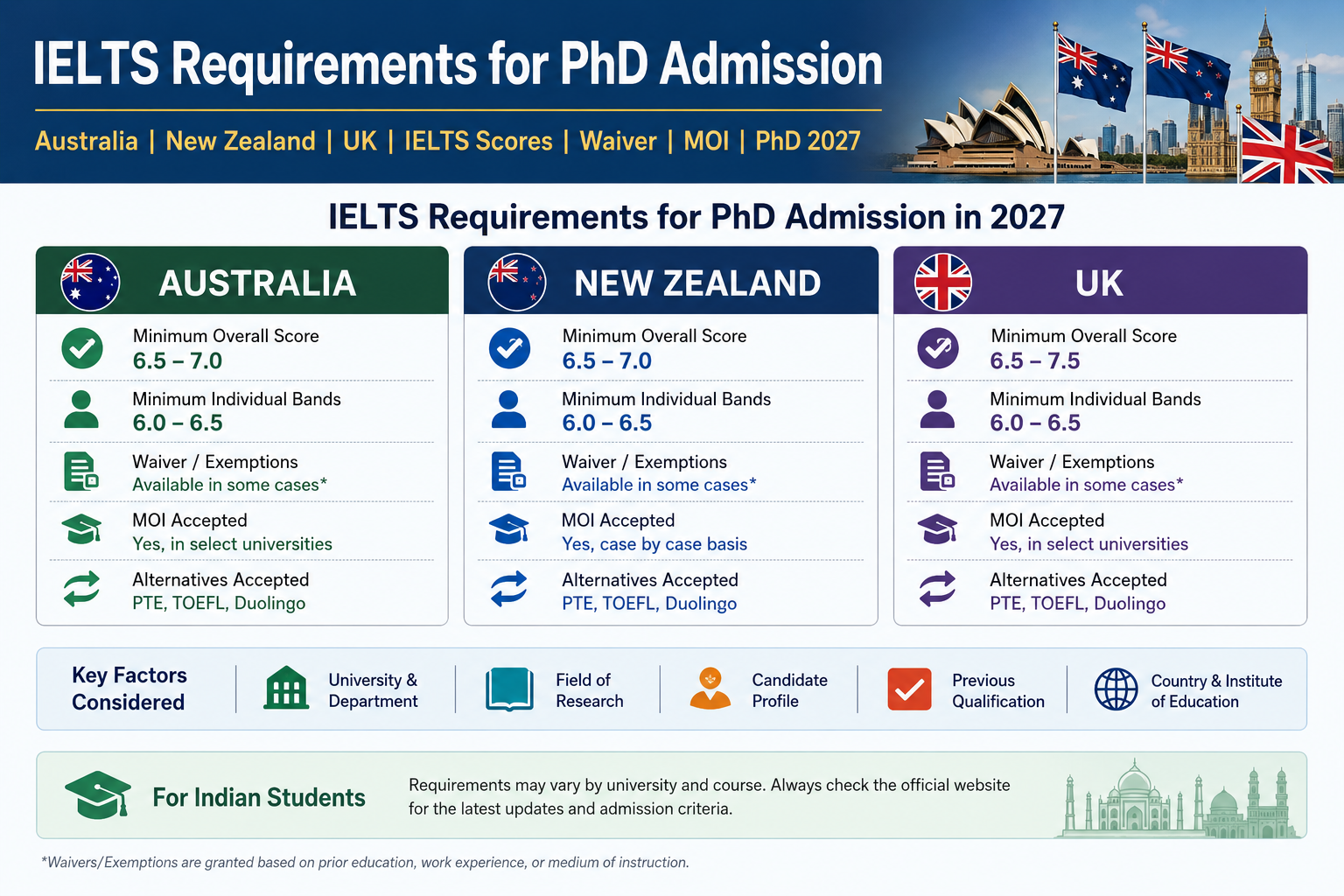
    There is no single IELTS score applicable to every doctoral programme. However, IELTS Academic 6.5 overall with no band below 6.0 is a common benchmark at a number of universities, particularly in Australia and New Zealand. Requirements in the UK can be higher, with some competitive programmes requiring IELTS 7.0 or 7.5 overall.

    For example, the University of Auckland currently states IELTS Academic 6.5 overall with no band below 6.0 for its PhD programme. Oxford’s graduate English requirements are 7.0 overall with at least 6.5 in each component at Standard level and 7.5 overall with at least 7.0 in each component at Higher level.

    Cambridge demonstrates why students should check programme-specific requirements rather than relying on country averages. Its PhD in Computer Science currently requires IELTS Academic 7.5 overall and 7.0 in every component.

    This EducationMESD guide explains the IELTS requirements for PhD admission in Australia, New Zealand and the UK for 2027, including minimum scores, individual band requirements, IELTS waivers, MOI, alternatives such as TOEFL and PTE, and practical guidance for Indian PhD applicants.

    PhD abroad for Indian students


    IELTS Requirements for PhD Admission: Quick Answer

    If you are searching for the minimum IELTS score for PhD admission, use the following figures only as general planning benchmarks:

    CountryCommon IELTS Range for PhDTypical Individual Band ExpectationIs IELTS 6.5 Often Enough?
    Australia6.5–7.0+Around 6.0–6.5+Often
    New Zealand6.5–7.0+Around 6.0+Often
    UK6.5–7.5+Around 6.0–7.0+Programme-dependent

    Important: IELTS requirements vary by university, faculty, discipline and individual doctoral programme. Applicants should always verify the latest requirements on the official programme page.

    Key takeaway

    For students applying across several universities, a practical IELTS target can be:

    IELTS Academic 7.0 overall with no band below 6.5

    This is not a universal admission requirement, but it may provide broader application flexibility than aiming only for 6.5.


    What IELTS Score Is Required for PhD Admission?

    There is no universal IELTS requirement for PhD admission abroad.

    Universities establish their own English-language requirements, and individual faculties may impose scores higher than the university-wide minimum.

    Students may therefore encounter requirements such as:

    • IELTS 6.5 overall with no band below 6.0;
    • IELTS 7.0 overall with minimum 6.5 components;
    • IELTS 7.5 overall with minimum 7.0 components;
    • higher Writing requirements for selected disciplines.

    Your required IELTS score may depend on:

    • university;
    • country;
    • research discipline;
    • faculty;
    • doctoral programme;
    • previous education;
    • professional accreditation;
    • English-language exemption rules.

    This means two PhD programmes at different universities—or even within different faculties of the same university—may have different English-language requirements.


    Why Is IELTS Required for PhD Admission Abroad?

    A doctoral degree requires extensive academic communication.

    PhD researchers may need to:

    • read hundreds of research papers;
    • conduct systematic or critical literature reviews;
    • write a research proposal;
    • communicate with supervisors;
    • prepare research reports;
    • submit journal manuscripts;
    • present research at international conferences;
    • participate in academic seminars;
    • write a doctoral thesis;
    • defend research through an oral examination or viva.

    Universities therefore need evidence that international applicants have sufficient academic English proficiency to undertake advanced research.

    For PhD admission, applicants normally need IELTS Academic, rather than IELTS General Training.

    official IELTS Academic test


    IELTS Requirements for PhD in Australia 2027

    Australia continues to attract international doctoral students because of its research-intensive universities, funding opportunities, global academic reputation and strong doctoral research ecosystem.

    For many students researching the IELTS requirements for PhD in Australia, a useful starting benchmark is:

    IELTS Academic 6.5 Overall with No Band Below 6.0

    However, this is not a national rule.

    Individual universities and faculties may require:

    • IELTS 7.0 overall;
    • 6.5 in individual components;
    • higher Writing scores;
    • additional professional language requirements.

    Therefore, students should verify the English-language requirement for the specific PhD programme, not simply the university’s general postgraduate requirement.

    PhD in Australia for Indian students


    Is IELTS 6.5 Enough for PhD in Australia?

    For many Australian doctoral programmes, IELTS 6.5 can be sufficient, particularly where the requirement is 6.5 overall with no individual score below 6.0.

    However, IELTS 6.5 does not make an applicant eligible for every programme.

    Consider this example.

    Applicant A

    ComponentScore
    Listening6.5
    Reading6.5
    Writing6.0
    Speaking6.5
    Overall6.5

    If the programme requires 6.5 overall with no band below 6.0, the applicant meets the language threshold.

    Applicant B

    ComponentScore
    Listening7.0
    Reading7.0
    Writing5.5
    Speaking6.5
    Overall6.5

    Despite achieving an overall 6.5, Applicant B may not satisfy a programme requiring no component below 6.0.

    The lesson is important:

    For PhD admission, your overall IELTS score and your individual band scores both matter.


    IELTS Requirements for PhD in New Zealand 2027

    New Zealand has become an increasingly attractive option for international doctoral students seeking research-intensive universities and internationally recognised PhD qualifications.

    A commonly encountered benchmark for PhD admission in New Zealand is:

    IELTS Academic 6.5 Overall with No Band Below 6.0

    The University of Auckland currently specifies exactly this requirement for its PhD programme: 6.5 overall with no band below 6.0. It also states that students must meet its English-language requirements as a condition of entry.

    Typical Planning Benchmark

    IELTS ComponentIndicative Score
    Overall6.5
    Listening6.0+
    Reading6.0+
    Writing6.0+
    Speaking6.0+

    These scores should be treated as a planning reference rather than a guarantee of eligibility.

    PhD in New Zealand for Indian students


    Is IELTS 6.5 Enough for PhD in New Zealand?

    For many doctoral programmes, IELTS 6.5 may be enough, provided the applicant also satisfies the minimum individual component requirements.

    The University of Auckland is a clear example, requiring IELTS Academic 6.5 overall and no component below 6.0 for its PhD.

    However, applicants should still check:

    University requirement → Faculty requirement → Programme requirement

    If the programme-specific requirement is higher, the higher threshold applies.


    IELTS Requirements for PhD in the UK 2027

    The IELTS requirements for PhD in the UK can be more variable than many students expect.

    Applicants may encounter requirements ranging approximately from:

    IELTS Academic 6.5 to 7.5+

    Highly competitive institutions and programmes requiring substantial academic writing or advanced communication may set higher standards.

    Oxford currently uses two graduate English-language levels:

    Oxford English LevelIELTS OverallMinimum Per Component
    Standard7.06.5
    Higher7.57.0

    Cambridge provides another strong example. Its current PhD in Computer Science requires:

    • IELTS Academic 7.5 overall
    • Listening: 7.0
    • Reading: 7.0
    • Writing: 7.0
    • Speaking: 7.0

    Its PhD in English similarly lists IELTS 7.5 overall with 7.0 in each component.

    This illustrates why students should avoid assuming that IELTS 6.5 will be sufficient for all UK PhD programmes.

    PhD in the UK for Indian students


    Is IELTS 6.5 Enough for PhD in the UK?

    Sometimes, but not always.

    Some UK doctoral programmes may accept IELTS 6.5, whereas others require:

    • 7.0 overall;
    • 7.5 overall;
    • minimum 6.5 components;
    • minimum 7.0 components.

    For applicants targeting multiple UK universities, the safest strategy is to determine the highest IELTS requirement among all shortlisted programmes.

    For example:

    Shortlisted ProgrammeIELTS Requirement
    Programme A6.5
    Programme B7.0
    Programme C7.0
    Programme D7.5

    In this situation, aiming for 7.5 gives the student the greatest flexibility.

    UK Student visa English-language requirements


    Australia vs New Zealand vs UK IELTS Requirements for PhD

    Here is a simplified comparison for students planning a PhD abroad in 2027.

    FactorAustraliaNew ZealandUK
    Common IELTS Range6.5–7.0+6.5–7.0+6.5–7.5+
    IELTS AcademicUsuallyUsuallyUsually
    IELTS 6.5 Often EnoughYesYesDepends
    Programme-Specific RequirementsYesYesYes
    Individual Bands ImportantYesYesYes
    Higher Writing Requirement PossibleYesYesYes
    IELTS Waiver May Be AvailableUniversity-dependentUniversity-dependentUniversity-dependent
    Alternative Tests May Be AcceptedYesYesYes

    Which country has the easiest IELTS requirement for PhD?

    There is no reliable country-wide answer.

    English-language requirements are primarily established by universities and individual programmes rather than by a single national PhD admissions standard.

    Applicants should therefore select universities based on research fit, supervisor availability, funding and programme requirements, not IELTS score alone.


    IELTS Overall Score vs Individual Band Score

    One of the most common mistakes in a PhD application is checking only the overall IELTS score.

    Suppose your IELTS result is:

    ComponentScore
    Listening7.5
    Reading7.0
    Writing5.5
    Speaking7.0
    Overall7.0

    If your university requires:

    IELTS 6.5 overall with no component below 6.0

    you may still fail to meet the requirement because your Writing score is only 5.5.

    Therefore:

    A higher overall IELTS score cannot necessarily compensate for an individual component below the programme minimum.


    Why Is IELTS Writing Important for PhD Students?

    Writing is particularly important at doctoral level.

    A PhD student may need to prepare:

    • research proposals;
    • literature reviews;
    • methodology chapters;
    • research reports;
    • journal manuscripts;
    • conference papers;
    • thesis chapters;
    • responses to peer reviewers.

    Universities may therefore impose stricter Writing requirements for programmes involving substantial academic writing.

    Students preparing for IELTS should not focus exclusively on their overall band.


    IELTS Academic or IELTS General for PhD Admission?

    For university-level doctoral admission, students should normally take:

    IELTS Academic

    IELTS Academic is intended for higher-education and academic contexts.

    IELTS General Training is mainly associated with migration, workplace communication and certain non-degree study purposes.

    Therefore:

    PhD Admission → IELTS Academic

    Before booking the examination, confirm which IELTS format your target university accepts.

    IELTS test types


    Can You Apply for a PhD Without IELTS?

    Yes, it may be possible to pursue a PhD without submitting IELTS, depending on university policy.

    However, “PhD without IELTS” does not generally mean that the English-language requirement disappears.

    Instead, a university may allow another form of evidence such as:

    • previous qualifying education conducted in English;
    • TOEFL;
    • PTE Academic;
    • Cambridge English qualifications;
    • another recognised test;
    • an approved exemption or waiver;
    • institution-specific evidence of English proficiency.

    Eligibility varies considerably.


    PhD Without IELTS for Indian Students

    Indian students frequently search for PhD abroad without IELTS because many have completed undergraduate or postgraduate degrees entirely in English.

    Some universities may recognise prior English-medium education under specific circumstances.

    However:

    Studying in English does not automatically guarantee an IELTS waiver.

    Universities can consider:

    • country of previous education;
    • institution attended;
    • degree level;
    • duration of study;
    • when the qualification was completed;
    • whether teaching and assessment were both conducted in English;
    • faculty-specific rules.

    Applicants should therefore obtain confirmation from their target university before assuming that IELTS will be waived.


    Is MOI Accepted for PhD Admission Abroad?

    MOI, or Medium of Instruction, is a document issued by a previous educational institution confirming that a programme was taught in a particular language.

    Indian students often use an MOI certificate to demonstrate that their Bachelor’s or Master’s degree was taught in English.

    Some universities may recognise previous English-medium education.

    Others may still require an approved English test.

    Therefore:

    MOI acceptance is university-specific and should never be assumed.

    Before relying on MOI, check whether the university accepts:

    • Indian English-medium qualifications;
    • your specific type of degree;
    • your institution;
    • the date your degree was completed;
    • MOI as formal evidence.

    What Is an IELTS Waiver for PhD Admission?

    An IELTS waiver means an applicant is permitted to satisfy the English-language requirement through another recognised route.

    This could be based on:

    • previous education;
    • an approved qualification;
    • country of study;
    • institutional policy;
    • another English-language test.

    A waiver is different from having no English-language requirement.

    Universities may still require evidence that applicants possess sufficient academic English proficiency.


    Alternatives to IELTS for PhD Admission

    Depending on the university, applicants may be able to submit other approved English tests.

    Common possibilities include:

    TOEFL iBT

    TOEFL is accepted by many universities worldwide.

    PTE Academic

    PTE Academic is recognised by many institutions, particularly in Australia, New Zealand and the UK.

    Cambridge C1 Advanced

    Some universities accept Cambridge C1 Advanced.

    Cambridge C2 Proficiency

    Cambridge C2 Proficiency may also satisfy university English-language requirements.

    Oxford, for example, currently lists IELTS Academic, Cambridge C1 Advanced and Cambridge C2 Proficiency among its accepted English qualifications, subject to specified score requirements.

    Acceptance and scores vary by university.


    Can You Contact a PhD Supervisor Before IELTS?

    In many cases, yes.

    You generally do not need to delay your supervisor search simply because you have not yet completed IELTS.

    A practical process is:

    Research Area → University → Potential Supervisor → Research Fit → Initial Contact → Research Proposal → IELTS → Formal Application

    When contacting a potential PhD supervisor, focus primarily on:

    • research alignment;
    • academic qualifications;
    • research experience;
    • publications;
    • proposed research idea;
    • methodology;
    • why you want to work with that supervisor.

    Your English-language qualification can then be handled according to the formal admissions requirements.

    how to find a PhD supervisor abroad

    official IELTS preparation resources


    Is IELTS Required Before Submitting a PhD Application?

    Not necessarily in every case.

    Some universities may allow students to apply before satisfying the English-language requirement and subsequently make an offer conditional on meeting it.

    For example, Cambridge’s Centre of Development Studies states that applicants requiring English-language evidence can initially receive a conditional offer before supplying the required result, although the requirement must ultimately be satisfied.

    Policies vary, so always check your specific programme.


    What Is a Good IELTS Score for PhD Admission?

    There is an important difference between:

    Minimum IELTS score

    and

    Strategic IELTS target

    If your shortlisted programmes require between 6.5 and 7.0, targeting:

    IELTS 7.0 Overall with No Band Below 6.5

    may provide a useful buffer.

    For programmes with higher requirements, applicants may need:

    IELTS 7.5 Overall with 7.0 in Each Component

    Oxford’s Higher level currently uses exactly this benchmark, while several Cambridge doctoral programmes also list 7.5 overall with 7.0 per component.


    Is IELTS 7.0 Good for PhD Admission?

    Yes. IELTS 7.0 is a strong score for many doctoral programmes, although it does not satisfy every programme.

    For example, it meets Oxford’s current Standard level requirement if each component is at least 6.5. However, it would not meet Oxford’s Higher level requirement or Cambridge’s current PhD in Computer Science requirement.

    This reinforces an important principle:

    The right IELTS score is the score required by your target programme—not an arbitrary global benchmark.


    IELTS Score Strategy for Indian PhD Applicants

    Students can follow this process before booking IELTS.

    Step 1: Select Your Research Area

    Define your broad and narrow research interests.

    Step 2: Choose Target Countries

    Consider Australia, New Zealand, the UK or a combination.

    Step 3: Shortlist Universities

    Create a shortlist of approximately 5–10 suitable institutions.

    Step 4: Identify Potential Supervisors

    Assess research alignment by reviewing:

    • faculty profiles;
    • recent publications;
    • ongoing research;
    • funded projects;
    • research groups.

    Step 5: Check IELTS Requirements

    Record:

    • overall IELTS requirement;
    • Writing minimum;
    • Reading minimum;
    • Listening minimum;
    • Speaking minimum.

    Step 6: Check IELTS Waiver Rules

    Determine whether your previous education may qualify.

    Step 7: Check Alternative Tests

    Look for:

    • TOEFL;
    • PTE;
    • Cambridge English;
    • other approved evidence.

    Step 8: Choose the Highest Requirement

    If your shortlist ranges from IELTS 6.5 to 7.5, prepare for the highest score.


    Recommended IELTS Target for Multiple PhD Applications

    Suppose you have the following shortlist:

    UniversityIELTS OverallMinimum Component
    University A6.56.0
    University B6.56.0
    University C7.06.5
    University D7.06.5
    University E7.57.0

    If you genuinely intend to apply to all five, your strategic target should be:

    IELTS 7.5 Overall with No Component Below 7.0

    Preparing according to the highest requirement reduces the risk of needing another IELTS attempt later.


    Does IELTS Score Affect PhD Scholarships?

    Usually, IELTS functions mainly as an eligibility requirement, rather than the primary criterion for scholarship selection.

    After satisfying the required English threshold, scholarship competitiveness is more likely to depend on:

    • academic performance;
    • research experience;
    • publications;
    • research proposal;
    • research novelty;
    • supervisor alignment;
    • recommendation letters;
    • academic CV;
    • methodology skills;
    • scholarship-specific criteria.

    Therefore:

    IELTS 8.0 does not automatically make an applicant more competitive for a PhD scholarship than an applicant with IELTS 7.0 who has a stronger research profile.


    IELTS Requirements for Fully Funded PhD Abroad

    Students looking for a fully funded PhD in Australia, New Zealand or the UK should evaluate English-language eligibility alongside funding eligibility.

    A competitive application usually requires alignment between:

    Research Interest → Research Gap → Supervisor → University → Funding → English Requirement → PhD Application

    Potential funding routes may include:

    Australia

    • Research Training Program-related funding;
    • university doctoral scholarships;
    • faculty-funded projects;
    • externally funded research projects.

    New Zealand

    • university doctoral scholarships;
    • research project funding;
    • faculty or school scholarships.

    UK

    • research council-funded opportunities;
    • UKRI-associated doctoral funding;
    • doctoral training programmes;
    • departmental studentships;
    • university scholarships;
    • funded research projects.

    Meeting IELTS requirements alone does not guarantee funding.


    When Should You Take IELTS for PhD Admission 2027?

    Students planning a 2027 PhD intake should ideally start checking IELTS requirements early in the application cycle.

    9–12 Months Before Applying

    Focus on:

    • research area;
    • country selection;
    • university shortlist;
    • potential supervisors;
    • scholarship research.

    6–9 Months Before Applying

    Work on:

    • supervisor communication;
    • research proposal;
    • academic CV;
    • IELTS preparation.

    4–6 Months Before Applying

    Complete:

    • IELTS test;
    • research proposal;
    • academic documents;
    • recommendation planning;
    • scholarship documentation.

    2–4 Months Before Deadlines

    Focus on:

    • IELTS retake if required;
    • final applications;
    • scholarship submissions;
    • remaining supporting documents.

    Starting early gives applicants sufficient time to address a low individual band.


    Common IELTS Mistakes PhD Applicants Should Avoid

    1. Assuming IELTS 6.5 Works Everywhere

    Requirements differ considerably.

    2. Looking Only at the Overall Score

    Individual component scores are equally important.

    3. Ignoring Faculty Requirements

    A faculty may require more than the university-wide minimum.

    4. Taking IELTS General Training

    IELTS Academic is normally the relevant test for doctoral admission.

    5. Assuming MOI Guarantees an IELTS Waiver

    It does not.

    6. Preparing Only for the Minimum Score

    Targeting a slightly higher score provides flexibility.

    7. Ignoring Writing

    Writing requirements can be particularly important at PhD level.

    8. Booking IELTS Before Shortlisting Universities

    Check your target programmes first.

    9. Confusing Admission and Visa Requirements

    University admissions requirements and immigration requirements are not necessarily identical.

    10. Depending on Old Information

    IELTS policies can change. Always verify current requirements before applying.


    Frequently Asked Questions About IELTS Requirements for PhD Admission

    What is the minimum IELTS score for PhD admission?

    There is no universal minimum. Students commonly encounter requirements from approximately IELTS 6.5 to 7.5 overall, depending on the university and PhD programme.

    Is IELTS 6.5 enough for PhD admission?

    It can be sufficient for many programmes, particularly in Australia and New Zealand, but not for all universities.

    What IELTS score is required for PhD in Australia?

    A common benchmark is IELTS Academic 6.5 overall with no band below 6.0, although individual programmes can require higher scores.

    What IELTS score is required for PhD in New Zealand?

    Many students encounter requirements around IELTS 6.5 overall with minimum 6.0 components. The University of Auckland currently uses this requirement for its PhD programme.

    What IELTS score is required for PhD in the UK?

    Requirements vary. Some programmes may accept around 6.5, while highly selective programmes can require 7.0–7.5 or higher.

    Is IELTS 7.0 enough for a UK PhD?

    For some programmes, yes. Oxford’s current Standard English level is 7.0 overall with 6.5 per component, but its Higher level is 7.5 overall with 7.0 per component.

    Can I pursue a PhD abroad without IELTS?

    Possibly, if your university accepts another recognised English qualification, previous qualifying education or an approved exemption.

    Can Indian students get an IELTS waiver?

    Potentially. Eligibility depends entirely on the university’s English-language policy.

    Is MOI accepted instead of IELTS?

    Some institutions may accept qualifying English-medium education, but MOI is not universally accepted.

    Which IELTS is required for PhD admission?

    Normally IELTS Academic.

    Can I take PTE instead of IELTS for a PhD?

    Many universities accept PTE Academic, but acceptance and minimum scores vary.

    Can TOEFL replace IELTS for PhD admission?

    Many universities accept TOEFL, subject to their current English-language rules.

    Can I contact a PhD supervisor without IELTS?

    Generally, yes. Supervisor outreach can often begin before completing the English-language test.

    Is IELTS required before applying for a PhD?

    Not always. Some institutions may issue conditional offers subject to later completion of the English-language requirement.

    Does IELTS affect PhD scholarship chances?

    IELTS mainly demonstrates language eligibility. Research quality, academic performance, proposal strength and supervisor fit generally matter much more after the English threshold is met.


    IELTS Requirements for PhD Admission: Final Comparison

    QuestionAustraliaNew ZealandUK
    Common IELTS starting benchmark6.56.56.5–7.5
    6.5 may be acceptedFrequentlyFrequentlyDepends
    7.0 may be requiredYesYesFrequently in some institutions
    7.5 possibleYesYesYes
    IELTS AcademicUsuallyUsuallyUsually
    Individual bands matterYesYesYes
    Waiver possibleInstitution-specificInstitution-specificInstitution-specific
    MOI may be consideredSometimesSometimesSometimes

    Final Verdict: What IELTS Score Should You Target for a PhD in 2027?

    For students planning a PhD in Australia, New Zealand or the UK in 2027, there is no single IELTS score that guarantees admission.

    As a broad planning guide:

    Australia: commonly around IELTS 6.5–7.0+

    New Zealand: commonly around IELTS 6.5–7.0+

    United Kingdom: approximately IELTS 6.5–7.5+, depending strongly on the programme.

    A score of IELTS 6.5 overall with no band below 6.0 can satisfy the English requirement for a number of doctoral programmes, particularly in Australia and New Zealand.

    However, students applying to several competitive universities should consider aiming for:

    IELTS 7.0 Overall with No Band Below 6.5

    Applicants targeting universities or programmes with higher English-language requirements may need:

    IELTS 7.5 Overall with No Band Below 7.0

    Instead of asking only “What is the minimum IELTS score for PhD admission?”, ask:

    “What is the highest IELTS requirement among the PhD programmes that match my research interests?”

    That question produces a far more effective application strategy.

    Your complete PhD roadmap should be:

    Research Interest → Research Gap → University → Supervisor → Research Proposal → Funding → IELTS Requirement → Application → Interview → Admission


    Planning a PhD Abroad in 2027?

    EducationMESD provides guidance for Indian students and research aspirants planning doctoral study internationally.

    Explore our detailed resources on:

    • PhD Abroad for Indian Students in 2027
    • PhD in Australia for Indian Students
    • Fully Funded PhD in Australia
    • PhD in New Zealand for Indian Students
    • PhD in the UK for Indian Students
    • PhD in Australia vs New Zealand vs UK
    • PhD Abroad Without GRE
    • How to Find and Contact a PhD Supervisor Abroad
    • How to Write a Research Proposal for PhD Admission Abroad

    A successful PhD application is not built around IELTS alone.

    how to write a PhD research proposal

    It is built around:

    Strong Research Fit + Right Supervisor + Strong Research Proposal + Academic Profile + Funding Strategy + Correct Application Timing
  • PhD Abroad for Indian Students in 2027: Ultimate Application Guide, Eligibility, Scholarships & Funding

    PhD Abroad for Indian Students in 2027: Ultimate Application Guide, Eligibility, Scholarships & Funding

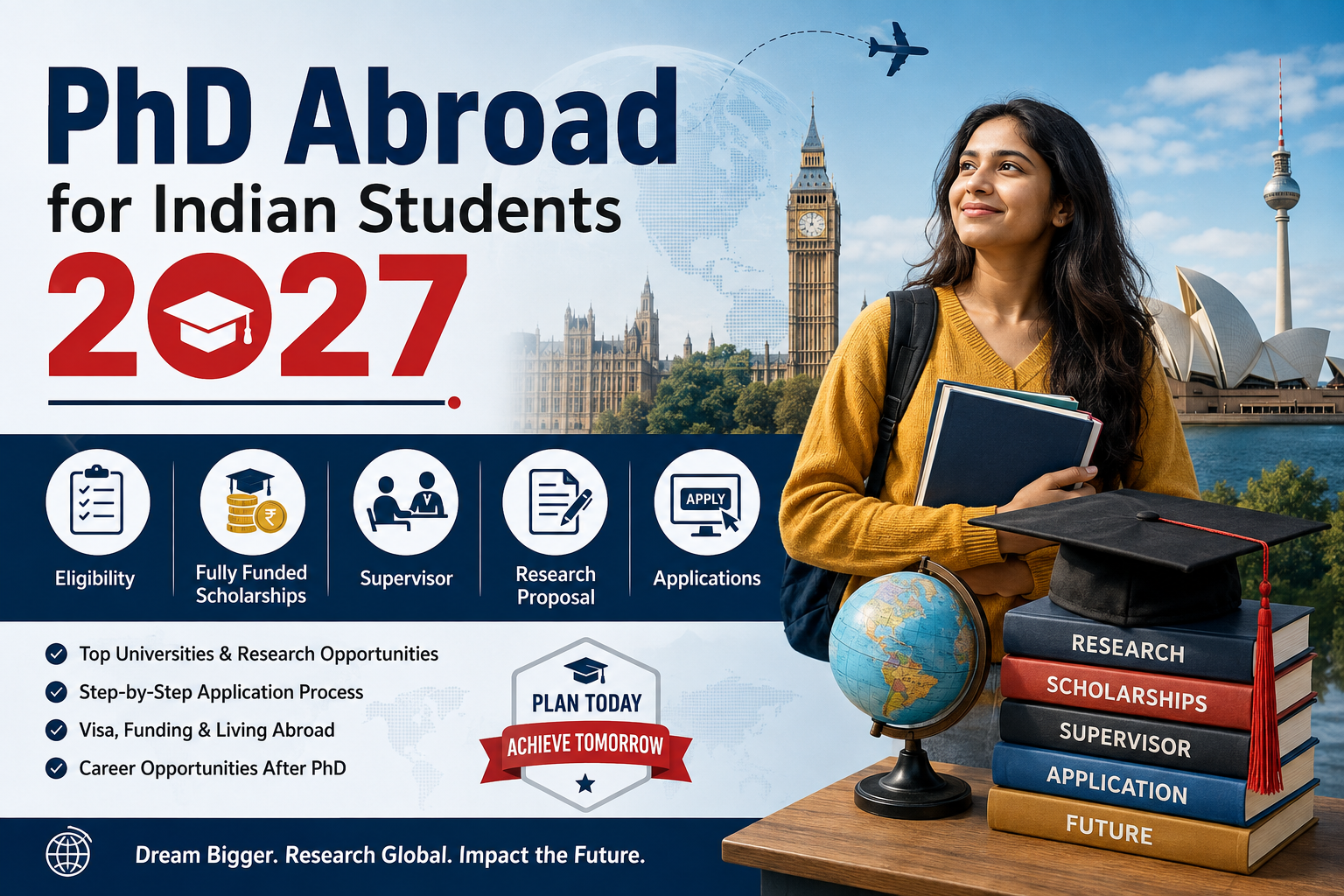
    Are you planning a PhD abroad for Indian students in 2027 but unsure where to begin? From finding the right research supervisor and writing a PhD research proposal to securing a fully funded PhD abroad, the doctoral application process can feel considerably more complex than applying for a master’s degree.

    For Indian students, studying for a PhD overseas can provide access to world-class research universities, advanced laboratories, international faculty, funded research projects, scholarships, global academic networks and career opportunities in academia and industry.

    However, a successful PhD application is not based only on university rankings or academic marks. Universities may evaluate your research experience, research proposal, academic CV, supervisor fit, Statement of Purpose (SOP), recommendation letters, publications, methodology skills and funding eligibility.

    If you are targeting a PhD abroad in 2027, preparation should ideally begin 12–18 months before your intended start date.

    This complete EducationMESD guide explains:

    • PhD abroad eligibility for Indian students
    • How to apply for PhD abroad from India
    • Best countries for PhD in 2027
    • Fully funded PhD opportunities
    • PhD scholarships for Indian students
    • PhD application timeline for 2027
    • How to find a PhD supervisor
    • How to write a research proposal
    • PhD SOP requirements
    • Documents required for PhD abroad
    • IELTS, TOEFL, GRE and GMAT requirements
    • PhD interview preparation
    • Common application mistakes
    • Frequently asked questions

    PhD Abroad for Indian Students in 2027: Quick Answer

    Indian students can apply for PhD programmes abroad in 2027 through universities, graduate schools, advertised research projects and funded doctoral positions. Depending on the programme, applicants may need a master’s degree or equivalent, research experience, a research proposal, academic transcripts, SOP, recommendation letters and proof of English-language proficiency.

    Students seeking a fully funded PhD abroad for Indian students in 2027 should search for university scholarships, research assistantships, teaching assistantships, government-supported research funding and project-funded PhD positions.


    PhD Abroad 2027: Quick Overview for Indian Students

    FactorTypical Requirement or Option
    DegreePhD / Doctorate
    Target Intake2027
    Typical QualificationMaster’s degree or equivalent; selected programmes accept strong 4-year bachelor’s graduates
    Research ExperienceStrongly recommended
    Research ProposalRequired for many research-led programmes
    SOPCommonly required
    Recommendation LettersUsually 2–3
    IELTS/TOEFL/PTEDepends on university
    GRE/GMATProgramme-specific
    Publication Required?Not universally
    Supervisor Required?Important or mandatory in many programmes
    FundingScholarships, studentships, RA/TA positions, research grants
    Popular CountriesUSA, UK, Australia, New Zealand, Germany, Canada
    Ideal Preparation Period12–18 months

    What Is a PhD Abroad?

    A PhD, or Doctor of Philosophy, is an advanced research degree in which a student investigates a specialised problem and produces an original contribution to knowledge.

    A PhD abroad can involve:

    • literature review;
    • theoretical development;
    • laboratory research;
    • field research;
    • experiments;
    • simulations;
    • data collection;
    • statistical analysis;
    • machine learning or computational modelling;
    • journal publications;
    • conference presentations;
    • thesis or dissertation writing.

    The exact structure varies considerably between countries.

    For example, many US programmes combine coursework and research, while doctoral programmes in the UK, Australia and New Zealand are often more directly research-focused.


    Why Pursue a PhD Abroad in 2027?

    Choosing to study a PhD abroad in 2027 can provide several academic and professional advantages.

    1. Access to Advanced Research Facilities

    International universities may provide access to:

    • advanced research laboratories;
    • high-performance computing;
    • specialised research equipment;
    • international databases;
    • research centres;
    • funded laboratories;
    • industrial research collaborations.

    These resources can be particularly valuable in fields such as artificial intelligence, biotechnology, engineering, healthcare and advanced sciences.


    2. Fully Funded PhD Opportunities

    One major reason Indian students consider doctoral study overseas is the availability of fully funded PhD opportunities abroad.

    Depending on the funding package, support may include:

    • full tuition fee coverage;
    • partial or full fee waiver;
    • annual stipend;
    • monthly living allowance;
    • research expenses;
    • conference funding;
    • health insurance;
    • relocation support.

    Funding arrangements differ substantially between programmes, so students should verify exactly what an offer covers.


    3. International Research Exposure

    A PhD abroad can allow researchers to collaborate with:

    • international faculty;
    • research laboratories;
    • multinational companies;
    • government research organisations;
    • universities in multiple countries.

    Such exposure can strengthen publications, research networks and future academic opportunities.


    4. Academic Career Opportunities

    A PhD can support careers such as:

    • Assistant Professor
    • Postdoctoral Researcher
    • Research Fellow
    • Research Scientist
    • Academic Researcher
    • Policy Researcher

    5. Industry Research Careers

    PhD graduates are also recruited outside universities.

    Possible career paths include:

    • AI Research Scientist
    • Data Scientist
    • Machine Learning Researcher
    • R&D Engineer
    • Biomedical Scientist
    • Quantitative Researcher
    • Research Consultant
    • Innovation Specialist
    • Economist
    • Consumer Researcher
    • Policy Analyst

    Best Countries for PhD Abroad for Indian Students in 2027

    The best country for PhD abroad depends on your research topic, supervisor, funding opportunities, laboratory requirements, career plans and preferred doctoral structure.

    Popular destinations for Indian students include:

    1. USA
    2. UK
    3. Australia
    4. New Zealand
    5. Germany
    6. Canada

    PhD in USA for Indian Students in 2027

    The USA is one of the leading destinations for PhD abroad for Indian students because of its extensive research university ecosystem and variety of funding models.

    US doctoral programmes commonly combine:

    • graduate-level coursework;
    • research training;
    • qualifying examinations;
    • teaching;
    • research;
    • dissertation preparation.

    EducationUSA identifies fellowships, teaching assistantships and research assistantships among the main forms of graduate financial assistance offered by US universities.

    Advantages of PhD in USA

    • Large number of research-intensive universities
    • Strong STEM research ecosystem
    • Research assistantships
    • Teaching assistantships
    • Interdisciplinary doctoral programmes
    • Strong university-industry collaboration
    • Extensive research infrastructure

    Popular PhD Fields in USA

    • Artificial Intelligence
    • Computer Science
    • Data Science
    • Engineering
    • Biotechnology
    • Biomedical Sciences
    • Economics
    • Business
    • Psychology
    • Public Policy

    PhD in UK for Indian Students in 2027

    A PhD in the UK for Indian students is usually highly research-focused.

    Applicants may enter through:

    • advertised studentships;
    • funded research projects;
    • doctoral training centres;
    • supervisor-led research;
    • university scholarships.

    For the 2026–27 academic year, UKRI lists a minimum stipend of £21,805 for UKRI-funded studentships and a published fee level of £5,238. International students should check the individual award carefully because UKRI contributes up to the home-fee level and a provider may require an international student to cover an additional fee difference.

    Advantages of PhD in UK

    • Research-intensive doctoral structure
    • Strong academic research ecosystem
    • Funded studentships
    • Doctoral training programmes
    • International research collaborations

    Best Suited For

    Students who already have:

    • a reasonably focused research topic;
    • relevant master’s research;
    • a strong research proposal;
    • clear supervisor alignment.

    PhD in Australia for Indian Students in 2027

    Australia is another major destination for fully funded PhD opportunities for international students.

    One important funding route is the Australian Government Research Training Program (RTP).

    The Australian Government confirms that RTP funding can support both domestic and international students completing research doctorates or research master’s degrees. Support may include tuition fee offsets, living-cost stipends and research-related allowances.

    For 2027, the Australian Government currently publishes a full-time RTP base stipend rate of AUD 35,550, with a maximum stipend rate of AUD 55,537. Actual awards and selection criteria are administered by individual universities.

    Advantages of PhD in Australia

    • Government-backed research funding framework
    • Strong research universities
    • Industry collaborations
    • International research ecosystem
    • Research-intensive STEM programmes

    Popular PhD Fields in Australia

    • Artificial Intelligence
    • Engineering
    • Healthcare
    • Environmental Science
    • Biotechnology
    • Agriculture
    • Sustainability
    • Business and Management

    PhD in New Zealand for Indian Students in 2027

    New Zealand can be particularly attractive to international doctoral students because of its PhD tuition framework.

    Official Study with New Zealand guidance states that international PhD candidates pay the same tuition fees as domestic New Zealand PhD students, subject to eligibility and university requirements. Current official guidance indicates approximately NZ$6,500–NZ$7,500 per year for many subjects, although fees vary by provider and programme.

    Advantages of PhD in New Zealand

    • Domestic-level PhD tuition treatment for eligible international doctoral students
    • Research-focused programmes
    • Close supervisor interaction
    • University scholarship opportunities
    • International research environment

    Popular Research Areas

    • Agriculture
    • Environmental Science
    • Sustainability
    • Engineering
    • Artificial Intelligence
    • Healthcare
    • Business
    • Social Sciences

    PhD in Germany for Indian Students in 2027

    Germany is highly attractive for students interested in:

    • engineering;
    • artificial intelligence;
    • robotics;
    • automotive research;
    • manufacturing;
    • physics;
    • natural sciences;
    • sustainability.

    Doctoral study may follow two broad models:

    Individual Doctorate

    You conduct research primarily under the supervision of a professor.

    Structured Doctoral Programme

    You join a graduate school or organised research programme.

    DAAD currently states that doctoral study at German public universities is tuition-free for at least the first six semesters, although students generally pay semester contributions and must budget separately for living expenses.

    DAAD also operates PhDGermany, where international applicants can search advertised doctoral positions from German universities and research organisations.

    Advantages of PhD in Germany

    • Low doctoral tuition at public universities
    • Excellent engineering ecosystem
    • Research institutes
    • Industry collaboration
    • Salaried doctoral opportunities
    • Strong science and technology research

    PhD in Canada for Indian Students in 2027

    Canada offers research opportunities across:

    • engineering;
    • computer science;
    • artificial intelligence;
    • healthcare;
    • natural sciences;
    • management;
    • economics;
    • social sciences.

    Canada’s official scholarship portal provides international students with information on scholarship opportunities, while individual universities may provide additional assistantships, grants and doctoral funding.

    A significant current immigration provision is that, from January 1, 2026, students entering qualifying master’s and doctoral degree programmes at public institutions generally do not need a provincial or territorial attestation letter when applying for a Canadian study permit. Eligible doctoral applicants applying from outside Canada may also qualify for faster processing.

    Advantages of PhD in Canada

    • Strong research universities
    • Interdisciplinary programmes
    • Technology and healthcare research
    • University-industry collaboration
    • International scholarship opportunities

    USA vs UK vs Australia vs New Zealand vs Germany vs Canada for PhD

    CountryTypical PhD StyleMajor Funding RouteKey Attraction
    USACoursework + ResearchRA, TA, FellowshipLarge research ecosystem
    UKResearch-intensiveStudentships, UKRI-linked fundingFocused doctoral research
    AustraliaResearch-intensiveRTP, University ScholarshipsStrong HDR funding
    New ZealandResearch-intensiveUniversity ScholarshipsDomestic-level PhD tuition treatment
    GermanyIndividual/StructuredSalaried positions, DAAD, grantsLow public-university doctoral tuition
    CanadaCoursework + Research variesAssistantships, Scholarships, GrantsStrong interdisciplinary research

    PhD Abroad Eligibility for Indian Students in 2027

    The PhD abroad eligibility for Indian students varies by university and country.

    There is no universal admission standard.

    However, universities generally evaluate the following areas.


    1. Bachelor’s and Master’s Qualifications

    Many universities expect applicants to hold a relevant:

    • Master’s degree
    • M.Tech
    • M.Sc.
    • MA
    • MBA
    • M.Phil.
    • equivalent postgraduate qualification

    Some doctoral programmes, particularly in the USA and selected other institutions, accept strong candidates directly after an appropriate four-year bachelor’s degree.

    Always check the exact programme requirements.


    2. Academic Performance

    Universities may consider:

    • bachelor’s CGPA;
    • master’s CGPA;
    • subject-specific grades;
    • dissertation performance;
    • research-methodology courses;
    • overall academic progression.

    There is no single minimum CGPA applicable to every overseas PhD.


    3. Research Experience

    Research experience can strongly influence a PhD application.

    Relevant evidence may include:

    • master’s dissertation;
    • bachelor’s thesis;
    • journal paper;
    • conference publication;
    • research internship;
    • laboratory research;
    • research assistantship;
    • funded project;
    • systematic literature review;
    • patent;
    • industrial R&D.

    Can I Apply for PhD Abroad Without Publications?

    Yes. You can apply for a PhD abroad without publications.

    Publications are not universally mandatory.

    A strong candidate may instead demonstrate research potential through:

    • dissertation work;
    • independent research;
    • strong methodology knowledge;
    • conference papers;
    • research internships;
    • research proposals;
    • technical projects.

    However, quality publications can strengthen applications for highly competitive funded PhD positions.


    Is IELTS Required for PhD Abroad?

    IELTS is not compulsory for every overseas PhD programme.

    Universities may accept:

    • IELTS Academic;
    • TOEFL iBT;
    • PTE Academic;
    • another approved English examination.

    Some institutions may provide waivers based on previous education or other conditions.

    A Medium of Instruction certificate does not automatically guarantee an IELTS waiver.

    Always check the target university’s English-language policy.


    Is GRE Required for PhD Abroad in 2027?

    GRE requirements vary considerably.

    A programme may:

    • require GRE;
    • make GRE optional;
    • recommend GRE;
    • not accept GRE.

    Some business or management programmes may accept the GRE or GMAT.

    Therefore, avoid spending money on a test until you have reviewed the requirements of your shortlisted programmes.


    Documents Required for PhD Abroad in 2027

    The following PhD abroad application documents are commonly requested:

    • Academic CV
    • Bachelor’s transcripts
    • Master’s transcripts
    • Degree certificates
    • Statement of Purpose
    • Research proposal
    • Personal statement, where required
    • Research statement
    • Letters of Recommendation
    • English-language test score
    • GRE/GMAT score where applicable
    • Passport
    • Publications
    • Dissertation abstract
    • Writing sample
    • Research portfolio
    • Employment certificates
    • Scholarship documents

    EducationMESD Tip

    Create one digital folder containing:

    Academic Documents + CV + SOP + Research Proposal + Publications + English Test + Passport + Recommendation Information

    This makes multiple applications easier to manage.


    How to Apply for PhD Abroad from India in 2027

    Here is the complete PhD application process for Indian students.


    Step 1: Choose Your Research Area

    Do not start with:

    Which university is highest ranked?

    Start with:

    What research problem do I want to investigate?

    Weak Topic

    Artificial Intelligence

    Better Topic

    Explainable Artificial Intelligence

    Stronger Research Direction

    Explainable multimodal deep-learning models for early detection of diabetic retinopathy.

    A focused research direction helps you find relevant academics.


    Step 2: Conduct a Literature Review

    Study recent research related to your proposed area.

    Depending on your discipline, useful databases may include:

    • Google Scholar
    • Scopus
    • Web of Science
    • PubMed
    • IEEE Xplore
    • ScienceDirect
    • ACM Digital Library

    Look for:

    • unresolved problems;
    • theoretical gaps;
    • inconsistent results;
    • dataset limitations;
    • methodological limitations;
    • under-researched populations;
    • emerging technologies.

    Step 3: Identify a Research Gap

    A strong research proposal should explain:

    What do we already know?

    What is missing?

    Why does that gap matter?

    How will your research address it?

    What new contribution will result?

    That is the foundation of a credible PhD proposal.


    How to Find a PhD Supervisor Abroad

    Finding the right PhD supervisor abroad can be one of the most important parts of the application.

    Search:

    • university faculty profiles;
    • recent journal articles;
    • Google Scholar profiles;
    • research-lab websites;
    • funded project pages;
    • doctoral vacancy portals.

    Evaluate potential supervisors based on:

    • research alignment;
    • recent publications;
    • funded projects;
    • methodology;
    • laboratory infrastructure;
    • doctoral students;
    • publication activity.

    Step 4: Read the Supervisor’s Recent Publications

    Before emailing a professor, read at least 2–3 recent relevant papers where possible.

    Ask yourself:

    • What is the professor currently researching?
    • Which methods do they use?
    • What datasets or contexts do they study?
    • What gaps are they exploring?
    • How does my proposed topic connect?

    Sample Email to a PhD Supervisor for 2027

    Subject: Prospective PhD Applicant 2027 – Explainable AI for Medical Imaging

    Dear Professor [Surname],

    I am planning to apply for PhD study in 2027 with a research interest in explainable artificial intelligence and medical image analysis.

    I recently studied your work on [specific research topic/paper], particularly your approach to [specific method or finding]. My current research focuses on [brief research area], and I am interested in extending this towards [specific problem].

    My academic and research background includes experience in [relevant skills/methodology].

    I would be grateful to know whether you expect to accept PhD researchers for the 2027 intake and whether my proposed research direction could align with your current projects.

    I have attached my academic CV for reference.

    Kind regards,
    [Name]


    How to Write a PhD Research Proposal for Universities Abroad

    A PhD research proposal explains what you want to investigate, why it matters and how you plan to conduct the research.

    A typical structure includes:

    Proposed Research Title

    Make the title specific and researchable.

    Background

    Explain the context of the problem.

    Problem Statement

    Define exactly what needs investigation.

    Literature Review

    Summarise the most relevant academic literature.

    Research Gap

    Identify what existing research has not sufficiently addressed.

    Research Aim

    State your overall purpose.

    Research Objectives

    Usually include 3–5 clear objectives.

    Research Questions

    Define the questions your PhD will answer.

    Methodology

    Explain:

    • research design;
    • population or dataset;
    • data collection;
    • experimental design;
    • analytical techniques;
    • algorithms;
    • statistics;
    • validation.

    Expected Contribution

    Explain the expected contribution to:

    • theory;
    • methodology;
    • policy;
    • practice;
    • industry.

    Timeline

    Provide realistic research stages.

    References

    Use recent and authoritative academic literature.


    How to Write SOP for PhD Abroad

    Your Statement of Purpose for PhD admission should demonstrate how your academic experience has developed into a clear research direction.

    A strong structure is:

    Academic Background → Research Experience → Research Problem → Proposed PhD → University Fit → Supervisor Fit → Career Goals


    Weak SOP Opening

    Since childhood, studying abroad has always been my dream.

    Stronger SOP Opening

    During my master’s dissertation on customer churn prediction, I observed that highly accurate machine-learning models frequently provided limited interpretability for managerial decision-making. This experience motivated my research interest in explainable artificial intelligence.

    The second example immediately demonstrates research motivation.


    Letters of Recommendation for PhD Abroad

    PhD programmes commonly require 2–3 Letters of Recommendation.

    Choose recommenders who can discuss your:

    • research potential;
    • academic ability;
    • analytical skills;
    • research methodology;
    • writing;
    • independence;
    • dissertation;
    • technical skills.

    A detailed recommendation from your research supervisor can be more useful than a generic letter from a senior academic who barely knows your work.


    Fully Funded PhD Abroad for Indian Students in 2027

    A fully funded PhD abroad for Indian students can significantly reduce the financial burden of doctoral study.

    A funding package may provide:

    • tuition coverage;
    • living stipend;
    • research expenses;
    • health coverage;
    • conference support;
    • relocation allowance.

    However, the meaning of fully funded differs between institutions.

    Always compare the guaranteed financial package with the actual cost of study.


    Types of PhD Funding Abroad

    University Scholarship

    A university awards doctoral funding based on academic and research merit.

    Research Assistantship

    The PhD researcher works on a funded project.

    Teaching Assistantship

    The student contributes to teaching, tutorials, assessment or laboratory instruction.

    Government Scholarship

    Funding comes from a national or government-supported programme.

    Research Council Studentship

    A research council funds selected doctoral training programmes or projects.

    Professor-Funded PhD

    A supervisor recruits researchers through external research grants.

    Salaried PhD Position

    Common in parts of Europe, the doctoral candidate may be employed as a researcher.


    Major PhD Funding Routes Worth Exploring in 2027

    Australia – Research Training Program

    Australia’s RTP can support eligible international research students through combinations of tuition offsets, stipends and related allowances.

    UK – UKRI-Linked Studentships

    UKRI-supported doctoral opportunities can include stipend and fee support. International applicants must review individual programme rules carefully because fee arrangements can differ.

    Germany – DAAD and Funded Research Positions

    Students can explore DAAD funding as well as advertised salaried doctoral positions at universities and research organisations.

    New Zealand – University Doctoral Scholarships

    New Zealand universities offer institutional doctoral scholarships alongside the country’s international PhD fee framework.

    USA – Fellowships, RA and TA Funding

    EducationUSA identifies fellowships, teaching assistantships and research assistantships among common funding routes for graduate study.

    Canada – Scholarships and University Funding

    International applicants can search Canada’s official scholarship resources while also checking individual universities for doctoral assistantships and funding packages.


    Fully Funded PhD vs Partially Funded PhD vs Self-Funded PhD

    FactorFully FundedPartially FundedSelf-Funded
    TuitionUsually largely/fully coveredPartly coveredStudent pays
    StipendUsually availableMay be limitedUsually none
    Research ExpensesMay be includedMay be limitedStudent/project dependent
    Conference SupportPossibleLimitedUsually personal/project
    Financial RiskLowerMediumHigh

    EducationMESD Funding Formula

    Before accepting a PhD offer, calculate:

    Guaranteed Funding – Tuition Liability – Living Costs – Mandatory Charges = Real Financial Position

    Never compare PhD offers using stipend alone.


    PhD Abroad 2027 Application Timeline

    Indian students targeting the 2027 PhD intake should begin early.

    January–April 2026: Build Your Research Profile

    Focus on:

    • research interests;
    • dissertation;
    • research papers;
    • literature review;
    • methodology skills;
    • research internships.

    May–August 2026: Shortlist Programmes

    Complete:

    • country selection;
    • university research;
    • supervisor shortlist;
    • academic CV;
    • initial proposal;
    • IELTS/TOEFL planning;
    • supervisor outreach.

    September–December 2026: Main Application Phase

    Prioritise:

    • final research proposal;
    • SOP;
    • recommendation letters;
    • university applications;
    • scholarship applications;
    • funded PhD vacancies.

    Students targeting programmes with fixed deadlines should verify each deadline individually.


    January–April 2027: Continue Applications

    Apply to:

    • programmes with later deadlines;
    • rolling doctoral admissions;
    • newly advertised research projects;
    • European PhD vacancies;
    • Australian HDR programmes;
    • New Zealand doctoral opportunities.

    Prepare for interviews.


    May–August 2027: Offer and Pre-Departure Stage

    After receiving an offer:

    • compare funding packages;
    • verify scholarship conditions;
    • accept the preferred offer;
    • arrange financial documents;
    • apply for the appropriate visa;
    • organise accommodation;
    • prepare for relocation.

    How Many PhD Universities Should You Apply To?

    There is no universal number.

    Instead of sending generic applications to 20–30 universities, consider approximately 6–12 highly relevant opportunities.

    For example:

    Highly Competitive

    2–3 applications

    Strong Research Match

    3–5 applications

    Additional Suitable Programmes

    2–4 applications

    The purpose is not simply to maximise the number of applications.

    For PhD admission:

    Research Fit > Application Quantity


    How to Choose the Best PhD Supervisor

    Before accepting an offer, evaluate:

    Research Alignment

    Does the professor’s recent research align with your topic?

    Publication Activity

    Are they actively publishing?

    Funding

    Does the research group have active projects?

    Supervision

    Are PhD candidates currently working with the professor?

    Laboratory Infrastructure

    Does the lab provide the resources required for your research?

    Alumni Outcomes

    Where are former PhD researchers working?

    Communication

    Does the supervisor communicate clearly about expectations and research direction?


    Best PhD Fields Abroad for Indian Students in 2027

    Artificial Intelligence and Computer Science

    Emerging research areas include:

    • Generative AI
    • Explainable AI
    • Federated Learning
    • Multimodal AI
    • Computer Vision
    • Natural Language Processing
    • Responsible AI
    • Robotics
    • Cybersecurity
    • Edge AI

    Engineering

    Popular research areas include:

    • Electrical Engineering
    • Electronics
    • Mechanical Engineering
    • Civil Engineering
    • Renewable Energy
    • Semiconductor Technology
    • Materials Science
    • Robotics
    • Smart Manufacturing

    Healthcare and Life Sciences

    Research opportunities include:

    • Biotechnology
    • Biomedical Engineering
    • Medical Imaging
    • Bioinformatics
    • Genomics
    • Public Health
    • Healthcare AI
    • Pharmaceutical Sciences

    Business and Management

    Popular doctoral research areas include:

    • Marketing
    • Consumer Behaviour
    • Artificial Intelligence in Business
    • Sustainability
    • Finance
    • Business Analytics
    • Entrepreneurship
    • Organisational Behaviour
    • Tourism
    • Digital Marketing

    Social Sciences

    Fields include:

    • Economics
    • Psychology
    • Sociology
    • Education
    • Public Policy
    • Development Studies
    • International Relations

    Common Mistakes Indian Students Make in PhD Applications

    1. Selecting Universities Only by Ranking

    A highly ranked university is not automatically the best place for your specific research.

    2. Sending Generic Supervisor Emails

    Mass emails can reduce the chance of receiving a meaningful response.

    3. Choosing an Extremely Broad Topic

    “AI in Healthcare” is an area, not a PhD research problem.

    4. Using the Same SOP Everywhere

    A strong SOP should demonstrate university and research alignment.

    5. Ignoring Research Methodology

    A good idea needs a credible methodology.

    6. Applying Without Checking Funding

    An admission offer does not automatically mean full funding.

    7. Selecting Referees Only by Designation

    Choose people who can genuinely evaluate your research ability.

    8. Applying Too Late

    Some scholarships close well before programme enrolment.

    9. Exaggerating Publications or Technical Skills

    Expect detailed questions during interviews.

    10. Ignoring Supervisor Compatibility

    Your supervisor can influence several years of your research experience.


    How to Strengthen Your PhD Profile Before 2027

    Gain Research Experience

    Work on:

    • dissertation research;
    • academic projects;
    • research internships;
    • funded projects;
    • conference papers;
    • quality journal manuscripts.

    Improve Research Methodology

    For quantitative research, consider developing competence in:

    • statistics;
    • regression;
    • experimental design;
    • structural equation modelling;
    • machine learning.

    For qualitative research:

    • interviews;
    • case studies;
    • thematic analysis;
    • grounded theory;
    • qualitative coding.

    Improve Technical Skills

    Select tools relevant to your discipline.

    For AI research, these may include:

    • Python;
    • PyTorch;
    • TensorFlow;
    • statistics;
    • data processing;
    • deep learning.

    For management research:

    • R;
    • SPSS;
    • SmartPLS;
    • AMOS;
    • qualitative-analysis software.

    Attend Conferences

    Research presentations can demonstrate academic engagement.

    Build a Coherent Research Profile

    Your:

    CV + SOP + Research Proposal + Publications + Supervisor Email

    should tell the same research story.


    PhD Abroad Application Checklist for Indian Students 2027

    Before submitting your application, verify:

    • Research area identified
    • Research topic narrowed
    • Recent literature reviewed
    • Research gap identified
    • Countries shortlisted
    • Universities shortlisted
    • Potential supervisors identified
    • Supervisor’s publications reviewed
    • Academic CV completed
    • Research proposal completed
    • SOP customised
    • Recommendation writers confirmed
    • Transcripts collected
    • Degree certificates collected
    • Passport checked
    • IELTS/TOEFL requirement checked
    • GRE/GMAT requirement checked
    • Publications properly listed
    • Scholarship options checked
    • Funding deadlines verified
    • Applications submitted before deadlines
    • Interview preparation completed
    • Financial offer reviewed

    Frequently Asked Questions About PhD Abroad for Indian Students in 2027

    Can Indian students apply for a PhD abroad in 2027?

    Yes. Indian students can apply to PhD programmes in countries including the USA, UK, Australia, New Zealand, Germany and Canada, subject to the academic and research requirements of each programme.


    How can I apply for a PhD abroad from India in 2027?

    Start by identifying your research area, reviewing current literature, shortlisting universities and supervisors, preparing an academic CV and research proposal, arranging recommendations and applying for both admission and funding.


    Can Indian students get a fully funded PhD abroad in 2027?

    Yes. Funding may be available through university scholarships, research grants, teaching assistantships, research assistantships, studentships and salaried doctoral positions.


    Is a master’s degree compulsory for a PhD abroad?

    Not universally. Many doctoral programmes expect a master’s degree, while some universities accept highly qualified applicants with an appropriate four-year bachelor’s degree.


    Can I do a PhD abroad without publications?

    Yes. Publications are not compulsory for every programme. Strong research experience, dissertation work, research proposals and methodological skills can also demonstrate doctoral potential.


    Can I do a PhD abroad without IELTS?

    Possibly. Some universities provide English-language waivers under specific conditions. Applicants must check the university’s official language policy.


    Is GRE compulsory for PhD abroad?

    No. GRE requirements are programme-specific.


    When should I start applying for PhD 2027?

    Students should ideally start preparing 12–18 months before their intended intake, particularly if they require supervisor approval or competitive funding.


    Which country is best for PhD abroad for Indian students?

    There is no single best country. The right destination depends on research alignment, funding, supervisor quality, university infrastructure and career goals.


    Which country is best for a fully funded PhD?

    The USA, UK, Australia, Germany, New Zealand and Canada all provide funded doctoral opportunities. Funding is usually programme-specific rather than guaranteed by the country.


    How do I find a fully funded PhD abroad?

    Search university scholarship pages, PhD vacancy portals, research-group websites, doctoral training programmes and official funding databases.


    How do I contact a professor for a PhD?

    Send a concise personalised email explaining your research background, proposed topic and how your research aligns with the professor’s recent work.


    How long does a PhD abroad take?

    Duration varies by country, university, discipline and research design. Applicants should verify the expected duration directly with the programme.


    What documents are required for PhD abroad?

    Common documents include academic transcripts, degree certificates, academic CV, SOP, research proposal, recommendation letters, English-language scores, passport and supporting research documents.


    Is a fully funded PhD really free?

    A fully funded offer may cover tuition and provide a living stipend, but students should check whether insurance, relocation, visa costs, research expenses and local living costs are fully covered.


    Does university ranking matter for a PhD?

    Ranking can be useful, but supervisor fit, research infrastructure, funding and research quality often matter more for doctoral study.


    Final Thoughts: Start Preparing for Your PhD Abroad in 2027

    A successful PhD abroad for Indian students in 2027 requires much more than selecting a famous international university.

    The strongest strategy is:

    Research Interest → Literature Review → Research Gap → Supervisor → University → Funding → Application → Interview → Offer

    If you want a fully funded PhD abroad in 2027, start building your research profile early. Strengthen your academic CV, improve your research methodology, develop a focused research proposal and contact supervisors whose work genuinely aligns with your interests.

    Whether you are considering a PhD in USA, UK, Australia, New Zealand, Germany or Canada, compare opportunities based on:

    • research quality;
    • supervisor expertise;
    • funding;
    • laboratory infrastructure;
    • doctoral training;
    • career outcomes.

    A PhD can shape several years of your academic and professional life, so choose the research environment—not simply the university name.


    Need Help With Your PhD Abroad Application?

    Planning a PhD involves multiple decisions—from selecting the right country and university to identifying supervisors, understanding funding and preparing application documents.

    EducationMESD helps aspiring students understand PhD abroad opportunities, university selection, research alignment, scholarships, application planning and international education pathways.

    If you are targeting the 2027 PhD intake, starting early gives you more time to build a competitive research profile and identify suitable funded opportunities.