Tag: MCC Counselling 2026

  • MCC Counselling vs State Counselling 2026: Key Differences in Seats, Domicile, Fees and Registration

    MCC Counselling vs State Counselling 2026: Key Differences in Seats, Domicile, Fees and Registration

    After qualifying for NEET UG, candidates must register for the appropriate counselling process to secure admission to MBBS, BDS and other eligible medical courses. At this stage, students frequently become confused about MCC counselling vs state counselling.

    The difference can be understood in one sentence:

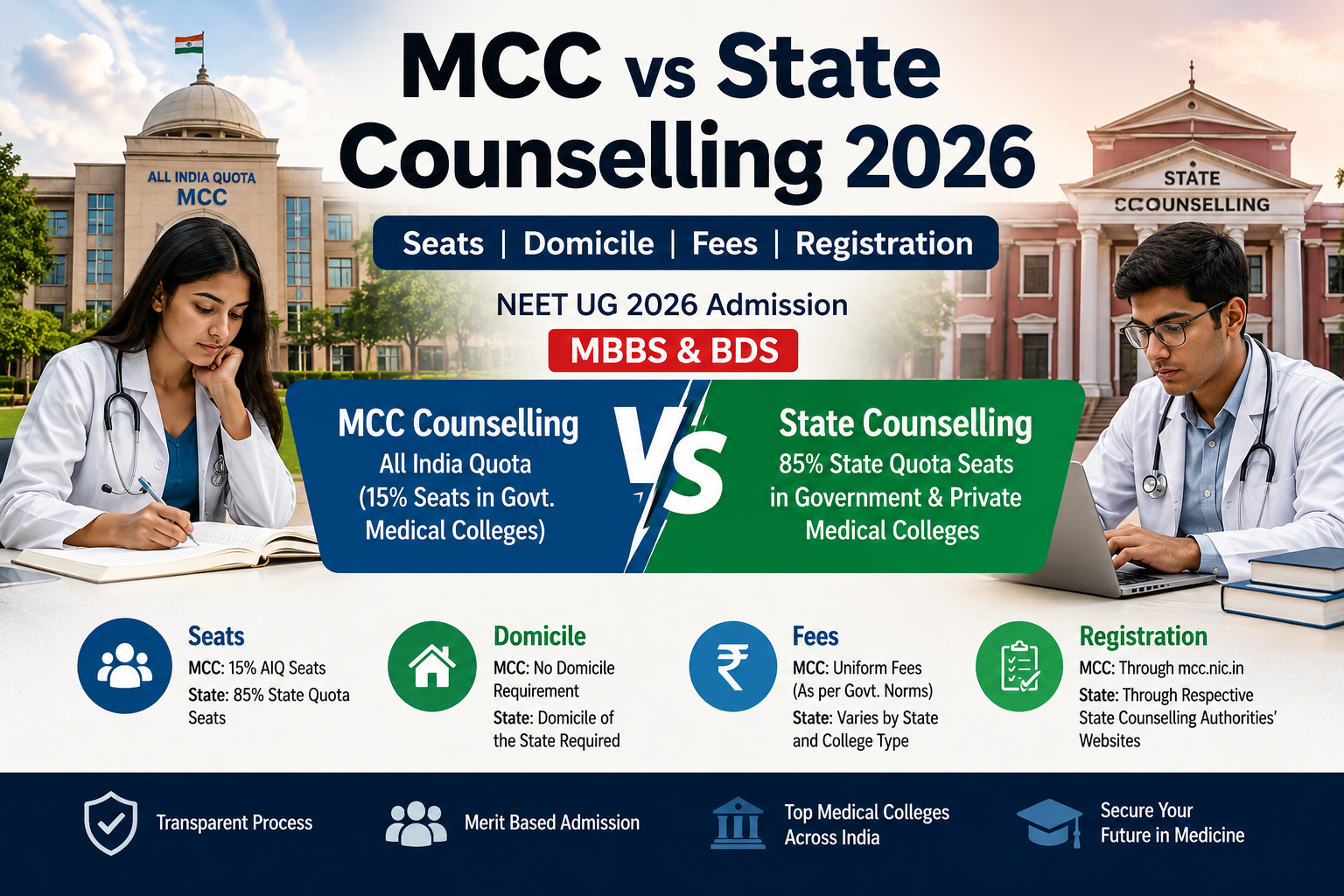
    MCC counselling is conducted at the national level primarily for 15% All India Quota seats and specified institutions, whereas state counselling is conducted separately by each state or Union Territory for state quota seats and most private medical college seats within that state.

    Candidates can generally participate in both counselling processes when eligible. However, MCC and state counselling require separate registration, fee payment, document submission, choice filling and seat allotment.

    This comprehensive guide explains the difference between MCC counselling and state counselling in 2026, including:

    • 15% All India Quota and state quota seats
    • Government and private medical colleges
    • Domicile requirements
    • Reservation policies
    • Registration procedures
    • Counselling fees
    • Choice-filling strategies
    • Required documents
    • Common counselling mistakes

    NEET UG Counselling 2026 Latest Update

    The National Testing Agency published the NEET UG 2026 scorecard on 16 July 2026.

    As of 29 July 2026, the MCC website identifies the portal as the admission and e-counselling service for Session 2026. However, its UG schedule page does not yet display the detailed counselling schedule, and the Candidate Activity Board states that information will be updated soon.

    Candidates should therefore monitor the official MCC website for the publication of:

    • MCC counselling registration dates
    • NEET UG 2026 counselling information bulletin
    • Round-wise schedule
    • Seat matrix
    • Registration fee and security deposit
    • Choice-filling dates
    • Seat-allotment results
    • Reporting and resignation rules

    Important: Never rely exclusively on previous-year dates or counselling rules. Use the official 2026 information bulletin once it is released.


    MCC Counselling vs State Counselling: Quick Answer

    MCC counselling is conducted by the Medical Counselling Committee under the Directorate General of Health Services. MCC is responsible for online counselling for 15% All India Quota undergraduate seats and specified central or institutional seat categories.

    State counselling is conducted by the authorised counselling authority of an individual state or Union Territory. It generally covers state quota seats in government colleges and seats in private medical and dental colleges located within that state.


    MCC Counselling vs State Counselling: Quick Comparison

    Comparison PointMCC CounsellingState Counselling
    Counselling levelNational levelState or Union Territory level
    Conducting authorityMedical Counselling Committee under DGHSAuthorised counselling body of the respective state
    Main government seat pool15% All India Quota seatsGenerally the remaining state quota seats
    Competition levelNational competitionState-based or category-specific competition
    Government collegesAIQ seats in participating government collegesState quota seats within the concerned state
    AIIMS admissionConducted through MCCNot conducted through regular state counselling
    JIPMER admissionConducted through MCCNot conducted through regular state counselling
    Central institutionsSpecified institutions and seat categoriesUsually outside regular state counselling
    Private medical collegesDeemed and other institutions included in the applicable MCC matrixMost non-deemed private colleges within the state
    Domicile for regular seatsGenerally not required for regular AIQ seatsCommonly required for government state quota seats
    Reservation rulesCentral rules for applicable categoriesRespective state reservation rules
    RegistrationThrough the MCC portalThrough the authorised state portal
    Choice fillingMCC choice-filling portalState choice-filling portal
    Registration feeDetermined by MCCDetermined separately by each state
    Merit considerationNEET UG rank, category, eligibility and preferencesNEET UG score, state merit, category and state eligibility
    Best suited forStudents seeking national-level college optionsStudents seeking seats within a particular state

    What Is MCC Counselling?

    MCC counselling is the centralised online medical counselling process conducted by the Medical Counselling Committee, which operates under the Directorate General of Health Services, Ministry of Health and Family Welfare, Government of India.

    The MCC is responsible for finalising counselling procedures and schedules, determining counselling fees and deposits, allocating applicable AIQ seats and coordinating with agencies involved in state and Union Territory counselling.

    Which Seats Are Covered by MCC Counselling?

    The MCC officially identifies the following UG counselling responsibilities:

    1. 15% All India Quota MBBS and BDS seats of participating states
    2. 100% MBBS and BDS seats of Banaras Hindu University
    3. 100% MBBS seats of AIIMS institutions across India
    4. 100% JIPMER seats in Puducherry and Karaikal
    5. 100% seats of Aligarh Muslim University, subject to applicable eligibility
    6. Specified state and institutional quota seats under Delhi University and IP University
    7. Faculty of Dentistry seats at Jamia Millia Islamia, including the applicable internal quota
    8. Specified ESIC IP quota seats

    These categories are listed by MCC, although candidates must confirm the precise 2026 institutions and seat categories in the official seat matrix.

    Who Should Apply for MCC Counselling?

    MCC counselling is particularly important for candidates who want to:

    • Compete for government medical colleges outside their home state
    • Apply for 15% All India Quota MBBS or BDS seats
    • Apply for AIIMS MBBS admission
    • Apply for JIPMER MBBS admission
    • Explore specified central universities
    • Consider deemed medical universities included in the current matrix
    • Access a wider national college choice
    • Avoid relying only on home-state counselling

    Qualifying for NEET UG does not automatically register a candidate for MCC counselling. A separate application must be completed when MCC registration opens.


    What Is State Counselling?

    State counselling is the NEET UG admission process conducted by the designated counselling authority of a state or Union Territory.

    Depending on the state, the authority may be a:

    • Directorate of Medical Education
    • State admission committee
    • State examination authority
    • Government medical university
    • State counselling board

    Each state publishes its own counselling rules and schedule.

    Which Seats Are Covered by State Counselling?

    State counselling generally covers:

    1. State quota MBBS seats in government medical colleges
    2. State quota BDS seats in government dental colleges
    3. Seats in state government universities
    4. Government quota seats in private medical colleges
    5. Private medical college seats
    6. Private dental college seats
    7. Management quota seats
    8. Minority quota seats
    9. Institutional quota seats
    10. NRI quota seats, where applicable

    The precise classification is different in every state. Candidates must read the official state prospectus before registering or filling choices.

    Who Should Apply for State Counselling?

    State counselling is essential for students who:

    • Have valid domicile or residence eligibility
    • Want government medical colleges in their home state
    • Prefer a college closer to home
    • Qualify for state-specific reservation benefits
    • Want admission to private medical colleges in a particular state
    • Want government quota seats in private institutions
    • Are considering management, minority or NRI quota seats

    What Is the Main Difference Between MCC and State Counselling?

    The biggest difference between MCC counselling and state counselling is the seat pool.

    MCC Seat Pool

    MCC primarily manages seats available under the All India Quota and seats of specified national, central and institutional categories.

    Candidates from across India generally compete for regular AIQ seats based on:

    • NEET UG rank
    • Candidate category
    • Eligibility
    • Reservation rules
    • Seat availability
    • Submitted preference order

    State Counselling Seat Pool

    A state counselling authority primarily manages seats allocated to that state and private medical or dental colleges under its jurisdiction.

    Admission may depend on:

    • NEET UG score
    • State merit rank
    • Domicile
    • Residence or schooling conditions
    • Candidate category
    • State reservation rules
    • Seat type
    • Submitted preferences

    The same candidate can therefore have different admission possibilities in MCC counselling and state counselling.


    15% All India Quota vs 85% State Quota

    The difference between 15% AIQ and 85% state quota is central to understanding NEET UG counselling.

    What Is the 15% All India Quota?

    Approximately 15% of eligible MBBS and BDS seats in participating state government colleges are made available under the All India Quota.

    The Medical Counselling Committee conducts online counselling for these seats.

    Candidates generally compete nationally for AIQ seats, subject to:

    • NEET UG qualification
    • All India Rank
    • Category
    • Reservation policy
    • Eligibility conditions
    • Choice preference
    • Seat availability

    What Is the 85% State Quota?

    The remaining eligible government-college seats are generally placed under the state quota and allotted by the concerned state counselling authority.

    Candidates may need to fulfil conditions related to:

    • Domicile
    • Permanent residence
    • Schooling in the state
    • Parents’ residence or employment
    • State category certification
    • Local or regional eligibility

    Simple Example

    Suppose a participating government medical college has 100 eligible MBBS seats.

    A simplified seat division may be:

    Seat CategoryApproximate SeatsCounselling Authority
    All India Quota15MCC
    State quota85State counselling authority

    This example is only for understanding the general system. Actual seat distribution may differ because of institutional status, special quotas, court orders, reservation rules, seat additions or other applicable conditions.


    MCC Counselling vs State Counselling: Domicile Rules

    Domicile is one of the most important differences between MCC and state counselling.

    Is Domicile Required for MCC Counselling?

    Domicile is generally not required for regular 15% All India Quota seats.

    However, candidates must not assume that every seat appearing on the MCC portal is completely open. MCC also manages certain:

    • Institutional quota seats
    • Internal quota seats
    • Domicile-linked central university seats
    • ESIC quota seats
    • University-specific categories
    • NRI categories

    The MCC portal specifically refers to institutional, internal, central university, ESIC and other categories in addition to regular AIQ seats.

    Candidates must check the eligibility code attached to every choice.

    Is Domicile Required for State Counselling?

    Domicile or residence eligibility is commonly required for government state quota seats.

    A state may ask for:

    • Domicile certificate
    • Permanent resident certificate
    • Residence certificate
    • Birth certificate
    • Class 10 or Class 12 schooling certificate
    • Parents’ domicile documents
    • Parents’ employment certificate
    • State-issued category certificate

    Some states allow outside-state candidates to apply for selected private, management or NRI quota seats. The eligibility conditions vary by state and must be checked separately.


    MCC vs State Counselling for Government Medical Colleges

    Government medical college seats can be available through both MCC and state counselling.

    Government Seats Through MCC

    MCC provides access to:

    • AIQ seats in participating state government colleges
    • AIIMS institutions
    • JIPMER campuses
    • Specified central universities
    • Other eligible institutions listed in the MCC seat matrix

    Government Seats Through State Counselling

    State counselling provides access to:

    • State quota seats in government medical colleges
    • Government dental colleges
    • State government universities
    • Government quota seats in participating private colleges, where applicable

    Candidates with a strong domicile advantage should not ignore state counselling, even when they also have a competitive All India Rank.


    MCC vs State Counselling for Private Medical Colleges

    Private medical college counselling is a major source of confusion.

    Private Colleges Under State Counselling

    Most non-deemed private medical colleges are included in the counselling process of the state in which they are located.

    Their seats may be divided into:

    • Government quota seats
    • State quota seats
    • Management quota seats
    • Minority quota seats
    • Institutional quota seats
    • NRI quota seats

    Deemed Universities Through MCC

    Deemed medical university seats have traditionally been handled through MCC counselling. Candidates must nevertheless verify the participating colleges, seat numbers and categories in the official MCC 2026 seat matrix before submitting choices.

    Never assume that every private medical college is included in MCC counselling.


    MCC vs State Counselling: Reservation Rules

    Reservation policies may be different in the two counselling systems.

    Reservation in MCC Counselling

    Central reservation rules apply to relevant All India Quota and central seat categories.

    Applicable categories can include:

    • Scheduled Caste
    • Scheduled Tribe
    • OBC-NCL
    • Economically Weaker Section
    • Persons with Benchmark Disabilities

    MCC states that 27% OBC and 10% EWS reservation has applied to AIQ seats prospectively since 2021.

    Reservation in State Counselling

    State counselling follows the reservation policy of the concerned state.

    Depending on the state, categories may include:

    • State OBC categories
    • Scheduled Castes
    • Scheduled Tribes
    • EWS
    • PwD
    • Women candidates
    • Defence quota
    • Freedom-fighter quota
    • Rural or regional quota
    • Government-school quota
    • Other state-specific reservations

    A certificate valid for state OBC reservation may not establish eligibility under the central OBC-NCL category. Candidates should check the prescribed certificate format, issuing authority and validity date.


    Is Separate Registration Required for MCC and State Counselling?

    Yes. Separate registration is required.

    Registering on the MCC website does not automatically register a candidate for state counselling. Similarly, completing state registration does not make the candidate eligible for MCC allotment.

    A student participating in both processes must generally complete:

    ActivityMCCState
    RegistrationSeparateSeparate
    Application feeSeparateSeparate
    Security depositAs prescribedAs prescribed
    Document uploadSeparateSeparate
    Choice fillingSeparateSeparate
    Choice lockingSeparateSeparate
    Allotment resultSeparateSeparate
    College reportingAs per MCC scheduleAs per state schedule

    Candidates should maintain a calendar containing all MCC and state deadlines.


    Can You Participate in MCC and State Counselling Together?

    Yes. Eligible candidates can generally participate in MCC and state counselling during the same admission cycle.

    Participating in both may provide access to:

    • AIQ government seats
    • Home-state government seats
    • AIIMS
    • JIPMER
    • Central institutions
    • Deemed universities
    • Private medical colleges
    • Management quota seats
    • NRI quota seats

    However, candidates must carefully monitor:

    • Seat-joining rules
    • Free-exit provisions
    • Resignation deadlines
    • Security-deposit forfeiture
    • Upgradation conditions
    • Round 3 eligibility
    • Stray vacancy eligibility
    • Restrictions on already joined candidates

    The current information bulletin should be treated as the final authority for round-wise rules.


    Which Is Better: MCC or State Counselling?

    Neither process is automatically better for every candidate.

    The best option depends on:

    • NEET UG rank
    • Category
    • State domicile
    • Preferred location
    • Government or private college preference
    • Family budget
    • Bond conditions
    • College quality
    • Hospital exposure
    • Previous closing-rank trends

    MCC Counselling May Be Better When

    MCC may be more suitable when the candidate:

    • Wants colleges outside the home state
    • Has a competitive All India Rank
    • Is targeting AIQ government seats
    • Wants AIIMS or JIPMER
    • Is considering central institutions
    • Wants a wider national choice list
    • Is considering deemed universities

    State Counselling May Be Better When

    State counselling may be more suitable when the candidate:

    • Has valid domicile
    • Wants a government college in the home state
    • Is eligible for state reservation
    • Prefers studying near home
    • Wants a non-deemed private college
    • Is exploring management or minority seats
    • Has a favourable state merit position

    Recommended Approach

    For most eligible candidates, the strongest strategy is to register for both MCC and state counselling.

    This expands the number of available colleges and reduces dependence on a single seat pool.


    MCC Counselling Process 2026

    The exact process should be verified after publication of the MCC 2026 information bulletin. The usual stages include:

    Step 1: Online Registration

    Create an account on the official MCC portal and enter the required NEET UG and personal details.

    Step 2: Fee Payment

    Pay the prescribed registration fee and security deposit. MCC determines the counselling fees and deposits applicable to its process.

    Step 3: Choice Filling

    Select preferred courses and colleges from the available seat matrix.

    Step 4: Choice Locking

    Review the sequence carefully and lock the choices before the deadline.

    Step 5: Seat Allotment

    The system considers rank, category, eligibility, reservation, seat availability and preference order.

    Step 6: Downloading the Allotment Letter

    Successful candidates download their allotment result and reporting instructions.

    Step 7: College Reporting

    Candidates report to the allotted college, complete document verification and pay the applicable institutional fee.

    Step 8: Subsequent Rounds

    Candidates may participate in subsequent rounds according to the applicable upgradation, resignation and eligibility rules.


    State Counselling Process 2026

    The usual state counselling process includes:

    1. State portal registration
    2. Payment of the state counselling fee
    3. Submission of NEET UG information
    4. Submission of domicile and category information
    5. Document upload or verification
    6. Publication of the state merit list
    7. Publication of the seat matrix
    8. Choice filling and locking
    9. Seat allotment
    10. Admission fee payment
    11. Reporting to the allotted college
    12. Participation in subsequent rounds, if eligible

    Some states may require physical document verification. Others may complete most stages online.

    Candidates should not assume that registration will reopen before later rounds.


    MCC Counselling vs State Counselling Fees

    MCC and state counselling have different fee structures.

    MCC Counselling Costs

    Candidates may need to pay:

    • Non-refundable registration fee
    • Refundable security deposit
    • Different deposits for different institutional categories
    • College admission fee after allotment

    The final amount must be checked in the official MCC 2026 bulletin.

    State Counselling Costs

    State authorities may charge:

    • Registration fee
    • Counselling fee
    • Security deposit
    • Seat-confirmation fee
    • University fee
    • Admission fee

    The amount may vary according to the candidate category and seat type.

    College Costs to Compare

    Before selecting a private or deemed medical college, check:

    • Annual tuition fee
    • Total course fee
    • Hostel fee
    • Mess charges
    • Refundable and non-refundable deposits
    • University fee
    • Examination fee
    • Miscellaneous charges
    • Service bond
    • Rural-service obligation
    • Discontinuation penalty
    • Internship stipend
    • Fee-refund policy

    Do not add an unaffordable college to the choice list merely to test the allotment system.


    Documents Required for MCC and State Counselling

    Candidates should prepare original documents, photocopies and clear scanned copies.

    Commonly required documents include:

    • NEET UG 2026 admit card
    • NEET UG 2026 scorecard
    • Class 10 marksheet and certificate
    • Class 12 marksheet and passing certificate
    • Date-of-birth proof
    • Government-issued photo identity proof
    • Recent passport-size photographs
    • Category certificate, where applicable
    • Central OBC-NCL certificate, where applicable
    • State OBC certificate, where applicable
    • EWS certificate
    • PwD certificate
    • Domicile or residence certificate
    • Schooling certificates
    • Migration certificate
    • Transfer certificate
    • Character certificate
    • Medical fitness certificate
    • Gap certificate, where required
    • NRI documents, where applicable
    • Allotment letter
    • Counselling payment receipt
    • College fee receipt
    • Required affidavits or undertakings

    The final document checklist must be verified from the official MCC bulletin, state prospectus and allotted college instructions.


    How to Create the Best NEET UG Choice List

    Candidates should arrange colleges according to their genuine preference, not simply according to previous closing ranks.

    Factors to Compare

    Compare each college using:

    • Government, private or deemed status
    • Total course cost
    • Hospital patient load
    • Clinical exposure
    • Infrastructure
    • Faculty and departments
    • Hostel facilities
    • Internship stipend
    • Service bond
    • Discontinuation penalty
    • Distance from home
    • Language and local environment
    • Previous closing ranks

    Three-Level Choice Strategy

    Aspirational Choices

    Colleges whose previous closing ranks were more competitive than the candidate’s current position.

    Realistic Choices

    Colleges where the candidate has a reasonable admission possibility based on rank, category and previous trends.

    Safe Choices

    Acceptable colleges whose previous closing ranks indicate a comparatively stronger possibility of admission.

    Previous closing ranks are indicators, not guarantees.


    Common MCC and State Counselling Mistakes

    Registering Only for MCC

    MCC registration does not provide access to state counselling seats.

    Waiting for the MCC Result Before State Registration

    State registration may close before the MCC process is completed.

    Assuming State Quota Is Open to Everyone

    Government state quota seats commonly have domicile or residence conditions.

    Assuming Every Private College Is Under MCC

    Most non-deemed private colleges are allotted through the relevant state authority.

    Ignoring the Complete Fee Structure

    Candidates should calculate the full course cost, not only first-year tuition.

    Filling Choices in Cut-Off Order

    Choices should reflect the candidate’s actual preference.

    Using the Wrong Category Certificate

    Central and state certificate requirements may differ.

    Ignoring Bond Conditions

    A low-fee government seat may have a compulsory service obligation.

    Missing Choice Locking or Reporting Deadlines

    A missed deadline can result in loss of the allotted seat.

    Depending on Unofficial Messages

    Schedules, seat matrices and exit rules should be verified only through official counselling portals.


    MCC Counselling vs State Counselling: Final Verdict

    The main difference between MCC counselling and state counselling lies in the conducting authority, seat quota, domicile rules, reservation policy, participating colleges and registration process.

    MCC counselling primarily covers:

    • 15% All India Quota seats
    • AIIMS seats
    • JIPMER seats
    • Specified central institutions
    • Institutional or internal categories notified by MCC
    • Deemed university seats included in the applicable seat matrix

    State counselling primarily covers:

    • State quota government seats
    • Government dental college seats
    • Most non-deemed private medical college seats
    • Government quota seats in private colleges
    • Management quota seats
    • Minority quota seats
    • NRI quota seats, where applicable

    For most eligible students, registering for both MCC counselling and state counselling creates the widest range of admission opportunities.

    A competitive NEET UG rank is important, but careful registration, documentation, financial planning and choice filling are equally necessary to convert the rank into a suitable MBBS or BDS seat.

    Disclaimer: Counselling dates, fees, eligibility conditions, seat matrices, reservation rules and round-wise exit conditions may change. Candidates should verify every admission decision through the official MCC website and the authorised state counselling portal.


    Frequently Asked Questions

    1. What is the difference between MCC counselling and state counselling?

    MCC counselling is conducted nationally for 15% All India Quota seats and specified institutions. State counselling is conducted separately by each state for state quota seats and most private medical colleges.

    2. Is MCC counselling compulsory for MBBS admission?

    MCC registration is required for seats allotted through MCC. Candidates targeting only eligible state counselling seats must register with the relevant state authority.

    3. Can I participate in MCC and state counselling together?

    Yes. Eligible candidates can generally participate in both. Separate registration, fee payment and choice filling are required.

    4. Does MCC counselling cover 85% state quota seats?

    Generally, no. State quota seats are normally allotted by the respective state counselling authority, except for certain central or institutional categories handled by MCC.

    5. Is domicile required for MCC counselling?

    Domicile is generally not required for regular 15% AIQ seats. Certain institutional, internal or university-specific categories may have separate conditions.

    6. Is domicile required for state counselling?

    Domicile is commonly required for government state quota seats. Private and management quota rules differ by state.

    7. Is AIIMS counselling conducted by MCC?

    Yes. MCC lists 100% MBBS seats in AIIMS institutions among its UG counselling responsibilities.

    8. Is JIPMER counselling conducted by MCC?

    Yes. MCC handles JIPMER Puducherry and JIPMER Karaikal seats.

    9. Are private medical colleges included in MCC counselling?

    Deemed university seats and other notified institutions may be included through MCC. Most non-deemed private colleges are handled through state counselling.

    10. Can candidates from another state apply for private MBBS seats?

    Some states allow outside-state candidates to apply for selected private, management or NRI quota seats. Eligibility varies by state.

    11. Is separate registration required for MCC and state counselling?

    Yes. Candidates must register separately for both processes.

    12. Which counselling has lower MBBS fees?

    Government seats under either AIQ or state quota generally cost less than private or deemed university seats. Actual fees depend on the institution and quota.

    13. Is the state quota always exactly 85%?

    No. The 85% state quota is a general structure for participating government colleges. Central institutions, special categories and other institutions may follow different seat distributions.

    14. Which rank is used in state counselling?

    State authorities use NEET UG performance along with state merit, domicile, category and other applicable eligibility conditions.

    15. Can I leave an MCC seat after getting a state seat?

    This depends on the counselling round, joining status, resignation deadline and forfeiture rules applicable at that time.

    16. What happens if I miss state counselling registration?

    The candidate may lose access to that state’s seats unless the authority officially reopens registration.

    17. Should I register for both MCC and state counselling?

    For most eligible candidates, registering for both is beneficial because it provides access to more colleges and seat categories.

    18. Where should I check NEET UG counselling updates?

    Check the official MCC website for MCC counselling and the authorised medical counselling portal of the concerned state for state-level admissions.


    Education MESD Counselling Support

    Need Help With NEET UG 2026 Counselling?

    Managing MCC registration, state counselling, domicile rules, private medical college fees and multiple choice lists can be difficult for students and parents.

    Education MESD supports medical aspirants with:

    • MCC and state counselling guidance
    • Eligibility and domicile assessment
    • Document preparation
    • College and fee comparison
    • Government, private and deemed university options
    • Choice-filling strategy
    • Round-wise counselling support

    Make informed decisions before locking your medical college choices
  • NEET UG 2026 Counselling Documents Checklist: Complete List for MBBS and BDS Admission

    NEET UG 2026 Counselling Documents Checklist: Complete List for MBBS and BDS Admission

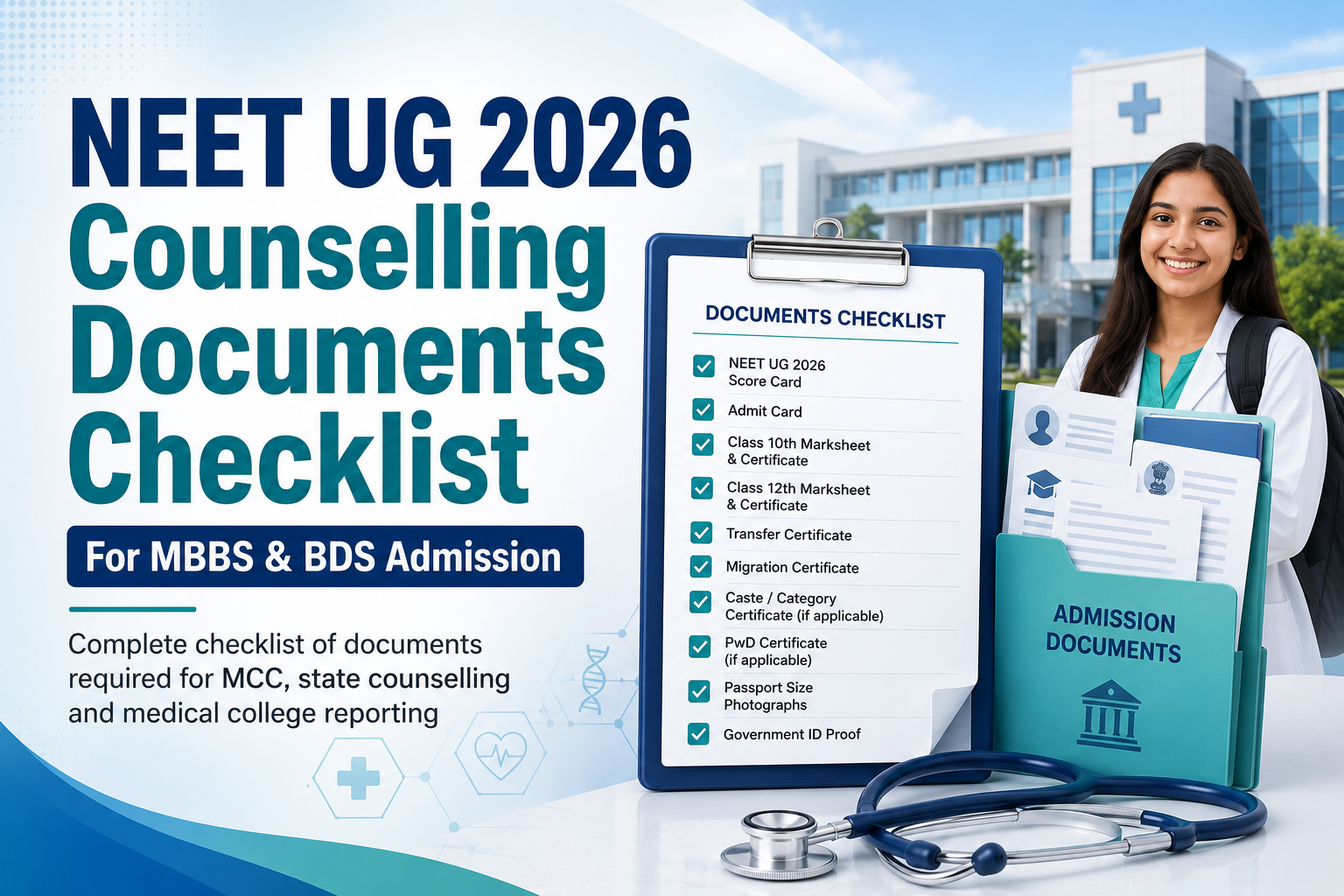
    The NEET UG 2026 counselling documents checklist is essential for every student seeking admission to an MBBS, BDS or another eligible medical course.

    Securing a good NEET rank and receiving a seat allotment are not enough to confirm admission. Candidates must produce the required original documents during physical reporting and document verification. Missing, expired or incorrect documents may delay admission, affect a reservation claim or result in cancellation of the allotted seat.

    The National Testing Agency published the NEET UG 2026 scorecard on 16 July 2026.

    As of 28 July 2026, the MCC website is operating for the 2026 session, but the current UG notices page displays only the NRI-candidature notice for the 2026–27 academic year. The complete NEET UG 2026 MCC information bulletin and final reporting checklist should therefore be checked once officially published.

    This guide is based on the latest detailed official MCC UG reporting checklist and includes additional documents commonly required by state authorities and individual medical colleges.

    Important: MCC, state counselling authorities and allotted colleges may have different document requirements. Always verify the final list from all three authorities before travelling for admission.


    What Documents Are Required for NEET UG 2026 Counselling?

    Candidates should generally carry their NEET UG admit card, NEET scorecard, seat-allotment letter, Class 10 certificate, Class 12 marksheet and passing certificate, identity proof, passport-size photographs and applicable category certificates. State-quota, NRI, PwD and institutional-quota candidates may need additional documents.

    This short answer can help the article appear for featured-snippet searches such as “documents required for NEET counselling 2026.”


    Quick NEET UG 2026 Counselling Documents Checklist

    DocumentWho needs it?Carry original?
    MCC or state allotment letterAll allotted candidatesPrinted copy
    NEET UG 2026 admit cardAll candidatesYes
    NEET UG 2026 scorecard/rank letterAll candidatesYes
    Class 10 certificateAll candidatesYes
    Date-of-birth certificateWhen DOB is absent from Class 10 certificateYes
    Class 12 marksheetAll candidatesYes
    Class 12 passing certificateAll candidatesYes
    Government photo IDAll candidatesYes
    Eight or more passport photographsAll candidatesPhysical copies
    SC/ST certificateApplicable candidatesYes
    Central OBC-NCL certificateApplicable MCC candidatesYes
    EWS certificateApplicable candidatesYes
    PwD/PwBD certificateApplicable candidatesYes
    Domicile certificateState-quota candidates, where requiredYes
    NRI/OCI/foreign-national documentsApplicable candidatesYes
    Transfer/migration certificateWhen required by collegeYes
    Medical fitness certificateWhen required by collegeYes
    Photocopy setsAll candidates3–5 sets
    Digital document backupAll candidatesRecommended

    The latest detailed MCC checklist requires original documents with attested photocopies during reporting.


    Mandatory Documents for MCC NEET UG Counselling 2026

    1. MCC Seat-Allotment Letter

    Candidates allotted a seat through MCC must download the provisional allotment letter from the MCC counselling portal.

    It generally includes:

    • Candidate’s name and roll number
    • Allotted medical or dental college
    • Course allotted
    • Counselling round
    • Quota and category
    • Reporting period
    • Reporting instructions

    Carry at least two or three clear printouts. Candidates allotted through state counselling must carry the allotment letter issued by the respective state authority.


    2. NEET UG 2026 Admit Card

    Carry the NEET UG 2026 admit card issued by NTA.

    The admit card is used to verify:

    • Candidate’s identity
    • NEET application number
    • Roll number
    • Photograph and signature
    • Examination details

    Keep both printed and digital copies available.


    3. NEET UG 2026 Scorecard or Rank Letter

    Download the official scorecard or result/rank letter issued by NTA.

    The document normally contains:

    • NEET UG score
    • Percentile
    • All India Rank
    • Category rank, where applicable
    • Qualifying status
    • Candidate details

    The MCC reporting checklist specifically includes the result or rank letter issued by NTA.


    4. Class 10 Certificate

    The Class 10 certificate is required to verify the candidate’s:

    • Name
    • Date of birth
    • Parent’s name
    • Educational record
    • Board information

    Check that the spelling of the candidate’s name matches the NEET application, Aadhaar card and Class 12 documents.


    5. Date-of-Birth Certificate

    A separate birth certificate may be required when the Class 10 or matriculation certificate does not mention the candidate’s date of birth.

    Carry:

    • Original birth certificate
    • Self-attested photocopies
    • Certified English or Hindi translation when the original is in another language

    The MCC checklist requires a date-of-birth certificate when the matriculation certificate does not contain the date of birth.


    6. Class 12 Marksheet

    Candidates must carry the original Class 12 marksheet showing their marks in the qualifying examination.

    It should clearly include marks obtained in:

    • Physics
    • Chemistry
    • Biology or Biotechnology
    • English
    • Other subjects studied

    Check that the marksheet is complete, legible and issued by the recognised examination board.


    7. Class 12 Passing Certificate

    The Class 12 passing certificate and Class 12 marksheet may be separate documents.

    The official MCC checklist mentions both documents independently. Therefore, candidates should not assume that the marksheet alone will be accepted.

    Students who have received digital documents through DigiLocker should also check whether their allotted college requires a board-issued physical original.


    8. Passport-Size Photographs

    The latest detailed MCC checklist asks candidates to carry eight passport-size photographs matching the photograph used in the application form.

    For safer preparation, carry:

    • 10–12 passport-size photographs
    • Photographs matching the NEET application photograph
    • Additional photographs for hostel, library and student ID formalities

    Keep the photographs in a protective envelope.


    9. Government-Issued Photo Identity Proof

    Carry an original government-issued photo ID.

    The MCC checklist accepts:

    • Aadhaar card
    • PAN card
    • Driving licence
    • Passport

    Aadhaar should preferably be carried as the primary identity document, with one additional ID as a backup.


    Category Certificates Required for NEET Counselling 2026

    10. SC Certificate

    Candidates claiming Scheduled Caste reservation should carry a valid SC certificate issued by the competent authority.

    The certificate should:

    • Follow the prescribed format
    • Clearly mention the caste or sub-caste
    • Contain the issuing authority’s signature and seal
    • Match the candidate’s name and other personal details

    Where the certificate is issued in a regional language, carry a certified English or Hindi translation along with the original.


    11. ST Certificate

    Scheduled Tribe candidates must carry a valid ST certificate issued by the competent authority.

    Check:

    • Candidate’s correct name
    • Tribe or sub-tribe
    • Issuing authority
    • Certificate number
    • Signature and official seal
    • Prescribed format

    State and Central formats may differ. Follow the format specified by the counselling authority through which the reservation is being claimed.


    12. OBC-NCL Certificate

    Candidates claiming OBC reservation through MCC must generally produce an OBC–Non-Creamy Layer certificate based on the Central OBC List.

    The candidate should verify that:

    • The community is included in the Central OBC List
    • The certificate mentions Non-Creamy Layer status
    • The sub-caste matches the Central List
    • The certificate follows the prescribed format
    • The certificate is valid for the applicable admission session

    A state OBC certificate alone may not establish eligibility for Central OBC-NCL reservation. MCC’s detailed reporting checklist specifically refers to the Central List of OBCs and Non-Creamy Layer status.


    13. EWS Certificate

    Candidates claiming Economically Weaker Section reservation must carry a valid EWS income and asset certificate.

    Verify:

    • Date of issue
    • Applicable financial year
    • Name of issuing authority
    • Official signature and seal
    • Prescribed certificate format
    • Validity for the relevant admission session

    An expired or incorrectly formatted certificate may affect the candidate’s reservation claim.


    14. PwD or PwBD Certificate

    Candidates applying under the Persons with Disability or Persons with Benchmark Disability category should prepare:

    • Valid PwD/PwBD certificate
    • UDID certificate or card, where applicable
    • Certificate from an authorised disability-assessment centre
    • Relevant medical reports
    • Documents required under the applicable MCC and NMC instructions

    The NEET UG 2026 information bulletin includes PwD/PwBD/UDID documentation among the applicable candidate records.

    Candidates must follow the final MCC 2026 notice regarding approved disability-certification centres.


    Documents Required for State-Quota NEET Counselling 2026

    The document requirements for the 85% state quota differ across states. In addition to the standard documents, candidates may need the following.

    15. Domicile or Residence Certificate

    A domicile, residence or permanent-residence certificate may be required to claim state-quota eligibility.

    Eligibility can depend on:

    • Candidate’s permanent residence
    • Parent’s residence
    • Place of schooling
    • Number of years studied in the state
    • Parent’s employment or government-service status
    • Local-area eligibility rules

    Candidates should read the official state counselling brochure carefully because domicile conditions are not identical across India.


    16. Study or Schooling Certificate

    Some states require proof that the candidate studied within the state for a prescribed period.

    The authority may request:

    • Class 6–12 study certificates
    • Class 10 study certificate
    • Class 12 study certificate
    • Bonafide certificate
    • Local-area certificate
    • Rural-area study certificate

    Submit only the documents requested by the concerned state counselling authority.


    17. Transfer Certificate

    The transfer certificate is issued by the school or institution last attended.

    Many medical colleges ask for the original transfer certificate during final admission. Candidates should request it early from their school if it has not already been issued.


    18. Migration Certificate

    A migration certificate may be required when the candidate moves from one:

    • Education board to another
    • University to another
    • State to another
    • Institution to another

    Confirm whether the certificate is required at initial reporting or can be submitted later.


    19. Character or Conduct Certificate

    The allotted college may ask for a recent character or conduct certificate issued by the school or institution last attended.

    Check whether the institution has specified:

    • A particular format
    • A permitted date of issue
    • Signature requirements
    • School stamp requirements

    20. Gap Certificate or Gap-Year Affidavit

    Students who completed Class 12 in an earlier year may be asked to submit a gap certificate or affidavit.

    It generally states:

    • Period of the academic gap
    • Reason for the gap
    • Activities undertaken during the period
    • Candidate’s declaration

    A gap certificate is not a universal MCC document. Prepare it only when required by the state authority or allotted college.


    21. Medical Fitness Certificate

    The allotted medical or dental college may require a medical fitness certificate.

    It may need to be issued by:

    • Registered medical practitioner
    • Government hospital
    • District medical board
    • Medical board of the allotted institution

    Use the college’s prescribed format when one is provided.


    NRI, OCI and Foreign-National Documents

    22. NRI Quota Documents

    NRI-quota requirements may vary between MCC, states, deemed universities and private institutions.

    Candidates may be asked to submit:

    • Candidate’s or sponsor’s passport
    • Valid visa
    • NRI status certificate
    • Overseas employment or residence proof
    • Sponsorship affidavit
    • Proof of relationship between sponsor and candidate
    • Family-tree or relationship certificate
    • Embassy or consulate certificate, where required
    • Financial-support undertaking
    • Candidate and sponsor declarations

    MCC has published a separate notice concerning eligibility for NRI candidature for the 2026–27 academic year, so candidates should follow that notice and subsequent round-specific instructions.


    23. OCI, PIO or Foreign-National Documents

    Applicable candidates should prepare:

    • Valid passport
    • OCI card
    • PIO-related documents, where applicable
    • Citizenship certificate
    • Visa
    • Nationality certificate
    • Other proof requested by MCC or the institution

    The official MCC reporting checklist identifies citizenship or card-number documentation as mandatory for applicable OCI, PIO and foreign-national candidates.


    Additional Documents for MBBS or BDS College Reporting

    The allotted institution may request documents beyond the standard MCC list.

    Candidates should keep the following ready where applicable:

    • MCC or state counselling registration slip
    • Choice-filling printout
    • Locked-choice printout
    • Counselling fee receipt
    • Security-deposit receipt
    • Seat-acceptance or willingness form
    • College fee-payment receipt
    • Online admission letter
    • Relieving letter after seat upgradation
    • Previous admission-cancellation letter
    • Anti-ragging undertaking by student
    • Anti-ragging undertaking by parent
    • Service-bond or rural-service undertaking
    • Hostel admission form
    • Local guardian declaration
    • Parent or guardian identity proof
    • Parent’s passport-size photographs
    • Income certificate
    • Minority certificate
    • Defence or ex-servicemen certificate
    • ESIC-related documents
    • Bank account details
    • Cancelled cheque

    MCC advises candidates to check the allotted college’s information because the institution may ask for additional documents.


    How to Organise NEET UG Counselling Documents

    Folder 1: Original Documents

    Arrange the originals in this order:

    1. Seat-allotment letter
    2. NEET UG 2026 admit card
    3. NEET UG 2026 scorecard
    4. Government photo ID
    5. Class 10 certificate
    6. Birth certificate, if applicable
    7. Class 12 marksheet
    8. Class 12 passing certificate
    9. Category certificate
    10. Domicile or study certificate
    11. Special-quota documents
    12. Transfer and migration certificates

    Folder 2: Photocopy Sets

    Prepare at least three to five photocopy sets.

    Each set should include:

    • NEET documents
    • Academic documents
    • Identity proof
    • Category certificates
    • Domicile documents
    • Allotment letter
    • Special-quota documents

    Self-attest each photocopy where required.

    Folder 3: Counselling Printouts

    Keep together:

    • Registration form
    • Payment receipts
    • Security-deposit receipt
    • Choice-filling printout
    • Locked choices
    • Allotment letter
    • Reporting instructions
    • College admission notice

    Folder 4: Photographs and Affidavits

    Keep:

    • Passport-size photographs
    • Gap affidavit
    • Name-mismatch affidavit
    • Anti-ragging declarations
    • Sponsorship affidavit
    • Parent or guardian declarations

    Create Digital Backups of All Documents

    Scan every document clearly and save copies in:

    • Mobile phone
    • Email
    • Google Drive or another cloud service
    • USB drive
    • Parent or guardian’s phone

    Use descriptive file names:

    • NEET-UG-2026-Admit-Card.pdf
    • NEET-UG-2026-Scorecard.pdf
    • MCC-Seat-Allotment-Letter.pdf
    • Class-10-Certificate.pdf
    • Class-12-Marksheet.pdf
    • OBC-NCL-Certificate.pdf
    • Domicile-Certificate.pdf

    Do not use unclear file names such as IMG001 or Scan123.


    Important NEET Document-Verification Rules

    Original Documents Are Compulsory

    Candidates must report with the required original documents. The latest detailed MCC bulletin states that candidates without original certificates or documents will not be allowed to take admission in the allotted medical or dental college.

    Another Person Cannot Complete Reporting

    MCC requires the allotted candidate to physically report to the college with the original documents. Another person cannot complete admission on the candidate’s behalf.

    Certificates Deposited Elsewhere May Cause Problems

    A letter stating that original certificates are deposited with another college or university may not be accepted as a substitute. Candidates should retrieve their originals before reporting.

    Translate Regional-Language Certificates

    When a certificate is issued in a language other than English or Hindi, carry:

    • Original certificate
    • Attested English or Hindi translation
    • Photocopies of both versions

    MCC’s detailed guidance advises candidates to carry an attested translated copy along with the original certificate.

    Resolve Name Mismatches Before Reporting

    Compare the following documents:

    • Aadhaar card
    • NEET application
    • Admit card
    • Scorecard
    • Class 10 certificate
    • Class 12 documents
    • Category certificate

    When the spelling differs, carry legally acceptable proof, generally an affidavit confirming that the documents relate to the same person.

    Do Not Wait Until the Final Reporting Day

    Some institutions may take two or three days to complete admission formalities. MCC advises candidates to contact the allotted college immediately after the allotment result and states that it cannot extend the joining deadline for an individual candidate.


    Common NEET Counselling Document Mistakes

    Avoid these frequent errors:

    1. Carrying photocopies but not originals
    2. Using an expired OBC-NCL or EWS certificate
    3. Carrying a state OBC certificate for a Central OBC-NCL claim
    4. Ignoring name or date-of-birth differences
    5. Forgetting the Class 12 passing certificate
    6. Carrying too few photographs
    7. Not translating regional-language certificates
    8. Depending only on mobile screenshots
    9. Reporting without checking the college-specific checklist
    10. Waiting until the final day to report
    11. Keeping originals deposited with another institution
    12. Forgetting the relieving letter after an upgraded allotment

    Printable NEET UG 2026 Counselling Checklist

    Essential Documents

    • MCC or state seat-allotment letter
    • NEET UG 2026 admit card
    • NEET UG 2026 scorecard/rank letter
    • Class 10 certificate
    • Birth certificate, if required
    • Class 12 marksheet
    • Class 12 passing certificate
    • Original photo identity proof
    • Eight or more passport-size photographs

    Category and Quota Documents

    • SC certificate, if applicable
    • ST certificate, if applicable
    • Central OBC-NCL certificate, if applicable
    • EWS certificate, if applicable
    • PwD/PwBD/UDID documentation, if applicable
    • Domicile certificate, if applicable
    • Study certificate, if applicable
    • NRI documents, if applicable
    • OCI or foreign-national documents, if applicable

    College Reporting Documents

    • Counselling registration slip
    • Choice-filling and locked-choice printouts
    • Counselling fee receipt
    • Security-deposit receipt
    • Transfer certificate
    • Migration certificate
    • Character certificate
    • Gap affidavit, if required
    • Medical fitness certificate
    • Anti-ragging undertakings
    • College-specific admission forms
    • Three to five photocopy sets
    • Digital backup of every document

    Frequently Asked Questions

    What documents are required for NEET UG 2026 counselling?

    Candidates generally need the NEET UG admit card, scorecard, seat-allotment letter, Class 10 certificate, Class 12 marksheet and passing certificate, identity proof, photographs and applicable category certificates.

    Are original documents compulsory for NEET counselling?

    Yes. Original documents are required during physical reporting. The detailed MCC guidance states that candidates without original certificates or documents will not be allowed to complete admission.

    How many photographs are required for MCC counselling?

    The latest detailed MCC checklist specifies eight passport-size photographs matching the application-form photograph. Carrying 10–12 photographs is safer.

    Is a domicile certificate required for MCC counselling?

    A domicile certificate is generally associated with state-quota or state-specific eligibility. Candidates applying through MCC should check the requirements of the specific quota, institution and allotted college.

    Which OBC certificate is required for MCC counselling?

    Candidates claiming OBC reservation through MCC generally need a valid OBC-NCL certificate corresponding to the Central OBC List and issued in the prescribed format.

    Is a gap certificate compulsory for NEET counselling?

    It is not a universal core MCC document. Some states and colleges may require it from candidates who completed Class 12 in a previous year.

    Can DigiLocker documents be used for NEET counselling?

    Candidates should follow the final counselling and college instructions. Even where digitally issued documents are recognised, candidates should not assume that digital copies will replace every original required during physical verification.

    What should I do if my name differs between documents?

    Arrange an affidavit or another legally accepted document showing that all certificates belong to the same person. Contact the allotted college before reporting.

    Are transfer and migration certificates compulsory?

    These certificates are commonly requested by institutions, but the exact requirements vary. Check the allotted college’s admission notice.

    Can the NEET UG 2026 document checklist change?

    Yes. MCC, state counselling authorities and colleges may publish revised or additional requirements. Check the official notices immediately before reporting.


    Conclusion

    Preparing the NEET UG 2026 counselling documents checklist early can protect candidates from admission delays and document-verification problems.

    Begin with the NEET UG 2026 admit card, scorecard, seat-allotment letter, Class 10 certificate, Class 12 marksheet, Class 12 passing certificate, photo identity proof and passport-size photographs.

    Candidates applying under state quota, OBC-NCL, EWS, SC, ST, PwD, NRI or another special category must also arrange valid category-specific certificates.

    Keep all original documents in a secure folder, prepare multiple photocopy sets and save scanned backups. Most importantly, compare your documents with the final MCC bulletin, state counselling brochure and allotted college’s reporting notice.

    Get Expert NEET UG 2026 Counselling Support

    Education MESD provides personalised assistance for:

    • MCC and state counselling registration
    • MBBS and BDS college selection
    • Choice filling and preference planning
    • Document verification
    • Private and deemed medical college admission
    • Budget-based college planning
    • NRI quota admission guidance
    • International medical admission options

    Contact the Education MESD counselling team for structured guidance based on your NEET rank, category, budget and preferred location.

  • What to Do After NEET UG 2026 Result? Complete Step-by-Step Roadmap for MBBS Admission

    What to Do After NEET UG 2026 Result? Complete Step-by-Step Roadmap for MBBS Admission

    NEET UG 2026 Result Is Out: Your Real Medical Admission Journey Starts Now

    The wait is finally over. After months of preparation, hard work and dedication, lakhs of medical aspirants have received their NEET UG 2026 results.

    But remember:

    Getting your NEET result is not the end of your journey. It is the first step towards securing your dream medical seat.

    Every year, many students qualify NEET but miss better opportunities because they do not understand:

    • How NEET counselling works
    • When to register
    • How to select colleges
    • Which documents are required
    • How to prepare a smart choice list

    The admission process after NEET UG 2026 requires careful planning, timely decisions and accurate information.

    This complete guide explains what to do after NEET UG 2026 result and how to move from your scorecard to your MBBS admission.


    Quick Checklist: What Should You Do After NEET UG 2026 Result?

    Immediately after checking your result:

    ✅ Download your NEET UG 2026 scorecard
    ✅ Check your All India Rank (AIR)
    ✅ Analyse your admission possibilities
    ✅ Prepare counselling documents
    ✅ Register for MCC counselling
    ✅ Register for state counselling
    ✅ Research medical colleges
    ✅ Prepare your preference list
    ✅ Participate in counselling rounds
    ✅ Complete admission formalities


    Step 1: Download and Verify Your NEET UG 2026 Scorecard

    The first thing every candidate should do after the NEET UG 2026 result declaration is download the official scorecard.

    Your NEET scorecard contains:

    • Candidate name
    • Roll number
    • Application number
    • Subject-wise marks
    • Total marks
    • Percentile score
    • All India Rank
    • Category rank
    • Qualification status

    Check These Details Carefully

    Before moving ahead, verify:

    ✔ Name spelling
    ✔ Date of birth
    ✔ Category details
    ✔ Marks obtained
    ✔ Rank information

    If there is any discrepancy, contact the concerned authority immediately.


    Step 2: Understand Your NEET UG 2026 Rank and Admission Chances

    Many students focus only on their marks. However, NEET rank is the most important factor during admission.

    Your medical college options depend on:

    1. All India Rank (AIR)

    AIR determines your position among all NEET candidates.

    A better rank increases your chances of getting:

    • Government medical colleges
    • AIIMS
    • Central universities
    • Lower-fee MBBS colleges

    2. Category Rank

    Category plays an important role in seat allotment.

    Students should check eligibility under:

    • General category
    • OBC-NCL
    • SC
    • ST
    • EWS
    • PwD

    Make sure your category certificate is valid before counselling.


    3. State Quota Advantage

    Every state has its own counselling process.

    A student may have better chances through:

    • State quota seats
    • Domicile benefits
    • Private medical colleges in the state

    Step 3: Understand NEET UG 2026 Counselling Process

    NEET counselling is the gateway to medical admission.

    Qualifying NEET does not automatically provide an MBBS seat.

    Students must participate in counselling conducted by different authorities.


    MCC NEET UG Counselling 2026

    The Medical Counselling Committee (MCC) conducts counselling for:

    • 15% All India Quota seats
    • AIIMS MBBS seats
    • JIPMER seats
    • Central universities
    • Deemed medical universities
    • ESIC medical colleges
    • Other participating institutions

    Who Should Participate?

    Students interested in:

    • National-level medical colleges
    • Deemed universities
    • Central institutions

    should register for MCC counselling.


    State NEET UG Counselling 2026

    Every state conducts separate counselling for:

    • Government medical colleges
    • Private medical colleges
    • State quota seats
    • Management quota seats

    Important Advice

    Do not depend only on MCC counselling.

    A smart candidate participates in:

    ✔ MCC counselling
    ✔ Home state counselling
    ✔ Other eligible counselling processes

    This increases admission opportunities.


    Step 4: NEET UG 2026 Counselling Documents Checklist

    Keep all documents ready before counselling registration.

    Mandatory Documents

    Examination Documents

    ✔ NEET UG 2026 Admit Card
    ✔ NEET UG 2026 Scorecard

    Academic Documents

    ✔ Class 10 Certificate
    ✔ Class 10 Marksheet
    ✔ Class 12 Certificate
    ✔ Class 12 Marksheet

    Identity Documents

    ✔ Aadhaar Card
    ✔ Passport-size photographs
    ✔ Signature

    Category Documents

    ✔ Caste Certificate
    ✔ OBC-NCL Certificate
    ✔ EWS Certificate
    ✔ PwD Certificate (if applicable)

    Other Documents

    ✔ Domicile Certificate
    ✔ Transfer Certificate
    ✔ Migration Certificate
    ✔ Character Certificate
    ✔ Medical Fitness Certificate


    Step 5: How to Select the Right Medical College After NEET UG 2026?

    Choosing a medical college is one of the biggest decisions after NEET.

    Do not select a college only because of:

    ❌ Advertisement
    ❌ Social media popularity
    ❌ Low cut-off
    ❌ Recommendations from others

    Analyse these factors:


    1. NMC Recognition

    Always verify:

    • College approval
    • Course recognition
    • Seat validity

    2. Hospital and Clinical Exposure

    A good MBBS college must provide:

    ✔ Large patient flow
    ✔ Multiple departments
    ✔ Practical clinical exposure
    ✔ Internship opportunities

    Remember:

    MBBS education depends heavily on real hospital experience.


    3. Total Cost of Education

    Before choosing a college, calculate:

    • Tuition fees
    • Hostel charges
    • Food expenses
    • Security deposits
    • Additional university charges

    For private medical colleges, always calculate the complete MBBS cost.


    4. Academic Environment

    Check:

    • Faculty quality
    • Research opportunities
    • Student performance
    • PG preparation environment

    Step 6: NEET UG 2026 Choice Filling Strategy

    Choice filling is one of the most important stages of counselling.

    A wrong preference order can affect your admission.

    Recommended Strategy

    Category 1: Dream Colleges

    Add colleges where admission is competitive.

    Examples:

    • Top government medical colleges
    • AIIMS institutions

    Category 2: Target Colleges

    Colleges where your rank matches previous trends.


    Category 3: Safe Colleges

    Options where your admission possibility is higher.


    Step 7: NEET UG 2026 Counselling Rounds Explained

    NEET counselling generally happens through multiple rounds.

    Round 1

    First seat allotment round.

    Round 2

    Candidates get opportunities for:

    • Upgradation
    • Fresh choices

    Round 3

    Final major counselling opportunity.

    Stray Vacancy Round

    Remaining vacant seats are filled.


    Step 8: What If You Did Not Get Your Expected NEET Rank?

    A lower NEET rank does not mean your medical dream is over.

    Students can explore:

    Courses Through NEET

    • MBBS
    • BDS
    • BAMS
    • BHMS
    • BUMS
    • BSMS
    • Veterinary Sciences
    • Nursing courses

    Other Options

    Students can consider:

    • Private medical colleges
    • Deemed universities
    • MBBS abroad
    • NEET preparation again

    The decision should depend on:

    • Career goals
    • Financial planning
    • Future opportunities

    Step 9: MBBS Abroad After NEET UG 2026

    Some students consider studying medicine abroad.

    Before selecting any foreign university, check:

    ✔ Recognition status
    ✔ University accreditation
    ✔ Hospital facilities
    ✔ Clinical exposure
    ✔ Internship rules
    ✔ Total cost
    ✔ Licensing requirements

    Avoid institutions promising:

    ❌ Guaranteed admission
    ❌ Guaranteed licence
    ❌ Unrealistically low fees

    Always verify before payment.


    Common Mistakes Students Make After NEET Result

    Avoid these mistakes:

    ❌ Waiting until the last date for counselling
    ❌ Registering only for one counselling
    ❌ Filling limited choices
    ❌ Ignoring private college fees
    ❌ Not checking college recognition
    ❌ Following unofficial cut-offs
    ❌ Sharing OTP/password with agents
    ❌ Missing reporting deadlines


    NEET UG 2026 Counselling Tips for Parents

    Parents should help students make practical decisions.

    Discuss Financial Planning

    Understand:

    • Total MBBS cost
    • Hostel expenses
    • Long-term education expenses

    Focus on Quality Education

    The cheapest or nearest college is not always the best option.

    Consider:

    • Clinical exposure
    • Infrastructure
    • Faculty
    • Career opportunities

    Avoid Admission Scams

    Never trust:

    • Guaranteed seat promises
    • Unofficial agents
    • Fake admission letters

    Frequently Asked Questions (FAQs)

    1. What should I do after NEET UG 2026 result?

    Download your scorecard, analyse your rank, prepare documents and register for counselling.


    2. Does qualifying NEET guarantee MBBS admission?

    No. Admission depends on rank, category, counselling choices and seat availability.


    3. Should I register for MCC and state counselling both?

    Yes, eligible students should participate in all applicable counselling processes.


    4. Which is more important: NEET marks or rank?

    Rank is more important because admission depends on your position among candidates.


    5. Can I get MBBS with a low NEET rank?

    Yes, depending on category, state quota, private colleges and available seats.


    Final NEET UG 2026 Admission Checklist

    Before counselling begins:

    ☑ Download scorecard
    ☑ Analyse rank
    ☑ Prepare documents
    ☑ Register for counselling
    ☑ Research colleges
    ☑ Compare fees
    ☑ Prepare choices
    ☑ Track deadlines


    Final Words: Plan Smart After NEET UG 2026 Result

    The NEET UG 2026 result is only the beginning of your medical admission journey.

    A successful medical admission requires:

    • Correct counselling strategy
    • Proper college research
    • Timely registration
    • Smart decision-making

    Do not rush because of pressure or rumours. Take decisions based on facts, affordability and long-term career goals.

    Education MESD helps NEET aspirants and parents with personalised counselling support, medical college selection guidance and MBBS admission assistance in India and abroad.

    Start your medical admission journey with the right information and the right guidance.