Tag: MBBS Admission 2026

  • MBBS Admission with Low NEET Score 2026: Can Students Still Get an MBBS Seat?

    MBBS Admission with Low NEET Score 2026: Can Students Still Get an MBBS Seat?

    MBBS admission with low NEET score is one of the biggest concerns for students and parents after the NEET UG 2026 result. A lower-than-expected score can make admission to a government medical college difficult, but it does not automatically mean that the dream of becoming a doctor is over.

    So, can students get MBBS admission with a low NEET score in 2026?

    The short answer is yes, it may be possible if the candidate has qualified NEET UG 2026 and fulfils the applicable counselling, category, domicile and seat-eligibility requirements.

    Students with lower NEET ranks may still explore legitimate opportunities through private medical colleges, deemed universities, eligible management/private seat categories, NRI quota where applicable, state counselling and later counselling rounds.

    However, there is one critical distinction every family must understand:

    A low NEET score is not the same as failing to qualify NEET.

    NEET UG 2026 is the common and uniform entrance examination for admission to undergraduate medical education in medical institutions in India.

    In this EducationMESD guide, we explain everything you need to know about MBBS admission with low NEET score in 2026, including qualifying marks, private MBBS admission, management quota, deemed universities, NRI seats, counselling strategy, admission at 200–400 marks, college selection and common mistakes.


    Quick Answer: Is MBBS Admission Possible with a Low NEET Score?

    Yes. MBBS admission with a low NEET score may be possible if the student is NEET qualified and has suitable options based on rank, category, domicile, budget, quota eligibility and counselling vacancies.

    A lower score usually makes government MBBS seats more difficult, but students may still find opportunities in private medical colleges and deemed universities.

    The most important factors are:

    • NEET UG 2026 qualifying status
    • All India Rank or AIR
    • Category and reservation eligibility
    • State domicile
    • Applicable counselling authority
    • Private or deemed university preference
    • Management/private seat eligibility
    • Genuine NRI eligibility, where applicable
    • Family budget
    • Previous and current closing ranks
    • Choice-filling strategy
    • Round-wise vacancies

    NEET qualification opens the counselling door; it does not guarantee an MBBS seat.


    NEET UG 2026 Qualifying Cutoff for MBBS Admission

    Before searching for private MBBS admission with low NEET score, first confirm whether you have qualified NEET UG 2026.

    According to the official NTA 2026 data, the qualifying ranges are as follows.

    CategoryNEET 2026 Qualifying CriteriaNEET 2026 Marks Range
    UR/EWS50th percentile or above715–213
    OBC40th to below 50th percentile212–177
    SC40th to below 50th percentile212–177
    ST40th to below 50th percentile212–177
    UR/EWS PwBD45th to below 50th percentile212–194
    OBC PwBD40th to below 45th percentile193–177
    SC PwBD40th to below 45th percentile193–177
    ST PwBD40th to below 45th percentile191–177

    Important

    These are NEET qualifying marks, not guaranteed MBBS admission cutoffs.

    For example, a General/EWS candidate scoring 213 marks is NEET qualified in 2026, but that does not mean an MBBS college will necessarily be available at 213 marks.

    Actual seat allotment depends on merit, choices, category, quota, college, counselling authority and seat availability.


    NEET Qualifying Cutoff vs MBBS Admission Cutoff

    This is one of the most important concepts for students searching for MBBS admission with low NEET score.

    What Is the NEET Qualifying Cutoff?

    The NEET qualifying cutoff determines whether a student has cleared the examination under the applicable category criteria.

    It is essentially the minimum qualification requirement.

    What Is the MBBS Admission Cutoff?

    An MBBS admission cutoff is the score or, more importantly, closing rank at which a particular medical college and seat category finishes admission during a specific counselling round.

    It can differ according to:

    FactorWhy It Matters
    Medical collegeEvery college has different demand
    Government/privateGovernment seats are usually more competitive
    StateCompetition and seat availability vary
    CategoryReservation can affect closing rank
    DomicileState eligibility can change available options
    QuotaAIQ, state, private, institutional or NRI categories differ
    Counselling roundClosing ranks may move across rounds
    Seat availabilityVacancies can change admission possibilities

    Therefore:

    NEET qualifying cutoff ≠ MBBS admission cutoff

    This single distinction can prevent many students from making poor admission decisions.


    What Is Considered a Low NEET Score in 2026?

    There is no official national definition of a “low NEET score.”

    A score can be considered low for one medical college but sufficient to remain competitive for another seat category.

    For example, a rank that is not competitive for a government MBBS seat through the All India Quota may still deserve evaluation for selected private medical colleges or deemed universities.

    Therefore, instead of asking only:

    “Is my NEET score low?”

    students should ask:

    “What MBBS colleges and seat categories are realistically available at my NEET rank?”

    That is a much more useful counselling question.


    Why NEET Rank Matters More Than Marks for MBBS Admission

    Students often search Google for terms such as:

    MBBS college at 250 marks

    or

    Can I get MBBS with 300 marks?

    But marks alone are not the best indicator of admission chances.

    NEET difficulty, candidate performance and score distribution vary every year. This means the same score can produce different ranks in different admission sessions.

    Official NTA data shows that 1,999,895 candidates appeared for NEET UG 2026 and 1,121,185 qualified.

    The qualifying range also changed substantially compared with the previous year. For UR/EWS candidates, the lower qualifying mark changed from 144 in 2025 to 213 in 2026. For OBC, SC and ST candidates, it moved from 113 to 177.

    This is precisely why comparing only:

    NEET 2025 marks vs NEET 2026 marks

    can lead to incorrect conclusions.

    During counselling, students should focus more closely on:

    AIR → Category → Domicile → Closing Rank → College → Seat Type → Counselling Round


    Can I Get Government MBBS Admission with a Low NEET Score?

    Getting a government MBBS seat with a low NEET score is generally much more difficult because government medical colleges attract intense competition.

    MCC conducts online counselling for eligible and qualified candidates for 15% All India Quota seats in participating government medical and dental colleges.

    State authorities handle their respective state counselling systems.

    Whether a student can obtain a government medical college depends on factors such as category, domicile, state competition, available seats and closing rank.

    Therefore, students with lower NEET ranks should avoid building their entire admission plan around only government medical colleges.

    A diversified strategy can be more practical.


    Can I Get Private MBBS Admission with a Low NEET Score?

    Yes, private MBBS admission with a low NEET score may be possible for NEET-qualified students, depending on rank, state, seat category, budget and counselling movement.

    Private medical colleges can have substantially different closing ranks because fees, location, demand and seat categories vary.

    This makes private MBBS one of the most important admission routes for students who are unable to secure a government medical seat.

    However, students must remember:

    Private MBBS Admission Does Not Mean Admission Without NEET

    NEET UG is the common entrance test for undergraduate medical education in medical institutions.

    Therefore:

    NEET qualified + lower rank = private MBBS possibilities may exist

    but

    Not NEET qualified + ability to pay high fees = not a legitimate shortcut to an MBBS seat

    Students and parents should be extremely cautious about anyone offering “direct MBBS without NEET” or a guaranteed medical seat outside authorised admission procedures.


    MBBS Admission Through Management Quota with Low NEET Score

    A common search among students is:

    “Can I get MBBS admission through management quota with low NEET marks?”

    The answer is that eligible NEET-qualified candidates may explore management/private-category seats where such categories exist under the applicable counselling structure.

    These seats can sometimes have different closing ranks from government quota seats.

    But management quota does not automatically mean:

    no NEET, no merit, no counselling or guaranteed admission.

    Seat terminology and rules differ by state, university and counselling authority.

    Before selecting such a seat, students should verify the actual category, approved fees, hostel expenses, university charges, refund rules, bond requirements and admission authority.


    Can Students Get MBBS in Deemed Universities with Low NEET Scores?

    Deemed universities are an important option for many NEET-qualified students with comparatively lower ranks.

    The MCC 2026 Information Bulletin states that MCC conducts counselling for 100% of participating Deemed University seats.

    This makes deemed universities an important part of a broader low NEET score MBBS admission strategy.

    However, fees can be considerably higher than government medical colleges.

    Students should therefore evaluate:

    Evaluation AreaWhat to Check
    TuitionFull course tuition obligation
    HostelAnnual hostel and mess expenses
    HospitalPatient volume and clinical exposure
    LocationTravel, connectivity and living expenses
    AcademicsFaculty, departments and teaching
    InternshipHospital training environment
    RecognitionCurrent college and intake status
    Closing rankRelevant previous/current counselling trends

    Do not select a deemed university simply because its cutoff appears achievable.

    The full financial commitment matters just as much as admission probability.


    Can NRI Quota Help with a Low NEET Score?

    For eligible candidates, NRI quota MBBS admission can be another route worth evaluating.

    However, NRI quota is not simply a high-fee option available to every student.

    Candidates must meet the documentation and eligibility requirements prescribed by the applicable counselling authority.

    MCC has published specific NRI candidature information for the 2026–27 academic year, confirming that this remains a regulated eligibility category rather than an informal admission route.

    Therefore, students should verify NRI eligibility before including NRI seats in their counselling strategy.


    Can I Get MBBS with 200 Marks in NEET 2026?

    This is one of the highest-intent questions from students searching for MBBS admission with low NEET score 2026.

    The answer depends first on category.

    General/EWS Candidate with 200 Marks

    For UR/EWS candidates, the NEET UG 2026 qualifying range starts at 213 marks.

    Therefore, a General/EWS candidate scoring 200 falls below the 2026 qualifying threshold.

    OBC/SC/ST Candidate with 200 Marks

    For OBC, SC and ST candidates, the qualifying range starts at 177 marks, subject to valid category eligibility.

    A candidate with 200 marks may therefore be NEET qualified under these categories.

    However, qualification alone does not guarantee MBBS admission.

    The candidate’s rank, domicile, budget, available private colleges, eligible quotas and counselling movement must be evaluated.


    Can I Get MBBS with 250 Marks in NEET 2026?

    A candidate with 250 marks is above the basic NEET 2026 qualifying threshold for the main categories, but MBBS admission cannot be predicted from marks alone.

    For students around this score range, the most important factors become:

    AIR, category, state, domicile, private-college budget, applicable quotas and counselling vacancies.

    Government MBBS admission may be difficult depending on the candidate’s profile, while selected private or deemed-university possibilities may deserve evaluation.

    There is no legitimate nationwide statement that:

    “250 marks guarantees private MBBS admission.”


    Can I Get MBBS with 300 Marks in NEET 2026?

    MBBS admission at 300 NEET marks may be possible in some private or eligible seat categories, but a score of 300 does not guarantee a medical seat.

    Students should compare their 2026 AIR, rather than relying only on previous-year marks.

    A smart counselling strategy at this score should include realistic private medical colleges, deemed-university options where financially feasible and active participation in relevant counselling rounds.


    Can I Get MBBS with 350 Marks in NEET 2026?

    At around 350 NEET marks, some students may find their pool of possible private MBBS options wider than candidates closer to the qualifying cutoff.

    However, admission continues to depend on rank, category, state, quota, college demand and available seats.

    There is no single nationwide cutoff that allows us to say:

    “350 marks will definitely get MBBS.”

    Admission prediction should always be profile based.


    Can I Get MBBS with 400 Marks in NEET 2026?

    Students with around 400 NEET marks may have more possibilities to evaluate, particularly in private medical colleges, but the result still depends on rank and counselling conditions.

    For some categories and states, opportunities may differ considerably from others.

    Therefore, the correct question is not simply:

    “Can I get MBBS at 400 marks?”

    It should be:

    “Which colleges closed near my AIR for my category and eligible quota?”

    This change from a score-based mindset to a rank-based mindset can significantly improve counselling decisions.


    Low NEET Score MBBS Admission: Options Comparison

    MBBS Admission RouteOpportunity with Lower NEET RankMain Constraint
    Government MBBS through AIQGenerally difficultHigh competition and rank
    Government State QuotaVaries by state/categoryDomicile, rank and reservation
    Private Medical CollegeOften worth exploringFees and state rules
    Management/Private CategoryMay create more optionsBudget and counselling rules
    Deemed UniversityImportant option for some candidatesHigh overall cost
    NRI QuotaCan be considered if genuinely eligibleDocumentation and higher fees
    Round 2Can create movementEligibility and seat availability
    Round 3Further possibilities may emergeRules become more restrictive
    Stray Vacancy RoundVacancies may remainUnpredictable availability

    Best Counselling Strategy for MBBS Admission with Low NEET Score

    A candidate with a lower NEET rank needs a broader and more data-driven counselling strategy than a student with a top rank.

    1. Confirm Your NEET Qualification

    Before discussing any private MBBS, management seat or deemed university, verify whether your NEET result meets the qualifying criteria for your category.

    2. Record Your AIR and Category

    Do not evaluate colleges only according to your marks.

    Your All India Rank is usually much more useful when comparing historical closing data.

    3. Identify Your Domicile

    State quota rules can significantly influence your available options.

    Two students with the same marks and AIR may have different opportunities because their state eligibility differs.

    4. Decide Your Maximum MBBS Budget

    Set a realistic full-course budget, not merely a first-year budget.

    A family that can manage the first-year fee may still face financial difficulty later if the total MBBS cost was not calculated in advance.

    5. Identify Every Eligible Counselling Route

    MCC handles multiple categories of UG medical counselling including 15% AIQ and 100% Deemed Universities, while state authorities conduct their applicable state counselling.

    Eligible students should understand every counselling route available to them.

    6. Create a Preference-Based College List

    Divide potential medical colleges conceptually into dream, competitive, realistic and safety options.

    Your final choice order should reflect the order in which you genuinely prefer to join colleges.

    7. Continue Tracking Counselling Rounds

    Do not assume that Round 1 is the end of the admission process.

    MCC’s 2026 scheme includes Round 1, Round 2, Round 3 and an AIQ Stray Vacancy Round, with upgradation available up to Round 3 under the stated scheme.

    Later rounds can create opportunities, but they should never be treated as guaranteed seats.


    Why Choice Filling Is Critical for Low NEET Score Candidates

    Choice filling is particularly important for candidates whose rank is near the competitive boundary.

    A student can have an available option and still miss it if the college is not included correctly in the preference list.

    Candidates should avoid filling only famous medical colleges.

    The aim is to build a wide but acceptable preference list where every choice represents a college the student is genuinely prepared to join.

    MCC’s 2026 bulletin confirms that allotment is based on merit and choice, and eligible candidates must register through the MCC system for the seats under MCC’s scope.

    Therefore, choice filling is not a formality.

    It is a major part of admission strategy.


    Do MBBS Cutoffs Fall in Round 2 or Round 3?

    They can move, but there is no guarantee that every cutoff will decrease.

    Closing ranks may change because students upgrade to another college, move through other counselling systems, fail to report, or seats become available.

    Some colleges may show meaningful movement, while highly preferred colleges may remain competitive.

    Students with low NEET scores should therefore continue tracking counselling but avoid building their entire strategy around the assumption:

    “I will definitely get a seat in the last round.”

    That is speculation, not counselling strategy.


    Can the Stray Vacancy Round Help Low NEET Score Students?

    Yes, a Stray Vacancy Round can create opportunities if seats remain unfilled.

    MCC’s 2026 counselling scheme includes an AIQ Stray Vacancy Round after the main rounds.

    However, eligibility restrictions apply across rounds, and participation in one round can affect eligibility in subsequent counselling.

    Students should read the applicable official rules rather than relying on social-media summaries.


    Private MBBS Admission with Low NEET Score: How to Select the Right College

    Getting a seat should not be the only objective.

    The real goal is getting a suitable MBBS seat at a medically sound institution and a financially sustainable cost.

    Check the Medical College’s Current Status

    Before paying fees, verify the college’s current recognition/permission and approved intake from the appropriate official sources.

    NMC maintains information on colleges teaching MBBS and their permitted/recognised intake status.

    Check Clinical Exposure

    A medical college’s teaching hospital is central to clinical learning.

    Look beyond attractive campus photographs and evaluate patient flow, OPD activity, emergency services, clinical departments and hospital infrastructure.

    Check Total MBBS Fees

    Do not calculate only tuition.

    A realistic cost assessment should consider tuition, hostel, mess, security deposits, university charges, examination fees and other applicable expenses.

    Check Location

    Students will spend several years at the institution.

    Connectivity, travel cost, climate, language environment and proximity to home can therefore matter.

    Check Internship and Hospital Training

    The internship environment can significantly influence the development of practical clinical skills.


    Government vs Private MBBS for Low NEET Score Students

    ParameterGovernment Medical CollegePrivate Medical College
    NEET requirementRequiredRequired
    CompetitionUsually very highVaries widely
    Tuition feesGenerally lowerGenerally higher
    Opportunity at lower ranksUsually limitedCan be greater
    Admission routeAIQ/StateApplicable State/MCC route
    College variationExistsCan be substantial
    Budget impactLower in many casesMajor consideration
    Clinical exposureVaries by institutionVaries by institution

    The correct choice is not simply government good, private bad.

    Students should compare actual institutions based on affordability, hospital exposure, academics, infrastructure and long-term suitability.


    Should You Take Any Private MBBS Seat Because Your NEET Score Is Low?

    No.

    Fear of losing one academic year can push families into expensive decisions.

    Before taking a high-fee MBBS seat, compare:

    total course cost vs family affordability vs college quality vs possibility of improving NEET through another attempt.

    If the family’s finances become unsustainable midway through MBBS, the consequences can be much more serious than taking a carefully planned decision at the start.


    Should You Take a Drop After a Low NEET Score?

    Taking a drop can be a reasonable decision for some students, but not for everyone.

    A repeat attempt deserves consideration when the student’s current private MBBS options are financially unrealistic, the student has a clear reason for the previous score, preparation can realistically improve, and becoming a doctor remains the student’s genuine goal.

    On the other hand, if a suitable medical college is available at a sustainable cost, taking another year simply to chase a specific college may not always be necessary.

    A drop decision should therefore combine academic potential and financial reasoning, rather than emotion alone.


    Biggest Myths About MBBS Admission with Low NEET Score

    MythReality
    Low NEET score means MBBS is impossibleNot necessarily if the candidate is qualified
    Qualifying NEET guarantees MBBSQualification only establishes basic eligibility
    Private MBBS does not require NEETNEET is the uniform entrance examination
    Management quota means direct admissionApplicable counselling and eligibility rules still matter
    200 marks guarantee private MBBSCompletely incorrect as a universal statement
    Deemed university means guaranteed seatAllotment still depends on merit, choice and availability
    Cutoffs always fall in stray roundNo such guarantee exists
    Paying an agent can guarantee admissionStudents should rely on authorised admission systems

    Avoid Fake “Guaranteed MBBS Admission” Offers

    Students with low NEET scores can become easy targets for fraudulent admission promises.

    NTA specifically cautions candidates against calls, messages or websites offering admission, seat blocking or score improvement and advises students to rely on official NTA, MCC and state counselling sources.

    MCC also states that it does not allot seats manually or on a nomination basis for the counselling under its authority.

    Therefore, be cautious of claims such as:

    “Guaranteed MBBS seat,” “direct admission without counselling,” “pay now to block the seat,” or “we can change your NEET score.”

    A legitimate education counselling service should help you evaluate your options.

    It should never promise to manipulate the admission system.


    MBBS Admission with Low NEET Score: Student Decision Matrix

    Student SituationRecommended Approach
    NEET qualified + strong AIRExplore government and private options
    Qualified + moderate AIRBuild broad AIQ/state/private strategy
    Qualified + lower AIR + sufficient budgetExplore private and deemed options
    Qualified + lower AIR + limited budgetAnalyse lower-cost options and drop decision
    Genuine NRI eligibilityEvaluate applicable NRI seats
    Score below qualifying cutoffAvoid direct-admission promises
    Borderline college closing rankTrack subsequent counselling rounds
    Multiple private options availableCompare hospital, fees and clinical exposure
    Unsure about affordabilityCalculate full MBBS cost before choice filling

    EducationMESD Formula for Low NEET Score MBBS Counselling

    For a realistic MBBS admission analysis, EducationMESD recommends using this sequence:

    NEET Qualification → AIR → Category → Domicile → Budget → Quota Eligibility → College Quality → Closing Rank → Choice Filling → Round-Wise Vacancy

    This framework is more useful than asking only:

    “What is the minimum NEET score for MBBS?”

    There is no single answer that works for every student.


    Frequently Asked Questions on MBBS Admission with Low NEET Score

    Can I Get MBBS Admission with a Low NEET Score in 2026?

    Yes. MBBS admission with low NEET score may be possible for NEET-qualified candidates through suitable private medical colleges, deemed universities and other eligible seat categories. Admission depends on AIR, category, domicile, budget, counselling rules and vacancies.


    What Is the Minimum NEET Score for Private MBBS Admission in 2026?

    There is no single national score that guarantees private MBBS admission.

    For NEET UG 2026, the qualifying range begins at 213 for UR/EWS and 177 for OBC/SC/ST, subject to applicable category requirements. Actual private MBBS closing ranks vary by college, state, quota and round.


    Can I Get Private MBBS with a Low NEET Score?

    Yes, a qualified candidate may have private MBBS options at comparatively lower ranks than government medical colleges. Availability depends on the candidate’s profile and counselling system.


    Can I Get MBBS with 200 Marks in NEET 2026?

    A UR/EWS candidate with 200 marks is below the 2026 qualifying lower mark of 213. An eligible OBC/SC/ST candidate with 200 marks is above the applicable lower qualifying mark of 177. Qualification, however, does not guarantee an MBBS seat.


    Can I Get MBBS with 250 Marks in NEET 2026?

    Possibly. A student with 250 marks should evaluate AIR, category, domicile, private colleges, deemed universities, budget and current counselling trends rather than relying on the score alone.


    Can I Get MBBS with 300 Marks in NEET 2026?

    Private MBBS possibilities may exist for some candidates, but 300 marks does not guarantee admission. Rank and counselling data are more useful than a fixed score.


    Can I Get MBBS with 400 Marks in NEET 2026?

    Potential options may increase at this level compared with a score near the qualifying threshold, but admission continues to depend on AIR, category, state, quota and counselling movement.


    Can I Get MBBS Through Management Quota with a Low NEET Score?

    Eligible NEET-qualified candidates may explore management/private seat categories where applicable under authorised counselling systems. Management quota should not be confused with admission without NEET.


    Is NEET Required for Private Medical College Admission?

    Yes. NEET UG is the uniform entrance examination for undergraduate medical admission in medical institutions in India.


    Can I Get MBBS Without NEET Through Management Quota?

    Students should not rely on any promise that claims legitimate MBBS admission can simply bypass NEET and applicable admission rules.


    Can Deemed Universities Accept Low NEET Scores?

    Deemed universities may be relevant for qualified candidates with lower ranks, depending on closing rank and seat availability. MCC conducts counselling for 100% of participating Deemed University seats.


    Is NRI Quota Good for Students with Low NEET Scores?

    It can be an option for candidates who genuinely satisfy the applicable NRI eligibility requirements and can manage the fee structure. It should not be treated as an automatic category available to every student.


    Does MBBS Cutoff Decrease in Later Counselling Rounds?

    Closing ranks can change because of candidate movement and vacancies, but there is no guarantee that the cutoff of a particular college will decrease.


    Should I Wait for the Stray Vacancy Round for MBBS?

    Eligible candidates can track the Stray Vacancy Round, but it should be treated as an additional opportunity rather than the main admission plan.


    Final Verdict: Can Students Get MBBS Admission with a Low NEET Score?

    Yes, MBBS admission with low NEET score can still be possible in 2026—but NEET qualification, AIR, category, domicile, budget, quota eligibility, college selection and counselling strategy determine the actual outcome.

    A lower NEET rank may reduce the possibility of highly competitive government medical colleges, but it does not automatically eliminate every MBBS route.

    NEET-qualified candidates can investigate private medical colleges, deemed universities, eligible management/private categories, genuine NRI options and later counselling rounds.

    The most important rule is:

    Do not judge your MBBS admission chances from marks alone.

    Analyse:

    AIR + Category + Domicile + Budget + College + Quota + Closing Rank + Counselling Round

    Students should also avoid anyone offering guaranteed seats or shortcuts outside authorised admission procedures.

    The right question is not:

    “Is my NEET score too low?”

    The right question is:

    “What is the best legitimate MBBS admission option available at my rank, category, domicile and budget?”

    That is where informed counselling can make a major difference.


    Get MBBS Counselling Support from EducationMESD

    A low NEET score can make medical counselling confusing, but the decision should be based on data rather than fear.

    EducationMESD helps students and parents evaluate NEET UG 2026 admission possibilities based on score, AIR, category, domicile, budget, college preference and counselling eligibility.

    Our approach focuses on realistic college selection, private and deemed university analysis, choice-filling strategy, fee planning and round-wise admission possibilities.

    Before paying a large medical-college fee or giving up on MBBS, understand your complete counselling profile.


  • Minimum NEET Score Required for Private MBBS Admission 2026: Cut-Off, Management Quota, Deemed & Counselling Guide

    Minimum NEET Score Required for Private MBBS Admission 2026: Cut-Off, Management Quota, Deemed & Counselling Guide

    What is the minimum NEET score for private MBBS admission 2026? This is one of the most common questions among students and parents after the NEET UG result.

    The short answer is that there is no single NEET score that guarantees admission to every private medical college in India.

    For NEET UG 2026, the qualifying threshold starts at 213 marks for UR/EWS candidates and 177 marks for OBC, SC and ST candidates. However, qualifying NEET only makes a candidate eligible for the admission process. It does not guarantee a private MBBS seat.

    Actual private MBBS admission depends on several factors, including:

    • NEET All India Rank (AIR)
    • Candidate category
    • Domicile state
    • Private medical college
    • State counselling rules
    • Government/private/management quota
    • Deemed university seats
    • NRI quota
    • MBBS fees and budget
    • College preference
    • Counselling round
    • Number of vacant seats

    Therefore, students searching for the minimum marks required for private MBBS admission should analyse their rank, quota, state and budget together rather than depending only on NEET marks.


    Minimum NEET Score for Private MBBS Admission 2026: Quick Answer

    Here is the simplest way to understand the NEET 2026 private MBBS admission situation.

    QuestionAnswer
    Minimum NEET qualifying marks for UR/EWS213
    Minimum NEET qualifying marks for OBC177
    Minimum NEET qualifying marks for SC177
    Minimum NEET qualifying marks for ST177
    Does qualifying NEET guarantee private MBBS?No
    Is NEET required for private MBBS?Yes
    Is NEET required for management quota?Yes
    Is NEET required for deemed university MBBS?Yes
    Is NEET required for NRI quota?Yes
    Is one cutoff applicable to all private colleges?No
    Is NEET AIR important?Yes, extremely important

    Key Takeaway

    NEET qualifying marks determine eligibility. Private MBBS closing rank determines actual admission.

    A candidate may qualify NEET but still not get a particular private medical college if the candidate’s AIR is below that college’s closing rank.


    NEET 2026 Qualifying Cut-Off for Private MBBS Admission

    The NEET qualifying cutoff is the minimum score required to become eligible for undergraduate medical counselling.

    NEET 2026 Category-Wise Qualifying Marks

    CategoryQualifying PercentileNEET 2026 Score Range
    UR / EWS50th Percentile715–213
    OBC40th Percentile212–177
    SC40th Percentile212–177
    ST40th Percentile212–177
    UR/EWS PwBD45th Percentile212–194
    OBC PwBD40th Percentile193–177
    SC PwBD40th Percentile193–177
    ST PwBD40th Percentile191–177

    For most private MBBS aspirants, the two most important qualifying benchmarks are:

    General / UR / EWS

    Minimum qualifying marks: 213

    OBC / SC / ST

    Minimum qualifying marks: 177

    However, students must remember that these are NEET qualifying cutoffs, not the closing cutoffs of private medical colleges.


    NEET Qualifying Cut-Off vs Private MBBS Admission Cut-Off

    This distinction is essential.

    What Is the NEET Qualifying Cut-Off?

    The qualifying cutoff determines whether you have cleared NEET and can participate in medical counselling, subject to other eligibility conditions.

    What Is the Private MBBS Admission Cut-Off?

    The admission cutoff is the closing rank or score at which a particular MBBS seat is allotted in a specific:

    • Medical college
    • State
    • Category
    • Quota
    • Counselling round

    NEET Qualifying Cutoff vs Admission Cutoff

    Qualifying Cut-OffAdmission Cut-Off
    Determines eligibilityDetermines actual seat allotment
    Based on qualifying percentileBased on merit and availability
    Category basedCollege and quota specific
    Same qualifying benchmark nationallyDifferent for every college
    Does not guarantee MBBS seatReflects actual counselling competition

    Therefore:

    NEET qualified does not automatically mean MBBS admitted.


    What Is a Good NEET Score for Private MBBS Admission 2026?

    There is no single officially defined good NEET score for private MBBS admission.

    However, the higher the score and better the AIR, the wider the choice of private medical colleges can generally become.

    Students should evaluate their admission chances using:

    NEET AIR + Category + Domicile + Quota + Budget + College + Counselling Round

    A candidate should not rely on statements such as:

    • “300 marks guarantee private MBBS.”
    • “400 marks guarantee management quota.”
    • “500 marks guarantee any private college.”

    Private MBBS admissions differ significantly by state, seat category and college.


    Private MBBS Admission Chances by NEET Score 2026

    The following score-wise analysis can help students understand how to approach private MBBS counselling.

    Important: These score bands are counselling guidance only. They are not guaranteed or official college cutoffs.

    NEET ScorePrivate MBBS Counselling Outlook
    500+Comparatively stronger position for multiple private MBBS options
    450–499Good scope to explore private colleges across eligible counselling systems
    400–449Private/management/deemed options may be available depending on AIR and budget
    350–399College, state and fee selection becomes increasingly important
    300–349Limited but possible options in certain counselling situations
    250–299Highly dependent on quota, fees, vacancies and state eligibility
    213–249 UR/EWSNEET qualified but practical private MBBS choices may be limited
    177–212 OBC/SC/STQualified under applicable category but admission options may be limited

    Can I Get Private MBBS With 500 Marks in NEET 2026?

    A NEET score of around 500 marks can provide a comparatively strong position for private MBBS admission.

    Students in this score range should explore:

    • Government quota seats in private medical colleges, where eligible
    • Private quota seats
    • Management quota seats
    • Deemed universities
    • State counselling options
    • Colleges with comparatively moderate fees

    Candidates should not restrict their choice list to only a few highly popular colleges.

    A broader and properly prioritised college list can improve admission possibilities.


    Can I Get Private MBBS With 450 Marks in NEET 2026?

    Students scoring around 450 marks can have realistic private MBBS opportunities, depending on their AIR, domicile, state and budget.

    Candidates should create three groups of colleges:

    Ambitious Colleges

    Colleges where admission may require favourable cutoff movement.

    Realistic Colleges

    Colleges where the candidate’s AIR is close to previous closing trends.

    Safer Colleges

    Colleges where the candidate has a comparatively stronger admission probability.

    This strategy is much more effective than randomly selecting medical colleges.


    Can I Get Private MBBS With 400 Marks in NEET 2026?

    A candidate scoring around 400 marks may have multiple private MBBS options, depending on:

    • NEET AIR
    • Category
    • Domicile
    • State
    • Private quota rules
    • Management quota availability
    • Deemed university options
    • Budget

    At this score, students should compare several types of MBBS seats rather than concentrating only on one category.


    Can I Get Private MBBS With 350 Marks?

    A NEET-qualified candidate scoring approximately 350 marks may still explore private MBBS admission.

    However, the range of realistic colleges may become smaller.

    Candidates should consider:

    • Private quota seats
    • Management quota
    • Deemed universities
    • Multiple eligible states
    • Less competitive medical colleges
    • Round 2 and Round 3 movement
    • Available budget

    Students should participate strategically instead of waiting only for the last counselling round.


    Can I Get Private MBBS With 300 Marks?

    One of the most searched questions is:

    “Can I get private MBBS with 300 marks in NEET?”

    A candidate with around 300 marks may have possibilities in certain private MBBS counselling situations, but admission cannot be guaranteed.

    Students should check:

    • NEET AIR
    • State eligibility
    • Private quota
    • Management quota
    • Deemed universities
    • Total fees
    • Previous closing rank
    • Current counselling vacancies

    Candidates should be especially careful about anyone claiming a guaranteed MBBS seat at 300 marks outside the official counselling mechanism.


    Can I Get Private MBBS With 250 Marks?

    A candidate scoring 250 marks in NEET 2026 has crossed the qualifying threshold for the major categories.

    However, private MBBS opportunities at this score may be limited and highly dependent on:

    • College demand
    • Quota
    • State counselling rules
    • Budget
    • Vacancies
    • Counselling round

    Candidates should keep a broad but financially realistic college list.


    Can I Get Private MBBS With 213 Marks?

    For UR/EWS candidates, 213 marks is the NEET UG 2026 qualifying threshold.

    A candidate scoring 213 has therefore qualified NEET under the applicable criterion.

    However:

    213 is not a guaranteed private MBBS admission score.

    Actual admission depends on:

    • AIR
    • State
    • Quota
    • Available seats
    • College demand
    • Fees
    • Counselling movement

    Can I Get MBBS Below 213 Marks?

    Yes, if the candidate belongs to an eligible category with a lower qualifying cutoff.

    For OBC, SC and ST candidates, the NEET 2026 qualifying threshold starts at 177 marks.

    Therefore, an eligible reserved-category candidate may qualify NEET below 213 marks.

    However, qualifying NEET is still mandatory for MBBS admission.


    Minimum NEET Score for Management Quota MBBS Admission 2026

    Students frequently search for the minimum NEET score for management quota MBBS admission.

    There is no single national management quota cutoff.

    The management quota closing rank depends on:

    • State
    • Private medical college
    • Number of seats
    • College demand
    • Tuition fees
    • Candidate AIR
    • Counselling round

    Is NEET Required for Management Quota MBBS?

    Yes.

    Management quota does not mean direct MBBS admission without NEET.

    Candidates must qualify NEET and follow the counselling and eligibility rules applicable to the college and state.


    Private MBBS Through Government Quota in Private Medical Colleges

    Some private medical colleges have seats available through state counselling under government or regulated-fee categories.

    These seats can be attractive because the fee may be lower than private or management quota fees.

    However, they are usually more competitive.

    Candidates seeking a low-fee private MBBS seat should carefully investigate government quota or regulated-fee seats in private medical colleges wherever they are eligible.


    Minimum NEET Score for Deemed University MBBS Admission 2026

    Deemed universities are a major option for candidates seeking private MBBS admission.

    There is no single cutoff applicable to all deemed medical colleges.

    The final closing rank depends on:

    • College popularity
    • MBBS fees
    • Number of seats
    • Location
    • Clinical exposure
    • Candidate preference
    • Counselling round

    Participating deemed university MBBS seats are allotted through MCC counselling.

    Who Should Consider Deemed Universities?

    Candidates who:

    • Are open to studying anywhere in India
    • Have a higher MBBS budget
    • Want to expand their private MBBS options
    • Want access to more medical college choices

    should consider deemed universities when preparing their counselling strategy.


    Minimum NEET Score for NRI Quota MBBS Admission 2026

    NRI quota seats are another option for eligible students.

    However, students should not assume that NRI quota means guaranteed admission at a very low NEET score.

    Candidates must:

    1. Qualify NEET
    2. Satisfy applicable NRI eligibility criteria
    3. Submit valid NRI documents
    4. Participate in the appropriate counselling process
    5. Meet the institution’s admission requirements

    NRI MBBS fees can also be considerably higher than regular private quota fees.


    Types of Private MBBS Seats in India

    Understanding private MBBS seat categories is essential before analysing cutoff.

    Seat CategoryMain Characteristic
    Government quota in private collegeRelatively lower regulated fee in many cases
    State/private quotaPrivate medical college seat through state counselling
    Management quotaUsually higher fees
    Minority quotaSpecific eligibility conditions may apply
    Deemed university seatMCC counselling
    NRI quotaNRI eligibility and documentation required

    Terminology can differ between states, so candidates should always check the official counselling prospectus.


    State-Wise Private MBBS Cut-Off: Why Does It Change?

    The private MBBS cutoff differs significantly from state to state.

    Factors include:

    • Number of private medical colleges
    • Total MBBS seats
    • State domicile rules
    • Open-state eligibility
    • Reservation policy
    • Private quota regulations
    • Management quota rules
    • College fees
    • Candidate demand
    • Medical college reputation
    • Hospital patient load
    • Location
    • Counselling process

    As a result, a student with the same NEET AIR may have better private MBBS opportunities in one state than another.


    Open States for Private MBBS Admission

    Some states may allow candidates from other states to participate for certain categories of private medical college seats, while others may impose domicile or eligibility restrictions.

    Students interested in private MBBS admission outside their home state should check:

    • Whether non-domicile candidates are eligible
    • Which quota is open
    • Registration requirements
    • Security deposit
    • Fee structure
    • Counselling schedule
    • Documents required

    Do not assume that every private medical college is automatically open to students from every state.


    NEET Marks vs NEET Rank: Which Matters More for Private MBBS?

    For admission prediction, NEET AIR is usually more useful than raw marks.

    Why?

    Because the relationship between marks and rank changes every year.

    For example, a particular score may correspond to one AIR in one year and a significantly different AIR the next year.

    This happens because of changes in:

    • Exam difficulty
    • Number of candidates
    • Overall student performance
    • Score distribution

    Therefore, compare:

    Your NEET AIR

    with

    Previous College Closing AIR

    rather than relying only on marks.


    How to Predict Private MBBS Admission Using NEET AIR

    To predict admission chances, prepare a college comparison sheet containing:

    ParameterWhat to Check
    NEET AIRYour current All India Rank
    CategoryApplicable reservation/category
    DomicileState eligibility
    CollegeTarget medical college
    QuotaGovernment/private/management/NRI
    Previous Closing AIRHistorical admission trend
    Tuition FeeAnnual tuition
    Total MBBS CostTuition + hostel + other charges
    Counselling RoundRound-wise cutoff movement
    PreferenceYour actual college priority

    This creates a much more accurate admission strategy than simply asking:

    “Can I get MBBS at 400 marks?”


    Private MBBS Admission Through MCC Counselling 2026

    MCC NEET UG counselling is important for candidates seeking admission to:

    • Deemed universities
    • Applicable All India counselling categories
    • Other institutions covered under MCC counselling

    Candidates should carefully check:

    • MCC registration dates
    • Seat matrix
    • Choice filling
    • Choice locking
    • Security deposit
    • Allotment result
    • Reporting requirements
    • Upgrade rules
    • Resignation rules

    Students should not wait for the last round before participating.


    Private MBBS Admission Through State Counselling 2026

    State counselling authorities generally handle private medical college seats under their respective state counselling frameworks.

    Depending on eligibility, students may need to register separately for different states.

    Before registration, check:

    • Domicile eligibility
    • Open-state eligibility
    • Private quota
    • Management quota
    • Minority quota
    • State merit criteria
    • Registration fee
    • Security deposit
    • College fee
    • Documents required

    Missing a registration deadline can eliminate multiple private medical college options.


    Private MBBS Admission With Low NEET Score: Best Strategy

    Students with a comparatively low NEET score should avoid panic-based choice filling.

    A better strategy is to:

    1. Analyse AIR Instead of Marks Alone

    Rank is more useful when comparing previous closing trends.

    2. Identify Eligible States

    Check both domicile and open-state opportunities.

    3. Compare Different Seat Categories

    Government quota, private quota, management quota, deemed and NRI seats may have different closing ranks.

    4. Set a Clear Budget

    Do not shortlist colleges that are financially unrealistic.

    5. Participate From Early Rounds

    Waiting only for stray vacancies is risky.

    6. Fill Enough Choices

    A short preference list can reduce allotment possibilities.

    7. Track Round-Wise Cut-Off Movement

    Closing ranks may change as students upgrade or resign.


    How to Prepare a Private MBBS College Preference List

    A strong choice list should include three groups.

    Ambitious Choices

    Colleges slightly above your current rank range but genuinely preferred.

    Realistic Choices

    Colleges whose previous cutoff is reasonably close to your AIR.

    Safer Choices

    Colleges where previous closing trends indicate a stronger admission probability.

    Important Choice-Filling Rule

    Arrange colleges in your actual preference order.

    Do not place a lower-preference college above a better college simply because you think it is easier to get.


    Private MBBS Fees in India: Why Budget Is Important

    Private MBBS fees can vary considerably across colleges and seat categories.

    Before choosing a college, calculate the complete MBBS course cost.

    Check:

    • Tuition fee
    • Hostel charges
    • Mess charges
    • University fee
    • Examination fee
    • Security deposit
    • Registration charges
    • Miscellaneous fee
    • Bond conditions
    • Fee escalation rules
    • NRI fee, where applicable

    A college should therefore be evaluated using:

    Admission Chance + Medical College Quality + Total Cost


    How to Choose the Right Private Medical College

    Getting a seat should not be the only objective.

    Before choosing a private medical college, evaluate:

    Recognition and Approval

    Check whether the college and MBBS programme are appropriately recognised.

    Teaching Hospital

    A strong teaching hospital is important for clinical learning.

    Patient Load

    Good patient flow can provide better clinical exposure.

    Faculty

    Check academic infrastructure and departments.

    Internship Exposure

    The quality of internship training matters significantly.

    Location

    Consider connectivity, climate and accessibility.

    Hostel Facilities

    Check accommodation, food and campus facilities.

    Fees

    Compare the complete course cost.

    Previous Cut-Off

    Analyse previous closing AIRs.

    Student Feedback

    Use feedback as one input, but do not base the entire decision on isolated online reviews.


    Does Private MBBS Cut-Off Decrease in Later Rounds?

    Private medical college cutoffs may move during later counselling rounds.

    This can happen when students:

    • Upgrade to a higher-preference college
    • Move to a government medical college
    • Shift to another state
    • Resign an allotted seat
    • Fail to report
    • Change course preference

    Vacant seats can therefore become available.

    However:

    Never depend entirely on a stray vacancy round.

    Students should participate strategically from earlier rounds.


    Common Mistakes in Private MBBS Counselling 2026

    Avoid these common errors:

    1. Assuming NEET qualification guarantees MBBS admission
    2. Comparing marks instead of AIR
    3. Checking only one state’s colleges
    4. Registering for too few counselling processes
    5. Filling too few college choices
    6. Ignoring management quota
    7. Ignoring deemed universities
    8. Ignoring private MBBS fees
    9. Missing counselling deadlines
    10. Ignoring domicile requirements
    11. Relying only on previous-year marks
    12. Waiting only for stray vacancies
    13. Trusting guaranteed-seat advertisements
    14. Paying outside official counselling channels
    15. Not checking college recognition
    16. Ignoring hospital clinical exposure
    17. Choosing only by low cutoff
    18. Ignoring total course expenditure
    19. Not keeping documents ready
    20. Failing to understand upgrade and resignation rules

    Documents Usually Required for Private MBBS Counselling

    Candidates should keep commonly required documents ready, such as:

    • NEET UG admit card
    • NEET scorecard
    • Class 10 certificate
    • Class 12 marksheet
    • Class 12 passing certificate
    • Date of birth proof
    • Identity proof
    • Passport-size photographs
    • Category certificate, if applicable
    • Domicile certificate, where required
    • PwBD certificate, if applicable
    • NRI documents, where applicable
    • Counselling registration documents
    • Seat allotment letter after allotment

    Exact documentation can differ according to counselling authority and quota.


    How EducationMESD Can Help With Private MBBS Admission 2026

    Private MBBS counselling requires much more than checking a NEET cutoff.

    A student must analyse:

    NEET Score → AIR → Category → Domicile → Budget → State → Quota → College → Counselling Round

    EducationMESD can assist students and parents with:

    • NEET score analysis
    • NEET AIR analysis
    • Private medical college shortlisting
    • State-wise MBBS admission options
    • Management quota guidance
    • Deemed university selection
    • NRI quota guidance
    • MCC counselling guidance
    • State counselling guidance
    • Previous cutoff analysis
    • MBBS fee comparison
    • Choice filling strategy
    • College preference planning
    • Documentation guidance
    • Round-wise counselling strategy

    The objective should not simply be to find any available medical college.

    The better objective is to find a college that provides the right balance of:

    Admission Probability + Budget + Clinical Exposure + College Quality


    Frequently Asked Questions on Minimum NEET Score for Private MBBS Admission 2026

    What is the minimum NEET score for private MBBS admission 2026?

    The NEET 2026 qualifying threshold starts at 213 marks for UR/EWS and 177 marks for OBC, SC and ST candidates. However, actual private MBBS admission cutoffs vary according to college, state, quota, category and counselling round.

    Is 500 marks enough for private MBBS admission?

    A score around 500 can provide comparatively stronger private MBBS options, but admission still depends on AIR, state, category, quota and budget.

    Can I get private MBBS with 450 marks?

    Private MBBS opportunities may be available at around 450 marks. Compare your AIR with previous college closing ranks for a more accurate prediction.

    Can I get private MBBS with 400 marks?

    A candidate around 400 marks may have private MBBS options depending on state, quota, college, AIR and budget.

    Can I get private MBBS with 350 marks?

    Private, management and deemed university possibilities may exist depending on rank, fees and counselling conditions.

    Can I get private MBBS with 300 marks?

    Some private MBBS possibilities may exist, but there is no guaranteed nationwide admission cutoff at 300 marks.

    Can I get private MBBS with 250 marks?

    A candidate at 250 marks has crossed the major 2026 qualifying thresholds, but actual private MBBS opportunities may be limited.

    Can I get private MBBS with 213 marks?

    213 marks is the UR/EWS qualifying threshold for NEET 2026, but it does not guarantee a private MBBS seat.

    What is the minimum NEET score for management quota?

    There is no common management quota cutoff across India. Candidates must qualify NEET and satisfy the counselling rules applicable to the institution and state.

    Can I get management quota MBBS without NEET?

    No. NEET qualification is required for MBBS admission.

    What is the NEET cutoff for deemed university MBBS?

    There is no single deemed university cutoff. Closing AIR varies by institution, fee, demand and counselling round.

    Can I get private MBBS with low NEET score?

    Possibilities depend on the candidate’s AIR, state eligibility, quota, budget and vacancies. Lower scores usually require a broader and more carefully planned counselling strategy.

    Is AIR more important than NEET marks?

    AIR is generally more useful for counselling prediction because marks-to-rank relationships change each year.

    Does private MBBS cutoff decrease in later rounds?

    Closing ranks may move because of vacancies and upgrades, but a decrease is never guaranteed.

    Which counselling is required for private MBBS?

    Depending on the college, students may need state NEET counselling, MCC counselling or both.

    Is NEET compulsory for NRI quota MBBS?

    Yes. NEET qualification and applicable NRI eligibility requirements must be satisfied.

    Is NEET compulsory for deemed university MBBS?

    Yes. Deemed university MBBS admission is based on NEET counselling.

    How can I predict which private medical college I can get?

    Compare your NEET AIR, category, domicile, budget and preferred quota against previous college-wise closing ranks and current counselling trends.


    Final Verdict: Minimum NEET Score for Private MBBS Admission 2026

    The minimum NEET score for private MBBS admission 2026 is not one universal number.

    The NEET 2026 qualifying thresholds are:

    CategoryMinimum Qualifying Score
    UR / EWS213
    OBC177
    SC177
    ST177

    However, these marks indicate NEET qualification, not guaranteed private MBBS admission.

    To estimate your actual chances, analyse:

    NEET AIR + Category + Domicile + State + Quota + Budget + College + Counselling Round

    The best private MBBS counselling strategy is therefore not:

    “Find the lowest cutoff college.”

    It is:

    “Find the best medical college available at my rank, eligibility and budget.”


    Get Personalised Private MBBS Admission Guidance With EducationMESD

    Want to know which private medical colleges are realistic for your NEET 2026 rank?

    Share:

    NEET Score | AIR | Category | Domicile State | Preferred State | MBBS Budget

    EducationMESD can help you identify:

    Ambitious Colleges

    Realistic Colleges

    Safer Colleges

    Get assistance with:

    Private MBBS Admission | Management Quota | Deemed Universities | NRI Quota | MCC Counselling | State Counselling | Choice Filling

    Make every NEET counselling choice count.

  • MBBS Admission in India 2026: Complete Guide to NEET, Counselling, Fees, Cut-Offs and Colleges

    MBBS Admission in India 2026: Complete Guide to NEET, Counselling, Fees, Cut-Offs and Colleges

    Planning MBBS admission in India 2026 can feel complicated for both students and parents. Qualifying NEET UG is only the first step. After the NEET result, candidates must understand MCC counselling, state counselling, 15% All India Quota, state quota, MBBS cut-offs, government and private medical college fees, choice filling, documents, security deposits and college selection.

    The good news is that the admission process becomes much easier when it is planned systematically.

    For the 2026 admission session, NEET UG continues to be the common entrance examination for undergraduate medical education in India. The National Testing Agency has already made the NEET UG 2026 Score Card available on its official portal.

    Meanwhile, the Medical Counselling Committee’s UG portal is active for Session 2026. As of August 2026, MCC has published 2026-related notices, while its Candidate Activity Board indicates that further counselling activity will be updated. Students should therefore check the official MCC portal regularly instead of relying on unofficial counselling dates.

    This MBBS Admission in India 2026 guide by EducationMESD explains the complete process step by step so that students and parents can make informed, realistic and financially responsible decisions.


    MBBS Admission in India 2026: Latest Update

    Students preparing for MBBS counselling should know these important points:

    • NEET UG 2026 scorecards are available through the official NTA NEET portal.
    • NEET UG is the common entrance test for undergraduate medical education in India.
    • MCC’s portal is operating under Admission and eCounselling Services for Session 2026.
    • MCC handles counselling for 15% All India Quota MBBS/BDS seats and several other specified institutions and seat categories.
    • State counselling authorities conduct counselling for medical seats falling under their respective jurisdiction.
    • Candidates should monitor official MCC and state counselling websites for registration dates, seat matrices and round-wise schedules.

    The NTA confirms that NEET UG 2026 serves as the common and uniform entrance examination for admission to undergraduate medical education in medical institutions.


    MBBS Admission in India 2026: Quick Overview

    ParticularDetails
    CourseBachelor of Medicine and Bachelor of Surgery
    Common NameMBBS
    Entrance ExaminationNEET UG 2026
    NEET Conducting AuthorityNational Testing Agency
    National Counselling AuthorityMedical Counselling Committee
    State CounsellingRespective State/UT Authorities
    Admission BasisNEET Rank + Eligibility + Counselling
    Minimum AgeAs prescribed under NEET UG eligibility rules
    MBBS Academic StudyApproximately 4.5 years
    Compulsory Internship1 year
    Total Training PeriodApproximately 5.5 years
    Major Seat RoutesAIQ, State Quota, Private, Deemed, Central/Institutional, NRI where applicable
    Main Official SourcesNTA, MCC, NMC and State Counselling Authorities

    What Is MBBS Admission in India?

    MBBS admission in India is the process through which NEET-qualified candidates obtain seats in recognised medical colleges through central or state counselling.

    The basic admission journey is:

    NEET UG → Result → Rank Analysis → Counselling Registration → Choice Filling → Seat Allotment → Reporting → Document Verification → Fee Payment → Final Admission

    However, the actual process is more detailed because candidates may have access to different types of seats depending on their:

    • NEET rank
    • Category
    • State domicile
    • Reservation
    • Budget
    • College preference
    • Quota eligibility
    • Counselling route

    Therefore, preparing a proper MBBS counselling strategy after NEET 2026 is extremely important.


    Is NEET Compulsory for MBBS Admission in India 2026?

    Yes. NEET UG is mandatory for MBBS admission in India.

    The official NTA portal describes NEET UG 2026 as the common and uniform entrance test for admission to undergraduate medical education in medical institutions.

    Therefore, students should be cautious about anyone claiming to offer:

    • MBBS admission without NEET
    • Direct government MBBS admission
    • Guaranteed MBBS seat without counselling
    • Backdoor medical college admission
    • Management quota admission without NEET eligibility
    • Cash-based MBBS admission outside the official process

    A legitimate MBBS admission must follow the applicable NEET and counselling framework.


    MBBS Eligibility Criteria in India 2026

    Candidates planning MBBS admission in India 2026 must satisfy the eligibility conditions prescribed for NEET UG and the concerned counselling authority.

    Academic Qualification

    Candidates generally need to have completed the qualifying examination with the prescribed subjects, including:

    • Physics
    • Chemistry
    • Biology/Biotechnology
    • English

    Students who studied through foreign boards, additional subjects or non-standard academic pathways should verify their eligibility through official regulations before participating in counselling.


    Minimum Age for MBBS Admission

    Candidates must satisfy the minimum age requirement prescribed under the applicable NEET UG rules.

    Students and parents should check the current NEET UG Information Bulletin rather than relying on previous-year eligibility information.


    NEET Qualification

    Candidates must qualify NEET according to the applicable qualifying criteria.

    However, an important distinction exists between:

    NEET qualifying cut-off

    and

    MBBS admission cut-off.

    Qualifying NEET makes a candidate eligible to participate in the admission process subject to applicable conditions.

    It does not automatically guarantee an MBBS seat.


    NEET Qualifying Cut-Off vs MBBS Admission Cut-Off

    This is one of the most misunderstood areas of MBBS admission after NEET.

    NEET Qualifying Cut-Off

    The qualifying cut-off determines whether a student has qualified the examination according to the prescribed percentile or criteria.

    MBBS College Cut-Off

    The admission cut-off represents the rank or score at which admission closes for a particular:

    • Medical college
    • Category
    • Quota
    • State
    • Counselling round
    • Seat category

    For example, two medical colleges may have completely different closing ranks even within the same state.

    Therefore, students should analyse college-wise closing ranks instead of looking only at the NEET qualifying score.


    What NEET Score Is Required for MBBS Admission in 2026?

    There is no universal NEET score that guarantees an MBBS seat.

    The score or rank required depends on several factors:

    • NEET All India Rank
    • Category
    • State
    • Domicile
    • Number of available seats
    • Government or private college
    • All India Quota
    • State quota
    • Reservation
    • Counselling round
    • Candidate preferences
    • College popularity
    • Budget

    Therefore, instead of asking:

    “How many marks are required for MBBS admission?”

    Students should ask:

    “Which MBBS colleges are realistically available for my NEET rank, category, domicile and budget?”

    That question produces a much more useful counselling strategy.


    MBBS Admission Process in India 2026: Step-by-Step

    The following process explains how to get MBBS admission in India after NEET 2026.

    Step 1: Qualify NEET UG 2026

    Candidates must appear for NEET UG and satisfy the applicable qualifying criteria.

    NTA has made the NEET UG 2026 Score Card available on the official portal.


    Step 2: Download the NEET UG 2026 Scorecard

    After obtaining the result, check:

    • Candidate name
    • NEET score
    • All India Rank
    • Category details
    • Qualifying status
    • Other candidate information

    Keep digital and printed copies safely.


    Step 3: Analyse Your NEET Rank

    Do not base your entire admission strategy only on NEET marks.

    For counselling, analyse:

    NEET Rank + Category + Domicile + Quota + Budget + Previous Cut-Offs

    Rank-based analysis is particularly helpful when comparing previous counselling trends.


    Step 4: Identify All Eligible Counselling Options

    Depending on eligibility, candidates may consider:

    • MCC counselling
    • 15% All India Quota
    • State counselling
    • Government medical colleges
    • Private medical colleges
    • Deemed Universities
    • Central institutions
    • NRI quota where applicable
    • Minority quota where applicable
    • Institutional quota where applicable

    Missing a counselling registration deadline can eliminate an entire group of medical colleges from consideration.


    Step 5: Prepare a Medical College Shortlist

    Before choice filling, create a structured college list.

    Include:

    • College name
    • State
    • Government/private/deemed status
    • Previous closing rank
    • Tuition fee
    • Hostel fee
    • Other charges
    • Bond
    • Attached teaching hospital
    • Patient exposure
    • Location
    • Seat category
    • College preference

    This helps prevent random decision-making during counselling.


    Step 6: Register for MCC and State Counselling

    Students should register only through official counselling portals.

    Do not rely solely on links circulated through:

    • WhatsApp
    • Telegram
    • Facebook
    • Instagram
    • YouTube
    • Unverified admission portals

    Always confirm important notices through MCC or the concerned state authority.


    Step 7: Pay Counselling Registration and Security Fees

    Depending on the counselling authority and seat type, candidates may need to pay:

    • Registration fee
    • Counselling fee
    • Refundable security deposit
    • Other prescribed fees

    Before making payment, understand:

    • Refund rules
    • Forfeiture rules
    • Non-reporting consequences
    • Resignation rules
    • Round-wise conditions

    Step 8: Complete Choice Filling

    Choice filling is one of the most important stages of NEET UG counselling 2026.

    Candidates must select and arrange medical colleges according to their genuine preference.

    Do not randomly copy another candidate’s choice list.

    Every student’s:

    • Rank
    • Category
    • Budget
    • Location preference
    • Domicile
    • Career priorities

    can be different.


    Step 9: Lock Your Choices

    Candidates should complete choice locking according to the instructions and deadline issued by the counselling authority.

    Before locking, review:

    • College order
    • Fee structure
    • Seat type
    • Location
    • Bond conditions
    • Eligibility

    Step 10: Check Seat Allotment Result

    Seat allotment is influenced by factors such as:

    NEET Rank + Reservation + Quota + Available Seats + Choice Order + Counselling Rules

    Candidates should download the official allotment letter if a seat is allocated.


    Step 11: Understand Joining and Upgradation Rules

    Depending on the counselling round, candidates may have options regarding:

    • Joining
    • Upgradation
    • Resignation
    • Further round participation
    • Exit

    These rules can change between rounds.

    Always check the current counselling scheme before making a decision.


    Step 12: Report to the Allotted Medical College

    After accepting an allotment, candidates generally need to complete:

    • Physical reporting
    • Original document verification
    • Fee payment
    • Medical examination where required
    • Admission formalities

    Missing the reporting deadline can have serious consequences.


    Who Conducts MBBS Counselling in India?

    There are two major counselling routes.

    1. MCC Counselling

    The Medical Counselling Committee conducts counselling for specified medical seats under its jurisdiction.

    MCC states that DGHS has responsibility for online counselling for 15% All India Quota undergraduate seats. Its UG responsibilities also include specified seats in institutions such as AIIMS, BHU, JIPMER, AMU and other categories described by MCC.


    2. State NEET Counselling

    The respective state or UT counselling authorities handle medical seats falling under their jurisdiction.

    These can include:

    • State government quota seats
    • State government medical colleges
    • Private medical college seats
    • Management quota seats where applicable
    • NRI seats where applicable
    • Minority seats where applicable

    The exact rules differ between states.


    What Is 15% All India Quota in MBBS Admission?

    The 15% All India Quota, commonly called AIQ, allows eligible candidates to compete for specified medical seats through national counselling.

    MCC confirms that it conducts online counselling for 15% AIQ MBBS/BDS seats of states under its jurisdiction.

    AIQ is important because it allows students to consider medical colleges beyond their home state’s regular state quota.

    For many candidates, AIQ should be an important part of their MBBS admission strategy in India.


    What Is 85% State Quota in MBBS Admission?

    Government medical college seats outside the 15% AIQ pool are commonly referred to as the 85% State Quota, subject to applicable state and institutional rules.

    Eligibility can depend on:

    • Domicile
    • Residence
    • Schooling
    • Category
    • Reservation
    • Local status
    • State-specific regulations

    Students should not assume that domicile rules are identical across India.

    Always verify the concerned state’s counselling rules.


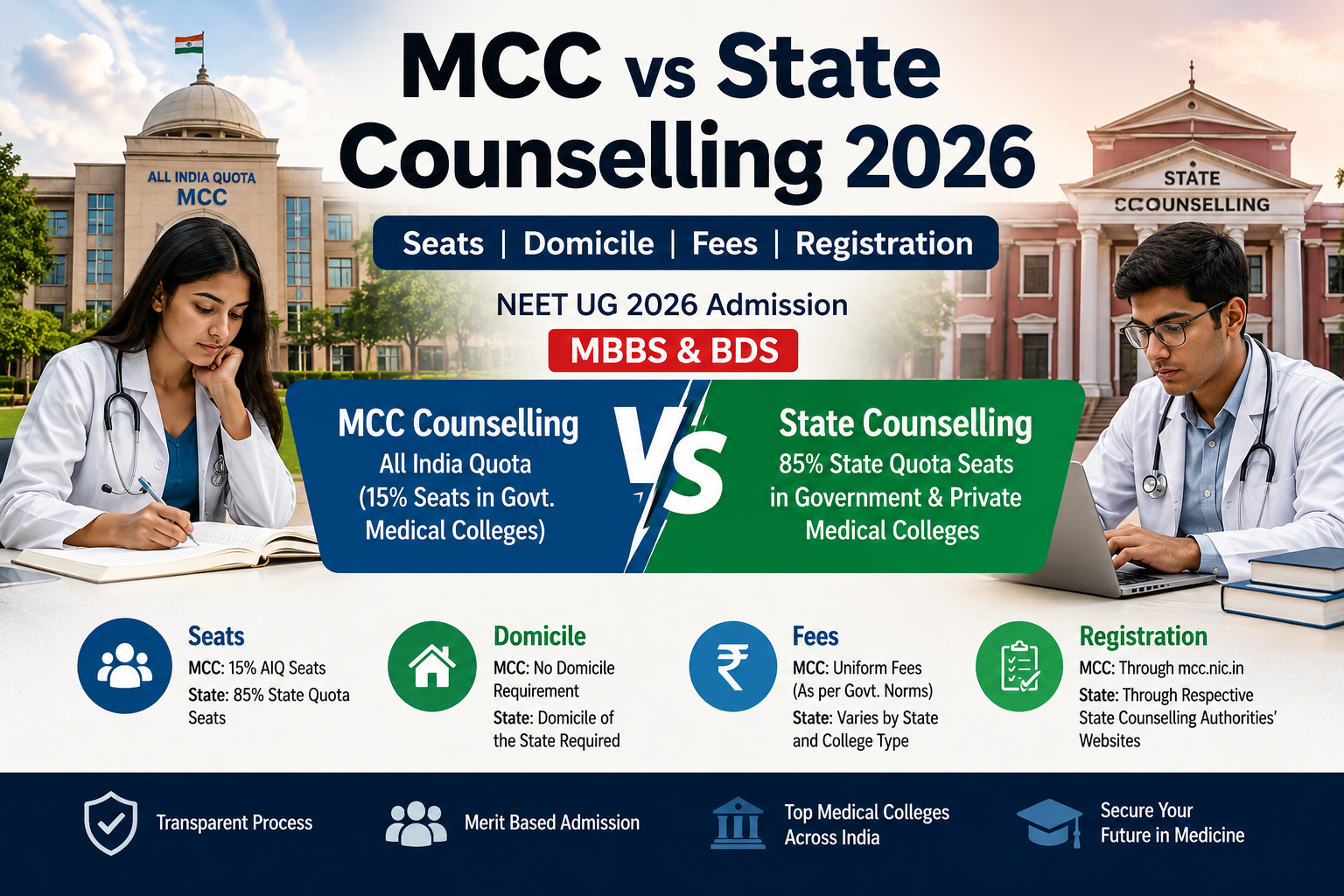
    MCC Counselling vs State Counselling: Which Is Better?

    For most eligible students, the better question is not:

    “Should I participate in MCC or state counselling?”

    Instead, ask:

    “Which counselling processes am I eligible for, and how can I use them strategically?”

    Eligible candidates may benefit from participating in both.

    MCC Counselling Can Provide Access To

    • 15% AIQ seats
    • AIIMS seats
    • JIPMER seats
    • BHU and other applicable central institutions
    • Deemed University seats
    • Certain institutional categories

    MCC’s stated undergraduate counselling responsibilities include 15% AIQ seats as well as 100% MBBS seats of AIIMS and specified central institutions.

    State Counselling Can Provide Access To

    • State government quota
    • State government colleges
    • Private medical colleges
    • Management quota where applicable
    • NRI quota where applicable
    • Minority quota where applicable

    Government MBBS Admission in India 2026

    Government medical colleges remain highly sought after because their tuition fees are generally much lower than most private medical colleges.

    However, competition can be intense.

    Government MBBS admission depends on:

    • NEET rank
    • Category
    • AIQ or state quota
    • Reservation
    • College preference
    • Seat availability
    • Counselling round

    Students targeting a government seat should prepare a broad preference list rather than restricting themselves to only a few famous colleges.


    Private Medical College Admission in India 2026

    Private MBBS admission through NEET can be an important option for candidates who do not obtain a preferred government seat.

    However, private medical colleges vary significantly in terms of:

    • Fees
    • Patient load
    • Infrastructure
    • Clinical exposure
    • Hostel quality
    • Teaching hospitals
    • Location
    • Reputation

    Before selecting a private medical college, verify:

    1. College status
    2. Tuition fee
    3. Hostel charges
    4. Additional charges
    5. Attached hospital
    6. Patient exposure
    7. Internship environment
    8. Bond conditions
    9. Location
    10. Total financial commitment

    Never choose a medical college based only on advertisements.


    Deemed University MBBS Admission 2026

    Deemed University MBBS seats falling under MCC’s counselling framework are another option for NEET-qualified candidates.

    MCC identifies Deemed Universities among the institutions for which it conducts counselling.

    Fees can be considerably higher than government medical colleges.

    Therefore, parents should calculate the complete MBBS cost before including Deemed Universities in the choice list.


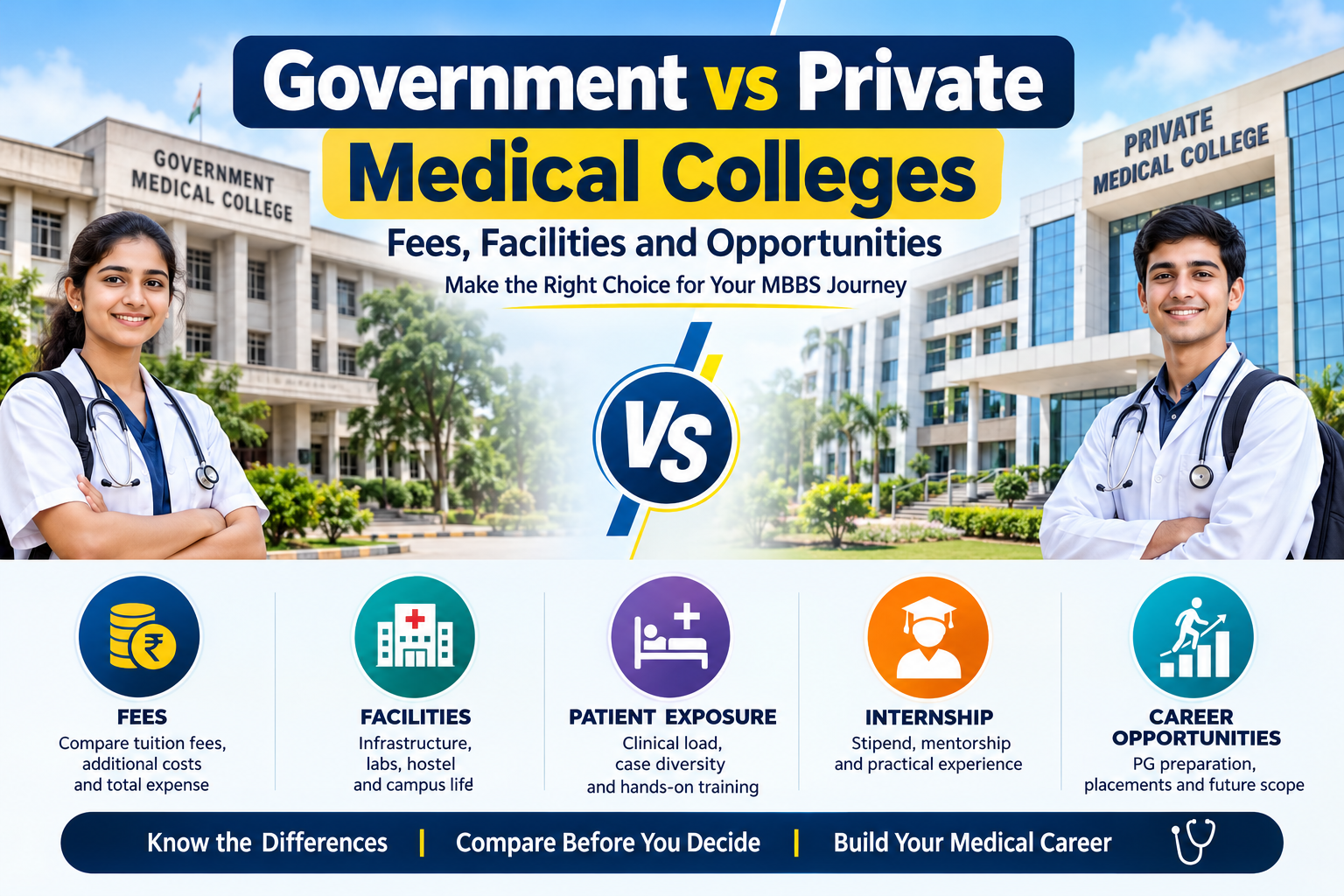
    Government vs Private Medical Colleges

    Students frequently search for government vs private medical colleges in India.

    The correct choice depends on the individual institution.

    ParameterGovernment Medical CollegePrivate Medical College
    Tuition FeesUsually lowerUsually higher
    CompetitionUsually very highVaries
    NEET RankOften more competitiveVaries
    Patient ExposureOften highInstitution-specific
    InfrastructureInstitution-specificInstitution-specific
    Teaching HospitalUsually availableMust be evaluated
    HostelCollege-specificCollege-specific
    AdmissionNEET + CounsellingNEET + Counselling

    The ownership type alone should not determine your decision.

    Clinical training quality should be a major consideration.


    MBBS Fees in India 2026

    MBBS fees in India can differ dramatically between government, private and deemed medical colleges.

    Parents should calculate the total educational cost rather than only the first-year tuition fee.

    Calculate These Expenses

    • Tuition fees
    • Admission fees
    • University fees
    • Hostel fees
    • Mess charges
    • Security deposit
    • Examination charges
    • Books
    • Equipment
    • Travel
    • Living expenses
    • Miscellaneous institutional charges
    • Bond liabilities where applicable

    Before joining any medical college, request the official fee structure.

    Avoid making major financial decisions based only on verbal assurances.


    How Much Does MBBS Cost in India?

    There is no single answer because costs differ substantially depending on:

    • Government vs private college
    • State
    • Seat category
    • University
    • Hostel
    • NRI quota
    • Deemed University
    • Additional institutional charges

    For this reason, families should determine a maximum affordable MBBS budget before choice filling begins.

    Do not wait until a seat is allotted to begin financial planning.


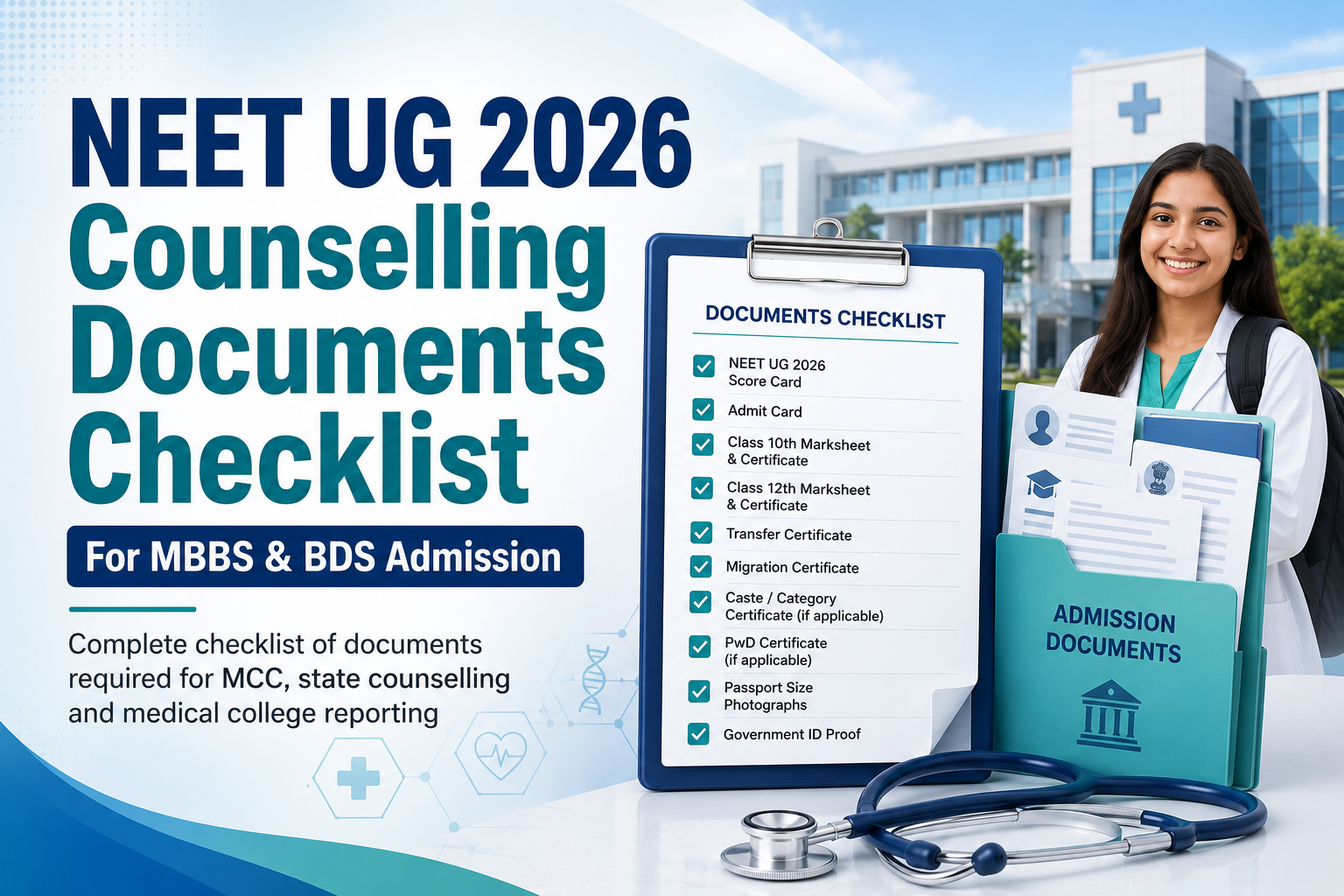
    Documents Required for MBBS Admission 2026

    Document requirements vary depending on the counselling authority and candidate category.

    Students should generally prepare:

    1. NEET UG 2026 Admit Card
    2. NEET UG 2026 Scorecard
    3. Class 10 Marksheet
    4. Class 10 Certificate
    5. Class 12 Marksheet
    6. Class 12 Certificate
    7. Valid Photo ID
    8. Passport-size photographs
    9. Category certificate if applicable
    10. SC/ST certificate if applicable
    11. OBC-NCL certificate if applicable
    12. EWS certificate if applicable
    13. Domicile certificate where applicable
    14. Residence certificate where applicable
    15. PwBD documents where applicable
    16. Counselling registration proof
    17. Payment receipt
    18. Allotment letter
    19. Migration certificate where required
    20. Transfer certificate where required
    21. Character certificate where required
    22. NRI documents where applicable

    Smart Document Preparation

    Keep:

    • Original documents
    • Several photocopy sets
    • Scanned PDF copies
    • Cloud backup
    • Pen-drive backup

    Do not wait until reporting day to organise documents.


    How to Select the Best Medical College After NEET 2026

    A medical college should not be selected only on the basis of its previous cut-off.

    Evaluate these factors.

    1. Recognition and Regulatory Status

    Verify the college and its current status using official sources.


    2. Teaching Hospital

    The attached teaching hospital is critical to medical education.

    Evaluate:

    • OPD
    • Inpatient departments
    • Emergency
    • ICU
    • Surgery
    • Medicine
    • Obstetrics
    • Paediatrics
    • Other clinical departments

    3. Patient Load

    Strong patient exposure gives students opportunities to observe diverse clinical conditions.

    A beautiful campus cannot replace meaningful clinical exposure.


    4. Clinical Training

    Evaluate how early and effectively students are exposed to:

    • Patient interaction
    • History taking
    • Clinical examination
    • Case discussion
    • Hospital procedures
    • Internship responsibilities

    5. Faculty

    Faculty availability and department stability matter.


    6. Infrastructure

    Check:

    • Laboratories
    • Library
    • Lecture halls
    • Dissection facilities
    • Skills laboratory
    • Simulation facilities
    • Hospital infrastructure
    • Hostel

    7. MBBS Fees

    Check the complete fee structure.

    A difference of several lakh rupees per year can become substantial over the duration of the programme.


    8. Bond Conditions

    Check:

    • Service bond
    • Bond period
    • Penalty
    • Discontinuation conditions

    before accepting the seat.


    9. Location

    Consider:

    • Distance from home
    • Flight/rail connectivity
    • Language
    • Climate
    • Safety
    • Living expenses

    10. Internship Exposure

    The internship is an important stage of clinical training.

    Evaluate whether interns receive sufficient practical exposure at the attached hospital.


    NEET Choice Filling Strategy 2026

    Choice filling can directly influence MBBS seat allotment.

    A good list should generally contain:

    Dream Colleges

    Highly preferred colleges with more competitive historical closing ranks.

    Target Colleges

    Colleges whose previous trends are relatively close to your rank.

    Safe Colleges

    Acceptable options where your rank appears comparatively stronger based on past trends.

    However, the final order should reflect genuine preference.


    Golden Rule of NEET Choice Filling

    Ask:

    “If I were allotted every college on this list, which one would I actually choose?”

    Put that college higher.

    Do not arrange colleges only by:

    • Previous cut-off
    • Reputation
    • Someone else’s list
    • Coaching institute prediction

    Evaluate your personal preferences.


    How to Predict MBBS College From NEET Rank

    A useful NEET college prediction requires more than marks.

    Use this formula:

    NEET Rank + Category + State + Domicile + Quota + Previous Cut-Off + Budget + Counselling Round = Realistic College Possibilities

    Previous closing ranks can help create:

    • Dream choices
    • Target choices
    • Safe choices

    However, previous-year cut-offs should be treated as indicators, not guarantees.


    Why MBBS Cut-Offs Change Every Year

    Medical college closing ranks may change due to:

    • Number of NEET candidates
    • Examination performance
    • Number of MBBS seats
    • New medical colleges
    • Seat increases
    • Category distribution
    • Candidate preferences
    • State policies
    • Counselling rules
    • Round-wise vacancies

    Therefore, never assume that a college will close at exactly the same rank as last year.


    Can I Get MBBS With a Low NEET Score?

    Possibly, depending on the candidate’s complete profile.

    A score considered low for one seat category may create different opportunities under another eligible category.

    Analyse:

    • Rank
    • Category
    • State
    • Domicile
    • Budget
    • Private options
    • Deemed options
    • Eligible quotas
    • Round-wise vacancies

    Avoid making decisions from generic statements such as:

    “Below this score, MBBS is impossible.”

    Personalised rank analysis is more reliable.


    Can I Get Government MBBS With My NEET Rank?

    Government MBBS admission chances depend on:

    • All India Rank
    • Category
    • State domicile
    • AIQ
    • State quota
    • Previous closing ranks
    • Seat availability
    • Reservation

    Compare your rank with several years of college-wise closing ranks where reliable data is available.


    Can I Get Direct MBBS Admission Without NEET?

    No legitimate recognised MBBS admission route should be based on bypassing the prescribed NEET admission framework.

    Be cautious if anyone offers:

    • MBBS without NEET
    • Guaranteed government seat
    • Guaranteed admission through connections
    • Admission outside counselling
    • Cash-only seat
    • Fake allotment
    • Rank manipulation

    NTA has also published a notice concerning fake, altered or AI-generated NEET UG 2026 documents, highlighting the need to verify all documents through official channels.


    Common NEET Counselling Mistakes to Avoid in 2026

    1. Missing Registration Deadlines

    Register early whenever possible.


    2. Depending on Unofficial Counselling Dates

    Use MCC and state counselling websites.


    3. Registering Only for One Counselling Route

    Explore every counselling process for which you are eligible.


    4. Incorrect Choice Order

    Arrange colleges according to genuine preference.


    5. Copying Another Student’s Choice List

    Your rank, budget and priorities may be different.


    6. Ignoring Private Colleges Until the Last Moment

    Research backup options before counselling begins.


    7. Ignoring Total MBBS Fees

    Check the complete programme cost.


    8. Not Checking Bond Conditions

    Service bonds can affect future plans.


    9. Depending Only on Last Year’s Cut-Off

    Use multiple years of data where appropriate.


    10. Missing Documents

    Prepare your document folder in advance.


    11. Ignoring Security Deposit Rules

    Understand refund and forfeiture conditions.


    12. Missing College Reporting Deadline

    Failure to report may lead to cancellation according to applicable rules.


    13. Selecting a College Only by Brand Name

    Check clinical exposure and hospital quality.


    14. Selecting a College Only by Infrastructure

    A modern campus does not automatically mean better medical training.


    15. Paying an Agent for a Guaranteed Seat

    Seat allotment should follow the official counselling process.


    MBBS Admission Strategy Based on NEET Rank

    A practical counselling strategy should vary according to the competitiveness of the candidate’s rank.

    Strong Competitive Rank

    Consider:

    • Top government medical colleges
    • AIIMS
    • Strong AIQ preferences
    • Leading state medical colleges

    Moderate Competitive Rank

    Consider:

    • Wider AIQ list
    • State government colleges
    • Less competitive locations
    • Private colleges as backup

    Borderline Government MBBS Rank

    Consider:

    • Extensive state counselling
    • Broad choice filling
    • Multiple rounds
    • Private options within budget
    • Deemed Universities where financially practical

    Rank Unlikely for Government MBBS

    Analyse:

    • Private medical colleges
    • Deemed Universities
    • NRI options if genuinely eligible
    • Other suitable healthcare programmes if MBBS is financially impractical

    Do not allow emotional pressure to create an unsustainable financial decision.


    MBBS Admission Financial Planning for Parents

    For parents, MBBS admission in India 2026 is both an academic and financial decision.

    Before counselling, calculate:

    Total Tuition Fee

    Hostel & Mess

    University Charges

    Books & Equipment

    Travel

    Living Costs

    Other Charges

    Potential Bond Liability

    Ask:

    “Can we comfortably fund the entire MBBS programme?”

    Do not ask only:

    “Can we pay the first-year fee?”


    Role of Parents During NEET Counselling

    Parents can support students by:

    • Monitoring deadlines
    • Organising documents
    • Checking college fees
    • Comparing colleges
    • Planning finances
    • Reviewing bond conditions
    • Verifying information
    • Evaluating hostel and location
    • Preventing panic-driven decisions

    However, students should also participate actively in the final choice because they will spend several years studying at the institution.


    MBBS Admission Checklist 2026

    Before accepting an MBBS seat, confirm:

    ✅ NEET UG qualification
    ✅ Correct NEET rank
    ✅ Candidate category
    ✅ Domicile eligibility
    ✅ AIQ eligibility
    ✅ State counselling eligibility
    ✅ Counselling registration
    ✅ Choice list
    ✅ Allotment letter
    ✅ College status
    ✅ Seat category
    ✅ Tuition fees
    ✅ Hostel fees
    ✅ Additional charges
    ✅ Security deposit
    ✅ Refund rules
    ✅ Bond conditions
    ✅ Teaching hospital
    ✅ Patient load
    ✅ Clinical exposure
    ✅ Internship environment
    ✅ Required documents
    ✅ Reporting deadline


    Best MBBS Counselling Strategy for 2026

    A strong counselling plan can be summarised as:

    1. Analyse Your Rank

    Use rank rather than marks alone.

    2. Determine Eligibility

    Identify AIQ, state and other eligible routes.

    3. Set Your Budget

    Decide the maximum affordable amount before counselling.

    4. Research Colleges

    Compare cut-offs, fees, hospitals and locations.

    5. Prepare a Broad Choice List

    Include dream, target and safe options.

    6. Arrange Colleges by Genuine Preference

    Do not blindly follow cut-offs.

    7. Monitor Every Counselling Round

    Seat movement can create new opportunities.

    8. Verify Before Paying

    Use official sources for major financial and admission decisions.


    Frequently Asked Questions About MBBS Admission in India 2026

    1. How can I get MBBS admission in India in 2026?

    To get MBBS admission in India 2026, candidates must satisfy the applicable eligibility requirements, qualify NEET UG 2026, participate in MCC and/or state counselling, fill college choices, obtain a seat allotment and complete the admission formalities.


    2. Is NEET compulsory for MBBS admission in 2026?

    Yes. NEET UG is the common entrance examination for undergraduate medical admission in India.


    3. Has the NEET UG 2026 result been declared?

    Yes. NTA’s official NEET UG portal currently provides access to the NEET UG 2026 Score Card.


    4. Has MCC counselling 2026 started?

    The MCC portal is active for Session 2026 and has published 2026-related UG notices. At the time of this update, the Candidate Activity Board indicates that further activity will be updated. Candidates should monitor the official MCC website for the latest registration and schedule announcements.


    5. Who conducts 15% AIQ MBBS counselling?

    The Medical Counselling Committee conducts online counselling for the 15% All India Quota undergraduate seats under its jurisdiction.


    6. Who conducts state quota MBBS counselling?

    The designated counselling authority of the respective state or UT conducts counselling for seats falling under its jurisdiction.


    7. Can I participate in both MCC and state counselling?

    Eligible students may participate in multiple counselling processes for which they satisfy the applicable requirements, subject to current counselling rules.


    8. Is qualifying NEET enough for MBBS admission?

    No. Qualifying NEET does not guarantee an MBBS seat. Actual admission depends on rank, category, quota, seat availability and choice filling.


    9. Can I get MBBS without NEET?

    Recognised MBBS admission in India must follow the prescribed NEET-based admission framework.


    10. What rank is required for a government MBBS college?

    There is no single rank applicable to all government colleges. Closing ranks differ by college, state, category, quota and counselling round.


    11. What is the 15% All India Quota?

    The 15% AIQ is a national counselling pool for specified undergraduate medical seats handled by MCC under its jurisdiction.


    12. What is the 85% state quota?

    The remaining government seats outside the AIQ pool are commonly handled through state counselling, subject to applicable state and institutional rules.


    13. Is a private medical college good for MBBS?

    A private medical college can be a suitable option if it provides appropriate clinical exposure, teaching quality, infrastructure and affordability. Evaluate the individual institution rather than ownership alone.


    14. How should I choose an MBBS college?

    Compare:

    • Clinical exposure
    • Teaching hospital
    • Patient load
    • Fees
    • Faculty
    • Infrastructure
    • Location
    • Hostel
    • Internship
    • Bond requirements

    15. How should I prepare my NEET choice list?

    Create dream, target and safe options, but arrange them according to genuine preference.


    16. Can MBBS cut-offs decrease in later rounds?

    Closing ranks can change between rounds depending on vacancies and candidate movement. Previous trends do not guarantee future results.


    17. What documents are needed for MBBS counselling?

    Common documents include the NEET scorecard, admit card, Class 10 and 12 certificates, identity proof, photographs and applicable category, domicile or quota documents.


    18. Which is better: AIQ or state counselling?

    Neither is universally better. Eligible candidates should evaluate both based on rank, domicile, category, college preference and seat availability.


    19. Should I choose government or private MBBS?

    Government colleges are generally more affordable, while private colleges can expand available options. Compare the individual college’s hospital, patient exposure, fees and academic environment.


    20. Where can I check official MBBS counselling updates?

    Candidates should use:

    • NTA NEET
    • Medical Counselling Committee
    • National Medical Commission
    • Respective state counselling authority
    • Official college/university websites

    MBBS Admission in India 2026: Final Advice

    MBBS admission in India 2026 is not just about getting a good NEET score.

    A successful admission strategy depends on:

    NEET Rank + Category + Domicile + Quota + Budget + College Research + Choice Filling + Counselling Decisions

    Students with similar ranks can receive very different outcomes because their counselling strategies are different.

    Therefore, students and parents should begin counselling preparation early.

    Do not make an important medical education decision based only on:

    • Social media predictions
    • WhatsApp messages
    • YouTube videos
    • Unverified agents
    • Previous-year cut-offs
    • College advertisements

    Verify important information through official sources and compare every option carefully.


    Need Help With MBBS Admission 2026?

    Choosing the right medical college requires analysing hundreds of combinations involving NEET rank, category, quota, domicile, fees, previous cut-offs and college preferences.

    EducationMESD helps students and parents understand their available options and prepare a structured medical admission strategy.

    EducationMESD Guidance Includes

    • NEET 2026 Rank Analysis
    • MBBS College Shortlisting
    • 15% All India Quota Guidance
    • State Counselling Guidance
    • Government Medical College Options
    • Private Medical College Options
    • Deemed University Options
    • MBBS Fee Comparison
    • Choice Filling Strategy
    • College Comparison
    • Counselling Documentation
    • Admission Planning

    Make Your MBBS Decision With Better Information

    Right Rank Analysis. Right College Choices. Right Counselling Strategy.

    EducationMESD – Your Trusted Guide for Medical Education and MBBS Admission Planning.


    Disclaimer

    Medical admission regulations, counselling schedules, eligibility requirements, seat matrices, fees, reservation rules, cut-offs, bonds and reporting requirements may change through official notifications.

    Students and parents should always verify the latest information from NTA, MCC, NMC, the concerned state counselling authority and the respective medical college before taking any admission or financial decision.

  • Government vs Private Medical Colleges in India: Fees, Facilities and Career Opportunities in 2026

    Government vs Private Medical Colleges in India: Fees, Facilities and Career Opportunities in 2026

    Choosing between government vs private medical colleges is one of the most important decisions candidates must make during NEET UG counselling. The type of medical college you select can affect your total MBBS expenses, clinical exposure, internship experience, campus life and future career planning.

    Government medical colleges are usually preferred because of their comparatively affordable fees, established teaching hospitals and high patient inflow. Private medical colleges, on the other hand, may provide modern infrastructure, advanced laboratories, structured academic systems and better campus facilities.

    However, a government medical college is not automatically better than every private medical college. Similarly, an attractive private medical college campus does not necessarily guarantee excellent clinical training.

    Before filling and locking choices, candidates should compare:

    • MBBS tuition fees
    • Total course expenses
    • NMC recognition status
    • Teaching-hospital patient flow
    • Faculty availability
    • Clinical exposure
    • Internship stipend
    • Service bond
    • Hostel facilities
    • Location and safety
    • Post-MBBS opportunities

    This detailed guide explains the difference between government and private medical colleges in India and helps NEET UG 2026 candidates make a practical, informed and financially responsible decision.


    Government vs Private Medical Colleges: Quick Comparison

    Comparison factorGovernment medical collegesPrivate medical colleges
    MBBS tuition feesGenerally lower and subsidisedUsually considerably higher
    NEET UG competitionVery highDepends on college and seat category
    Required NEET rankUsually more competitiveWider range depending on quota
    Patient exposureOften high because of large patient inflowVaries according to the attached hospital
    Clinical case diversityUsually broadStrong in established teaching hospitals
    InfrastructureMay be older but functionalOften modern and well maintained
    Simulation laboratoriesAvailable in leading institutionsCommon in many established private colleges
    Hostel expensesUsually lowerGenerally higher
    Faculty experienceStrong in many established collegesVaries considerably between institutions
    Internship workloadOften intensiveDepends on hospital occupancy and patient flow
    Internship stipendGoverned by applicable institutional or state policyAmount and regularity may vary
    Service bondApplicable in several statesMay also apply according to state rules
    Research opportunitiesStrong in leading government institutionsGood in selected private and deemed universities
    Campus amenitiesUsually basic to moderateOften better developed
    Financial burdenComparatively lowerCan be substantial
    Career eligibilityRecognised MBBS graduates can pursue standard career pathwaysSame, subject to recognised qualification and applicable rules

    What Is a Government Medical College?

    A government medical college is established, funded or administered by the central government, a state government, a municipal authority or another government-controlled institution.

    Because a significant portion of the cost is publicly funded, MBBS tuition fees in government medical colleges are generally lower than fees in private medical colleges.

    Government medical colleges are commonly attached to large public hospitals that treat patients from different economic and social backgrounds. This can provide undergraduate students with exposure to a wide range of medical conditions, emergency cases, surgeries, maternal healthcare services and public-health programmes.

    Examples of government-controlled medical institutions include:

    • State government medical colleges
    • Central government institutions
    • All India Institute of Medical Sciences institutions
    • Government autonomous medical colleges
    • Municipal medical colleges
    • Employee State Insurance medical colleges
    • Medical colleges operated by government societies

    Admission to most government MBBS seats is based on NEET UG rank, category, quota, domicile eligibility and counselling rules.


    What Is a Private Medical College?

    A private medical college is operated by a private educational trust, society, university, charitable organisation or private institution.

    Private medical colleges may offer different categories of seats, depending on the state and institution, such as:

    • Government-quota seats
    • State-quota seats
    • Private-quota seats
    • Management-quota seats
    • Minority-quota seats
    • Institutional-quota seats
    • NRI-quota seats

    The fee for each seat category can be different, even within the same medical college.

    Some private medical colleges are affiliated with state health universities, while others are part of deemed-to-be universities. Candidates must understand the applicable counselling authority before registration and choice filling.

    MCC conducts counselling for 15% All India Quota MBBS and BDS seats contributed by participating states, along with specified central institutions and other categories under its jurisdiction. Candidates must follow the relevant state counselling authority for the applicable state-quota and private-college seats.


    Government vs Private Medical Colleges: Detailed Comparison

    1. MBBS Fees in Government vs Private Medical Colleges

    The most significant difference between government and private medical colleges is the cost of MBBS education.

    Government medical college fees

    Government medical college fees are generally subsidised. This makes government colleges financially accessible to students from a wider range of socioeconomic backgrounds.

    However, government medical college fees are not identical across India. The amount may depend on:

    • State fee regulations
    • Type of government institution
    • University charges
    • Candidate category
    • Hostel selection
    • Bond conditions
    • Institutional policies

    Candidates should not assume that every government medical college charges the same annual fee.

    Private medical college fees

    Private medical college fees are normally higher because the institutions receive less direct government funding and bear significant expenditure on faculty, hospitals, laboratories, equipment, infrastructure and campus administration.

    The fee can vary according to:

    • College reputation
    • State fee regulation
    • Government or management quota
    • Minority status
    • Deemed university status
    • NRI quota
    • Hostel type
    • Location
    • Attached hospital facilities

    A government-quota seat in a private medical college may be considerably more affordable than a management or NRI seat in the same college.

    Important rule regarding MBBS tuition duration

    The National Medical Commission has clarified that MBBS course fees should be charged only for the prescribed academic duration of four and a half years. The academic course is followed by compulsory rotating medical internship.

    Candidates should examine any demand for tuition beyond the prescribed academic duration and seek written clarification from the institution and appropriate counselling authority.


    2. Total Cost of MBBS Education

    Candidates frequently compare colleges using only the annual tuition fee. This can lead to serious financial miscalculations.

    The total cost of MBBS in India may include much more than tuition.

    Additional expenses to calculate

    ExpensePoints to verify
    Tuition feeAnnual amount and permitted escalation
    Admission feeOne-time or recurring
    Security depositRefundable or non-refundable
    Hostel feeMandatory or optional
    Mess chargesMonthly or annual
    University registrationOne-time or yearly
    Examination feeUniversity and supplementary examinations
    Laboratory feeIncluded in tuition or separate
    Library feeIncluded or separately charged
    Clinical instrumentsStethoscope, dissection kit and examination tools
    Books and subscriptionsPrinted and digital resources
    TransportHostel-to-hospital or college transport
    Electricity and internetIncluded or separately charged
    Internship-related chargesVerify whether any are applicable
    Service-bond penaltyAmount payable for non-compliance
    Discontinuation penaltyConsequences of leaving the course
    Miscellaneous chargesSports, cultural activities and student services

    Before selecting a private MBBS seat, families should prepare a complete course budget covering at least:

    • Four-and-a-half years of academic study
    • One year of compulsory internship
    • Hostel and living expenses
    • Annual fee increases
    • Travel expenses
    • Emergency financial requirements

    A medical college should be considered affordable only when the family can manage the complete cost—not merely the first-year fee.


    3. NEET Rank and Admission Competition

    Government medical college seats are highly competitive because of their lower fees, established reputation and strong patient exposure.

    Candidates generally require a better NEET rank to obtain:

    • Government medical college seats
    • Popular state-quota colleges
    • All India Quota seats
    • Government colleges in metropolitan cities
    • Established institutions with strong postgraduate departments

    Private medical colleges may remain available at a wider range of NEET ranks, depending on:

    • Seat category
    • State
    • College demand
    • Tuition fee
    • Counselling round
    • Candidate category
    • Domicile rules
    • NRI eligibility

    However, qualifying NEET UG does not guarantee admission to a particular private college or seat category.

    Candidates must participate only through the official counselling process. They should avoid agents or intermediaries who promise:

    • Confirmed admission without counselling
    • Admission without NEET eligibility
    • A seat through cash payment
    • Backdoor admission
    • Guaranteed seat conversion
    • Unofficial management approval

    All medical colleges and approved MBBS seats should be verified through the National Medical Commission’s College and Course Search and the latest applicable seat matrix. NMC’s current search facility includes the institution’s management type, annual intake, recognition status and permission details.


    4. Infrastructure and Campus Facilities

    Infrastructure in government medical colleges

    Established government medical colleges may have:

    • Large teaching hospitals
    • Emergency and trauma departments
    • Operation theatres
    • Intensive care units
    • Blood banks
    • Diagnostic laboratories
    • Community medicine facilities
    • Medical libraries
    • Museums and demonstration rooms
    • Speciality and super-speciality departments
    • Rural and urban health centres

    Some government colleges, particularly older institutions, may have ageing buildings, crowded wards or basic hostel facilities.

    Candidates should not reject a government medical college only because the buildings appear old. A busy teaching hospital with experienced faculty and strong clinical exposure can provide excellent medical education even when the campus is not visually impressive.

    Infrastructure in private medical colleges

    Many private medical colleges invest heavily in:

    • Modern lecture theatres
    • Smart classrooms
    • Digital libraries
    • Clinical skills laboratories
    • Simulation centres
    • Advanced diagnostic equipment
    • Air-conditioned academic blocks
    • Well-maintained hostels
    • Sports facilities
    • Campus security
    • Wi-Fi connectivity
    • Hospital information systems

    These facilities can create a structured and comfortable learning environment.

    However, candidates must verify whether the equipment and laboratories are regularly used for undergraduate teaching. Infrastructure should support medical learning rather than function only as a promotional feature.


    5. Patient Exposure and Clinical Training

    Clinical exposure is one of the most important factors when choosing an MBBS college.

    A medical student must learn how to:

    • Take patient history
    • Perform physical examinations
    • Develop clinical reasoning
    • Interpret laboratory reports
    • Understand radiological findings
    • Observe medical procedures
    • Participate in supervised patient care
    • Communicate with patients and families
    • Respond to emergency situations
    • Work with multidisciplinary healthcare teams

    Patient exposure in government colleges

    Government hospitals often receive a high number of patients because treatment is free or comparatively affordable.

    This may provide exposure to:

    • Common diseases
    • Advanced untreated conditions
    • Emergency cases
    • Trauma
    • Infectious diseases
    • Maternal and child healthcare
    • Surgical cases
    • Chronic illnesses
    • Rural healthcare challenges
    • Public-health programmes

    High patient inflow can be an important advantage, but the quality of learning also depends on faculty supervision, departmental organisation and opportunities for student participation.

    Patient exposure in private colleges

    Patient exposure in private medical colleges varies significantly.

    Established private teaching hospitals may have:

    • High outpatient attendance
    • Strong surgical departments
    • Advanced diagnostic facilities
    • Modern intensive care units
    • Speciality and super-speciality services
    • Organised clinical documentation
    • Experienced consultants

    Newer or poorly located private colleges may have lower patient attendance, which can reduce clinical learning opportunities.

    What candidates should verify

    Before selecting a college, ask about:

    • Average outpatient attendance
    • Hospital bed occupancy
    • Number of functioning beds
    • Emergency patient volume
    • Daily deliveries
    • Major and minor surgeries
    • ICU and NICU facilities
    • Diagnostic workload
    • Blood-bank availability
    • Community health postings
    • Clinical rotations
    • Number of postgraduate departments

    Do not judge clinical exposure only from the number of hospital beds mentioned in the brochure. Actual occupancy and patient turnover are more meaningful.


    6. Faculty Quality and Academic Environment

    Faculty quality depends on experience, availability, stability and involvement in undergraduate teaching.

    Government medical college faculty

    Established government medical colleges may provide:

    • Experienced senior professors
    • Faculty managing complex clinical cases
    • Strong departmental traditions
    • Exposure to postgraduate teaching
    • Government healthcare experience
    • Research guidance
    • Public-health programme exposure
    • Established alumni networks

    Possible limitations may include:

    • Large student batches
    • Heavy patient workload
    • Less individual attention
    • Vacant faculty positions in some newer colleges
    • Administrative delays

    Private medical college faculty

    Good private medical colleges may provide:

    • Structured academic calendars
    • Regular internal assessments
    • Tutorial-based learning
    • Digital learning systems
    • Faculty mentoring
    • Simulation-based teaching
    • Smaller academic groups
    • Research support
    • International collaborations

    However, faculty turnover can affect teaching continuity in some institutions.

    Candidates should speak with current students to understand:

    • Whether regular classes are conducted
    • Whether professors are available
    • How clinical postings are organised
    • Whether internal assessments are fair
    • Whether academic doubts are addressed
    • Whether faculty members remain associated with the college long term

    7. Hostel Facilities and Campus Life

    MBBS is academically demanding, and students often spend five-and-a-half years around the college and hospital. Therefore, hostel conditions can significantly affect health, safety and academic performance.

    Government medical college hostels

    Government hostels are generally more affordable. However, facilities may vary in terms of:

    • Room sharing
    • Cleanliness
    • Washrooms
    • Water supply
    • Internet connectivity
    • Maintenance
    • Mess quality
    • Security
    • Availability during internship

    Private medical college hostels

    Private colleges often provide:

    • Better-maintained rooms
    • Security systems
    • Internet access
    • Recreational facilities
    • Housekeeping
    • Attached washrooms in selected categories
    • Modern mess facilities
    • Campus transport
    • Separate hostel blocks

    These facilities usually come with higher hostel and mess charges.

    Hostel checklist

    Candidates should verify:

    • Is hostel accommodation compulsory?
    • Are hostel fees refundable?
    • Is the hostel available during internship?
    • How many students share one room?
    • Is the campus safe?
    • Is the hospital within walking distance?
    • Are food and drinking water satisfactory?
    • Is internet access available?
    • Are there restrictions or curfew rules?
    • Is electricity charged separately?

    8. Internship Experience and Stipend

    After completing the academic component of MBBS, students must complete compulsory rotating medical internship according to the applicable regulatory framework.

    Internship commonly includes rotations in areas such as:

    • General medicine
    • General surgery
    • Paediatrics
    • Obstetrics and gynaecology
    • Community medicine
    • Emergency medicine
    • Orthopaedics
    • Psychiatry
    • Anaesthesiology
    • Elective or allied departments

    Internship in government medical colleges

    Government-college interns may receive extensive hands-on exposure because of:

    • High patient volume
    • Busy emergency departments
    • Labour-room duties
    • Ward responsibilities
    • Public-health postings
    • Frequent procedures
    • High clinical workload

    The stipend and working conditions depend on the relevant state or institutional policy.

    Internship in private medical colleges

    The quality of internship in private colleges depends on:

    • Hospital patient flow
    • Clinical workload
    • Faculty supervision
    • Institutional policy
    • Availability of postgraduate residents
    • Number of interns
    • Stipend rules

    Some private institutions provide strong, supervised clinical training, while others may offer limited responsibilities or variable stipend arrangements.

    Questions to ask current interns

    1. What is the monthly internship stipend?
    2. Is it paid regularly?
    3. What is the average duty duration?
    4. Are interns allowed to perform procedures under supervision?
    5. How busy are the medicine and surgery departments?
    6. How many deliveries occur in the hospital?
    7. Is hostel accommodation available during internship?
    8. Are interns charged any additional fee?
    9. Is attendance managed transparently?
    10. Are rural or community postings properly organised?

    9. Service Bond and Discontinuation Penalty

    A service bond may require an MBBS graduate to work for a specified period in a government or designated health facility after graduation.

    Bond rules vary by:

    • State
    • Institution
    • Seat category
    • Counselling authority
    • Admission year

    Candidates should verify:

    • Mandatory service duration
    • Rural-service requirement
    • Bond penalty
    • Conditions for exemption
    • Postings after graduation
    • Whether postgraduate admission affects the bond
    • Rules for returning original documents
    • Whether the bond applies to all seat categories

    Students should also examine the discontinuation clause.

    Leaving an MBBS course after admission may lead to:

    • Loss of security deposit
    • Payment of a discontinuation penalty
    • Liability for remaining tuition
    • Delay in returning documents
    • Debarment under applicable counselling rules
    • Forfeiture of counselling security money

    Never accept a seat without reading the official bond and discontinuation conditions.


    10. Research and Academic Opportunities

    Research in government medical colleges

    Leading government institutions may offer:

    • Established research departments
    • Faculty-led clinical studies
    • Community health research
    • Government-funded projects
    • Institutional ethics committees
    • Scientific conferences
    • Case-report opportunities
    • Postgraduate and super-speciality exposure

    Research in private medical colleges

    Selected private and deemed universities may provide:

    • Modern research laboratories
    • Institutional funding
    • Biomedical engineering collaborations
    • Medical simulation research
    • International partnerships
    • Digital health projects
    • Artificial intelligence in healthcare research
    • Dedicated research centres

    Research opportunities depend more on the individual institution than on whether the college is government or private.

    Candidates interested in research should check:

    • Faculty publications
    • Research laboratories
    • Ethics committee activity
    • Student research programmes
    • Conference participation
    • Institutional grants
    • Interdisciplinary collaborations

    11. Career Opportunities After MBBS

    Graduates from recognised government and private medical colleges can pursue the same broad professional pathways, subject to applicable eligibility, registration and recruitment requirements.

    Career options after MBBS

    • Junior residency
    • Postgraduate medical education
    • Government medical officer
    • Private hospital employment
    • Clinical practice
    • Public-health services
    • Medical research
    • Medical teaching
    • Hospital administration
    • Healthcare management
    • Armed forces medical services
    • Clinical informatics
    • Digital health
    • Medical writing
    • Pharmaceutical research
    • Overseas licensing pathways

    The name of the college may influence early networking and exposure, but long-term success generally depends on:

    • Clinical competence
    • Communication skills
    • Professional ethics
    • Academic performance
    • Postgraduate entrance preparation
    • Practical experience
    • Research profile
    • Continuous medical education

    A student from a private medical college is not automatically disadvantaged in postgraduate entrance examinations or government recruitment.

    Similarly, admission to a government college does not guarantee postgraduate success without consistent study and clinical skill development.


    Advantages of Government Medical Colleges

    The major benefits of studying MBBS in a government medical college may include:

    • Comparatively affordable tuition fees
    • Lower overall financial burden
    • High patient inflow in many institutions
    • Exposure to diverse clinical conditions
    • Busy emergency and trauma departments
    • Established faculty in older colleges
    • Affordable hostel facilities
    • Strong alumni networks
    • Exposure to public-health systems
    • Opportunities to understand rural healthcare
    • Competitive academic environment
    • Reduced dependence on educational loans

    Government medical colleges are particularly attractive for candidates who secure a competitive NEET rank and want strong clinical exposure at a manageable cost.


    Disadvantages of Government Medical Colleges

    Possible limitations may include:

    • Extremely high admission competition
    • Older infrastructure in some institutions
    • Crowded hospitals
    • Limited hostel capacity
    • Heavy clinical workload
    • Large student batches
    • Service-bond requirements
    • Rural or remote locations
    • Basic campus amenities
    • Administrative delays
    • Limited individual mentoring in some departments

    These disadvantages are not applicable to every government college. Candidates must assess each institution separately.


    Advantages of Private Medical Colleges

    The potential advantages of private medical colleges include:

    • Modern infrastructure
    • Advanced clinical skills laboratories
    • Simulation-based learning
    • Digitised academic systems
    • Better-maintained hostels
    • Structured internal assessment
    • Campus security
    • Modern diagnostic facilities
    • Organised mentoring in selected colleges
    • Availability across a wider range of NEET ranks
    • Research opportunities in selected universities
    • Better recreational facilities
    • Technology-enabled classrooms

    A well-established private college with a busy teaching hospital can provide excellent medical education and clinical exposure.


    Disadvantages of Private Medical Colleges

    The major concerns include:

    • High tuition fees
    • Expensive hostel and mess charges
    • Financial pressure on families
    • Different fees for different quotas
    • Possibility of annual fee escalation
    • Variable patient inflow
    • Variation in internship stipend
    • Faculty turnover in some institutions
    • Additional institutional charges
    • High discontinuation penalties
    • Dependence on the quality of the attached hospital
    • Risk of selecting a college based only on infrastructure

    Families should avoid taking an unaffordable private MBBS seat without carefully evaluating the long-term financial consequences.


    Government or Private Medical College: Which Is Better?

    There is no universal answer.

    A government medical college may be the better option when:

    • The candidate has a competitive NEET rank.
    • The college has a strong teaching hospital.
    • The family wants to minimise educational expenses.
    • The candidate values high-volume clinical exposure.
    • The bond conditions are acceptable.
    • Hostel and location are manageable.

    A private medical college may be appropriate when:

    • A government seat is not available.
    • The total fee is affordable without creating unmanageable debt.
    • The college is recognised.
    • The attached hospital has sufficient patient flow.
    • Faculty members are stable and experienced.
    • Internship conditions are satisfactory.
    • The fee structure is transparent.
    • Infrastructure genuinely supports clinical education.

    The correct comparison is not simply government college vs private college.

    Candidates should compare:

    One specific government medical college against one specific private medical college.

    A reputed private medical college may be preferable to a newly established government college with limited faculty, inadequate connectivity or an underdeveloped hospital. Conversely, a government college with excellent patient exposure may offer greater educational value than an expensive private institution with limited clinical workload.


    How to Choose the Best Medical College After NEET UG

    Step 1: Verify NMC recognition

    Confirm:

    • College name
    • MBBS course approval
    • Annual seat intake
    • Recognition status
    • Permission status
    • Year of establishment

    NMC’s College and Course Search currently provides filters for government and private institutions and displays annual intake and recognition-related information.

    Step 2: Check the official counselling authority

    Identify whether the seat is offered through:

    • MCC counselling
    • State counselling
    • Central university counselling under MCC
    • Deemed university counselling
    • Institutional category permitted by the authority

    Do not rely only on college representatives or agents.

    Step 3: Calculate the complete MBBS cost

    Include:

    • Tuition
    • Hostel
    • Mess
    • University charges
    • Security deposit
    • Examination fees
    • Travel
    • Instruments
    • Fee escalation
    • Bond implications

    Step 4: Evaluate the teaching hospital

    Check:

    • Outpatient attendance
    • Bed occupancy
    • Emergency services
    • Surgery volume
    • Deliveries
    • ICU facilities
    • Diagnostic services
    • Clinical departments

    Step 5: Examine faculty and academic performance

    Ask about:

    • Faculty stability
    • Class regularity
    • University results
    • Clinical teaching
    • Internal assessment
    • Mentoring
    • Research support

    Step 6: Check internship conditions

    Verify:

    • Monthly stipend
    • Payment regularity
    • Clinical duties
    • Supervision
    • Working hours
    • Accommodation

    Step 7: Understand the service bond

    Read all clauses concerning:

    • Mandatory service
    • Bond duration
    • Penalty
    • Rural postings
    • Document retention
    • Exemptions

    Step 8: Speak with current students

    Speak with students from different batches, particularly:

    • Second- or third-year MBBS students
    • Final-year students
    • Interns
    • Recent graduates

    Do not depend only on one student’s opinion.

    Step 9: Visit the college when possible

    Inspect:

    • Hospital wards
    • OPD
    • Emergency department
    • Hostels
    • Library
    • Laboratories
    • Campus safety
    • Transport
    • Surrounding area

    Step 10: Arrange choices in genuine preference order

    Choice filling should reflect the college you genuinely prefer.

    Do not place an unaffordable college higher merely because it has better buildings or stronger advertising.


    Medical College Selection Scorecard

    Use this 100-point scorecard to compare shortlisted colleges objectively.

    Selection criterionSuggested weight
    Teaching hospital and patient exposure20
    Total MBBS cost15
    NMC approval and seat status15
    Faculty and academic quality10
    Internship experience and stipend10
    Service bond and discontinuation rules10
    Infrastructure and laboratories5
    Hostel and campus safety5
    Location and connectivity5
    Student feedback and academic record5
    Total100

    Score every college independently. This reduces the risk of choosing a college based only on reputation, fees or campus appearance.


    Red Flags to Avoid While Selecting a Medical College

    Be cautious when:

    • The college or approved intake cannot be verified through NMC.
    • The institution refuses to provide the complete fee structure.
    • An agent demands cash for a confirmed seat.
    • Admission is offered outside official counselling.
    • The teaching hospital has very low patient attendance.
    • Major departments are not functional.
    • Students report frequent faculty shortages.
    • Internship stipend information is unclear.
    • Hostel charges are not disclosed.
    • The institution demands tuition beyond the prescribed academic duration.
    • The service bond is not clearly explained.
    • The discontinuation penalty is extremely high.
    • Original documents are retained without transparent rules.
    • The college pressures candidates to make immediate unofficial payments.

    Frequently Asked Questions

    1. Is a government medical college better than a private medical college?

    Government medical colleges are generally preferred because of lower fees and potentially higher patient inflow. However, quality varies. An established private medical college with experienced faculty and a busy teaching hospital may provide better training than a poorly developed or newly established institution.

    2. Why are government medical college fees lower?

    Government colleges receive public funding and subsidies. Therefore, students usually pay a smaller portion of the actual cost of medical education.

    3. Is MBBS from a private medical college valid?

    Yes, provided the medical college and MBBS intake are duly recognised or permitted by the competent authority and the candidate obtains admission through the authorised counselling process.

    4. Do private medical college graduates get government jobs?

    Graduates holding a recognised medical qualification can apply for eligible government recruitment, junior residency and postgraduate programmes according to the applicable rules.

    5. Which type of college offers better patient exposure?

    Government hospitals often receive larger patient volumes, but this is not true in every case. Several established private teaching hospitals also provide excellent clinical exposure. Candidates should evaluate actual patient flow and hospital occupancy.

    6. Are private medical colleges available at lower NEET ranks?

    Some private, management and NRI seats may be available at lower closing ranks than government seats. Availability depends on the state, quota, fees, counselling round and candidate eligibility.

    7. Is the MBBS degree different in government and private colleges?

    The degree pathway is broadly the same when the programme is properly recognised and affiliated. The main differences are generally related to cost, institution, clinical environment, faculty, infrastructure and student experience.

    8. Can an MBBS college charge tuition during internship?

    NMC has clarified that MBBS course fees should be charged only for the prescribed four-and-a-half-year academic duration. Candidates should carefully verify any separately claimed internship-related charge.

    9. Should I take an education loan for a private MBBS seat?

    An education loan should be considered only after evaluating the total course cost, interest burden, repayment period, family income and likely post-MBBS financial position. Avoid taking an unsustainable loan only because a seat is immediately available.

    10. What should I check before choosing a private medical college?

    Check NMC status, total fees, patient exposure, faculty, hospital facilities, internship stipend, hostel conditions, bond rules and feedback from current students.

    11. What is more important: infrastructure or patient exposure?

    Both are important, but patient exposure and supervised clinical training are generally more critical for developing medical competence. Modern infrastructure has limited value if the hospital does not receive sufficient patients.

    12. Can I upgrade from a private college to a government college?

    Upgradation depends on the applicable counselling scheme, round, choice order, seat availability and rules. Candidates should read the official counselling information bulletin carefully before participating.

    13. Is a government-quota seat in a private college a good option?

    It can be a valuable option when the fee is regulated or comparatively affordable and the college has strong clinical exposure, good faculty and satisfactory internship conditions.

    14. Should I prefer an old private college over a new government college?

    Consider patient flow, faculty, fees, location, hospital development and recognition status. An established private college may offer better clinical and academic stability, while the new government college may offer lower fees. The decision should be based on a college-to-college comparison.

    15. How can EducationMESD help during NEET counselling?

    EducationMESD can assist candidates in understanding counselling procedures, quotas, college comparison, fee structures, choice filling, documentation and admission planning.


    Final Verdict: Government vs Private Medical Colleges

    For most NEET UG candidates, a recognised government medical college with good patient exposure is the preferred choice because it combines affordable education with extensive clinical learning.

    However, securing a government MBBS seat requires a competitive rank, and the available college may not always match the candidate’s preferred location, infrastructure or personal circumstances.

    A good private medical college can be a practical alternative when:

    • The total cost is affordable.
    • The college and seats are officially recognised.
    • The attached hospital has adequate patient flow.
    • Faculty members are experienced and stable.
    • Internship training is meaningful.
    • The stipend policy is transparent.
    • Hostel and campus facilities are satisfactory.
    • The family understands all bond and penalty conditions.

    The best medical college is not necessarily the cheapest college, the most expensive college or the college with the most attractive campus.

    The best choice is the institution that offers:

    • Recognised medical education
    • Strong clinical exposure
    • Experienced faculty
    • Transparent fees
    • Financial sustainability
    • Meaningful internship training
    • A safe learning environment
    • Opportunities for professional growth

    Choose carefully, verify every claim and never make an MBBS admission decision under pressure from agents or unofficial representatives.


    Need Help Choosing the Right Medical College?

    Selecting a medical college requires much more than comparing NEET cut-offs.

    EducationMESD supports students and parents with:

    • Government and private medical college comparison
    • MBBS fee analysis
    • All India Quota and state-quota guidance
    • Domicile and category eligibility
    • Choice filling and preference-list preparation
    • Bond and penalty evaluation
    • Counselling documentation
    • College shortlisting
    • MBBS admission guidance

    Make your medical college decision using verified information, realistic financial planning and a properly structured choice list.

    Contact EducationMESD before locking your NEET UG counselling choices.


  • MCC Counselling vs State Counselling 2026: Key Differences in Seats, Domicile, Fees and Registration

    MCC Counselling vs State Counselling 2026: Key Differences in Seats, Domicile, Fees and Registration

    After qualifying for NEET UG, candidates must register for the appropriate counselling process to secure admission to MBBS, BDS and other eligible medical courses. At this stage, students frequently become confused about MCC counselling vs state counselling.

    The difference can be understood in one sentence:

    MCC counselling is conducted at the national level primarily for 15% All India Quota seats and specified institutions, whereas state counselling is conducted separately by each state or Union Territory for state quota seats and most private medical college seats within that state.

    Candidates can generally participate in both counselling processes when eligible. However, MCC and state counselling require separate registration, fee payment, document submission, choice filling and seat allotment.

    This comprehensive guide explains the difference between MCC counselling and state counselling in 2026, including:

    • 15% All India Quota and state quota seats
    • Government and private medical colleges
    • Domicile requirements
    • Reservation policies
    • Registration procedures
    • Counselling fees
    • Choice-filling strategies
    • Required documents
    • Common counselling mistakes

    NEET UG Counselling 2026 Latest Update

    The National Testing Agency published the NEET UG 2026 scorecard on 16 July 2026.

    As of 29 July 2026, the MCC website identifies the portal as the admission and e-counselling service for Session 2026. However, its UG schedule page does not yet display the detailed counselling schedule, and the Candidate Activity Board states that information will be updated soon.

    Candidates should therefore monitor the official MCC website for the publication of:

    • MCC counselling registration dates
    • NEET UG 2026 counselling information bulletin
    • Round-wise schedule
    • Seat matrix
    • Registration fee and security deposit
    • Choice-filling dates
    • Seat-allotment results
    • Reporting and resignation rules

    Important: Never rely exclusively on previous-year dates or counselling rules. Use the official 2026 information bulletin once it is released.


    MCC Counselling vs State Counselling: Quick Answer

    MCC counselling is conducted by the Medical Counselling Committee under the Directorate General of Health Services. MCC is responsible for online counselling for 15% All India Quota undergraduate seats and specified central or institutional seat categories.

    State counselling is conducted by the authorised counselling authority of an individual state or Union Territory. It generally covers state quota seats in government colleges and seats in private medical and dental colleges located within that state.


    MCC Counselling vs State Counselling: Quick Comparison

    Comparison PointMCC CounsellingState Counselling
    Counselling levelNational levelState or Union Territory level
    Conducting authorityMedical Counselling Committee under DGHSAuthorised counselling body of the respective state
    Main government seat pool15% All India Quota seatsGenerally the remaining state quota seats
    Competition levelNational competitionState-based or category-specific competition
    Government collegesAIQ seats in participating government collegesState quota seats within the concerned state
    AIIMS admissionConducted through MCCNot conducted through regular state counselling
    JIPMER admissionConducted through MCCNot conducted through regular state counselling
    Central institutionsSpecified institutions and seat categoriesUsually outside regular state counselling
    Private medical collegesDeemed and other institutions included in the applicable MCC matrixMost non-deemed private colleges within the state
    Domicile for regular seatsGenerally not required for regular AIQ seatsCommonly required for government state quota seats
    Reservation rulesCentral rules for applicable categoriesRespective state reservation rules
    RegistrationThrough the MCC portalThrough the authorised state portal
    Choice fillingMCC choice-filling portalState choice-filling portal
    Registration feeDetermined by MCCDetermined separately by each state
    Merit considerationNEET UG rank, category, eligibility and preferencesNEET UG score, state merit, category and state eligibility
    Best suited forStudents seeking national-level college optionsStudents seeking seats within a particular state

    What Is MCC Counselling?

    MCC counselling is the centralised online medical counselling process conducted by the Medical Counselling Committee, which operates under the Directorate General of Health Services, Ministry of Health and Family Welfare, Government of India.

    The MCC is responsible for finalising counselling procedures and schedules, determining counselling fees and deposits, allocating applicable AIQ seats and coordinating with agencies involved in state and Union Territory counselling.

    Which Seats Are Covered by MCC Counselling?

    The MCC officially identifies the following UG counselling responsibilities:

    1. 15% All India Quota MBBS and BDS seats of participating states
    2. 100% MBBS and BDS seats of Banaras Hindu University
    3. 100% MBBS seats of AIIMS institutions across India
    4. 100% JIPMER seats in Puducherry and Karaikal
    5. 100% seats of Aligarh Muslim University, subject to applicable eligibility
    6. Specified state and institutional quota seats under Delhi University and IP University
    7. Faculty of Dentistry seats at Jamia Millia Islamia, including the applicable internal quota
    8. Specified ESIC IP quota seats

    These categories are listed by MCC, although candidates must confirm the precise 2026 institutions and seat categories in the official seat matrix.

    Who Should Apply for MCC Counselling?

    MCC counselling is particularly important for candidates who want to:

    • Compete for government medical colleges outside their home state
    • Apply for 15% All India Quota MBBS or BDS seats
    • Apply for AIIMS MBBS admission
    • Apply for JIPMER MBBS admission
    • Explore specified central universities
    • Consider deemed medical universities included in the current matrix
    • Access a wider national college choice
    • Avoid relying only on home-state counselling

    Qualifying for NEET UG does not automatically register a candidate for MCC counselling. A separate application must be completed when MCC registration opens.


    What Is State Counselling?

    State counselling is the NEET UG admission process conducted by the designated counselling authority of a state or Union Territory.

    Depending on the state, the authority may be a:

    • Directorate of Medical Education
    • State admission committee
    • State examination authority
    • Government medical university
    • State counselling board

    Each state publishes its own counselling rules and schedule.

    Which Seats Are Covered by State Counselling?

    State counselling generally covers:

    1. State quota MBBS seats in government medical colleges
    2. State quota BDS seats in government dental colleges
    3. Seats in state government universities
    4. Government quota seats in private medical colleges
    5. Private medical college seats
    6. Private dental college seats
    7. Management quota seats
    8. Minority quota seats
    9. Institutional quota seats
    10. NRI quota seats, where applicable

    The precise classification is different in every state. Candidates must read the official state prospectus before registering or filling choices.

    Who Should Apply for State Counselling?

    State counselling is essential for students who:

    • Have valid domicile or residence eligibility
    • Want government medical colleges in their home state
    • Prefer a college closer to home
    • Qualify for state-specific reservation benefits
    • Want admission to private medical colleges in a particular state
    • Want government quota seats in private institutions
    • Are considering management, minority or NRI quota seats

    What Is the Main Difference Between MCC and State Counselling?

    The biggest difference between MCC counselling and state counselling is the seat pool.

    MCC Seat Pool

    MCC primarily manages seats available under the All India Quota and seats of specified national, central and institutional categories.

    Candidates from across India generally compete for regular AIQ seats based on:

    • NEET UG rank
    • Candidate category
    • Eligibility
    • Reservation rules
    • Seat availability
    • Submitted preference order

    State Counselling Seat Pool

    A state counselling authority primarily manages seats allocated to that state and private medical or dental colleges under its jurisdiction.

    Admission may depend on:

    • NEET UG score
    • State merit rank
    • Domicile
    • Residence or schooling conditions
    • Candidate category
    • State reservation rules
    • Seat type
    • Submitted preferences

    The same candidate can therefore have different admission possibilities in MCC counselling and state counselling.


    15% All India Quota vs 85% State Quota

    The difference between 15% AIQ and 85% state quota is central to understanding NEET UG counselling.

    What Is the 15% All India Quota?

    Approximately 15% of eligible MBBS and BDS seats in participating state government colleges are made available under the All India Quota.

    The Medical Counselling Committee conducts online counselling for these seats.

    Candidates generally compete nationally for AIQ seats, subject to:

    • NEET UG qualification
    • All India Rank
    • Category
    • Reservation policy
    • Eligibility conditions
    • Choice preference
    • Seat availability

    What Is the 85% State Quota?

    The remaining eligible government-college seats are generally placed under the state quota and allotted by the concerned state counselling authority.

    Candidates may need to fulfil conditions related to:

    • Domicile
    • Permanent residence
    • Schooling in the state
    • Parents’ residence or employment
    • State category certification
    • Local or regional eligibility

    Simple Example

    Suppose a participating government medical college has 100 eligible MBBS seats.

    A simplified seat division may be:

    Seat CategoryApproximate SeatsCounselling Authority
    All India Quota15MCC
    State quota85State counselling authority

    This example is only for understanding the general system. Actual seat distribution may differ because of institutional status, special quotas, court orders, reservation rules, seat additions or other applicable conditions.


    MCC Counselling vs State Counselling: Domicile Rules

    Domicile is one of the most important differences between MCC and state counselling.

    Is Domicile Required for MCC Counselling?

    Domicile is generally not required for regular 15% All India Quota seats.

    However, candidates must not assume that every seat appearing on the MCC portal is completely open. MCC also manages certain:

    • Institutional quota seats
    • Internal quota seats
    • Domicile-linked central university seats
    • ESIC quota seats
    • University-specific categories
    • NRI categories

    The MCC portal specifically refers to institutional, internal, central university, ESIC and other categories in addition to regular AIQ seats.

    Candidates must check the eligibility code attached to every choice.

    Is Domicile Required for State Counselling?

    Domicile or residence eligibility is commonly required for government state quota seats.

    A state may ask for:

    • Domicile certificate
    • Permanent resident certificate
    • Residence certificate
    • Birth certificate
    • Class 10 or Class 12 schooling certificate
    • Parents’ domicile documents
    • Parents’ employment certificate
    • State-issued category certificate

    Some states allow outside-state candidates to apply for selected private, management or NRI quota seats. The eligibility conditions vary by state and must be checked separately.


    MCC vs State Counselling for Government Medical Colleges

    Government medical college seats can be available through both MCC and state counselling.

    Government Seats Through MCC

    MCC provides access to:

    • AIQ seats in participating state government colleges
    • AIIMS institutions
    • JIPMER campuses
    • Specified central universities
    • Other eligible institutions listed in the MCC seat matrix

    Government Seats Through State Counselling

    State counselling provides access to:

    • State quota seats in government medical colleges
    • Government dental colleges
    • State government universities
    • Government quota seats in participating private colleges, where applicable

    Candidates with a strong domicile advantage should not ignore state counselling, even when they also have a competitive All India Rank.


    MCC vs State Counselling for Private Medical Colleges

    Private medical college counselling is a major source of confusion.

    Private Colleges Under State Counselling

    Most non-deemed private medical colleges are included in the counselling process of the state in which they are located.

    Their seats may be divided into:

    • Government quota seats
    • State quota seats
    • Management quota seats
    • Minority quota seats
    • Institutional quota seats
    • NRI quota seats

    Deemed Universities Through MCC

    Deemed medical university seats have traditionally been handled through MCC counselling. Candidates must nevertheless verify the participating colleges, seat numbers and categories in the official MCC 2026 seat matrix before submitting choices.

    Never assume that every private medical college is included in MCC counselling.


    MCC vs State Counselling: Reservation Rules

    Reservation policies may be different in the two counselling systems.

    Reservation in MCC Counselling

    Central reservation rules apply to relevant All India Quota and central seat categories.

    Applicable categories can include:

    • Scheduled Caste
    • Scheduled Tribe
    • OBC-NCL
    • Economically Weaker Section
    • Persons with Benchmark Disabilities

    MCC states that 27% OBC and 10% EWS reservation has applied to AIQ seats prospectively since 2021.

    Reservation in State Counselling

    State counselling follows the reservation policy of the concerned state.

    Depending on the state, categories may include:

    • State OBC categories
    • Scheduled Castes
    • Scheduled Tribes
    • EWS
    • PwD
    • Women candidates
    • Defence quota
    • Freedom-fighter quota
    • Rural or regional quota
    • Government-school quota
    • Other state-specific reservations

    A certificate valid for state OBC reservation may not establish eligibility under the central OBC-NCL category. Candidates should check the prescribed certificate format, issuing authority and validity date.


    Is Separate Registration Required for MCC and State Counselling?

    Yes. Separate registration is required.

    Registering on the MCC website does not automatically register a candidate for state counselling. Similarly, completing state registration does not make the candidate eligible for MCC allotment.

    A student participating in both processes must generally complete:

    ActivityMCCState
    RegistrationSeparateSeparate
    Application feeSeparateSeparate
    Security depositAs prescribedAs prescribed
    Document uploadSeparateSeparate
    Choice fillingSeparateSeparate
    Choice lockingSeparateSeparate
    Allotment resultSeparateSeparate
    College reportingAs per MCC scheduleAs per state schedule

    Candidates should maintain a calendar containing all MCC and state deadlines.


    Can You Participate in MCC and State Counselling Together?

    Yes. Eligible candidates can generally participate in MCC and state counselling during the same admission cycle.

    Participating in both may provide access to:

    • AIQ government seats
    • Home-state government seats
    • AIIMS
    • JIPMER
    • Central institutions
    • Deemed universities
    • Private medical colleges
    • Management quota seats
    • NRI quota seats

    However, candidates must carefully monitor:

    • Seat-joining rules
    • Free-exit provisions
    • Resignation deadlines
    • Security-deposit forfeiture
    • Upgradation conditions
    • Round 3 eligibility
    • Stray vacancy eligibility
    • Restrictions on already joined candidates

    The current information bulletin should be treated as the final authority for round-wise rules.


    Which Is Better: MCC or State Counselling?

    Neither process is automatically better for every candidate.

    The best option depends on:

    • NEET UG rank
    • Category
    • State domicile
    • Preferred location
    • Government or private college preference
    • Family budget
    • Bond conditions
    • College quality
    • Hospital exposure
    • Previous closing-rank trends

    MCC Counselling May Be Better When

    MCC may be more suitable when the candidate:

    • Wants colleges outside the home state
    • Has a competitive All India Rank
    • Is targeting AIQ government seats
    • Wants AIIMS or JIPMER
    • Is considering central institutions
    • Wants a wider national choice list
    • Is considering deemed universities

    State Counselling May Be Better When

    State counselling may be more suitable when the candidate:

    • Has valid domicile
    • Wants a government college in the home state
    • Is eligible for state reservation
    • Prefers studying near home
    • Wants a non-deemed private college
    • Is exploring management or minority seats
    • Has a favourable state merit position

    Recommended Approach

    For most eligible candidates, the strongest strategy is to register for both MCC and state counselling.

    This expands the number of available colleges and reduces dependence on a single seat pool.


    MCC Counselling Process 2026

    The exact process should be verified after publication of the MCC 2026 information bulletin. The usual stages include:

    Step 1: Online Registration

    Create an account on the official MCC portal and enter the required NEET UG and personal details.

    Step 2: Fee Payment

    Pay the prescribed registration fee and security deposit. MCC determines the counselling fees and deposits applicable to its process.

    Step 3: Choice Filling

    Select preferred courses and colleges from the available seat matrix.

    Step 4: Choice Locking

    Review the sequence carefully and lock the choices before the deadline.

    Step 5: Seat Allotment

    The system considers rank, category, eligibility, reservation, seat availability and preference order.

    Step 6: Downloading the Allotment Letter

    Successful candidates download their allotment result and reporting instructions.

    Step 7: College Reporting

    Candidates report to the allotted college, complete document verification and pay the applicable institutional fee.

    Step 8: Subsequent Rounds

    Candidates may participate in subsequent rounds according to the applicable upgradation, resignation and eligibility rules.


    State Counselling Process 2026

    The usual state counselling process includes:

    1. State portal registration
    2. Payment of the state counselling fee
    3. Submission of NEET UG information
    4. Submission of domicile and category information
    5. Document upload or verification
    6. Publication of the state merit list
    7. Publication of the seat matrix
    8. Choice filling and locking
    9. Seat allotment
    10. Admission fee payment
    11. Reporting to the allotted college
    12. Participation in subsequent rounds, if eligible

    Some states may require physical document verification. Others may complete most stages online.

    Candidates should not assume that registration will reopen before later rounds.


    MCC Counselling vs State Counselling Fees

    MCC and state counselling have different fee structures.

    MCC Counselling Costs

    Candidates may need to pay:

    • Non-refundable registration fee
    • Refundable security deposit
    • Different deposits for different institutional categories
    • College admission fee after allotment

    The final amount must be checked in the official MCC 2026 bulletin.

    State Counselling Costs

    State authorities may charge:

    • Registration fee
    • Counselling fee
    • Security deposit
    • Seat-confirmation fee
    • University fee
    • Admission fee

    The amount may vary according to the candidate category and seat type.

    College Costs to Compare

    Before selecting a private or deemed medical college, check:

    • Annual tuition fee
    • Total course fee
    • Hostel fee
    • Mess charges
    • Refundable and non-refundable deposits
    • University fee
    • Examination fee
    • Miscellaneous charges
    • Service bond
    • Rural-service obligation
    • Discontinuation penalty
    • Internship stipend
    • Fee-refund policy

    Do not add an unaffordable college to the choice list merely to test the allotment system.


    Documents Required for MCC and State Counselling

    Candidates should prepare original documents, photocopies and clear scanned copies.

    Commonly required documents include:

    • NEET UG 2026 admit card
    • NEET UG 2026 scorecard
    • Class 10 marksheet and certificate
    • Class 12 marksheet and passing certificate
    • Date-of-birth proof
    • Government-issued photo identity proof
    • Recent passport-size photographs
    • Category certificate, where applicable
    • Central OBC-NCL certificate, where applicable
    • State OBC certificate, where applicable
    • EWS certificate
    • PwD certificate
    • Domicile or residence certificate
    • Schooling certificates
    • Migration certificate
    • Transfer certificate
    • Character certificate
    • Medical fitness certificate
    • Gap certificate, where required
    • NRI documents, where applicable
    • Allotment letter
    • Counselling payment receipt
    • College fee receipt
    • Required affidavits or undertakings

    The final document checklist must be verified from the official MCC bulletin, state prospectus and allotted college instructions.


    How to Create the Best NEET UG Choice List

    Candidates should arrange colleges according to their genuine preference, not simply according to previous closing ranks.

    Factors to Compare

    Compare each college using:

    • Government, private or deemed status
    • Total course cost
    • Hospital patient load
    • Clinical exposure
    • Infrastructure
    • Faculty and departments
    • Hostel facilities
    • Internship stipend
    • Service bond
    • Discontinuation penalty
    • Distance from home
    • Language and local environment
    • Previous closing ranks

    Three-Level Choice Strategy

    Aspirational Choices

    Colleges whose previous closing ranks were more competitive than the candidate’s current position.

    Realistic Choices

    Colleges where the candidate has a reasonable admission possibility based on rank, category and previous trends.

    Safe Choices

    Acceptable colleges whose previous closing ranks indicate a comparatively stronger possibility of admission.

    Previous closing ranks are indicators, not guarantees.


    Common MCC and State Counselling Mistakes

    Registering Only for MCC

    MCC registration does not provide access to state counselling seats.

    Waiting for the MCC Result Before State Registration

    State registration may close before the MCC process is completed.

    Assuming State Quota Is Open to Everyone

    Government state quota seats commonly have domicile or residence conditions.

    Assuming Every Private College Is Under MCC

    Most non-deemed private colleges are allotted through the relevant state authority.

    Ignoring the Complete Fee Structure

    Candidates should calculate the full course cost, not only first-year tuition.

    Filling Choices in Cut-Off Order

    Choices should reflect the candidate’s actual preference.

    Using the Wrong Category Certificate

    Central and state certificate requirements may differ.

    Ignoring Bond Conditions

    A low-fee government seat may have a compulsory service obligation.

    Missing Choice Locking or Reporting Deadlines

    A missed deadline can result in loss of the allotted seat.

    Depending on Unofficial Messages

    Schedules, seat matrices and exit rules should be verified only through official counselling portals.


    MCC Counselling vs State Counselling: Final Verdict

    The main difference between MCC counselling and state counselling lies in the conducting authority, seat quota, domicile rules, reservation policy, participating colleges and registration process.

    MCC counselling primarily covers:

    • 15% All India Quota seats
    • AIIMS seats
    • JIPMER seats
    • Specified central institutions
    • Institutional or internal categories notified by MCC
    • Deemed university seats included in the applicable seat matrix

    State counselling primarily covers:

    • State quota government seats
    • Government dental college seats
    • Most non-deemed private medical college seats
    • Government quota seats in private colleges
    • Management quota seats
    • Minority quota seats
    • NRI quota seats, where applicable

    For most eligible students, registering for both MCC counselling and state counselling creates the widest range of admission opportunities.

    A competitive NEET UG rank is important, but careful registration, documentation, financial planning and choice filling are equally necessary to convert the rank into a suitable MBBS or BDS seat.

    Disclaimer: Counselling dates, fees, eligibility conditions, seat matrices, reservation rules and round-wise exit conditions may change. Candidates should verify every admission decision through the official MCC website and the authorised state counselling portal.


    Frequently Asked Questions

    1. What is the difference between MCC counselling and state counselling?

    MCC counselling is conducted nationally for 15% All India Quota seats and specified institutions. State counselling is conducted separately by each state for state quota seats and most private medical colleges.

    2. Is MCC counselling compulsory for MBBS admission?

    MCC registration is required for seats allotted through MCC. Candidates targeting only eligible state counselling seats must register with the relevant state authority.

    3. Can I participate in MCC and state counselling together?

    Yes. Eligible candidates can generally participate in both. Separate registration, fee payment and choice filling are required.

    4. Does MCC counselling cover 85% state quota seats?

    Generally, no. State quota seats are normally allotted by the respective state counselling authority, except for certain central or institutional categories handled by MCC.

    5. Is domicile required for MCC counselling?

    Domicile is generally not required for regular 15% AIQ seats. Certain institutional, internal or university-specific categories may have separate conditions.

    6. Is domicile required for state counselling?

    Domicile is commonly required for government state quota seats. Private and management quota rules differ by state.

    7. Is AIIMS counselling conducted by MCC?

    Yes. MCC lists 100% MBBS seats in AIIMS institutions among its UG counselling responsibilities.

    8. Is JIPMER counselling conducted by MCC?

    Yes. MCC handles JIPMER Puducherry and JIPMER Karaikal seats.

    9. Are private medical colleges included in MCC counselling?

    Deemed university seats and other notified institutions may be included through MCC. Most non-deemed private colleges are handled through state counselling.

    10. Can candidates from another state apply for private MBBS seats?

    Some states allow outside-state candidates to apply for selected private, management or NRI quota seats. Eligibility varies by state.

    11. Is separate registration required for MCC and state counselling?

    Yes. Candidates must register separately for both processes.

    12. Which counselling has lower MBBS fees?

    Government seats under either AIQ or state quota generally cost less than private or deemed university seats. Actual fees depend on the institution and quota.

    13. Is the state quota always exactly 85%?

    No. The 85% state quota is a general structure for participating government colleges. Central institutions, special categories and other institutions may follow different seat distributions.

    14. Which rank is used in state counselling?

    State authorities use NEET UG performance along with state merit, domicile, category and other applicable eligibility conditions.

    15. Can I leave an MCC seat after getting a state seat?

    This depends on the counselling round, joining status, resignation deadline and forfeiture rules applicable at that time.

    16. What happens if I miss state counselling registration?

    The candidate may lose access to that state’s seats unless the authority officially reopens registration.

    17. Should I register for both MCC and state counselling?

    For most eligible candidates, registering for both is beneficial because it provides access to more colleges and seat categories.

    18. Where should I check NEET UG counselling updates?

    Check the official MCC website for MCC counselling and the authorised medical counselling portal of the concerned state for state-level admissions.


    Education MESD Counselling Support

    Need Help With NEET UG 2026 Counselling?

    Managing MCC registration, state counselling, domicile rules, private medical college fees and multiple choice lists can be difficult for students and parents.

    Education MESD supports medical aspirants with:

    • MCC and state counselling guidance
    • Eligibility and domicile assessment
    • Document preparation
    • College and fee comparison
    • Government, private and deemed university options
    • Choice-filling strategy
    • Round-wise counselling support

    Make informed decisions before locking your medical college choices

  • NEET UG 2026 Counselling Documents Checklist: Complete List for MBBS and BDS Admission

    NEET UG 2026 Counselling Documents Checklist: Complete List for MBBS and BDS Admission

    The NEET UG 2026 counselling documents checklist is essential for every student seeking admission to an MBBS, BDS or another eligible medical course.

    Securing a good NEET rank and receiving a seat allotment are not enough to confirm admission. Candidates must produce the required original documents during physical reporting and document verification. Missing, expired or incorrect documents may delay admission, affect a reservation claim or result in cancellation of the allotted seat.

    The National Testing Agency published the NEET UG 2026 scorecard on 16 July 2026.

    As of 28 July 2026, the MCC website is operating for the 2026 session, but the current UG notices page displays only the NRI-candidature notice for the 2026–27 academic year. The complete NEET UG 2026 MCC information bulletin and final reporting checklist should therefore be checked once officially published.

    This guide is based on the latest detailed official MCC UG reporting checklist and includes additional documents commonly required by state authorities and individual medical colleges.

    Important: MCC, state counselling authorities and allotted colleges may have different document requirements. Always verify the final list from all three authorities before travelling for admission.


    What Documents Are Required for NEET UG 2026 Counselling?

    Candidates should generally carry their NEET UG admit card, NEET scorecard, seat-allotment letter, Class 10 certificate, Class 12 marksheet and passing certificate, identity proof, passport-size photographs and applicable category certificates. State-quota, NRI, PwD and institutional-quota candidates may need additional documents.

    This short answer can help the article appear for featured-snippet searches such as “documents required for NEET counselling 2026.”


    Quick NEET UG 2026 Counselling Documents Checklist

    DocumentWho needs it?Carry original?
    MCC or state allotment letterAll allotted candidatesPrinted copy
    NEET UG 2026 admit cardAll candidatesYes
    NEET UG 2026 scorecard/rank letterAll candidatesYes
    Class 10 certificateAll candidatesYes
    Date-of-birth certificateWhen DOB is absent from Class 10 certificateYes
    Class 12 marksheetAll candidatesYes
    Class 12 passing certificateAll candidatesYes
    Government photo IDAll candidatesYes
    Eight or more passport photographsAll candidatesPhysical copies
    SC/ST certificateApplicable candidatesYes
    Central OBC-NCL certificateApplicable MCC candidatesYes
    EWS certificateApplicable candidatesYes
    PwD/PwBD certificateApplicable candidatesYes
    Domicile certificateState-quota candidates, where requiredYes
    NRI/OCI/foreign-national documentsApplicable candidatesYes
    Transfer/migration certificateWhen required by collegeYes
    Medical fitness certificateWhen required by collegeYes
    Photocopy setsAll candidates3–5 sets
    Digital document backupAll candidatesRecommended

    The latest detailed MCC checklist requires original documents with attested photocopies during reporting.


    Mandatory Documents for MCC NEET UG Counselling 2026

    1. MCC Seat-Allotment Letter

    Candidates allotted a seat through MCC must download the provisional allotment letter from the MCC counselling portal.

    It generally includes:

    • Candidate’s name and roll number
    • Allotted medical or dental college
    • Course allotted
    • Counselling round
    • Quota and category
    • Reporting period
    • Reporting instructions

    Carry at least two or three clear printouts. Candidates allotted through state counselling must carry the allotment letter issued by the respective state authority.


    2. NEET UG 2026 Admit Card

    Carry the NEET UG 2026 admit card issued by NTA.

    The admit card is used to verify:

    • Candidate’s identity
    • NEET application number
    • Roll number
    • Photograph and signature
    • Examination details

    Keep both printed and digital copies available.


    3. NEET UG 2026 Scorecard or Rank Letter

    Download the official scorecard or result/rank letter issued by NTA.

    The document normally contains:

    • NEET UG score
    • Percentile
    • All India Rank
    • Category rank, where applicable
    • Qualifying status
    • Candidate details

    The MCC reporting checklist specifically includes the result or rank letter issued by NTA.


    4. Class 10 Certificate

    The Class 10 certificate is required to verify the candidate’s:

    • Name
    • Date of birth
    • Parent’s name
    • Educational record
    • Board information

    Check that the spelling of the candidate’s name matches the NEET application, Aadhaar card and Class 12 documents.


    5. Date-of-Birth Certificate

    A separate birth certificate may be required when the Class 10 or matriculation certificate does not mention the candidate’s date of birth.

    Carry:

    • Original birth certificate
    • Self-attested photocopies
    • Certified English or Hindi translation when the original is in another language

    The MCC checklist requires a date-of-birth certificate when the matriculation certificate does not contain the date of birth.


    6. Class 12 Marksheet

    Candidates must carry the original Class 12 marksheet showing their marks in the qualifying examination.

    It should clearly include marks obtained in:

    • Physics
    • Chemistry
    • Biology or Biotechnology
    • English
    • Other subjects studied

    Check that the marksheet is complete, legible and issued by the recognised examination board.


    7. Class 12 Passing Certificate

    The Class 12 passing certificate and Class 12 marksheet may be separate documents.

    The official MCC checklist mentions both documents independently. Therefore, candidates should not assume that the marksheet alone will be accepted.

    Students who have received digital documents through DigiLocker should also check whether their allotted college requires a board-issued physical original.


    8. Passport-Size Photographs

    The latest detailed MCC checklist asks candidates to carry eight passport-size photographs matching the photograph used in the application form.

    For safer preparation, carry:

    • 10–12 passport-size photographs
    • Photographs matching the NEET application photograph
    • Additional photographs for hostel, library and student ID formalities

    Keep the photographs in a protective envelope.


    9. Government-Issued Photo Identity Proof

    Carry an original government-issued photo ID.

    The MCC checklist accepts:

    • Aadhaar card
    • PAN card
    • Driving licence
    • Passport

    Aadhaar should preferably be carried as the primary identity document, with one additional ID as a backup.


    Category Certificates Required for NEET Counselling 2026

    10. SC Certificate

    Candidates claiming Scheduled Caste reservation should carry a valid SC certificate issued by the competent authority.

    The certificate should:

    • Follow the prescribed format
    • Clearly mention the caste or sub-caste
    • Contain the issuing authority’s signature and seal
    • Match the candidate’s name and other personal details

    Where the certificate is issued in a regional language, carry a certified English or Hindi translation along with the original.


    11. ST Certificate

    Scheduled Tribe candidates must carry a valid ST certificate issued by the competent authority.

    Check:

    • Candidate’s correct name
    • Tribe or sub-tribe
    • Issuing authority
    • Certificate number
    • Signature and official seal
    • Prescribed format

    State and Central formats may differ. Follow the format specified by the counselling authority through which the reservation is being claimed.


    12. OBC-NCL Certificate

    Candidates claiming OBC reservation through MCC must generally produce an OBC–Non-Creamy Layer certificate based on the Central OBC List.

    The candidate should verify that:

    • The community is included in the Central OBC List
    • The certificate mentions Non-Creamy Layer status
    • The sub-caste matches the Central List
    • The certificate follows the prescribed format
    • The certificate is valid for the applicable admission session

    A state OBC certificate alone may not establish eligibility for Central OBC-NCL reservation. MCC’s detailed reporting checklist specifically refers to the Central List of OBCs and Non-Creamy Layer status.


    13. EWS Certificate

    Candidates claiming Economically Weaker Section reservation must carry a valid EWS income and asset certificate.

    Verify:

    • Date of issue
    • Applicable financial year
    • Name of issuing authority
    • Official signature and seal
    • Prescribed certificate format
    • Validity for the relevant admission session

    An expired or incorrectly formatted certificate may affect the candidate’s reservation claim.


    14. PwD or PwBD Certificate

    Candidates applying under the Persons with Disability or Persons with Benchmark Disability category should prepare:

    • Valid PwD/PwBD certificate
    • UDID certificate or card, where applicable
    • Certificate from an authorised disability-assessment centre
    • Relevant medical reports
    • Documents required under the applicable MCC and NMC instructions

    The NEET UG 2026 information bulletin includes PwD/PwBD/UDID documentation among the applicable candidate records.

    Candidates must follow the final MCC 2026 notice regarding approved disability-certification centres.


    Documents Required for State-Quota NEET Counselling 2026

    The document requirements for the 85% state quota differ across states. In addition to the standard documents, candidates may need the following.

    15. Domicile or Residence Certificate

    A domicile, residence or permanent-residence certificate may be required to claim state-quota eligibility.

    Eligibility can depend on:

    • Candidate’s permanent residence
    • Parent’s residence
    • Place of schooling
    • Number of years studied in the state
    • Parent’s employment or government-service status
    • Local-area eligibility rules

    Candidates should read the official state counselling brochure carefully because domicile conditions are not identical across India.


    16. Study or Schooling Certificate

    Some states require proof that the candidate studied within the state for a prescribed period.

    The authority may request:

    • Class 6–12 study certificates
    • Class 10 study certificate
    • Class 12 study certificate
    • Bonafide certificate
    • Local-area certificate
    • Rural-area study certificate

    Submit only the documents requested by the concerned state counselling authority.


    17. Transfer Certificate

    The transfer certificate is issued by the school or institution last attended.

    Many medical colleges ask for the original transfer certificate during final admission. Candidates should request it early from their school if it has not already been issued.


    18. Migration Certificate

    A migration certificate may be required when the candidate moves from one:

    • Education board to another
    • University to another
    • State to another
    • Institution to another

    Confirm whether the certificate is required at initial reporting or can be submitted later.


    19. Character or Conduct Certificate

    The allotted college may ask for a recent character or conduct certificate issued by the school or institution last attended.

    Check whether the institution has specified:

    • A particular format
    • A permitted date of issue
    • Signature requirements
    • School stamp requirements

    20. Gap Certificate or Gap-Year Affidavit

    Students who completed Class 12 in an earlier year may be asked to submit a gap certificate or affidavit.

    It generally states:

    • Period of the academic gap
    • Reason for the gap
    • Activities undertaken during the period
    • Candidate’s declaration

    A gap certificate is not a universal MCC document. Prepare it only when required by the state authority or allotted college.


    21. Medical Fitness Certificate

    The allotted medical or dental college may require a medical fitness certificate.

    It may need to be issued by:

    • Registered medical practitioner
    • Government hospital
    • District medical board
    • Medical board of the allotted institution

    Use the college’s prescribed format when one is provided.


    NRI, OCI and Foreign-National Documents

    22. NRI Quota Documents

    NRI-quota requirements may vary between MCC, states, deemed universities and private institutions.

    Candidates may be asked to submit:

    • Candidate’s or sponsor’s passport
    • Valid visa
    • NRI status certificate
    • Overseas employment or residence proof
    • Sponsorship affidavit
    • Proof of relationship between sponsor and candidate
    • Family-tree or relationship certificate
    • Embassy or consulate certificate, where required
    • Financial-support undertaking
    • Candidate and sponsor declarations

    MCC has published a separate notice concerning eligibility for NRI candidature for the 2026–27 academic year, so candidates should follow that notice and subsequent round-specific instructions.


    23. OCI, PIO or Foreign-National Documents

    Applicable candidates should prepare:

    • Valid passport
    • OCI card
    • PIO-related documents, where applicable
    • Citizenship certificate
    • Visa
    • Nationality certificate
    • Other proof requested by MCC or the institution

    The official MCC reporting checklist identifies citizenship or card-number documentation as mandatory for applicable OCI, PIO and foreign-national candidates.


    Additional Documents for MBBS or BDS College Reporting

    The allotted institution may request documents beyond the standard MCC list.

    Candidates should keep the following ready where applicable:

    • MCC or state counselling registration slip
    • Choice-filling printout
    • Locked-choice printout
    • Counselling fee receipt
    • Security-deposit receipt
    • Seat-acceptance or willingness form
    • College fee-payment receipt
    • Online admission letter
    • Relieving letter after seat upgradation
    • Previous admission-cancellation letter
    • Anti-ragging undertaking by student
    • Anti-ragging undertaking by parent
    • Service-bond or rural-service undertaking
    • Hostel admission form
    • Local guardian declaration
    • Parent or guardian identity proof
    • Parent’s passport-size photographs
    • Income certificate
    • Minority certificate
    • Defence or ex-servicemen certificate
    • ESIC-related documents
    • Bank account details
    • Cancelled cheque

    MCC advises candidates to check the allotted college’s information because the institution may ask for additional documents.


    How to Organise NEET UG Counselling Documents

    Folder 1: Original Documents

    Arrange the originals in this order:

    1. Seat-allotment letter
    2. NEET UG 2026 admit card
    3. NEET UG 2026 scorecard
    4. Government photo ID
    5. Class 10 certificate
    6. Birth certificate, if applicable
    7. Class 12 marksheet
    8. Class 12 passing certificate
    9. Category certificate
    10. Domicile or study certificate
    11. Special-quota documents
    12. Transfer and migration certificates

    Folder 2: Photocopy Sets

    Prepare at least three to five photocopy sets.

    Each set should include:

    • NEET documents
    • Academic documents
    • Identity proof
    • Category certificates
    • Domicile documents
    • Allotment letter
    • Special-quota documents

    Self-attest each photocopy where required.

    Folder 3: Counselling Printouts

    Keep together:

    • Registration form
    • Payment receipts
    • Security-deposit receipt
    • Choice-filling printout
    • Locked choices
    • Allotment letter
    • Reporting instructions
    • College admission notice

    Folder 4: Photographs and Affidavits

    Keep:

    • Passport-size photographs
    • Gap affidavit
    • Name-mismatch affidavit
    • Anti-ragging declarations
    • Sponsorship affidavit
    • Parent or guardian declarations

    Create Digital Backups of All Documents

    Scan every document clearly and save copies in:

    • Mobile phone
    • Email
    • Google Drive or another cloud service
    • USB drive
    • Parent or guardian’s phone

    Use descriptive file names:

    • NEET-UG-2026-Admit-Card.pdf
    • NEET-UG-2026-Scorecard.pdf
    • MCC-Seat-Allotment-Letter.pdf
    • Class-10-Certificate.pdf
    • Class-12-Marksheet.pdf
    • OBC-NCL-Certificate.pdf
    • Domicile-Certificate.pdf

    Do not use unclear file names such as IMG001 or Scan123.


    Important NEET Document-Verification Rules

    Original Documents Are Compulsory

    Candidates must report with the required original documents. The latest detailed MCC bulletin states that candidates without original certificates or documents will not be allowed to take admission in the allotted medical or dental college.

    Another Person Cannot Complete Reporting

    MCC requires the allotted candidate to physically report to the college with the original documents. Another person cannot complete admission on the candidate’s behalf.

    Certificates Deposited Elsewhere May Cause Problems

    A letter stating that original certificates are deposited with another college or university may not be accepted as a substitute. Candidates should retrieve their originals before reporting.

    Translate Regional-Language Certificates

    When a certificate is issued in a language other than English or Hindi, carry:

    • Original certificate
    • Attested English or Hindi translation
    • Photocopies of both versions

    MCC’s detailed guidance advises candidates to carry an attested translated copy along with the original certificate.

    Resolve Name Mismatches Before Reporting

    Compare the following documents:

    • Aadhaar card
    • NEET application
    • Admit card
    • Scorecard
    • Class 10 certificate
    • Class 12 documents
    • Category certificate

    When the spelling differs, carry legally acceptable proof, generally an affidavit confirming that the documents relate to the same person.

    Do Not Wait Until the Final Reporting Day

    Some institutions may take two or three days to complete admission formalities. MCC advises candidates to contact the allotted college immediately after the allotment result and states that it cannot extend the joining deadline for an individual candidate.


    Common NEET Counselling Document Mistakes

    Avoid these frequent errors:

    1. Carrying photocopies but not originals
    2. Using an expired OBC-NCL or EWS certificate
    3. Carrying a state OBC certificate for a Central OBC-NCL claim
    4. Ignoring name or date-of-birth differences
    5. Forgetting the Class 12 passing certificate
    6. Carrying too few photographs
    7. Not translating regional-language certificates
    8. Depending only on mobile screenshots
    9. Reporting without checking the college-specific checklist
    10. Waiting until the final day to report
    11. Keeping originals deposited with another institution
    12. Forgetting the relieving letter after an upgraded allotment

    Printable NEET UG 2026 Counselling Checklist

    Essential Documents

    • MCC or state seat-allotment letter
    • NEET UG 2026 admit card
    • NEET UG 2026 scorecard/rank letter
    • Class 10 certificate
    • Birth certificate, if required
    • Class 12 marksheet
    • Class 12 passing certificate
    • Original photo identity proof
    • Eight or more passport-size photographs

    Category and Quota Documents

    • SC certificate, if applicable
    • ST certificate, if applicable
    • Central OBC-NCL certificate, if applicable
    • EWS certificate, if applicable
    • PwD/PwBD/UDID documentation, if applicable
    • Domicile certificate, if applicable
    • Study certificate, if applicable
    • NRI documents, if applicable
    • OCI or foreign-national documents, if applicable

    College Reporting Documents

    • Counselling registration slip
    • Choice-filling and locked-choice printouts
    • Counselling fee receipt
    • Security-deposit receipt
    • Transfer certificate
    • Migration certificate
    • Character certificate
    • Gap affidavit, if required
    • Medical fitness certificate
    • Anti-ragging undertakings
    • College-specific admission forms
    • Three to five photocopy sets
    • Digital backup of every document

    Frequently Asked Questions

    What documents are required for NEET UG 2026 counselling?

    Candidates generally need the NEET UG admit card, scorecard, seat-allotment letter, Class 10 certificate, Class 12 marksheet and passing certificate, identity proof, photographs and applicable category certificates.

    Are original documents compulsory for NEET counselling?

    Yes. Original documents are required during physical reporting. The detailed MCC guidance states that candidates without original certificates or documents will not be allowed to complete admission.

    How many photographs are required for MCC counselling?

    The latest detailed MCC checklist specifies eight passport-size photographs matching the application-form photograph. Carrying 10–12 photographs is safer.

    Is a domicile certificate required for MCC counselling?

    A domicile certificate is generally associated with state-quota or state-specific eligibility. Candidates applying through MCC should check the requirements of the specific quota, institution and allotted college.

    Which OBC certificate is required for MCC counselling?

    Candidates claiming OBC reservation through MCC generally need a valid OBC-NCL certificate corresponding to the Central OBC List and issued in the prescribed format.

    Is a gap certificate compulsory for NEET counselling?

    It is not a universal core MCC document. Some states and colleges may require it from candidates who completed Class 12 in a previous year.

    Can DigiLocker documents be used for NEET counselling?

    Candidates should follow the final counselling and college instructions. Even where digitally issued documents are recognised, candidates should not assume that digital copies will replace every original required during physical verification.

    What should I do if my name differs between documents?

    Arrange an affidavit or another legally accepted document showing that all certificates belong to the same person. Contact the allotted college before reporting.

    Are transfer and migration certificates compulsory?

    These certificates are commonly requested by institutions, but the exact requirements vary. Check the allotted college’s admission notice.

    Can the NEET UG 2026 document checklist change?

    Yes. MCC, state counselling authorities and colleges may publish revised or additional requirements. Check the official notices immediately before reporting.


    Conclusion

    Preparing the NEET UG 2026 counselling documents checklist early can protect candidates from admission delays and document-verification problems.

    Begin with the NEET UG 2026 admit card, scorecard, seat-allotment letter, Class 10 certificate, Class 12 marksheet, Class 12 passing certificate, photo identity proof and passport-size photographs.

    Candidates applying under state quota, OBC-NCL, EWS, SC, ST, PwD, NRI or another special category must also arrange valid category-specific certificates.

    Keep all original documents in a secure folder, prepare multiple photocopy sets and save scanned backups. Most importantly, compare your documents with the final MCC bulletin, state counselling brochure and allotted college’s reporting notice.

    Get Expert NEET UG 2026 Counselling Support

    Education MESD provides personalised assistance for:

    • MCC and state counselling registration
    • MBBS and BDS college selection
    • Choice filling and preference planning
    • Document verification
    • Private and deemed medical college admission
    • Budget-based college planning
    • NRI quota admission guidance
    • International medical admission options

    Contact the Education MESD counselling team for structured guidance based on your NEET rank, category, budget and preferred location.

  • What to Do After NEET UG 2026 Result? Complete Step-by-Step Roadmap for MBBS Admission

    What to Do After NEET UG 2026 Result? Complete Step-by-Step Roadmap for MBBS Admission

    NEET UG 2026 Result Is Out: Your Real Medical Admission Journey Starts Now

    The wait is finally over. After months of preparation, hard work and dedication, lakhs of medical aspirants have received their NEET UG 2026 results.

    But remember:

    Getting your NEET result is not the end of your journey. It is the first step towards securing your dream medical seat.

    Every year, many students qualify NEET but miss better opportunities because they do not understand:

    • How NEET counselling works
    • When to register
    • How to select colleges
    • Which documents are required
    • How to prepare a smart choice list

    The admission process after NEET UG 2026 requires careful planning, timely decisions and accurate information.

    This complete guide explains what to do after NEET UG 2026 result and how to move from your scorecard to your MBBS admission.


    Quick Checklist: What Should You Do After NEET UG 2026 Result?

    Immediately after checking your result:

    ✅ Download your NEET UG 2026 scorecard
    ✅ Check your All India Rank (AIR)
    ✅ Analyse your admission possibilities
    ✅ Prepare counselling documents
    ✅ Register for MCC counselling
    ✅ Register for state counselling
    ✅ Research medical colleges
    ✅ Prepare your preference list
    ✅ Participate in counselling rounds
    ✅ Complete admission formalities


    Step 1: Download and Verify Your NEET UG 2026 Scorecard

    The first thing every candidate should do after the NEET UG 2026 result declaration is download the official scorecard.

    Your NEET scorecard contains:

    • Candidate name
    • Roll number
    • Application number
    • Subject-wise marks
    • Total marks
    • Percentile score
    • All India Rank
    • Category rank
    • Qualification status

    Check These Details Carefully

    Before moving ahead, verify:

    ✔ Name spelling
    ✔ Date of birth
    ✔ Category details
    ✔ Marks obtained
    ✔ Rank information

    If there is any discrepancy, contact the concerned authority immediately.


    Step 2: Understand Your NEET UG 2026 Rank and Admission Chances

    Many students focus only on their marks. However, NEET rank is the most important factor during admission.

    Your medical college options depend on:

    1. All India Rank (AIR)

    AIR determines your position among all NEET candidates.

    A better rank increases your chances of getting:

    • Government medical colleges
    • AIIMS
    • Central universities
    • Lower-fee MBBS colleges

    2. Category Rank

    Category plays an important role in seat allotment.

    Students should check eligibility under:

    • General category
    • OBC-NCL
    • SC
    • ST
    • EWS
    • PwD

    Make sure your category certificate is valid before counselling.


    3. State Quota Advantage

    Every state has its own counselling process.

    A student may have better chances through:

    • State quota seats
    • Domicile benefits
    • Private medical colleges in the state

    Step 3: Understand NEET UG 2026 Counselling Process

    NEET counselling is the gateway to medical admission.

    Qualifying NEET does not automatically provide an MBBS seat.

    Students must participate in counselling conducted by different authorities.


    MCC NEET UG Counselling 2026

    The Medical Counselling Committee (MCC) conducts counselling for:

    • 15% All India Quota seats
    • AIIMS MBBS seats
    • JIPMER seats
    • Central universities
    • Deemed medical universities
    • ESIC medical colleges
    • Other participating institutions

    Who Should Participate?

    Students interested in:

    • National-level medical colleges
    • Deemed universities
    • Central institutions

    should register for MCC counselling.


    State NEET UG Counselling 2026

    Every state conducts separate counselling for:

    • Government medical colleges
    • Private medical colleges
    • State quota seats
    • Management quota seats

    Important Advice

    Do not depend only on MCC counselling.

    A smart candidate participates in:

    ✔ MCC counselling
    ✔ Home state counselling
    ✔ Other eligible counselling processes

    This increases admission opportunities.


    Step 4: NEET UG 2026 Counselling Documents Checklist

    Keep all documents ready before counselling registration.

    Mandatory Documents

    Examination Documents

    ✔ NEET UG 2026 Admit Card
    ✔ NEET UG 2026 Scorecard

    Academic Documents

    ✔ Class 10 Certificate
    ✔ Class 10 Marksheet
    ✔ Class 12 Certificate
    ✔ Class 12 Marksheet

    Identity Documents

    ✔ Aadhaar Card
    ✔ Passport-size photographs
    ✔ Signature

    Category Documents

    ✔ Caste Certificate
    ✔ OBC-NCL Certificate
    ✔ EWS Certificate
    ✔ PwD Certificate (if applicable)

    Other Documents

    ✔ Domicile Certificate
    ✔ Transfer Certificate
    ✔ Migration Certificate
    ✔ Character Certificate
    ✔ Medical Fitness Certificate


    Step 5: How to Select the Right Medical College After NEET UG 2026?

    Choosing a medical college is one of the biggest decisions after NEET.

    Do not select a college only because of:

    ❌ Advertisement
    ❌ Social media popularity
    ❌ Low cut-off
    ❌ Recommendations from others

    Analyse these factors:


    1. NMC Recognition

    Always verify:

    • College approval
    • Course recognition
    • Seat validity

    2. Hospital and Clinical Exposure

    A good MBBS college must provide:

    ✔ Large patient flow
    ✔ Multiple departments
    ✔ Practical clinical exposure
    ✔ Internship opportunities

    Remember:

    MBBS education depends heavily on real hospital experience.


    3. Total Cost of Education

    Before choosing a college, calculate:

    • Tuition fees
    • Hostel charges
    • Food expenses
    • Security deposits
    • Additional university charges

    For private medical colleges, always calculate the complete MBBS cost.


    4. Academic Environment

    Check:

    • Faculty quality
    • Research opportunities
    • Student performance
    • PG preparation environment

    Step 6: NEET UG 2026 Choice Filling Strategy

    Choice filling is one of the most important stages of counselling.

    A wrong preference order can affect your admission.

    Recommended Strategy

    Category 1: Dream Colleges

    Add colleges where admission is competitive.

    Examples:

    • Top government medical colleges
    • AIIMS institutions

    Category 2: Target Colleges

    Colleges where your rank matches previous trends.


    Category 3: Safe Colleges

    Options where your admission possibility is higher.


    Step 7: NEET UG 2026 Counselling Rounds Explained

    NEET counselling generally happens through multiple rounds.

    Round 1

    First seat allotment round.

    Round 2

    Candidates get opportunities for:

    • Upgradation
    • Fresh choices

    Round 3

    Final major counselling opportunity.

    Stray Vacancy Round

    Remaining vacant seats are filled.


    Step 8: What If You Did Not Get Your Expected NEET Rank?

    A lower NEET rank does not mean your medical dream is over.

    Students can explore:

    Courses Through NEET

    • MBBS
    • BDS
    • BAMS
    • BHMS
    • BUMS
    • BSMS
    • Veterinary Sciences
    • Nursing courses

    Other Options

    Students can consider:

    • Private medical colleges
    • Deemed universities
    • MBBS abroad
    • NEET preparation again

    The decision should depend on:

    • Career goals
    • Financial planning
    • Future opportunities

    Step 9: MBBS Abroad After NEET UG 2026

    Some students consider studying medicine abroad.

    Before selecting any foreign university, check:

    ✔ Recognition status
    ✔ University accreditation
    ✔ Hospital facilities
    ✔ Clinical exposure
    ✔ Internship rules
    ✔ Total cost
    ✔ Licensing requirements

    Avoid institutions promising:

    ❌ Guaranteed admission
    ❌ Guaranteed licence
    ❌ Unrealistically low fees

    Always verify before payment.


    Common Mistakes Students Make After NEET Result

    Avoid these mistakes:

    ❌ Waiting until the last date for counselling
    ❌ Registering only for one counselling
    ❌ Filling limited choices
    ❌ Ignoring private college fees
    ❌ Not checking college recognition
    ❌ Following unofficial cut-offs
    ❌ Sharing OTP/password with agents
    ❌ Missing reporting deadlines


    NEET UG 2026 Counselling Tips for Parents

    Parents should help students make practical decisions.

    Discuss Financial Planning

    Understand:

    • Total MBBS cost
    • Hostel expenses
    • Long-term education expenses

    Focus on Quality Education

    The cheapest or nearest college is not always the best option.

    Consider:

    • Clinical exposure
    • Infrastructure
    • Faculty
    • Career opportunities

    Avoid Admission Scams

    Never trust:

    • Guaranteed seat promises
    • Unofficial agents
    • Fake admission letters

    Frequently Asked Questions (FAQs)

    1. What should I do after NEET UG 2026 result?

    Download your scorecard, analyse your rank, prepare documents and register for counselling.


    2. Does qualifying NEET guarantee MBBS admission?

    No. Admission depends on rank, category, counselling choices and seat availability.


    3. Should I register for MCC and state counselling both?

    Yes, eligible students should participate in all applicable counselling processes.


    4. Which is more important: NEET marks or rank?

    Rank is more important because admission depends on your position among candidates.


    5. Can I get MBBS with a low NEET rank?

    Yes, depending on category, state quota, private colleges and available seats.


    Final NEET UG 2026 Admission Checklist

    Before counselling begins:

    ☑ Download scorecard
    ☑ Analyse rank
    ☑ Prepare documents
    ☑ Register for counselling
    ☑ Research colleges
    ☑ Compare fees
    ☑ Prepare choices
    ☑ Track deadlines


    Final Words: Plan Smart After NEET UG 2026 Result

    The NEET UG 2026 result is only the beginning of your medical admission journey.

    A successful medical admission requires:

    • Correct counselling strategy
    • Proper college research
    • Timely registration
    • Smart decision-making

    Do not rush because of pressure or rumours. Take decisions based on facts, affordability and long-term career goals.

    Education MESD helps NEET aspirants and parents with personalised counselling support, medical college selection guidance and MBBS admission assistance in India and abroad.

    Start your medical admission journey with the right information and the right guidance.