Tag: Government Medical College

  • What Is the 15% All India Quota in MBBS Admission? Complete AIQ Guide 2026

    What Is the 15% All India Quota in MBBS Admission? Complete AIQ Guide 2026

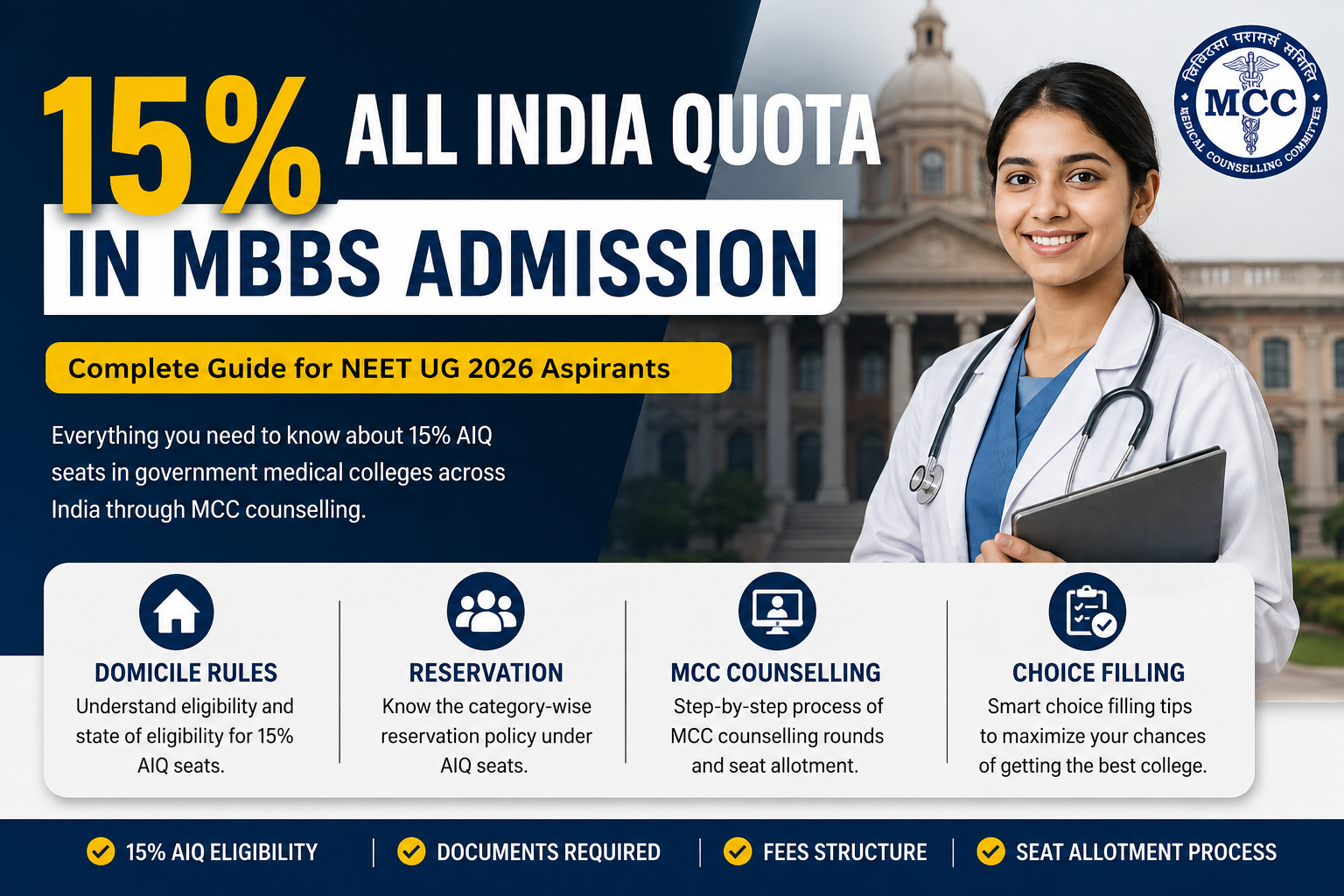
    The 15% All India Quota in MBBS admission, commonly called the 15% AIQ, allows NEET-qualified candidates to compete for government medical college seats across India without being restricted to their home state.

    Participating government medical and dental colleges contribute 15% of their seats to the All India Quota pool. The Medical Counselling Committee, or MCC, conducts online counselling for these seats based on the candidate’s NEET UG rank, reservation category, eligibility, submitted preferences and available seats.

    The remaining seats in these colleges are generally filled through the respective state counselling authorities under State Quota rules. However, the exact seat distribution can differ for central universities, AIIMS, JIPMER, ESIC institutions and other special categories.

    For the 2026 admission session, MCC published its UG Information Bulletin on 1 August 2026, and registration for UG counselling is scheduled to begin on 5 August 2026. Candidates should continue checking the official MCC portal because counselling dates and instructions may be revised.

    Quick Answer: What Is the 15% All India Quota?

    The 15% All India Quota in MBBS admission is a national pool of MBBS seats offered by participating government medical colleges.

    These seats are:

    • Open to eligible NEET-qualified candidates from across India
    • Generally free from state-domicile restrictions
    • Allotted through MCC NEET UG counselling
    • Distributed according to NEET merit, reservation and candidate choices
    • Separate from the 85% State Quota counselling process

    A student from West Bengal, for example, can compete for a 15% AIQ seat in a participating government medical college in Maharashtra, Rajasthan, Uttar Pradesh, Karnataka, Gujarat, Assam or another state.

    Latest MCC NEET UG Counselling 2026 Update

    The MCC NEET UG Counselling 2026 Information Bulletin confirms several important points:

    • MCC will conduct online counselling for 15% AIQ MBBS and BDS seats.
    • AIQ counselling will have Round 1, Round 2, Round 3 and the Stray Vacancy Round.
    • Open AIQ seats are domicile-free.
    • Central Government reservation rules apply to the 15% AIQ pool.
    • New Freeze and Float reporting options have been introduced for 2026.
    • Both Freeze and Float candidates must upload the required documents online.
    • Candidates joining a Round 3 seat cannot resign or participate in further counselling rounds.

    What Does 15% AIQ Mean in NEET Counselling?

    The term AIQ stands for All India Quota.

    Under this system, 15% of MBBS and BDS seats in participating state government colleges are placed in a common national counselling pool. Eligible candidates from different states compete for these seats through MCC counselling.

    Example of 15% AIQ seat calculation

    Suppose a government medical college has 200 MBBS seats.

    Seat categoryIllustrative number of seats
    15% All India Quota30
    Remaining State Quota170
    Total MBBS seats200

    This is only a basic example. The actual seat matrix may differ because of:

    • Reservation rosters
    • Institutional quotas
    • Seat increases or withdrawals
    • Central university rules
    • Special categories
    • Court directions
    • Changes issued by MCC or the institution

    Candidates must therefore check the official MCC seat matrix before filling choices.

    Who Conducts the 15% All India Quota Counselling?

    The Medical Counselling Committee of the Directorate General of Health Services, under the Ministry of Health and Family Welfare, conducts counselling for the 15% All India Quota.

    MCC is responsible for:

    1. Publishing the counselling schedule
    2. Opening online registration
    3. Collecting the registration fee and security deposit
    4. Publishing the participating college list
    5. Releasing the AIQ seat matrix
    6. Conducting choice filling and locking
    7. Processing seat allotment
    8. Publishing counselling results
    9. Managing reporting and upgradation
    10. Conducting subsequent counselling rounds

    MCC states that it does not allot seats manually or through nomination. Candidates must register and complete the process through the official MCC portal.

    Is Domicile Required for 15% All India Quota MBBS Seats?

    No. Domicile is generally not required for open 15% AIQ seats.

    The MCC 2026 bulletin specifically describes 15% All India Quota counselling as domicile-free. A candidate can therefore apply for eligible AIQ seats in participating government medical colleges outside their home state.

    However, candidates should not assume that every seat listed on the MCC portal is domicile-free. MCC also conducts counselling for institutional, internal and state quota seats of certain central universities and institutes.

    Before selecting a college, check whether the seat is listed under:

    • 15% All India Quota
    • Open quota
    • State quota
    • Institutional quota
    • Internal quota
    • ESIC Insured Persons quota
    • NRI quota
    • Deemed university quota

    Eligibility can differ between these seat types.

    Who Is Eligible for 15% AIQ MBBS Admission?

    A candidate must satisfy the applicable NEET UG, NMC, MCC and institutional eligibility conditions.

    In general, a candidate must:

    • Qualify NEET UG 2026
    • Be eligible for admission to the MBBS course
    • Register separately for MCC NEET UG counselling
    • Pay the required counselling fee and security deposit
    • Provide accurate personal and category information
    • Complete choice filling and choice locking
    • Upload the prescribed documents
    • Produce original documents during physical reporting
    • Fulfil the allotted college’s eligibility requirements

    Registering for MCC counselling does not create an automatic right to an MBBS seat. Admission depends on merit, category, eligibility, college preference and seat availability.

    Is Separate MCC Registration Required?

    Yes. NEET UG examination registration and MCC counselling registration are separate processes.

    Qualifying NEET UG makes a candidate eligible to participate, but the candidate must register separately on the MCC website to be considered for AIQ seat allotment.

    Candidates should use the mobile number and email address provided during NTA registration because MCC states that counselling OTPs will be sent to those registered contact details.

    15% All India Quota vs 85% State Quota

    One of the most searched questions among NEET candidates is the difference between 15% AIQ and 85% State Quota.

    Particular15% All India Quota85% State Quota
    Counselling authorityMedical Counselling CommitteeRespective state authority
    Candidate poolEligible candidates across IndiaCandidates eligible under state rules
    Domicile requirementGenerally not requiredUsually required
    Reservation policyCentral Government rulesState reservation policy
    Registration portalMCC portalState counselling portal
    Merit considerationNEET UG rank and AIQ rulesNEET rank and state merit rules
    Choice fillingConducted through MCCConducted through state portal
    College coverageAIQ seats of participating institutionsSeats under state authority
    RegistrationSeparate MCC registrationSeparate state registration
    Bond and fee rulesDepend on the allotted college/stateDepend on state and institution

    Candidates may generally participate in both AIQ and State Quota counselling, provided they meet the eligibility criteria and comply with the joining, resignation and seat-holding rules.

    Which Seats Are Included in MCC UG Counselling?

    MCC counselling includes more than the 15% All India Quota.

    The MCC’s undergraduate responsibilities include counselling for:

    • 15% AIQ MBBS and BDS seats of participating states
    • 100% MBBS seats of AIIMS
    • 100% JIPMER seats
    • BHU seats
    • AMU seats
    • Certain Delhi University and IP University seats
    • ESIC seats under applicable categories
    • Faculty of Dentistry, Jamia Millia Islamia
    • Deemed university MBBS and BDS seats
    • AFMC registration
    • Certain central institutes and universities

    However, all these seats should not be described as 15% AIQ seats. For example, MCC conducts counselling for 100% of AIIMS MBBS seats, but AIIMS seats are different from the 15% seats contributed by state government colleges.

    Reservation Policy for 15% AIQ MBBS Seats

    The Central Government reservation policy applies to the 15% All India Quota.

    CategoryReservation under AIQ
    Scheduled Castes15%
    Scheduled Tribes7.5%
    OBC–Non-Creamy Layer27%
    Economically Weaker Section10%
    Persons with Disabilities5% horizontal reservation

    The 5% PwD reservation is horizontal and is applied according to the applicable NMC norms.

    OBC-NCL requirements for AIQ

    Candidates seeking OBC reservation under AIQ should ensure that:

    • Their community is included in the Central OBC List.
    • They belong to the Non-Creamy Layer.
    • Their certificate is issued by a competent authority.
    • The certificate follows the prescribed format.
    • The certificate is valid for the relevant counselling session.

    A caste included only in a state OBC list may not qualify for OBC-NCL reservation under the Central All India Quota.

    EWS certificate requirements

    Candidates claiming EWS reservation must submit a valid EWS certificate in the prescribed Central Government format.

    PwD certificate requirements

    PwD candidates must fulfil the relevant disability and medical eligibility requirements and obtain the required certificate from an authorised assessment centre.

    Incorrect category information or failure to produce valid supporting documents can result in cancellation of the allotted seat.

    How Does 15% AIQ Counselling Work?

    The 15% All India Quota counselling process includes registration, fee payment, choice filling, allotment and reporting.

    Step 1: MCC counselling registration

    Candidates must visit the MCC portal and complete online registration using their NEET UG details.

    All information should be checked carefully before submission. MCC states that the information taken from the NTA record may be used during counselling and may not be changed later.

    Step 2: Pay the registration fee and security deposit

    Candidates must pay:

    • A non-refundable registration fee
    • A refundable security deposit

    Only candidates who complete the required payment can proceed to choice filling.

    Step 3: Check the AIQ seat matrix

    Before filling choices, candidates should check:

    • College name
    • Course
    • Seat category
    • Quota type
    • Number of available seats
    • College fees
    • Hostel charges
    • Service bond
    • Bond penalty
    • Internship stipend
    • Location and connectivity

    Step 4: Fill college choices

    Candidates can select colleges and arrange them in their genuine order of preference.

    The most preferred college should be placed first. Candidates should not arrange colleges only according to predicted closing ranks.

    Step 5: Lock the choices

    Candidates must review and lock their choices within the MCC schedule.

    Once choices are locked, changes may not be permitted. MCC advises candidates to verify fees, bonds and institutional conditions before finalising choices.

    Step 6: Seat allotment

    MCC processes allotment on the basis of:

    • NEET UG rank
    • Reservation category
    • Submitted choices
    • Seat availability
    • Quota eligibility
    • Institutional requirements
    • Counselling rules

    Step 7: Select Freeze or Float

    A candidate receiving an allotment must follow the applicable Freeze or Float procedure.

    Step 8: Upload documents

    Both Freeze and Float candidates must upload clear scanned copies of the prescribed documents within the reporting period.

    Step 9: Complete reporting or upgradation

    Freeze candidates physically report to the allotted college, while eligible Float candidates can complete online document verification and seek upgradation.

    Freeze and Float Options in MCC Counselling 2026

    The MCC 2026 counselling scheme introduces a revised system for candidates who receive a seat.

    Freeze: No upgradation

    A Freeze candidate:

    • Accepts the allotted seat
    • Does not seek a better seat in the next round
    • Uploads the required documents
    • Physically reports to the allotted institution
    • Completes original document verification
    • Pays the institutional admission fee
    • Finalises admission

    Freeze is suitable for candidates who are satisfied with their allotted college.

    Float: Willing to upgrade

    A Float candidate:

    • Provisionally accepts the allotted seat
    • Remains willing to upgrade in the next round
    • Submits willingness online
    • Uploads the required documents
    • Completes online document verification
    • Does not initially need to visit the allotted college physically

    The allotted institute can raise a query when it finds:

    • Blurred documents
    • Missing documents
    • Incorrect certificates
    • Category mismatches
    • Inconsistencies between claims and documents

    The candidate must upload corrected documents within the reporting schedule.

    How Many Rounds Are There in AIQ Counselling?

    MCC conducts four principal rounds for 15% All India Quota seats:

    1. AIQ Round 1
    2. AIQ Round 2
    3. AIQ Round 3
    4. AIQ Stray Vacancy Round

    MCC also states that AIQ seats are not returned to participating states after Round 2 and that upgradation is available up to Round 3.

    AIQ Round 1

    Round 1 normally includes:

    • Registration
    • Fee payment
    • Choice filling
    • Choice locking
    • Seat allotment
    • Freeze or Float selection
    • Document upload
    • Reporting or upgradation

    Round 1 generally permits free exit according to the applicable MCC schedule.

    AIQ Round 2

    Round 2 can include:

    • Fresh registration for eligible candidates
    • Fresh choice filling
    • Seat allotment
    • Joining or upgradation
    • Exit with forfeiture in applicable cases

    A candidate who receives a Round 2 or later seat and does not join may lose the security deposit.

    AIQ Round 3

    Round 3 has stricter rules.

    Candidates should understand that:

    • Non-joining can result in forfeiture of the security deposit.
    • A joined Round 3 seat cannot be resigned.
    • A candidate joining in Round 3 cannot participate in further counselling.
    • Round 3 candidates and retained Float candidates must complete mandatory physical reporting according to MCC instructions.

    AIQ Stray Vacancy Round

    The Stray Vacancy Round fills seats remaining after earlier rounds.

    Candidates may be ineligible when they:

    • Already hold or have joined a medical seat
    • Have been allotted a Round 3 seat
    • Are included in the joined-candidate data shared between MCC and states
    • Fail to fulfil stray-round registration requirements
    • Fall under another MCC ineligibility condition

    Candidates should read the specific Stray Vacancy Round notice before participating.

    MCC Counselling Fees for 15% AIQ Seats in 2026

    The MCC 2026 bulletin specifies the following payment structure for 15% AIQ and specified central institution seats:

    Candidate categoryNon-refundable registration feeRefundable security depositTotal
    UR/EWS₹1,000₹10,000₹11,000
    SC/ST/OBC/PwD₹500₹5,000₹5,500

    The security deposit may be forfeited if a candidate receives a seat in Round 2 or a subsequent round and fails to join, or if admission is cancelled because of incorrect information or invalid documents.

    The refundable security amount is normally returned to the same bank account or payment source from which it was deposited after completion of the counselling process, subject to MCC’s refund conditions.

    Documents Required for 15% AIQ MBBS Admission

    Candidates should keep original documents, scanned copies and photocopies ready.

    Commonly required documents include:

    1. MCC seat allotment letter
    2. NEET UG admit card
    3. NEET UG scorecard or rank letter
    4. Class 10 certificate
    5. Date-of-birth proof
    6. Class 12 certificate
    7. Class 12 marksheet
    8. Valid identity proof
    9. Passport-size photographs
    10. SC certificate, where applicable
    11. ST certificate, where applicable
    12. Central OBC-NCL certificate, where applicable
    13. EWS certificate, where applicable
    14. PwD certificate, where applicable
    15. NRI, OCI or foreign-national documents, where applicable
    16. Additional documents required by the allotted institution

    Candidates should check the MCC bulletin and the allotted college’s reporting notice before admission. Failure to produce the required original documents can result in cancellation.

    What Is the AIQ Cut-Off for MBBS Admission?

    There is no single fixed 15% AIQ MBBS cut-off for all government medical colleges.

    The closing rank changes according to:

    • NEET UG difficulty level
    • Number of qualified candidates
    • Number of available MBBS seats
    • Candidate category
    • College popularity
    • College location
    • Tuition fees
    • Service bond
    • Hospital patient flow
    • Internship stipend
    • Preference trends
    • Counselling round

    NEET qualifying cut-off vs AIQ admission cut-off

    The NEET qualifying cut-off is the minimum score or percentile required to qualify for counselling.

    The AIQ college cut-off is the opening or closing rank at which a particular college and category is allotted.

    Qualifying NEET does not guarantee a government MBBS seat.

    How to Prepare an AIQ Medical College Preference List

    A well-planned preference list can significantly affect the final allotment.

    Check medical college recognition

    Verify the college, permitted seats and course information through official regulatory and institutional sources.

    Compare the total MBBS fee

    Do not examine only the annual tuition fee. Calculate:

    • Tuition fees
    • Admission charges
    • Hostel fees
    • Mess charges
    • University fees
    • Security deposit
    • Examination fees
    • Other institutional charges

    Check the service bond

    Government medical colleges in different states may have different bond conditions.

    Check:

    • Bond duration
    • Bond penalty
    • Compulsory service
    • Rural service
    • Post-MBBS obligations
    • Exemption conditions

    Evaluate hospital patient flow

    A high-volume teaching hospital can provide broader clinical exposure during the clinical years and internship.

    Compare internship conditions

    Candidates should review:

    • Internship stipend
    • Duty conditions
    • Departmental rotations
    • Patient exposure
    • Hostel availability

    Consider location and language

    Studying outside the home state may require adjustment to:

    • Local language
    • Climate
    • Food
    • Travel
    • Cost of living
    • Distance from family

    Arrange choices by genuine preference

    The most desired college should be placed first, followed by the second, third and subsequent preferences.

    Do not place a less-preferred college above a better option merely because the less-preferred college appears more achievable.

    Advantages of the 15% All India Quota

    Access to colleges outside the home state

    Candidates can compete for participating government medical colleges across India.

    More MBBS admission options

    Students can participate in AIQ counselling in addition to eligible State Quota counselling.

    Domicile-free competition

    Open 15% AIQ seats generally do not require domicile of the college’s state.

    Centralised counselling

    Allotment is processed through MCC on the basis of merit, eligibility, reservation and candidate preference.

    Wider college comparison

    Students can compare institutions based on fees, clinical exposure, infrastructure, bonds and location.

    Limitations of the 15% All India Quota

    Nationwide competition

    AIQ seats attract candidates from across India and are often highly competitive.

    Different state bond rules

    An AIQ candidate remains subject to the bond and service conditions of the allotted college or state.

    Relocation expenses

    Candidates studying outside their home state may incur additional hostel, travel and living costs.

    Language challenges

    Students may need to communicate with patients in the local language during clinical training.

    Complex counselling rules

    Candidates must coordinate MCC counselling with State Quota counselling and carefully follow resignation deadlines.

    Common Mistakes in 15% AIQ Counselling

    1. Not completing separate MCC registration

    NEET registration does not automatically enrol a candidate in MCC counselling.

    2. Filling too few choices

    Selecting only a few highly competitive colleges can reduce the chance of allotment.

    3. Ignoring college fees

    Government medical colleges do not necessarily have identical fee structures.

    4. Not checking service bonds

    Bond duration and penalty can affect postgraduate plans and future employment.

    5. Using an incorrect OBC certificate

    AIQ OBC reservation requires compliance with Central OBC-NCL rules.

    6. Arranging choices according to cut-off rather than preference

    Candidates should arrange colleges in the order they genuinely want to join.

    7. Ignoring quota eligibility

    The same institution may display AIQ, institutional, state, NRI or internal seats.

    8. Depending only on previous-year cut-offs

    Past ranks are useful references, but they do not guarantee the current year’s allotment.

    9. Missing document-upload deadlines

    Both Freeze and Float candidates must upload the required documents under the 2026 process.

    10. Participating in Round 3 without understanding the consequences

    Round 3 has strict non-resignation and further-participation restrictions.

    11. Depending on unofficial agents

    Candidates should verify information from MCC, NTA, NMC, state counselling and college websites.

    12. Waiting until the last day

    Technical problems, payment failures or document discrepancies can prevent completion.

    Frequently Asked Questions About 15% All India Quota

    What is the 15% All India Quota in MBBS admission?

    It is a national pool containing 15% of MBBS seats contributed by participating government medical colleges. MCC allots these seats through NEET UG counselling.

    Is domicile required for 15% AIQ seats?

    No. Open 15% All India Quota seats are generally domicile-free.

    Who conducts AIQ MBBS counselling?

    The Medical Counselling Committee under DGHS, Ministry of Health and Family Welfare, conducts AIQ counselling.

    Can I apply for both AIQ and State Quota counselling?

    Yes. Eligible candidates can generally participate in both, but separate registration and choice filling are required.

    Are AIIMS seats part of the 15% AIQ?

    No. MCC conducts counselling for 100% of AIIMS MBBS seats, but AIIMS seats are not the same as the 15% state-contributed AIQ pool.

    Is OBC reservation available under AIQ?

    Yes. Eligible OBC-NCL candidates receive 27% reservation according to the Central OBC List and applicable rules.

    What is the EWS reservation under AIQ?

    EWS candidates receive 10% reservation according to Central Government norms.

    How many rounds are conducted for AIQ counselling?

    MCC conducts Round 1, Round 2, Round 3 and the Stray Vacancy Round.

    What is the Freeze option?

    Freeze means that the candidate accepts the allotted college and does not seek upgradation.

    What is the Float option?

    Float means that the candidate provisionally accepts the allotted seat but remains willing to upgrade in the next round.

    Can I resign from a Round 3 AIQ seat?

    A candidate cannot resign from an allotted and joined Round 3 seat under the MCC 2026 counselling scheme.

    What happens if I do not join a Round 2 seat?

    The candidate’s security deposit may be forfeited.

    Are private medical colleges included in the 15% AIQ?

    The traditional 15% AIQ primarily refers to seats contributed by participating government medical colleges. Private and deemed university seats follow separate quota, fee and counselling structures.

    Is the AIQ cut-off higher than the State Quota cut-off?

    It depends on the college, category, state and counselling year. AIQ involves nationwide competition, but some State Quota seats can also have highly competitive closing ranks.

    How many colleges should I select during AIQ choice filling?

    Candidates should include every college they are genuinely willing and financially able to join, subject to MCC’s choice-filling instructions.

    Conclusion

    The 15% All India Quota in MBBS admission gives NEET-qualified candidates an opportunity to compete for government medical college seats across India without being restricted to their domicile state.

    However, a successful AIQ counselling strategy requires more than qualifying NEET. Candidates must understand MCC registration, reservation rules, counselling rounds, Freeze and Float options, document requirements, fees, service bonds and choice-filling principles.

    For NEET UG 2026, candidates should pay particular attention to the revised online document-verification process and the strict Round 3 rules.

    A carefully prepared AIQ preference list can help a candidate secure the most suitable available medical college according to rank, category, affordability and career priorities.

    EducationMESD provides guidance for NEET UG counselling, AIQ and State Quota planning, MBBS college selection, document preparation and choice filling. Students and parents should verify all final decisions against the latest official MCC and institutional notices.

    Disclaimer: Counselling schedules, seat matrices, fees, eligibility conditions, reservation rules and reporting procedures may be revised by MCC, NTA, NMC, state authorities or participating institutions. Candidates must check the latest official notices before registration, choice locking, payment or admission.

  • NEET 2026 College Predictor: Factors Students Must Consider Before Choosing a Medical College

    NEET 2026 College Predictor: Factors Students Must Consider Before Choosing a Medical College

    The NEET UG 2026 result and scorecard were released on July 16, 2026, and students are now entering one of the most important stages of the medical admission process: identifying the colleges they may receive through counselling.

    Questions such as these are common among students and parents:

    • Which medical college can I get with my NEET 2026 rank?
    • Can I get a government MBBS college?
    • Which states should I consider during counselling?
    • Should I choose a private medical college or a deemed university?
    • Is a NEET college predictor accurate?
    • How should I arrange my choices during counselling?

    A NEET 2026 college predictor can help answer some of these questions by comparing a student’s rank, category, domicile, quota and preferences with previous counselling data.

    However, a predicted college is not necessarily the right college. Students must also consider fees, recognition, clinical exposure, service bonds, hostel facilities, internship conditions and location before finalising their MBBS or BDS choices.

    This comprehensive guide explains how to use a NEET college predictor 2026 correctly and the most important factors students must evaluate before selecting a medical college.


    What Is a NEET 2026 College Predictor?

    A NEET 2026 college predictor is an online admission-support tool that estimates the medical colleges a student may receive based on their NEET UG rank and counselling details.

    Most college predictor tools require information such as:

    • NEET UG 2026 All India Rank
    • NEET 2026 score
    • Candidate category
    • Domicile state
    • Preferred course
    • Preferred college type
    • All India Quota or state quota
    • Gender, where applicable
    • Previous years’ opening and closing ranks
    • Preferred location
    • Estimated fee range

    The predictor compares these details with previous counselling trends and generates a list of possible medical colleges.

    The result may classify colleges as:

    Prediction categoryMeaning
    High chanceThe student’s rank is comfortably within previous closing-rank trends
    Moderate chanceAdmission may be possible depending on the counselling round and seat movement
    Low chanceAdmission is less likely but may become possible if cut-offs change
    Ambitious choiceThe college is highly competitive compared with the student’s present rank
    Safe choicePrevious closing ranks indicate a comparatively stronger admission possibility

    These classifications are estimates. Only an allotment result issued by the authorised counselling authority confirms admission.


    How Does a NEET College Predictor Work?

    A medical college predictor based on NEET rank generally uses historical counselling data.

    The tool compares the candidate’s profile with:

    • Previous opening ranks
    • Previous closing ranks
    • Category-wise cut-offs
    • Quota-wise cut-offs
    • State counselling data
    • Round-wise seat allotment results
    • College type
    • Course preference
    • Available seat information

    For example, suppose a medical college closed at approximately Rank 25,000 for a particular category and quota in a previous admission round. A student with a similar rank may see that college listed as a realistic or moderate-chance option.

    However, the closing rank may change in 2026 because of:

    • Number of participating candidates
    • Difficulty level of the examination
    • Overall candidate performance
    • Changes in available seats
    • Addition of new medical colleges
    • Revised reservation policies
    • Fee changes
    • Bond conditions
    • Candidate preference patterns
    • Upgradation and withdrawal during counselling

    Therefore, previous cut-offs should be treated as reference data rather than guaranteed admission limits.


    Why Should Students Use a NEET 2026 College Predictor?

    A college predictor can help students prepare for counselling in a more systematic manner.

    Students can use it to:

    • Estimate government MBBS college admission chances
    • Identify possible private medical colleges
    • Compare All India Quota and state quota options
    • Shortlist colleges according to rank
    • Explore medical colleges in different states
    • Compare previous years’ cut-offs
    • Create a balanced choice-filling list
    • Identify ambitious, realistic and safe colleges
    • Find backup options
    • Reduce confusion during counselling
    • Avoid depending on only one or two preferred colleges

    A good predictor can simplify college shortlisting. Nevertheless, students must independently verify every predicted college before including it in their final preference list.


    NEET 2026 College Predictor: Important Factors Students Must Consider

    1. NEET UG 2026 All India Rank

    The NEET 2026 All India Rank, commonly called AIR, is one of the most important factors used by a college predictor.

    Students sometimes focus only on their NEET score. However, rank is usually more useful for college prediction because the relationship between marks and rank can change every year.

    The same NEET score may produce different ranks in different years depending on:

    • Number of candidates
    • Difficulty level of the question paper
    • Overall performance of candidates
    • Number of high-scoring students
    • Tie-breaking rules
    • Score distribution

    Students should use the official rank mentioned on their NEET UG 2026 scorecard rather than an estimated rank calculated before the result.

    SEO takeaway

    For a more accurate NEET college prediction by rank, enter your official All India Rank and not only your NEET marks.


    2. Candidate Category

    Medical admission cut-offs differ across categories.

    Common categories include:

    • General or Unreserved
    • Economically Weaker Section
    • Other Backward Classes–Non-Creamy Layer
    • Scheduled Caste
    • Scheduled Tribe
    • Persons with Benchmark Disabilities

    Students must choose the correct category while using a NEET UG 2026 college predictor.

    Selecting the wrong category may produce an inaccurate list of colleges because category-wise closing ranks can vary significantly.

    Candidates should also verify:

    • Whether the category certificate is valid
    • Whether it follows the required format
    • Whether it was issued by the appropriate authority
    • Whether a central or state-specific certificate is required
    • Whether the certificate satisfies the relevant counselling rules

    A category benefit available under one counselling system may not automatically apply in the same way under another state’s rules.


    3. All India Quota and State Quota

    Students should not generate one common prediction for every counselling route.

    The Medical Counselling Committee conducts undergraduate counselling for categories including 15% All India Quota MBBS and BDS seats, along with seats in AIIMS, JIPMER, BHU and other institutions covered under the MCC counselling framework.

    State counselling authorities manage seats that fall under their respective state counselling systems, subject to applicable eligibility, reservation and domicile rules.

    Students may need separate predictions for:

    • 15% All India Quota seats
    • State quota seats
    • Central universities
    • AIIMS
    • JIPMER
    • Deemed universities
    • Employees’ State Insurance Corporation institutions
    • Armed Forces Medical College, subject to its admission process
    • Management quota seats
    • NRI quota seats
    • Institutional or internal quota seats

    Why quota selection matters

    The same college may have different closing ranks for:

    • All India Quota
    • State quota
    • Management quota
    • NRI quota
    • Different reservation categories

    Students should therefore select the exact counselling quota for which they are eligible.


    4. Domicile and State Eligibility Rules

    Domicile is a critical factor in state medical counselling.

    A NEET 2026 college predictor may show a state medical college based on the student’s rank, but the student may not be eligible for its state quota seats.

    State eligibility rules may consider:

    • Permanent residence
    • Place of schooling
    • Parents’ residence
    • Parents’ employment
    • Domicile certificate
    • State-specific category certificate
    • Number of years studied in the state
    • Institutional preference
    • Special regional eligibility

    These conditions are not identical across India.

    Before adding a state medical college to the preference list, students should read the official information bulletin issued by that state’s counselling authority.

    Important point

    A favourable predicted cut-off does not override domicile or eligibility requirements.


    5. Previous Years’ Opening and Closing Ranks

    Most NEET college predictor tools use previous counselling cut-offs.

    Students should compare at least two or three recent admission cycles rather than relying on a single year.

    They should check:

    • Opening rank
    • Closing rank
    • Candidate category
    • Counselling quota
    • College type
    • Course
    • Counselling round

    Previous closing ranks can change because of:

    • Seat increases or reductions
    • New medical colleges
    • Revised fees
    • Changes in bond requirements
    • Candidate preferences
    • Reservation changes
    • Upgradation between rounds
    • Changes in college reputation
    • Location and hostel conditions
    • Institutional recognition or approval status

    For example, a college that closed at Rank 40,000 in one year may close earlier or later in 2026.

    Best practice

    Use previous cut-offs as a probability indicator, not as a fixed NEET 2026 admission cut-off.


    6. Counselling Round

    Medical college closing ranks may differ across counselling rounds.

    Depending on the applicable counselling schedule, students may encounter stages such as:

    • Round 1
    • Round 2
    • Round 3
    • Stray vacancy round
    • Special stray vacancy round, where announced

    A college available at a particular rank in a later round may not have been available at the same rank in Round 1.

    Seat movement can happen when students:

    • Upgrade to another college
    • Join through another counselling authority
    • Withdraw from the allotted seat
    • Fail to report
    • Become ineligible
    • Choose another course
    • Leave a seat for financial or personal reasons

    Students should compare round-wise NEET closing ranks instead of using only the final cut-off.

    They must also understand the applicable rules related to:

    • Free exit
    • Seat acceptance
    • Upgradation
    • Resignation
    • Reporting
    • Security deposit
    • Forfeiture
    • Eligibility for subsequent rounds

    These conditions should be verified from the official counselling bulletin before participation.


    7. Official Seat Matrix for 2026

    The number of seats available in a college directly affects admission probability.

    A predictor that relies only on historical data may not reflect the final NEET 2026 seat matrix.

    Seat availability can change due to:

    • New medical colleges
    • Increased MBBS intake
    • Reduced intake
    • New seats added during counselling
    • Seat withdrawal
    • Category conversion
    • Revised institutional participation
    • Regulatory decisions

    Students should compare predictor results with the official seat matrix released by the relevant counselling authority.

    The seat matrix should also be checked before each round because the number or classification of available seats may change.


    8. NMC Recognition and Approved Intake

    A predicted college should never be selected without checking its regulatory status.

    The National Medical Commission provides information for students, including the list of colleges teaching MBBS, college and course details, approved intake and information relating to undergraduate internship stipends.

    Students should verify:

    • Name of the medical college
    • Location
    • Course offered
    • University affiliation
    • Management type
    • Year of establishment
    • Approved annual intake
    • Recognition status
    • Permission or approval details
    • Any relevant remarks

    Do not depend only on:

    • College advertisements
    • Social media claims
    • Promotional brochures
    • Unofficial education portals
    • Verbal assurances from agents

    Recognition and approved intake should be verified using official records.


    9. Government, Private or Deemed Medical College

    The type of medical college affects competition, fees and admission routes.

    Government medical colleges

    Government medical colleges generally attract high competition because their tuition fees are usually lower than those of private institutions.

    Students should compare:

    • State quota cut-off
    • All India Quota cut-off
    • Bond conditions
    • Hostel availability
    • Internship stipend
    • Patient flow

    Private medical colleges

    Private colleges may offer different seat categories, such as:

    • Government quota
    • State merit quota
    • Management quota
    • Institutional quota
    • NRI quota

    Fees and closing ranks may differ substantially across these categories.

    Deemed universities

    Deemed university seats covered by MCC counselling may have a separate fee structure and admission pattern. Students should examine the entire cost before placing these colleges high in their preference list. MCC’s official counselling framework includes deemed university seats and specified central institutions.


    10. Complete MBBS Fee Structure

    Students must consider the total cost of medical education, not only the first-year tuition fee.

    The complete cost may include:

    • Annual tuition fee
    • Admission fee
    • Hostel fee
    • Mess charges
    • Examination fee
    • University charges
    • Laboratory fee
    • Library fee
    • Security deposit
    • Transport charges
    • Student activity charges
    • Clinical or equipment charges
    • Annual fee escalation
    • Internship-related expenses
    • Miscellaneous institutional charges

    Before selecting a college, calculate the expected expenditure for the entire course and internship period.

    Questions students should ask

    • Is the fee fixed for the complete programme?
    • Can the college increase the fee annually?
    • Is hostel accommodation compulsory?
    • Is the hostel fee included in the quoted amount?
    • Is the security deposit refundable?
    • Are there additional university or examination charges?
    • What is the management or NRI quota fee?
    • Is a bank guarantee required?

    A college that appears affordable initially may become expensive after all compulsory charges are included.


    11. Service Bond and Discontinuation Penalty

    Some states or institutions may require students to complete a service obligation after graduation or internship.

    Students should verify:

    • Duration of compulsory service
    • Rural service requirement
    • Government service requirement
    • Bond amount
    • Conditions for exemption
    • Penalty for breaking the bond
    • Course discontinuation penalty
    • Rules for returning original documents
    • Conditions linked to postgraduate admission

    A low-fee college may carry a significant service bond. This should be evaluated before accepting the seat.

    The bond policy should be checked from the current official state or institutional document because previous years’ rules may not apply unchanged in 2026.


    12. Clinical Exposure and Patient Flow

    MBBS education depends heavily on practical clinical learning.

    A medical college with strong patient flow can provide students with exposure to a wider range of medical conditions.

    Students should examine:

    • Number of teaching hospital beds
    • Daily outpatient attendance
    • Inpatient occupancy
    • Emergency department activity
    • Availability of clinical departments
    • Number and variety of surgeries
    • Diagnostic facilities
    • Intensive care units
    • Community medicine exposure
    • Rural health centre postings
    • Faculty supervision
    • Hands-on learning opportunities

    Do not judge clinical exposure only from the size of the campus or hospital building.

    A visually impressive hospital may not necessarily have adequate patient numbers. Students should compare official information, current student feedback and direct observations wherever possible.


    13. Faculty and Academic Environment

    The quality of the academic environment can significantly influence a student’s medical education.

    Important factors include:

    • Availability of qualified faculty
    • Regularity of classes
    • Practical laboratory sessions
    • Cadaver and anatomy laboratory facilities
    • Clinical demonstrations
    • Internal assessment system
    • Mentoring support
    • Library resources
    • Digital learning facilities
    • Research opportunities
    • Academic conferences
    • Student support mechanisms

    Students should also check whether the institution provides a disciplined but supportive learning environment.

    College age alone should not determine preference. A relatively new college with good faculty, facilities and patient flow may be preferable to an older institution with weak academic systems.


    14. Internship Stipend and Working Conditions

    Internship is a crucial part of undergraduate medical training.

    The NMC provides a dedicated area for information relating to stipends paid by medical colleges for the undergraduate MBBS course.

    Students should compare:

    • Monthly internship stipend
    • Regularity of payment
    • Duty hours
    • Emergency duties
    • Departmental rotations
    • Accommodation during internship
    • Leave policy
    • Clinical responsibilities
    • Bond obligations after internship

    Stipend amounts may differ between government, private and deemed institutions. Students should verify the latest applicable amount instead of relying on old online discussions.


    15. Hostel, Campus and Student Safety

    Most MBBS students spend several years on or near the campus.

    Students and parents should assess:

    • Availability of separate hostels
    • Distance between hostel and hospital
    • Room occupancy
    • Hostel security
    • Anti-ragging mechanisms
    • Mess quality
    • Drinking water
    • Internet connectivity
    • Electricity backup
    • Library access
    • Sports facilities
    • Medical support
    • Psychological counselling
    • Local transportation
    • Campus rules and restrictions

    Students should also confirm whether hostel accommodation is compulsory and whether the quoted hostel charges apply for the entire academic year.


    16. Location and Connectivity

    The location of a medical college can affect travel, living expenses and personal comfort.

    Students should consider:

    • Distance from home
    • Nearest railway station
    • Nearest airport
    • Road connectivity
    • Availability of public transport
    • Climate
    • Local cost of living
    • Safety of the area
    • Access to essential services
    • Language used by patients
    • Travel expenses during holidays
    • Accessibility during emergencies

    A college should not be rejected only because it is far from home. However, the practical and financial impact of the location should be understood before admission.


    17. Local Language and Patient Communication

    Although classroom teaching may largely use English, students often need to communicate with patients in the local or regional language.

    This becomes important during:

    • History taking
    • Clinical examination
    • Community postings
    • Emergency duties
    • Internship
    • Rural health centre visits

    Students joining a college in another state should be willing to learn basic patient-communication terms in the local language.

    Language should not automatically prevent a student from choosing a good college, but the student’s adaptability must be considered.


    18. Personal Priorities

    There is no single “best medical college” for every NEET aspirant.

    One student may prioritise low fees, while another may prioritise proximity to home or stronger clinical exposure.

    Common priorities include:

    • Government college
    • Lower tuition fee
    • No service bond
    • Better patient flow
    • Higher internship stipend
    • Good hostel
    • Urban location
    • Proximity to home
    • Established college
    • Research opportunities
    • Safe campus
    • Better transportation

    Students should define their top priorities before using a NEET college predictor 2026.

    Without clear priorities, the predictor may generate a long list that does not help with the final decision.


    How to Use the NEET 2026 College Predictor Correctly

    Step 1: Enter Your Official NEET 2026 Details

    Use the exact information provided on your official scorecard:

    • NEET score
    • All India Rank
    • Category rank, where applicable
    • Category
    • Candidate details

    Avoid using an estimated rank after the official result has been released.


    Step 2: Select the Correct Category and Domicile

    Enter the category under which you are legally eligible to participate.

    Select the correct domicile state and verify whether you satisfy that state’s counselling conditions.


    Step 3: Generate Separate Predictions for Each Quota

    Run separate predictions for:

    • All India Quota
    • Home-state quota
    • Other eligible state counselling
    • Deemed universities
    • Private colleges
    • Management quota
    • NRI quota, where applicable

    Combining different quotas may create misleading results.


    Step 4: Compare Multiple Years and Rounds

    Review:

    • Recent opening ranks
    • Recent closing ranks
    • Round 1 cut-offs
    • Round 2 cut-offs
    • Round 3 cut-offs
    • Stray vacancy trends
    • Category-wise movement
    • Quota-wise movement

    Do not make a decision based on a single cut-off figure.


    Step 5: Categorise Colleges

    Divide your options into three main groups.

    Ambitious colleges

    These are highly preferred colleges where your rank is less competitive than previous closing-rank trends.

    Realistic colleges

    These are colleges where your rank is close to recent cut-off trends.

    Safer colleges

    These are colleges where your rank appears comfortably within previous closing-rank ranges.

    A balanced preference list should contain colleges from all three groups.


    Step 6: Verify Every Predicted College

    For every shortlisted college, verify:

    • NMC status
    • Approved intake
    • University affiliation
    • Current fee structure
    • Hostel charges
    • Service bond
    • Discontinuation penalty
    • Clinical exposure
    • Internship stipend
    • Location
    • Counselling eligibility

    Remove any college that does not meet your academic, financial or personal requirements.


    Step 7: Arrange Choices by Genuine Preference

    Students should generally arrange eligible choices in the order in which they genuinely prefer them.

    Do not place a less-preferred college above a better option merely because its admission probability appears higher.

    A sensible preference order may consider:

    1. College quality
    2. Clinical exposure
    3. Total fee
    4. Bond conditions
    5. Location
    6. Hostel and safety
    7. Personal preference

    Choice filling should not be based only on predicted probability.


    Step 8: Review Before Locking

    Before final submission, check:

    • College name
    • College code
    • Course
    • Quota
    • Category
    • Preference order
    • Fee structure
    • Location
    • Eligibility
    • Bond conditions

    A small mistake in college code or preference order can affect the final allotment.


    NEET 2026 College Selection Comparison Table

    FactorWhy it mattersWhat students should verify
    NEET rankDetermines competitivenessOfficial AIR and category
    CategoryAffects closing ranksValid certificate and eligibility
    QuotaChanges admission cut-offAIQ, state, management or NRI
    DomicileDetermines state eligibilityCurrent state counselling rules
    Previous cut-offIndicates admission trendMultiple years and rounds
    Seat matrixAffects admission chancesOfficial 2026 seat availability
    NMC statusConfirms regulatory positionCollege, course and intake
    Total feeDetermines affordabilityComplete programme expenditure
    Service bondCreates future obligationDuration, amount and penalty
    Patient flowInfluences clinical learningOPD, beds and hospital exposure
    Internship stipendAffects internship financesAmount and payment regularity
    HostelAffects student lifeAvailability, safety and charges
    LocationAffects travel and adjustmentConnectivity, language and cost
    Academic environmentInfluences learning qualityFaculty, laboratories and mentoring

    Common Mistakes While Using a NEET College Predictor

    Students should avoid these common errors:

    1. Entering an estimated rank instead of the official rank
    2. Selecting the wrong category
    3. Ignoring domicile requirements
    4. Using only marks for college prediction
    5. Comparing only one year’s cut-off
    6. Ignoring counselling-round differences
    7. Treating the prediction as guaranteed admission
    8. Selecting only highly competitive colleges
    9. Ignoring the official seat matrix
    10. Failing to verify NMC information
    11. Comparing only tuition fees
    12. Overlooking service bonds
    13. Ignoring hostel and living expenses
    14. Copying another student’s preference list
    15. Depending entirely on social media reviews
    16. Missing counselling deadlines
    17. Choosing a college only because it is close to home
    18. Locking choices without reviewing college codes

    Avoiding these mistakes can make the counselling process more organised and reduce the risk of poor college selection.


    How Accurate Is a NEET 2026 College Predictor?

    No NEET college predictor can guarantee 100% accuracy.

    Its reliability depends on:

    • Accuracy of student information
    • Quality of previous counselling data
    • Updated seat matrix
    • Correct category mapping
    • Correct quota mapping
    • Changes in reservation policies
    • Candidate choice-filling behaviour
    • Seat additions or withdrawals
    • Movement between counselling rounds
    • Changes in college fees and preferences

    A college predictor should be used as a decision-support and shortlisting tool.

    It cannot replace:

    • Official counselling registration
    • Official choice filling
    • Official seat allotment result
    • Verification of documents
    • Reporting at the allotted college

    NEET 2026 College Predictor Checklist

    Before adding a college to your final preference list, ask:

    • Is the college listed in the relevant official records?
    • Is the MBBS intake approved?
    • Am I eligible under the selected quota?
    • Do I satisfy the domicile conditions?
    • Is my category certificate valid?
    • What were the recent round-wise closing ranks?
    • How many seats are available in 2026?
    • What is the complete programme fee?
    • Can my family afford the entire course?
    • Is hostel accommodation compulsory?
    • Is there a service bond?
    • What is the discontinuation penalty?
    • How strong is the patient flow?
    • What internship stipend is provided?
    • Is the location suitable?
    • Have I checked current student feedback?
    • Have I read the official counselling bulletin?
    • Have I created ambitious, realistic and safe choices?

    A college should remain on the final list only when the answer to these questions is satisfactory.


    Frequently Asked Questions About the NEET 2026 College Predictor

    1. What is the best NEET 2026 college predictor?

    The best NEET college predictor is one that uses recent round-wise counselling data and allows students to filter results by rank, category, quota, domicile, course, college type and budget. Students should still verify every prediction through official sources.

    2. Is the NEET 2026 college predictor accurate?

    A college predictor can provide a useful estimate, but it cannot guarantee admission. Actual allotment depends on the official seat matrix, candidate preferences, category, quota, counselling round and seat availability.

    3. Which medical college can I get with my NEET 2026 rank?

    Possible colleges depend on your All India Rank, category, domicile, quota, preferred state, budget and counselling round. A predictor can generate an initial shortlist, but every option must be verified before choice filling.

    4. Should I use NEET marks or rank for college prediction?

    The official All India Rank is generally more useful because marks-to-rank patterns may change every year. Enter both where the tool requires them, but give greater importance to rank-based comparisons.

    5. Can a NEET college predictor predict government MBBS colleges?

    Yes. It can estimate possible government colleges using previous category-wise and quota-wise cut-offs. The result remains an estimate and not a confirmed seat allotment.

    6. Can a college predictor estimate AIIMS admission chances?

    A predictor may estimate possible AIIMS options when it includes recent institution-wise counselling data. MCC conducts counselling for AIIMS undergraduate medical seats under its counselling framework.

    7. Can I use the same prediction for AIQ and state counselling?

    No. All India Quota and state counselling may have different eligibility rules, reservations, seat matrices and closing ranks. Generate separate predictions for each counselling route.

    8. Does qualifying NEET guarantee an MBBS seat?

    No. Qualification alone does not guarantee admission. Seat allotment depends on rank, category, quota, eligibility, seat availability and counselling choices.

    9. How many previous years’ cut-offs should I compare?

    Students should ideally compare at least two or three recent counselling cycles, including category-wise, quota-wise and round-wise closing ranks.

    10. Can NEET cut-offs change in later counselling rounds?

    Yes. Closing ranks may move because of upgrades, withdrawals, non-reporting, newly added seats and changes in candidate preferences. However, favourable movement cannot be guaranteed.

    11. Should I select only high-chance colleges?

    No. Students should create a balanced list containing ambitious, realistic and safer colleges. The choices should then be arranged according to genuine preference.

    12. Where can I verify a medical college’s status?

    Students should verify medical college and course information using the National Medical Commission’s official student and college-information resources.

    13. Does a college predictor include private medical college fees?

    Some predictors include estimated fee information, but students should confirm the latest fee structure through official counselling notices, state fee orders and institutional documents.

    14. Is domicile necessary for medical admission?

    Domicile is particularly important for many state quota seats. The exact conditions depend on the state counselling authority and must be checked separately.

    15. Is a predicted college guaranteed in the stray vacancy round?

    No. Stray-round admission depends on vacancies, eligibility, applicable rules and candidate participation. A previous stray-round closing rank does not guarantee the same result in 2026.


    Final Words

    A NEET 2026 college predictor is a valuable tool for identifying possible MBBS and BDS colleges, but it should not be the only basis for making an admission decision.

    Students must consider:

    • NEET 2026 rank
    • Candidate category
    • Counselling quota
    • Domicile eligibility
    • Previous closing ranks
    • Counselling rounds
    • Official seat matrix
    • NMC information
    • Total MBBS fees
    • Service bond
    • Clinical exposure
    • Internship stipend
    • Hostel facilities
    • Location
    • Personal priorities

    The most effective approach is to use the predictor to create a broad shortlist and then verify every college carefully.

    A well-planned choice list should contain:

    • Ambitious colleges
    • Realistic colleges
    • Safer colleges
    • Financially affordable options
    • Academically suitable institutions
    • Colleges the student is genuinely willing to join

    Do not select a college only because a predictor shows a high admission probability. Select it only after confirming that the institution meets your academic, financial, clinical and personal requirements.


    Get Expert NEET 2026 Counselling Support from EducationMESD

    NEET counselling involves thousands of combinations involving rank, category, quota, domicile, fees, bonds and college preferences.

    A small mistake in shortlisting or choice filling may affect the final allotment.

    EducationMESD supports students and parents with:

    • NEET 2026 college shortlisting
    • Rank-based college analysis
    • All India Quota guidance
    • State counselling guidance
    • Government and private college comparison
    • MBBS abroad options
    • Fee and budget analysis
    • Choice-filling strategy
    • Counselling document verification
    • Personalised admission guidance

    Make your medical college decision using verified information, realistic expectations and a carefully planned counselling strategy.

    Start your NEET 2026 college analysis with EducationMESD today.