Tag: Doctoral Scholarships

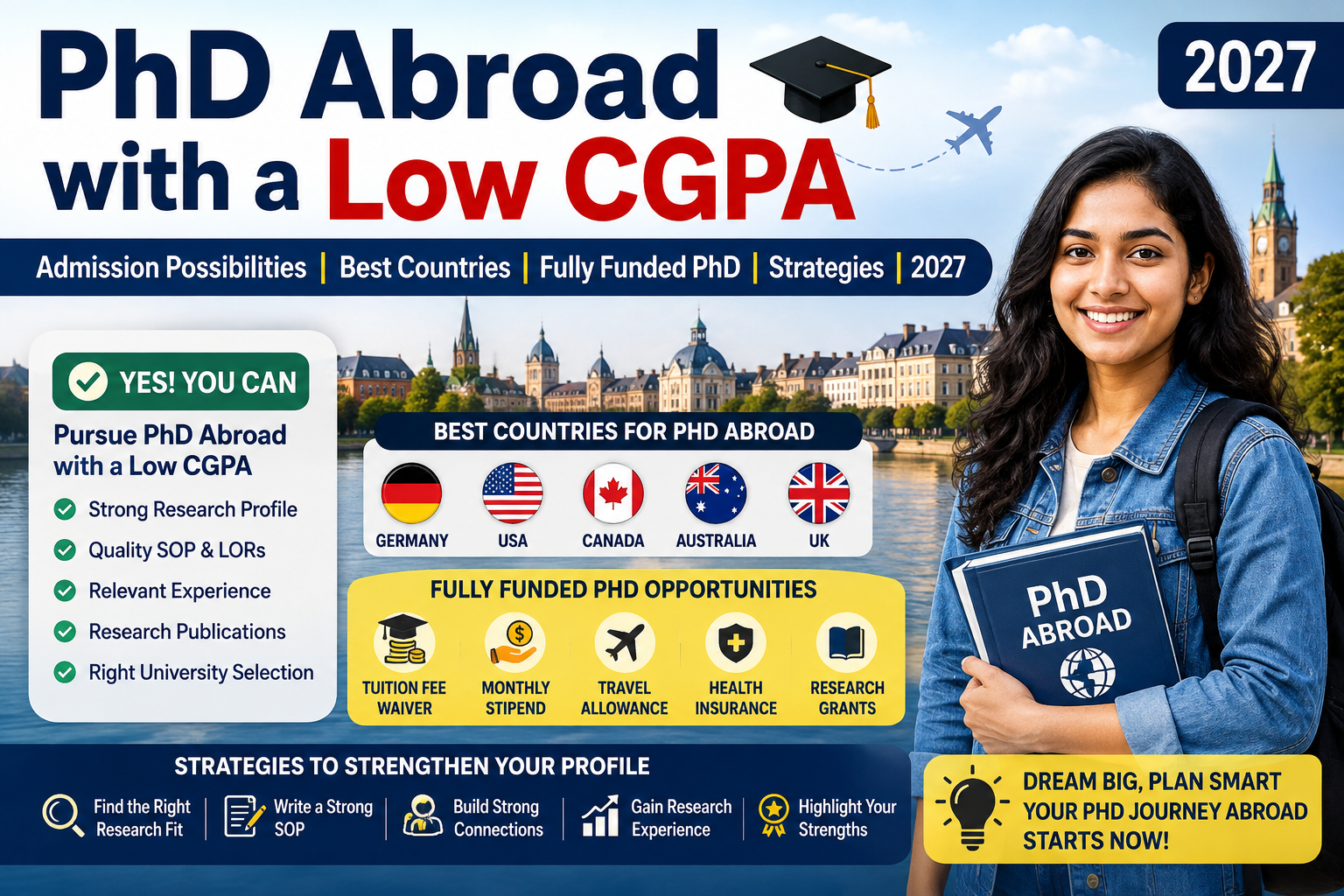
  • PhD Abroad with a Low CGPA: Admission Possibilities, Best Countries, Scholarships & Strategies for Indian Students 2027

    PhD Abroad with a Low CGPA: Admission Possibilities, Best Countries, Scholarships & Strategies for Indian Students 2027

    Are you worried that a low CGPA will stop you from pursuing a PhD abroad?

    The good news is that a PhD abroad with a low CGPA may still be possible, depending on the university, country, doctoral program, research experience and overall strength of your profile.

    Many Indian students believe that having a CGPA below 7.0 means they cannot apply for PhD programs in countries such as the UK, Australia, New Zealand, USA, Germany or other European destinations.

    That is not always correct.

    PhD admission is different from admission to many taught undergraduate or postgraduate programs because a doctorate is primarily a research degree. Universities may therefore examine your academic grades alongside your:

    • research experience
    • master’s dissertation
    • journal publications
    • conference papers
    • research proposal
    • Statement of Purpose
    • Letters of Recommendation
    • professional experience
    • technical expertise
    • academic improvement
    • supervisor compatibility
    • research-project fit

    A lower CGPA may certainly make admission and scholarship competition more difficult, particularly at highly selective universities.

    However, a strong research profile can sometimes make your application considerably more competitive.

    The right question is therefore not:

    “Can I do a PhD abroad with a low CGPA?”

    Instead, ask:

    “How can I build enough evidence of research ability to overcome a weaker academic record?”

    This comprehensive PhD abroad with a low CGPA guide for Indian students in 2027 explains admission possibilities, CGPA ranges, country-wise opportunities, scholarship strategies and practical ways to strengthen your PhD profile.

    PhD abroad for Indian students


    Quick Answer: Can I Pursue a PhD Abroad with a Low CGPA?

    Yes, pursuing a PhD abroad with a low CGPA can be possible if you meet the university’s minimum eligibility requirements and demonstrate strong research potential.

    Your chances can improve when your application includes:

    • strong postgraduate performance
    • a research-intensive master’s degree
    • a high-quality dissertation
    • research publications
    • relevant research experience
    • strong academic recommendations
    • an excellent research proposal
    • a focused SOP
    • relevant professional or R&D experience
    • strong alignment with a potential supervisor

    However, remember:

    PhD admission eligibility and fully funded PhD scholarship competitiveness are not the same thing.

    You may qualify for admission but still face intense competition for funding.


    What Is Considered a Low CGPA for PhD Abroad?

    There is no universal CGPA requirement for PhD admission abroad.

    Indian universities commonly use a 10-point CGPA system, while overseas institutions may use:

    • 4.0 GPA scales
    • percentage systems
    • UK degree classifications
    • honours classifications
    • institution-specific international equivalency systems

    For planning purposes, Indian applicants can use the following broad framework.

    Indian CGPAGeneral PositionSuggested PhD Strategy
    8.0–10.0StrongTarget competitive universities and scholarships
    7.0–7.9Generally competitiveFocus on research quality and supervisor fit
    6.5–6.9ModerateStrengthen publications and research experience
    6.0–6.4ChallengingTarget flexible programs and research-heavy pathways
    5.5–5.9DifficultConsider MRes, MPhil or strong research experience
    Below 5.5Very challengingBuild a stronger postgraduate/research record first

    These ranges are not official admission criteria.

    Universities evaluate international qualifications differently, so always check the exact PhD entry requirements on the official university website.


    Can I Do a PhD Abroad with 5.5 CGPA?

    A PhD abroad with 5.5 CGPA can be difficult, particularly if the university has a strict academic cut-off.

    However, this does not necessarily mean the end of your PhD plans.

    A better pathway may be:

    Low Bachelor’s CGPA → Research Master’s/MRes/MPhil → Strong Dissertation → Publications → PhD

    You can also strengthen your profile through:

    • research assistant positions
    • university research projects
    • peer-reviewed publications
    • industry R&D experience
    • technical research projects
    • conference presentations
    • strong postgraduate academic performance

    Applicants below standard eligibility thresholds should avoid spending money on applications before confirming formal eligibility.


    Can I Do a PhD Abroad with 6 CGPA?

    Yes, a PhD abroad with 6 CGPA may be possible at some universities, but university selection becomes extremely important.

    Compare these two profiles:

    Candidate A

    CGPA: 6.0
    Publications: None
    Research Experience: None
    Master’s Thesis: Average

    Candidate B

    CGPA: 6.0
    Master’s CGPA: 8.3
    Publications: 3
    Research Experience: 3 years
    Master’s Thesis: Strong
    Supervisor Match: Excellent

    Although both applicants have the same undergraduate CGPA, Candidate B presents much stronger evidence of doctoral readiness.

    That is why research performance after your bachelor’s degree matters.


    Can I Get a PhD Abroad with 6.5 CGPA?

    A 6.5 CGPA can potentially be sufficient for some PhD programs abroad, depending on:

    • the university
    • degree equivalency
    • postgraduate performance
    • research experience
    • publications
    • supervisor support
    • research proposal
    • funding requirements

    Students with a CGPA between 6.5 and 7.0 should concentrate strongly on research fit rather than applying randomly based on university rankings.


    Can I Get a PhD Abroad with 7 CGPA?

    Yes. A 7 CGPA may satisfy the academic requirements of some international PhD programs, although requirements differ.

    Applicants around this range can improve their chances by developing:

    • peer-reviewed publications
    • a strong dissertation
    • relevant research projects
    • international conference exposure
    • a high-quality research proposal
    • strong recommendations
    • a carefully targeted supervisor list

    A 7 CGPA alone does not guarantee admission, but it can provide a workable foundation when combined with a strong research profile.


    Does CGPA Matter for PhD Admission Abroad?

    Yes, CGPA matters for PhD admission abroad, but it is not always the only selection criterion.

    Doctoral admissions committees are trying to determine whether you can:

    1. identify an original research problem,
    2. review existing academic literature,
    3. formulate research questions,
    4. design an appropriate methodology,
    5. analyse complex evidence,
    6. conduct independent research,
    7. publish scholarly work, and
    8. complete a doctoral thesis.

    Your CGPA provides evidence of academic performance.

    Your research portfolio provides evidence of research readiness.

    For PhD admission, both can matter.


    What Can Compensate for a Low CGPA in PhD Admission?

    Several factors can strengthen a weak-CGPA PhD application.

    1. Strong Master’s Degree

    Strong postgraduate performance can demonstrate academic improvement.

    For example:

    B.Tech CGPA: 6.2

    followed by:

    M.Tech CGPA: 8.6

    shows a significant upward academic trend.


    2. Research Publications

    Peer-reviewed publications can demonstrate:

    • academic writing ability
    • methodology skills
    • literature knowledge
    • data-analysis capability
    • research independence
    • familiarity with peer review

    Quality is more important than quantity.


    3. Strong Master’s Thesis

    Your master’s dissertation may become one of the strongest pieces of evidence showing your research potential.

    Highlight:

    • research problem
    • methodology
    • findings
    • publications generated
    • technical contribution

    4. Research Experience

    Experience as a:

    • Research Assistant
    • Junior Research Fellow
    • project researcher
    • laboratory researcher
    • industry R&D professional

    can significantly strengthen your profile.


    5. Strong Research Proposal

    A well-developed proposal demonstrates that you understand:

    • research gaps
    • research questions
    • methodology
    • theoretical foundations
    • feasibility
    • potential contribution

    6. Strong PhD Supervisor Fit

    A potential supervisor may be more interested in your profile if your technical or research expertise aligns closely with their current research.

    Research fit can therefore become strategically important for lower-CGPA applicants.

    find and contact a PhD supervisor abroad


    Best Countries for PhD Abroad with a Low CGPA

    Students often search for countries accepting low CGPA for PhD admission.

    There is no country where low grades automatically guarantee admission.

    However, differences in doctoral systems create different opportunities.


    1. PhD in USA with Low GPA

    The USA can be worth considering for applicants with strong research profiles because doctoral admission practices vary between universities and departments.

    Some programs impose minimum GPA requirements.

    Others use broader holistic assessment.

    Students targeting a PhD in USA with low GPA should strengthen:

    • Statement of Purpose
    • research experience
    • publications
    • Letters of Recommendation
    • faculty alignment
    • quantitative skills
    • technical research expertise

    SEO Tip for Students

    Do not search only:

    “Universities accepting low GPA for PhD USA.”

    Also search:

    “PhD faculty working in [your research field] USA.”

    Research fit often provides a better application strategy than GPA filtering alone.


    2. PhD in UK with Low CGPA

    The UK remains a popular destination for Indian PhD applicants.

    UK doctoral opportunities generally fall into two broad categories:

    Student-Proposed PhD

    You develop your research proposal and identify a supervisor.

    Advertised PhD Project

    You apply for an existing research project, often with predefined funding.

    For lower-CGPA applicants, advertised projects can sometimes be attractive when your technical expertise closely matches the project requirements.

    Strengthen your application through:

    • strong master’s performance
    • MRes or MPhil experience
    • publications
    • research assistantships
    • dissertation quality
    • relevant industry experience
    • supervisor alignment

    3. PhD in Australia with Low CGPA

    Australia can be particularly attractive for candidates with a strong postgraduate research background.

    Australian PhD applications may place considerable emphasis on:

    • research components in previous degrees
    • honours research
    • master’s thesis
    • publications
    • research proposal
    • supervisor availability

    An applicant with a weaker undergraduate record but a strong research master’s degree may therefore have a more competitive profile.

    However, fully funded PhD scholarships in Australia can be significantly more competitive than basic admission.

    Australian Government Department of Education


    4. PhD in New Zealand with Low CGPA

    Students can also explore a PhD in New Zealand with low CGPA, particularly when their postgraduate research and proposed doctoral project are strong.

    Popular areas include:

    • Artificial Intelligence
    • Computer Science
    • Engineering
    • Management
    • Business
    • Agriculture
    • Sustainability
    • Environmental Science
    • Education
    • Healthcare

    A strong supervisor match can be especially important.


    5. PhD in Germany with Low CGPA

    Germany offers several doctoral pathways:

    • individual PhD supervision
    • structured doctoral programs
    • funded university projects
    • research institute positions
    • doctoral researcher vacancies

    For project-specific doctoral positions, employers and research teams may pay close attention to:

    • relevant research experience
    • technical skills
    • publications
    • programming knowledge
    • methodological expertise
    • project fit

    This can benefit applicants whose professional and research capabilities are stronger than their historical grades.

    DAAD Germany


    6. PhD in Europe with Low CGPA

    Other European destinations worth exploring include:

    • Netherlands
    • Sweden
    • Norway
    • Denmark
    • Finland
    • France
    • Belgium
    • Austria
    • Switzerland

    In some European systems, doctoral positions operate similarly to research jobs.

    Applicants are selected for a particular funded research project.

    This means specialised knowledge can become particularly valuable.


    Which Country Is Best for PhD with Low CGPA?

    There is no single best country for PhD applicants with low CGPA.

    Your best destination depends on:

    • academic eligibility
    • master’s performance
    • research experience
    • publications
    • subject area
    • funding needs
    • research proposal
    • supervisor availability
    • technical skills

    A student with strong AI research experience may find an excellent funded project in Germany or the Netherlands, while another candidate in management may find stronger supervisor-led opportunities in the UK or Australia.

    Choose based on research fit—not just country rankings.


    How to Get PhD Admission Abroad with Low CGPA: 15 Effective Strategies

    1. Build a Strong Research Profile

    Research experience is one of the best ways to reduce the emphasis on old grades.

    Gain experience through:

    • research assistantships
    • master’s projects
    • research laboratories
    • academic collaborations
    • research internships
    • industry R&D

    2. Publish High-Quality Research Papers

    Aim for credible publications in your research area.

    Relevant outputs include:

    • journal articles
    • conference papers
    • systematic reviews
    • methodological papers
    • reputable book chapters

    Never publish solely to increase paper count.


    3. Develop a Strong PhD Research Proposal

    A high-quality proposal should answer:

    What is the research problem?

    Clearly define the problem.

    What is the research gap?

    Explain what existing studies have not addressed.

    Why does the research matter?

    Show academic and practical significance.

    What are your research questions?

    Define measurable or investigable questions.

    What methodology will you use?

    Explain data, experiments, models, participants or analytical techniques.

    What is the expected contribution?

    Demonstrate potential originality.

    how to write a PhD research proposal


    4. Find the Right PhD Supervisor

    Supervisor matching can be particularly important for students pursuing a PhD abroad with a low CGPA.

    Identify professors based on:

    • recent publications
    • research interests
    • funded projects
    • laboratory focus
    • research methodology
    • current PhD opportunities

    Do not send the same email to 100 professors.

    Personalised outreach is much more effective.


    5. Write a Powerful Statement of Purpose

    Your SOP should focus primarily on your research journey and future potential.

    Use this structure:

    Academic Background → Research Experience → Research Gap → Proposed Research → Supervisor Fit → Long-Term Goal

    If your CGPA needs explanation, keep it short.

    Then emphasise your subsequent achievements.


    6. Demonstrate Academic Improvement

    An upward trajectory can strengthen your narrative.

    For example:

    Bachelor’s: 6.1 CGPA

    Master’s: 8.5 CGPA

    Dissertation: Excellent

    Research Papers: 4

    Research Experience: 3 Years

    This demonstrates that your current research ability is not accurately represented by your earlier academic performance.


    7. Get Strong Letters of Recommendation

    A strong LOR should provide specific examples of your:

    • research aptitude
    • analytical ability
    • technical competence
    • independence
    • writing ability
    • academic maturity
    • persistence
    • doctoral potential

    Choose referees who actually know your research.


    8. Build an Academic Research CV

    Your PhD CV should include:

    • research interests
    • education
    • thesis/dissertation
    • publications
    • conference presentations
    • research projects
    • research experience
    • technical skills
    • awards
    • patents
    • professional experience

    A PhD CV should present you as a researcher, not simply as a job applicant.


    9. Use Your Master’s Degree Strategically

    A strong master’s degree can help reposition an applicant with weaker undergraduate grades.

    Highlight:

    • master’s CGPA
    • dissertation
    • research methods
    • technical contribution
    • papers generated from the project

    10. Gain Relevant Professional Experience

    Industry experience can be valuable when directly related to your proposed PhD.

    Examples:

    AI Engineer → PhD in Artificial Intelligence

    Data Scientist → PhD in Machine Learning

    Marketing Manager → PhD in Marketing

    Teacher → PhD in Education

    Biomedical Engineer → PhD in Medical Imaging


    11. Apply for Research Assistant Positions

    A research assistant role can help you develop:

    • publications
    • laboratory experience
    • methodologies
    • academic references
    • international collaboration

    It can be an excellent bridge between a weak academic record and a competitive PhD application.


    12. Target Advertised Funded PhD Projects

    Search for projects where your skills directly match the research requirements.

    For example:

    “Federated Learning + Medical Imaging + PyTorch”

    will be more valuable for a project requiring those exact capabilities than for a generic computer science PhD.


    13. Create an Ambitious–Target–Realistic University List

    A strong application portfolio should include:

    Ambitious Universities

    Highly competitive programs.

    Target Universities

    Programs where you reasonably meet academic and research requirements.

    Strong Research-Fit Opportunities

    Projects where your expertise closely matches the supervisor’s requirements.

    Do not rely solely on global university rankings.


    14. Consider an MPhil, MRes or Research Master’s

    If your CGPA does not meet direct PhD entry requirements, consider:

    Low CGPA → MRes/MPhil → Strong Research Performance → Publications → PhD

    This can provide a much stronger recent academic record.


    15. Apply Early

    Funding deadlines may be earlier than general admission deadlines.

    Starting early gives you time to:

    • contact supervisors
    • improve your proposal
    • prepare SOP
    • request LORs
    • take IELTS/TOEFL if required
    • identify scholarships
    • revise your academic CV

    Can a Master’s Degree Compensate for Low Bachelor’s CGPA?

    A strong master’s degree can significantly strengthen your PhD application, particularly when the postgraduate program contains substantial research.

    Example:

    Bachelor’s CGPA: 6.2
    Master’s CGPA: 8.7
    Publications: 3
    Research Experience: 2 years
    Strong Dissertation: Yes

    This indicates substantial academic progression.

    However, postgraduate performance cannot automatically override a compulsory eligibility threshold.


    Can Research Publications Compensate for Low CGPA?

    Publications can help demonstrate research capability, but they usually cannot replace formal academic eligibility.

    Publications are particularly useful when they are:

    • peer-reviewed
    • relevant
    • credible
    • methodologically strong
    • connected to your proposed research

    One strong paper is usually more valuable than several weak publications.


    Can Work Experience Compensate for Low CGPA?

    Relevant work experience can strengthen your profile, especially for applied PhDs.

    Examples include professional experience in:

    • AI and Data Science
    • Engineering
    • Healthcare
    • Management
    • Finance
    • Marketing
    • Education
    • Sustainability

    The closer the professional experience is to your proposed PhD, the more valuable it becomes.


    Can GRE Compensate for Low CGPA?

    A strong GRE score may provide additional academic evidence where the test is accepted.

    However:

    GRE cannot normally override mandatory academic requirements.

    Many doctoral programs have also made GRE scores optional or unnecessary.

    Always check the latest program-specific policy.

    PhD abroad without GRE


    Can IELTS Compensate for Low CGPA?

    No.

    IELTS, TOEFL and PTE demonstrate English-language proficiency.

    They do not replace academic eligibility requirements.

    A high IELTS score is useful for satisfying language requirements but does not directly compensate for poor academic grades.


    Can You Get a Fully Funded PhD Abroad with a Low CGPA?

    Yes, a fully funded PhD abroad with a low CGPA may be possible, but funding is generally more competitive than admission.

    Possible funding sources include:

    • university PhD scholarships
    • government scholarships
    • supervisor research grants
    • research assistantships
    • research-council projects
    • industry-funded PhDs
    • project-specific doctoral positions

    Applicants with lower CGPA should particularly consider funded projects where their specialist research skills provide a strong match.

    fully funded PhD scholarships for Indian students


    PhD Admission vs PhD Scholarship: Understand the Difference

    PhD Admission

    The university determines whether you are academically and academically/research-ready for the doctoral program.

    PhD Funding

    A separate scholarship or funding competition may rank candidates based on:

    • academic performance
    • publications
    • awards
    • research experience
    • proposal quality
    • supervisor support
    • project relevance

    Therefore:

    PhD Admission ≠ Fully Funded PhD

    Students must plan for both separately.

    UK Research and Innovation


    How to Find Fully Funded PhD Opportunities with Low CGPA

    Use specific search queries instead of generic searches.

    Examples:

    • Fully funded PhD UK international students 2027
    • Fully funded PhD Australia Indian students 2027
    • PhD scholarship New Zealand international students
    • Doctoral researcher Germany machine learning
    • Funded PhD Netherlands artificial intelligence
    • PhD studentship UK data science
    • Fully funded PhD management Europe

    Then verify eligibility on the official university or funding website.


    Low CGPA but Strong Research Profile: Example

    Consider this hypothetical profile:

    CriteriaApplicant Profile
    Bachelor’s CGPA6.4/10
    Master’s CGPA8.5/10
    Journal Publications3
    Conference Papers2
    Research Experience3 Years
    Master’s DissertationStrong
    Technical SkillsStrong
    Supervisor FitExcellent

    The bachelor’s CGPA is relatively weak.

    But the overall research profile is significantly stronger.

    The applicant should not write:

    “Please overlook my low CGPA.”

    A better positioning is:

    “My subsequent postgraduate performance, publications and research experience demonstrate my readiness for doctoral-level research.”


    Documents Required for PhD Abroad with a Low CGPA

    Prepare a complete application package containing:

    • Academic CV
    • Statement of Purpose
    • Research Proposal
    • Bachelor’s transcripts
    • Master’s transcripts
    • Degree certificates
    • Thesis/dissertation abstract
    • Research publications
    • Conference papers
    • Letters of Recommendation
    • IELTS/TOEFL/PTE score where required
    • Research portfolio
    • Work-experience documents
    • Scholarship application documents
    • Passport
    • University-specific forms

    Common Mistakes to Avoid When Applying for PhD with Low CGPA

    Applying Only to Top-Ranked Universities

    Rankings should not be the only selection factor.

    Searching Only for “Low CGPA Universities”

    Search for research fit and project compatibility instead.

    Sending Generic Emails to Professors

    Personalise every serious supervisor approach.

    Hiding Low Grades

    Your transcript will show them.

    Writing an SOP Only About Low CGPA

    Your SOP should primarily communicate research ability.

    Publishing in Predatory Journals

    Low-quality publications can reduce your credibility.

    Assuming Supervisor Interest Guarantees Admission

    Formal eligibility requirements still apply.

    Assuming Admission Means Full Funding

    Scholarship decisions may be separate.


    PhD Abroad Strategy Based on Your CGPA

    CGPARecommended Strategy
    8.0+Target highly competitive PhDs and scholarships
    7.0–7.9Strong research-fit applications
    6.5–6.9Publications + proposal + supervisor targeting
    6.0–6.4Research-heavy profile strengthening
    5.5–5.9Consider MRes/MPhil or RA experience
    Below 5.5Build a stronger postgraduate research record first

    Step-by-Step Plan for PhD Abroad with a Low CGPA

    Step 1: Evaluate Your Academic Profile

    Analyse:

    • bachelor’s CGPA
    • master’s CGPA
    • dissertation
    • research experience
    • publications

    Step 2: Identify Your Research Area

    Avoid overly broad topics.

    Step 3: Select Suitable Countries

    Compare:

    • eligibility
    • funding
    • research facilities
    • supervisor availability

    Step 4: Check Formal PhD Requirements

    Do this before paying application fees.

    Step 5: Identify Potential Supervisors

    Create a targeted shortlist.

    Step 6: Read Their Recent Publications

    Understand their current research direction.

    Step 7: Develop Your Research Proposal

    Align it with the research group where appropriate.

    Step 8: Create an Academic CV

    Prioritise research achievements.

    Step 9: Prepare Your SOP

    Explain your research journey clearly.

    Step 10: Obtain Strong LORs

    Approach research supervisors and academics early.

    Step 11: Identify Funding

    Research university, government and project-based scholarships.

    Step 12: Apply Strategically

    Quality applications are better than random mass applications.


    Frequently Asked Questions: PhD Abroad with a Low CGPA

    Can I pursue a PhD abroad with a low CGPA?

    Yes. It may be possible if you meet the university’s minimum requirements and build a strong research profile.

    Is 5.5 CGPA enough for PhD abroad?

    Direct admission can be difficult. A research master’s, MPhil, MRes or substantial research experience may improve your options.

    Is 6 CGPA enough for PhD abroad?

    Some programs may consider applicants around this range, depending on their qualifications, postgraduate record and research profile.

    Can I get a PhD abroad with 6.5 CGPA?

    Yes, potentially. Research publications, a strong master’s degree and supervisor alignment can improve your chances.

    Is 7 CGPA enough for PhD abroad?

    It may satisfy the requirements of some programs. Always check university-specific criteria.

    Which country is best for PhD with low CGPA?

    There is no universally best country. The UK, Australia, New Zealand, USA, Germany and other European destinations all have different PhD admission models.

    Can I get a fully funded PhD with low CGPA?

    Potentially, but funding is competitive. Strong research experience, publications and project alignment can help.

    Can master’s CGPA compensate for low bachelor’s CGPA?

    A strong master’s performance can significantly improve your profile, particularly when accompanied by high-quality research.

    Can publications compensate for low CGPA?

    Publications strengthen your application but usually do not replace mandatory academic eligibility requirements.

    Can work experience compensate for low CGPA?

    Relevant research or professional experience can strengthen the overall application.

    Can GRE improve my chances with low CGPA?

    Where accepted, a strong GRE result can provide additional evidence of academic ability but cannot usually override formal requirements.

    Does IELTS compensate for low CGPA?

    No. IELTS measures English-language proficiency rather than academic performance.

    Should I mention my low CGPA in my SOP?

    Mention it briefly only when clarification is genuinely useful. Focus primarily on your academic improvement and research achievements.

    Should I contact a professor before applying?

    For many research-focused PhDs, contacting an appropriate supervisor can be beneficial or required. Follow the university’s specific application procedure.

    Can I pursue PhD abroad after M.Tech with low CGPA?

    Yes, depending on eligibility. A strong M.Tech dissertation, research publications and technical experience may strengthen your application.

    Can I pursue PhD abroad after MSc with low CGPA?

    Potentially. Your MSc research performance, dissertation and proposed doctoral topic will be important.

    Can I pursue PhD abroad after MCA with low CGPA?

    Potentially, especially for Computer Science, IT and related areas if the program accepts your qualification and you have adequate research preparation.

    Can I pursue PhD abroad after MBA with low CGPA?

    Potentially, particularly in areas such as management, marketing, finance, entrepreneurship and organisational studies.

    Is research experience more important than CGPA for PhD admission?

    Both can matter. Research experience can substantially strengthen an application, but it does not automatically override mandatory academic entry requirements.

    Can a professor accept me despite low CGPA?

    A supervisor may support your application, but the university’s formal academic eligibility requirements still apply.


    Final Verdict: Is PhD Abroad with a Low CGPA Possible in 2027?

    Yes, PhD abroad with a low CGPA can be possible for Indian students in 2027, but success requires strategic profile building and careful university selection.

    A lower CGPA does not have to define your entire academic future.

    The strongest strategy is to build evidence of your current research capability through:

    Strong Master’s Performance + Research Experience + Publications + Excellent Proposal + Supervisor Fit + Strong LORs + Relevant Technical Skills

    Do not focus exclusively on finding:

    “Universities accepting low CGPA for PhD.”

    Instead, identify:

    “PhD supervisors, funded projects and universities where my research expertise is a strong match.”

    That research-first approach can give you a much more realistic and effective PhD application strategy.


    Start Your PhD Abroad Journey with EducationMESD

    Planning a PhD abroad with a low CGPA requires more than submitting applications to multiple universities.

    You need a structured strategy covering:

    • country selection
    • university eligibility
    • research-profile evaluation
    • supervisor identification
    • proposal development
    • SOP preparation
    • scholarship targeting
    • funded PhD identification
    • application planning

    EducationMESD supports prospective research scholars in understanding international PhD admissions and developing a realistic application pathway based on their academic and research profiles.Whether you are planning a PhD in Australia, New Zealand, UK, USA, Germany or Europe, the right research fit, supervisor and application strategy can make a significant difference.

  • PhD in New Zealand for Indian Students: Fees, Funding and Admission Process

    PhD in New Zealand for Indian Students: Fees, Funding and Admission Process

    Are you planning a PhD in New Zealand for Indian students and looking for accurate information about fees, fully funded scholarships, stipend, eligibility and the admission process? New Zealand can be an attractive PhD destination for Indian students because eligible international doctoral candidates can pay domestic-level PhD tuition fees rather than standard international postgraduate fees.

    Funding opportunities are also substantial. Major university doctoral scholarships currently offer stipends of approximately NZ$32,000 to NZ$35,000+ per year, often together with tuition-fee coverage. For example, the University of Auckland’s 2026 doctoral scholarship rate is NZ$35,468 per year, while the University of Otago Doctoral Scholarship provides NZ$34,128 per year plus a domestic tuition-fee waiver.

    New Zealand also provides unusually flexible work rights for doctoral candidates. Immigration New Zealand states that students enrolled in a PhD or Research Master’s programme have no limit on their permitted work hours, although full-time doctoral students must continue studying full-time.

    This complete EducationMESD guide explains everything Indian applicants need to know about a PhD in New Zealand, including:

    PhD Fees → Scholarships → Stipend → Eligibility → IELTS → Research Proposal → Supervisor → Admission Process → Student Visa → Work Rights → Family → Post-Study Work


    PhD in New Zealand for Indian Students: Quick Answer

    A PhD in New Zealand can be comparatively affordable for Indian students because eligible international PhD candidates pay domestic tuition rates. Major university scholarships can also cover tuition and provide annual stipends of around NZ$32,000–NZ$35,000+. A full-time PhD commonly takes around three to four years, and doctoral students receive favourable work and family visa provisions under current New Zealand immigration rules.


    PhD in New Zealand for Indian Students: Highlights

    ParticularDetails
    DegreeDoctor of Philosophy – PhD
    Typical DurationApproximately 3–4 years
    International PhD FeesEligible international students pay domestic-level fees
    Auckland 2026 PhD FeeNZ$8,847.60 per year
    Major Scholarship StipendsApproximately NZ$32,000–NZ$35,000+ per year
    Master’s Required?Common route, but not universally compulsory
    Research ProposalUsually important
    SupervisorResearch alignment is critical
    IELTSCommon benchmark around 6.5; programme requirements vary
    GREGenerally not a standard university-wide requirement
    PhD Work RightsNo hourly limit under current rules
    PartnerPhD students can support a partner work visa, subject to eligibility
    Dependent ChildrenCan be supported for student visas
    Post-Study WorkUp to 3 years for eligible master’s/doctoral graduates

    The University of Auckland confirms a 2026 doctoral fee of NZ$8,847.60 per year, while Immigration New Zealand confirms the work, family and post-study provisions described above.


    Why Study a PhD in New Zealand for Indian Students?

    For Indian students comparing the UK, Australia, New Zealand, Canada or the USA for PhD study, New Zealand has one particularly important financial advantage: eligible international doctoral students are treated like domestic students for PhD tuition purposes.

    This can substantially reduce the cost difference between domestic and international doctoral study.

    Key Benefits of a PhD in New Zealand

    1. Domestic PhD Fees for International Students

    Eligible international PhD students can pay the same tuition rate as domestic doctoral students. The University of Auckland, for example, lists a 2026 PhD tuition fee of NZ$8,847.60 per year.

    2. Fully Funded PhD Scholarships

    New Zealand universities offer doctoral scholarships that can include:

    • annual living stipend
    • tuition-fee coverage
    • student services fees in some cases
    • health insurance in selected scholarships
    • research funding through particular projects.

    Current doctoral awards at Auckland, Otago, Waikato, Wellington, Canterbury, AUT and Massey demonstrate substantial funding opportunities for eligible candidates.

    3. Strong Work Rights for PhD Students

    Unlike the standard work-hour limits applying to many international students, New Zealand currently places no hourly work limit on students enrolled in a PhD or Research Master’s programme. Full-time doctoral students still need to maintain full-time study.

    4. Benefits for Spouse and Children

    A student undertaking a PhD at a New Zealand university can support a work visa for their partner and student visas for dependent children, subject to immigration requirements.

    5. Post-Study Work Opportunities

    Students completing an eligible master’s or doctoral qualification after at least 30 weeks of study in New Zealand can currently receive a three-year Post Study Work Visa.


    PhD Fees in New Zealand for Indian Students

    One of the most searched questions is:

    How Much Does a PhD in New Zealand Cost for Indian Students?

    Eligible international PhD students are generally able to access domestic doctoral tuition fees, making doctoral study significantly different from standard international bachelor’s or master’s tuition.

    University of Auckland PhD Fees 2026

    The University of Auckland publishes the following figures for 2026:

    Cost2026 Amount
    PhD Tuition FeeNZ$8,847.60/year
    Estimated Student Services FeeNZ$1,132.80/year

    New international PhD students who qualify under the domestic-fee policy pay the same annual tuition as New Zealand PhD students.

    Lincoln University PhD Fees 2026

    Lincoln University lists estimated 2026 PhD tuition of:

    NZ$9,060 for 120 credits

    for both domestic and international PhD candidates, subject to the applicable conditions.

    Important for Indian Applicants

    Do not estimate the cost of a New Zealand PhD by looking at the international master’s tuition rate.

    Search specifically for:

    International PhD Fees + University Name

    because doctoral fee treatment is different.


    Are PhD Fees the Same for International and Domestic Students in New Zealand?

    For eligible international PhD candidates, yes—domestic-rate tuition is one of the major advantages of doctoral study in New Zealand.

    Education New Zealand’s official study portal states that international PhD candidates can pay the same fees as New Zealand domestic students. Individual universities apply detailed eligibility conditions.

    Some institutions specifically require international candidates to remain based in New Zealand, apart from approved temporary research-related absences, to retain domestic-fee status. Lincoln University, for example, explicitly states this condition.


    Fully Funded PhD in New Zealand for Indian Students

    Yes, Indian students can compete for a fully funded PhD in New Zealand.

    A fully funded doctoral package commonly combines:

    Tuition Fee Coverage + Living Stipend

    Depending on the scholarship, additional benefits may include:

    • student services fees
    • medical insurance
    • relocation support
    • conference support
    • research expenses.

    However, the meaning of “fully funded” differs between scholarships. Applicants should check whether costs such as insurance, student levies and relocation are included.


    Best PhD Scholarships in New Zealand for Indian Students

    1. University of Auckland Doctoral Scholarship

    The University of Auckland Doctoral Scholarship provides a strong funding package.

    2026 Value

    NZ$35,468 per year + tuition fees, with additional eligible benefits depending on the award conditions.

    The stipend is adjusted under the university’s applicable scholarship provisions.


    2. University of Otago Doctoral Scholarship

    The University of Otago Doctoral Scholarship is open to eligible domestic and international doctoral candidates.

    Current PhD Funding

    NZ$34,128 per year + domestic tuition-fee waiver for 36 months

    The standard award excludes student services fees and insurance. Otago lists up to 153 doctoral scholarships annually.


    3. University of Waikato Doctoral Scholarship

    The University of Waikato Doctoral Scholarship currently offers:

    Up to NZ$33,000 per year for up to 36 months + domestic tuition fees + Student Services Fee.

    This represents one of the attractive funding options for international applicants seeking a fully funded PhD in New Zealand.


    4. Wellington Doctoral Scholarship

    Victoria University of Wellington’s main doctoral scholarship currently provides:

    NZ$32,000 per year + domestic tuition fees for up to three years.


    5. University of Canterbury Doctoral Scholarship

    The University of Canterbury lists its general doctoral scholarship at:

    NZ$32,650 per 120 points + eligible thesis-only tuition fees, up to the scholarship’s specified maximum duration.

    The standard UC Doctoral Scholarship currently has scholarship rounds associated with 15 May and 15 October closing dates. Applicants should verify the relevant year’s round before submitting.


    6. AUT Doctoral Scholarship

    Auckland University of Technology’s 2026 doctoral scholarships provide:

    NZ$34,737 per year + tuition fees + compulsory Student Services Fee for up to three years of full-time study.


    7. Massey University Doctoral Scholarship

    The Massey University Doctoral Scholarship currently lists:

    NZ$90,000 + fees over three years.

    For the current 2026 round, Massey lists applications opening on 1 August 2026 and closing on 1 October 2026.


    PhD Scholarship and Stipend in New Zealand: Comparison

    UniversityCurrent Indicative FundingTuition Support
    University of AucklandNZ$35,468/yearYes
    AUTNZ$34,737/yearYes + Student Services Fee
    University of OtagoNZ$34,128/yearDomestic tuition waiver
    University of WaikatoUp to NZ$33,000/yearTuition + Student Services Fee
    University of CanterburyNZ$32,650 per 120 pointsEligible tuition
    Victoria University of WellingtonNZ$32,000/yearDomestic tuition
    Massey UniversityNZ$90,000 over 3 yearsFees

    These are current published scholarship values and should be treated as indicative for planning because scholarship rates and regulations can change between application cycles.


    How Much Is the PhD Stipend in New Zealand?

    A competitive PhD stipend in New Zealand currently falls around NZ$32,000–NZ$35,000+ per year for several major university doctoral scholarships.

    For example:

    • Auckland – NZ$35,468
    • AUT – NZ$34,737
    • Otago – NZ$34,128
    • Waikato – up to NZ$33,000
    • Wellington – NZ$32,000.

    Applicants should compare total scholarship coverage, not only the stipend amount.

    A NZ$33,000 scholarship covering tuition, student fees and other expenses could be financially stronger than a slightly higher stipend that leaves several additional costs unpaid.


    Is PhD in New Zealand Free for Indian Students?

    Not automatically.

    International PhD students can benefit from domestic-level tuition, but they still have tuition and living expenses unless these costs are covered by a scholarship or other funding source.

    Therefore:

    Without Scholarship

    Domestic PhD Tuition + Living Expenses + Insurance + Other Costs

    With Full Scholarship

    Tuition Coverage + Annual Living Stipend + Possible Additional Benefits

    A competitive doctoral scholarship can therefore make a PhD in New Zealand effectively fully funded for an Indian applicant, depending on the precise award package.


    Cost of Living in New Zealand for Indian PhD Students

    Living expenses depend on the city, accommodation type, household size and personal lifestyle.

    Major costs include:

    • accommodation
    • food and groceries
    • electricity
    • internet
    • mobile
    • transportation
    • insurance
    • books and research expenses
    • personal costs
    • travel between India and New Zealand.

    For visa purposes, Immigration New Zealand currently requires tertiary students funding themselves to show NZ$20,000 per year for living costs, or NZ$1,667 per month for programmes shorter than a year. This immigration requirement should not be confused with a guaranteed estimate of an individual’s actual annual expenditure.


    Best Universities for PhD in New Zealand

    Indian students can explore PhD opportunities across New Zealand’s universities, including:

    1. University of Auckland
    2. University of Otago
    3. Victoria University of Wellington
    4. University of Canterbury
    5. University of Waikato
    6. Massey University
    7. Auckland University of Technology
    8. Lincoln University

    For doctoral study, university ranking should not be the only deciding factor.

    The better decision framework is:

    Research Fit → Supervisor → Funding → Facilities → Research Group → University

    A university with a highly relevant supervisor and funded research opportunity can be a much better PhD option than a higher-ranked institution without appropriate expertise.


    PhD Eligibility in New Zealand for Indian Students

    The eligibility for PhD in New Zealand for Indian students varies between universities and academic disciplines.

    Applicants generally need a strong prior academic qualification with substantial research preparation.

    Potential pathways include:

    • relevant master’s degree with research
    • master’s degree with dissertation or thesis
    • bachelor’s honours degree containing substantial research
    • another equivalent research qualification accepted by the university.

    Admission decisions may consider:

    FactorImportance
    Academic PerformanceVery High
    Master’s Thesis/DissertationVery High
    Research ExperienceVery High
    Research ProposalVery High
    Supervisor AlignmentVery High
    PublicationsAdvantageous
    Research Methodology SkillsImportant
    Academic ReferencesImportant
    English ProficiencyRequired where applicable

    Minimum admission criteria are not the same as competitive scholarship criteria.

    A student may be academically eligible for a PhD but still need a much stronger research profile to secure full funding.


    Can Indian Students Apply for PhD in New Zealand After M.Tech or M.Sc?

    Potentially, yes.

    Indian students may be considered after qualifications such as:

    • M.Tech
    • M.E.
    • M.Sc.
    • M.A.
    • M.Com.
    • MBA
    • M.Pharm.
    • M.Phil.
    • or another relevant postgraduate qualification.

    The university will assess the qualification’s academic level, relevance and research component.

    For students completing coursework-heavy postgraduate degrees, evidence such as a dissertation, published research, research projects or substantial methodological training can strengthen the application.


    Can I Apply for PhD in New Zealand Without a Master’s?

    Potentially, yes.

    A master’s degree is not universally mandatory if an applicant possesses an acceptable honours qualification or other equivalent preparation containing substantial research.

    However, for many Indian applicants, a research-based master’s degree provides the most straightforward route because it offers evidence of:

    Research Methods + Dissertation + Independent Research + Academic Writing


    IELTS Requirement for PhD in New Zealand

    English-language requirements depend on the university and programme.

    An IELTS Academic score around 6.5 overall with no band below 6.0 is a common postgraduate benchmark at major institutions, but some programmes require higher scores.

    Candidates should check the exact doctoral programme rather than assuming one IELTS requirement applies throughout New Zealand.

    Fields such as:

    • Education
    • Health
    • Law
    • Linguistics
    • clinical disciplines

    may impose higher requirements.

    Accepted alternatives can also vary by university.


    Is GRE Required for PhD in New Zealand?

    GRE is generally not a standard university-wide requirement for New Zealand PhD admission.

    Selection is normally much more research-oriented.

    Applicants should concentrate on:

    Academic Performance + Dissertation + Proposal + Publications + Research Experience + Supervisor Fit + References

    A particular programme can still impose additional requirements, so always check its admission page before applying.


    Research Proposal for PhD in New Zealand

    A strong research proposal is one of the most important parts of a competitive doctoral application.

    Your proposal should answer:

    What will you investigate?

    Why does the problem matter?

    What gap exists in current research?

    How will you investigate it?

    What new contribution could your PhD make?

    Recommended PhD Research Proposal Structure

    SectionContent
    Proposed TitlePrecise research title
    BackgroundContext of the problem
    Problem StatementProblem being investigated
    Research GapWhat existing studies have missed
    Research QuestionsQuestions to be answered
    Research ObjectivesIntended research achievements
    Literature ReviewRelevant current research
    Theoretical FrameworkApplicable theories/models
    MethodologyDesign, sample, data and analysis
    Ethical ConsiderationsResearch ethics
    Expected ContributionNew knowledge expected
    Research TimelineProposed PhD stages
    ReferencesKey scholarly literature

    Example of a Strong PhD Research Topic

    Too Broad

    Artificial Intelligence in Healthcare

    This does not clearly identify the research problem, methodology or contribution.

    More Research-Focused

    Privacy-Preserving Federated Learning for Multi-Institutional Brain Tumour Segmentation Using Lightweight Deep Neural Networks

    The second topic narrows the:

    Technology + Problem + Context + Methodological Direction

    That makes it easier to identify suitable supervisors and communicate the potential research contribution.


    How to Find a PhD Supervisor in New Zealand

    Your supervisor can be more important to doctoral success than the overall university ranking.

    Before contacting a professor, investigate:

    • current research interests
    • publications from the last few years
    • ongoing research projects
    • funded projects
    • research laboratory/group
    • methodological expertise
    • previous PhD supervision
    • industry collaborations.

    Best Supervisor Search Strategy

    Use:

    Research Topic → Keywords → Recent Papers → Authors → University Profiles → Potential Supervisor

    Do not begin with:

    University Ranking → Random Professor → Generic Email

    Research alignment should come first.


    How to Email a PhD Supervisor in New Zealand

    Your first email should be concise and academically focused.

    Include:

    1. brief academic introduction
    2. current/highest qualification
    3. previous research experience
    4. proposed research area
    5. specific reason for contacting that professor
    6. connection with their recent research
    7. request to discuss PhD supervision
    8. academic CV
    9. concise research proposal/concept note.

    Avoid generic statements such as:

    “I read your profile and am highly interested in your esteemed university.”

    Instead, demonstrate real academic alignment by referencing the professor’s relevant research theme and explaining how your proposed work connects to it.


    PhD Admission Process in New Zealand for Indian Students

    The PhD admission process in New Zealand is research-driven and should normally begin before the formal application.

    Step 1: Identify Your Research Interest

    Start with your academic field.

    Example:

    Computer Science → Artificial Intelligence → Federated Learning → Medical Imaging


    Step 2: Identify the Research Gap

    Read recent:

    • Scopus-indexed studies
    • Web of Science papers
    • systematic reviews
    • recent conference proceedings
    • papers published by potential supervisors.

    Your objective is to identify an unresolved problem—not simply a popular subject.


    Step 3: Shortlist Universities

    Evaluate universities on:

    Supervisor Expertise + Research Group + Infrastructure + Funding + Project Fit

    Do not shortlist only according to rankings.


    Step 4: Identify Potential Supervisors

    Create a targeted list of researchers whose current work genuinely overlaps with your proposal.

    A shortlist of 5–10 highly relevant potential supervisors is generally more useful than mass-emailing dozens of unrelated academics.


    Step 5: Prepare an Academic CV

    A research-oriented PhD CV should prioritise:

    • education
    • master’s dissertation
    • research experience
    • publications
    • conference presentations
    • research projects
    • patents
    • technical skills
    • research methods
    • teaching experience
    • awards.

    Step 6: Develop the Research Proposal

    Your proposal should demonstrate:

    Problem → Research Gap → Objectives → Methodology → Expected Contribution


    Step 7: Contact Supervisors

    Where supervisor contact is required or encouraged, send personalised academic emails.

    Do not send identical proposals and emails to dozens of academics.


    Step 8: Submit the Formal PhD Application

    The university may assess:

    • previous qualification
    • research preparation
    • academic grades
    • proposal
    • supervisor arrangements
    • references
    • English proficiency
    • publications and research experience.

    Step 9: Apply for PhD Scholarships

    Do not assume that:

    PhD Admission = PhD Scholarship

    Some funding is integrated with admission, while other scholarships have separate applications, rounds or nomination processes.

    Check this before submitting your university application.


    Step 10: Attend an Interview if Required

    Be prepared to explain:

    • why the problem matters
    • what the research gap is
    • proposed methodology
    • expected contribution
    • why the supervisor is suitable
    • why you selected that research group.

    Step 11: Receive Admission and Funding Decisions

    Before accepting, check:

    • tuition coverage
    • annual stipend
    • scholarship duration
    • insurance
    • student fees
    • research costs
    • supervisor
    • start date
    • scholarship conditions.

    Step 12: Apply for Your New Zealand Student Visa

    Students studying in New Zealand for more than three months normally require an appropriate student visa and an offer of place from a New Zealand education provider.


    Documents Required for PhD in New Zealand

    Indian applicants should generally prepare:

    • valid passport
    • bachelor’s degree certificate
    • bachelor’s transcripts
    • master’s degree certificate
    • master’s transcripts
    • grading-scale information where required
    • academic CV
    • research proposal
    • dissertation/thesis information
    • publication list
    • research experience documents
    • English-language test result where applicable
    • academic references
    • supervisor communication/support where applicable
    • statement of research interest if requested.

    Always follow the university’s exact document checklist.


    PhD in New Zealand Without Publications: Is It Possible?

    Yes.

    Publications can strengthen a PhD or scholarship application, but a publication record should not be treated as the only evidence of research potential.

    A candidate without journal publications can still build a strong profile through:

    Master’s Dissertation + Strong Grades + Research Proposal + Research Projects + Technical Skills + Conference Work + Strong References

    For scholarship competition, high-quality research evidence is generally more valuable than accumulating low-quality publications merely to increase the publication count.


    How to Get a Fully Funded PhD in New Zealand

    If your target is a fully funded PhD in New Zealand for Indian students, focus on six areas.

    1. Build a Research-Focused Academic Profile

    Your application should show evidence that you can conduct independent research.

    2. Identify a Strong Research Gap

    Avoid generic proposals based only on popular keywords such as AI, sustainability, tourism or healthcare.

    3. Match With the Right Supervisor

    A supervisor should have expertise directly relevant to your methodology or research problem.

    4. Demonstrate Methodological Skills

    Show that you understand the techniques required for the proposed research.

    5. Strengthen Research Outputs

    Where possible, build evidence through:

    • journal publications
    • conference papers
    • dissertation
    • research projects
    • datasets
    • software
    • patents.

    6. Apply Strategically

    Do not depend on one university.

    Create a portfolio based on:

    Excellent Fit + Good Fit + Emerging Opportunity


    New Zealand Student Visa for PhD Students

    A doctoral student will generally need an appropriate student visa to undertake full-time PhD study in New Zealand.

    For tertiary students funding their own stay, Immigration New Zealand currently requires evidence of NZ$20,000 per year for living expenses, in addition to other applicable financial requirements.

    Applicants should use the current Immigration New Zealand requirements when preparing their visa documents because immigration rules can change during an admission cycle.


    Can PhD Students Work in New Zealand?

    Yes.

    This is a particularly important benefit for doctoral candidates.

    Immigration New Zealand currently states:

    There is no limit on the hours a student can work if enrolled in a doctoral degree or Research Master’s programme at a New Zealand tertiary institution.

    A PhD student working full-time must still continue studying full-time.

    Scholarship holders should separately check whether their scholarship conditions impose restrictions on additional employment.


    Can Your Spouse Work While You Do a PhD in New Zealand?

    Potentially, yes.

    Current immigration rules allow a student studying a Level 9 or Level 10 qualification to support a work visa for their partner. For students pursuing a PhD at a New Zealand university, Immigration New Zealand also states that they can support:

    • a work visa for their partner
    • student visas for dependent children.

    This can make New Zealand particularly attractive for Indian professionals planning doctoral study with their families.


    Can Children of PhD Students Study in New Zealand?

    Eligible PhD students can support student visas for dependent children under current immigration settings.

    The official Study with New Zealand portal also highlights domestic-school treatment for children of international PhD students under applicable conditions.

    Applicants taking family members should verify current immigration and schooling rules for their specific circumstances before making financial commitments.


    Post-Study Work Visa After PhD in New Zealand

    After completing an eligible doctoral qualification, students may qualify for a Post Study Work Visa.

    Under current rules, a person who completes a master’s or doctoral-level qualification and studies in New Zealand for at least 30 weeks can work in New Zealand for three years on the Post Study Work Visa.

    Because a PhD lasts several years, Indian applicants should check the immigration policy again close to graduation rather than assuming today’s rules will remain unchanged throughout their doctorate.


    Career Opportunities After PhD in New Zealand

    Depending on the discipline and individual expertise, doctoral graduates may pursue careers in:

    • universities
    • research institutions
    • government
    • technology companies
    • engineering organisations
    • consulting
    • healthcare research
    • environmental research
    • agriculture and food technology
    • financial services
    • public policy
    • R&D.

    Potential positions include:

    Lecturer | Postdoctoral Researcher | Research Scientist | AI Researcher | Data Scientist | R&D Engineer | Research Consultant | Policy Researcher | Innovation Specialist

    For students targeting an academic career, aim to complete the PhD with more than a thesis.

    Build:

    PhD + Publications + Conferences + Teaching + Collaboration + Research Network


    Popular PhD Fields in New Zealand for Indian Students

    Artificial Intelligence and Computer Science

    Popular research directions can include:

    • artificial intelligence
    • machine learning
    • generative AI
    • data science
    • cybersecurity
    • federated learning
    • computer vision
    • natural language processing
    • robotics.

    Engineering

    Potential areas include:

    • civil engineering
    • mechanical engineering
    • electrical engineering
    • renewable energy
    • materials engineering
    • environmental engineering.

    Business and Management

    Research areas may include:

    • marketing
    • finance
    • entrepreneurship
    • tourism
    • sustainability
    • strategy
    • organisational behaviour.

    Health Sciences

    Potential research areas include:

    • public health
    • biomedical science
    • health informatics
    • healthcare analytics
    • population health.

    Agriculture and Environment

    New Zealand also provides research opportunities in areas such as:

    • agricultural technology
    • food science
    • sustainability
    • climate research
    • ecology
    • environmental management.

    When Should Indian Students Apply for a PhD in New Zealand?

    A funded PhD application should ideally begin well before the intended start date, particularly where scholarship rounds have fixed deadlines.

    Suggested PhD Application Timeline

    Time Before StartRecommended Action
    12–15 monthsDecide research field
    10–12 monthsConduct literature review
    9–12 monthsIdentify research gap
    9–10 monthsShortlist universities
    8–10 monthsIdentify supervisors
    8–9 monthsPrepare academic CV
    7–9 monthsDevelop proposal
    6–9 monthsContact supervisors
    6–8 monthsSubmit applications
    5–8 monthsApply for scholarships
    3–6 monthsFinalise offer and funding
    2–4 monthsComplete visa preparation
    Before DepartureAccommodation, insurance and travel

    University and scholarship schedules vary, so applicants should verify individual deadlines.


    PhD in New Zealand vs Australia vs UK

    Indian students often compare these three popular destinations.

    FactorNew ZealandAustraliaUK
    Research PhDYesYesYes
    Fully Funded OptionsYesYesYes
    International PhD Domestic Fee BenefitMajor NZ advantageGenerally different structureGenerally international fees
    Typical Research FocusHighHighHigh
    Supervisor ImportanceVery HighVery HighVery High
    ScholarshipsCompetitiveCompetitiveCompetitive
    Suitable for FamiliesPotentially attractiveDepends on visa rulesDepends on visa rules

    New Zealand’s most distinctive advantage in this comparison is the domestic-fee treatment available to eligible international PhD students.

    Suggested internal link:
    PhD in Australia vs New Zealand vs UK in 2027: Eligibility, Funding, Stipend and Career Opportunities


    Common Mistakes Indian Students Should Avoid

    Selecting Universities Only by Ranking

    For PhD study, supervisor alignment is usually much more important than ranking alone.

    Sending Generic Emails to Professors

    A personalised academic message demonstrates preparation and genuine research alignment.

    Choosing an Extremely Broad Topic

    “AI in Healthcare” or “Sustainability in Tourism” is a field—not yet a research problem.

    Ignoring the Master’s Research Component

    Doctoral admission is based heavily on evidence of research capability.

    Assuming Admission Automatically Includes Funding

    Always verify the scholarship process separately.

    Missing Scholarship Deadlines

    Some scholarships have fixed rounds even when doctoral admissions may be more flexible.

    Applying to Only One University

    A diversified, research-aligned application strategy can reduce unnecessary risk.

    Focusing Only on Stipend Value

    Consider the complete package:

    Stipend + Tuition + Student Fees + Insurance + Research Support


    Is a PhD in New Zealand Worth It for Indian Students?

    For many research-focused Indian applicants, yes.

    A PhD in New Zealand can be particularly attractive because of the combination of:

    Domestic-Level PhD Tuition

    Eligible international doctoral students can access domestic-level fees.

    Fully Funded Scholarships

    Several universities currently offer doctoral packages exceeding NZ$30,000 per year together with tuition support.

    PhD Work Rights

    Doctoral candidates currently have no hourly work limit while maintaining applicable study requirements.

    Family Benefits

    Eligible PhD candidates can support work visas for partners and student visas for dependent children.

    Post-Study Work

    Eligible master’s and doctoral graduates can currently access a three-year Post Study Work Visa after meeting the relevant study requirements.

    However, the final decision should not depend solely on visa benefits or fees.

    For a successful doctorate, use:

    Research Interest → Research Gap → Supervisor → University → Funding → Application


    Frequently Asked Questions About PhD in New Zealand for Indian Students

    1. How much does a PhD in New Zealand cost for Indian students?

    Eligible international PhD students can pay domestic tuition rates. The University of Auckland, for example, lists its 2026 PhD tuition at NZ$8,847.60 per year, plus an estimated Student Services Fee of NZ$1,132.80.

    2. Is a PhD in New Zealand free for Indian students?

    Not automatically. However, eligible international PhD students receive domestic-rate tuition, and successful scholarship recipients may receive both tuition coverage and a living stipend.

    3. Can Indian students get a fully funded PhD in New Zealand?

    Yes. Major universities including Auckland, Otago, Waikato, Wellington, Canterbury, AUT and Massey currently publish substantial doctoral scholarship opportunities.

    4. What is the PhD stipend in New Zealand?

    Many major university scholarships currently provide approximately NZ$32,000–NZ$35,000+ per year. Exact values and coverage vary by university.

    5. Which New Zealand university offers the highest PhD stipend?

    Among the major awards covered in this guide, the University of Auckland lists NZ$35,468 per year for 2026, while AUT lists NZ$34,737 and Otago NZ$34,128. Scholarship packages should also be compared on tuition and additional benefits, not stipend alone.

    6. Is IELTS compulsory for PhD in New Zealand?

    International candidates normally need to demonstrate English-language proficiency unless they meet another accepted pathway. Requirements vary between universities and programmes.

    7. Can I do a PhD in New Zealand after M.Tech?

    Potentially, yes, provided the qualification meets the university’s academic and research requirements.

    8. Can I apply after an Indian master’s degree?

    Yes, subject to the university accepting the qualification as suitable preparation for doctoral research.

    9. Can I apply for PhD in New Zealand without publications?

    Yes. Publications can strengthen an application but are not the only evidence of research ability. A strong dissertation, research experience, proposal and academic record can also be important.

    10. Is GRE required for a PhD in New Zealand?

    GRE is generally not a standard university-wide requirement for New Zealand PhD programmes. Check your individual programme for exceptions.

    11. Do I need to find a supervisor before applying?

    The process differs by institution and academic unit. Because supervisor alignment is central to doctoral study, applicants should investigate potential supervisors early in the process.

    12. Can PhD students work in New Zealand?

    Yes. PhD and Research Master’s students currently have no limit on their work hours, while full-time doctoral candidates must continue studying full-time.

    13. Can my spouse work while I study for a PhD?

    Eligible PhD students can support a work visa for their partner under current immigration rules.

    14. Can I take my children to New Zealand?

    Eligible PhD candidates can support student visas for their dependent children.

    15. How long does a PhD take in New Zealand?

    A full-time research doctorate commonly takes around three to four years, depending on the programme and research progress.

    16. Can I stay in New Zealand after my PhD?

    Eligible doctoral graduates who meet the relevant study requirement can currently obtain a three-year Post Study Work Visa.

    17. Is New Zealand good for a fully funded PhD?

    It can be an attractive option because international doctoral students may access domestic-level tuition and several universities offer substantial stipend-plus-fee scholarship packages.


    Final Thoughts: PhD in New Zealand for Indian Students

    A PhD in New Zealand for Indian students can offer an attractive combination of affordable doctoral fees, fully funded PhD scholarships, competitive stipends, research opportunities and favourable current work and family provisions.

    The financial advantage is particularly significant. Eligible international PhD students can receive domestic-level tuition treatment, while major university scholarships currently provide stipends of approximately NZ$32,000–NZ$35,000+ per year, often with tuition support.

    But the strongest PhD application should not begin with:

    “Which is the highest-ranked university in New Zealand?”

    It should begin with:

    Research Interest → Research Gap → Supervisor → University → Funding → Application

    Indian students targeting a fully funded PhD in New Zealand should start early, build a strong research profile, prepare a focused proposal, identify supervisors whose current work matches their research interests and apply strategically for funding.


    EducationMESD PhD Abroad Guidance

    Planning to apply for a PhD in New Zealand, Australia, the UK or another international destination?

    EducationMESD can support aspiring researchers with:

    PhD University Shortlisting | Supervisor Identification | Research Proposal Guidance | Academic CV Review | Scholarship Shortlisting | Application Strategy

    The goal should not simply be to secure a PhD admission offer—it should be to identify the right supervisor, research environment and funding opportunity.