Category: Study Abroad

  • MCC Counselling vs State Counselling 2026: Key Differences in Seats, Domicile, Fees and Registration

    MCC Counselling vs State Counselling 2026: Key Differences in Seats, Domicile, Fees and Registration

    After qualifying for NEET UG, candidates must register for the appropriate counselling process to secure admission to MBBS, BDS and other eligible medical courses. At this stage, students frequently become confused about MCC counselling vs state counselling.

    The difference can be understood in one sentence:

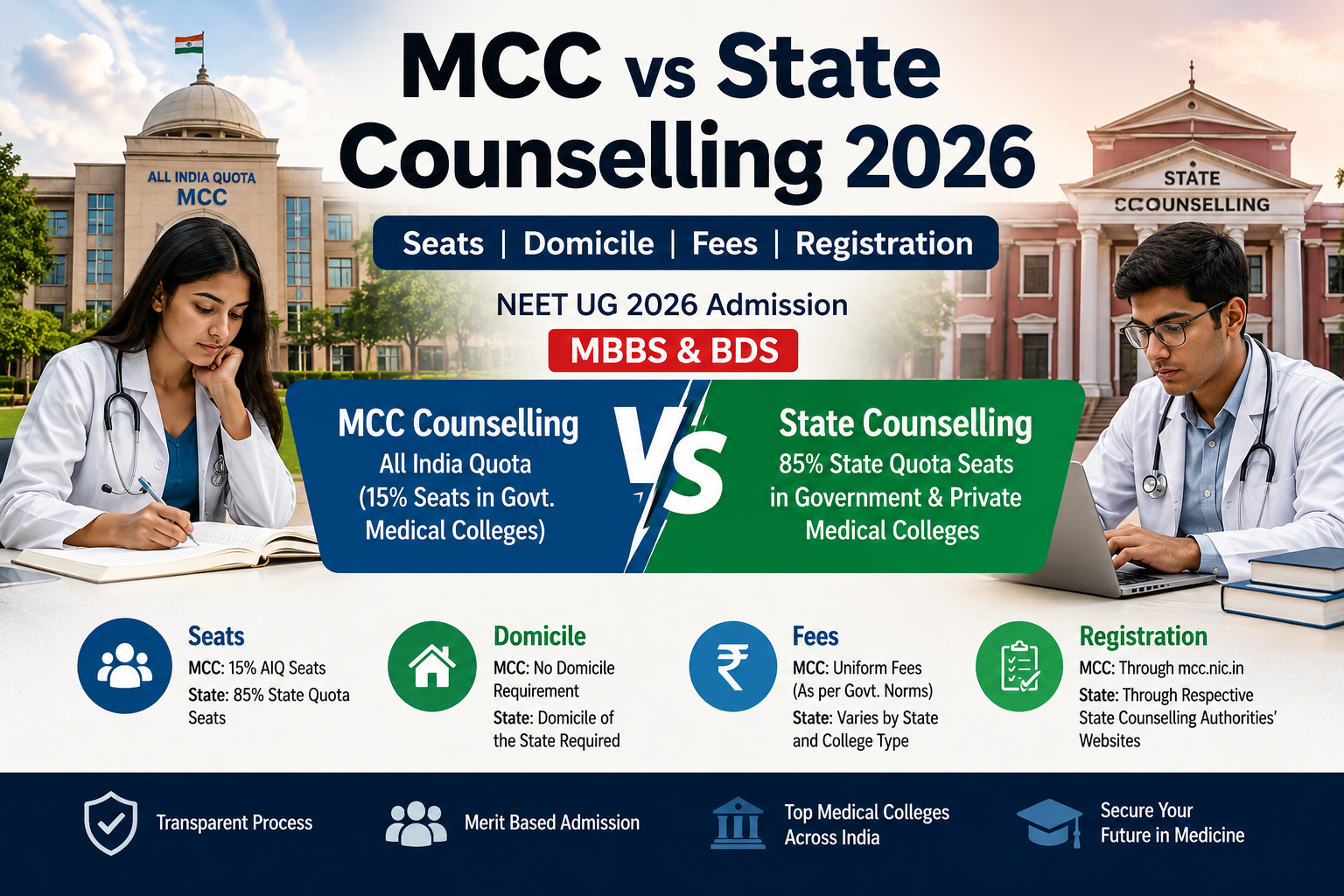
    MCC counselling is conducted at the national level primarily for 15% All India Quota seats and specified institutions, whereas state counselling is conducted separately by each state or Union Territory for state quota seats and most private medical college seats within that state.

    Candidates can generally participate in both counselling processes when eligible. However, MCC and state counselling require separate registration, fee payment, document submission, choice filling and seat allotment.

    This comprehensive guide explains the difference between MCC counselling and state counselling in 2026, including:

    • 15% All India Quota and state quota seats
    • Government and private medical colleges
    • Domicile requirements
    • Reservation policies
    • Registration procedures
    • Counselling fees
    • Choice-filling strategies
    • Required documents
    • Common counselling mistakes

    NEET UG Counselling 2026 Latest Update

    The National Testing Agency published the NEET UG 2026 scorecard on 16 July 2026.

    As of 29 July 2026, the MCC website identifies the portal as the admission and e-counselling service for Session 2026. However, its UG schedule page does not yet display the detailed counselling schedule, and the Candidate Activity Board states that information will be updated soon.

    Candidates should therefore monitor the official MCC website for the publication of:

    • MCC counselling registration dates
    • NEET UG 2026 counselling information bulletin
    • Round-wise schedule
    • Seat matrix
    • Registration fee and security deposit
    • Choice-filling dates
    • Seat-allotment results
    • Reporting and resignation rules

    Important: Never rely exclusively on previous-year dates or counselling rules. Use the official 2026 information bulletin once it is released.


    MCC Counselling vs State Counselling: Quick Answer

    MCC counselling is conducted by the Medical Counselling Committee under the Directorate General of Health Services. MCC is responsible for online counselling for 15% All India Quota undergraduate seats and specified central or institutional seat categories.

    State counselling is conducted by the authorised counselling authority of an individual state or Union Territory. It generally covers state quota seats in government colleges and seats in private medical and dental colleges located within that state.


    MCC Counselling vs State Counselling: Quick Comparison

    Comparison PointMCC CounsellingState Counselling
    Counselling levelNational levelState or Union Territory level
    Conducting authorityMedical Counselling Committee under DGHSAuthorised counselling body of the respective state
    Main government seat pool15% All India Quota seatsGenerally the remaining state quota seats
    Competition levelNational competitionState-based or category-specific competition
    Government collegesAIQ seats in participating government collegesState quota seats within the concerned state
    AIIMS admissionConducted through MCCNot conducted through regular state counselling
    JIPMER admissionConducted through MCCNot conducted through regular state counselling
    Central institutionsSpecified institutions and seat categoriesUsually outside regular state counselling
    Private medical collegesDeemed and other institutions included in the applicable MCC matrixMost non-deemed private colleges within the state
    Domicile for regular seatsGenerally not required for regular AIQ seatsCommonly required for government state quota seats
    Reservation rulesCentral rules for applicable categoriesRespective state reservation rules
    RegistrationThrough the MCC portalThrough the authorised state portal
    Choice fillingMCC choice-filling portalState choice-filling portal
    Registration feeDetermined by MCCDetermined separately by each state
    Merit considerationNEET UG rank, category, eligibility and preferencesNEET UG score, state merit, category and state eligibility
    Best suited forStudents seeking national-level college optionsStudents seeking seats within a particular state

    What Is MCC Counselling?

    MCC counselling is the centralised online medical counselling process conducted by the Medical Counselling Committee, which operates under the Directorate General of Health Services, Ministry of Health and Family Welfare, Government of India.

    The MCC is responsible for finalising counselling procedures and schedules, determining counselling fees and deposits, allocating applicable AIQ seats and coordinating with agencies involved in state and Union Territory counselling.

    Which Seats Are Covered by MCC Counselling?

    The MCC officially identifies the following UG counselling responsibilities:

    1. 15% All India Quota MBBS and BDS seats of participating states
    2. 100% MBBS and BDS seats of Banaras Hindu University
    3. 100% MBBS seats of AIIMS institutions across India
    4. 100% JIPMER seats in Puducherry and Karaikal
    5. 100% seats of Aligarh Muslim University, subject to applicable eligibility
    6. Specified state and institutional quota seats under Delhi University and IP University
    7. Faculty of Dentistry seats at Jamia Millia Islamia, including the applicable internal quota
    8. Specified ESIC IP quota seats

    These categories are listed by MCC, although candidates must confirm the precise 2026 institutions and seat categories in the official seat matrix.

    Who Should Apply for MCC Counselling?

    MCC counselling is particularly important for candidates who want to:

    • Compete for government medical colleges outside their home state
    • Apply for 15% All India Quota MBBS or BDS seats
    • Apply for AIIMS MBBS admission
    • Apply for JIPMER MBBS admission
    • Explore specified central universities
    • Consider deemed medical universities included in the current matrix
    • Access a wider national college choice
    • Avoid relying only on home-state counselling

    Qualifying for NEET UG does not automatically register a candidate for MCC counselling. A separate application must be completed when MCC registration opens.


    What Is State Counselling?

    State counselling is the NEET UG admission process conducted by the designated counselling authority of a state or Union Territory.

    Depending on the state, the authority may be a:

    • Directorate of Medical Education
    • State admission committee
    • State examination authority
    • Government medical university
    • State counselling board

    Each state publishes its own counselling rules and schedule.

    Which Seats Are Covered by State Counselling?

    State counselling generally covers:

    1. State quota MBBS seats in government medical colleges
    2. State quota BDS seats in government dental colleges
    3. Seats in state government universities
    4. Government quota seats in private medical colleges
    5. Private medical college seats
    6. Private dental college seats
    7. Management quota seats
    8. Minority quota seats
    9. Institutional quota seats
    10. NRI quota seats, where applicable

    The precise classification is different in every state. Candidates must read the official state prospectus before registering or filling choices.

    Who Should Apply for State Counselling?

    State counselling is essential for students who:

    • Have valid domicile or residence eligibility
    • Want government medical colleges in their home state
    • Prefer a college closer to home
    • Qualify for state-specific reservation benefits
    • Want admission to private medical colleges in a particular state
    • Want government quota seats in private institutions
    • Are considering management, minority or NRI quota seats

    What Is the Main Difference Between MCC and State Counselling?

    The biggest difference between MCC counselling and state counselling is the seat pool.

    MCC Seat Pool

    MCC primarily manages seats available under the All India Quota and seats of specified national, central and institutional categories.

    Candidates from across India generally compete for regular AIQ seats based on:

    • NEET UG rank
    • Candidate category
    • Eligibility
    • Reservation rules
    • Seat availability
    • Submitted preference order

    State Counselling Seat Pool

    A state counselling authority primarily manages seats allocated to that state and private medical or dental colleges under its jurisdiction.

    Admission may depend on:

    • NEET UG score
    • State merit rank
    • Domicile
    • Residence or schooling conditions
    • Candidate category
    • State reservation rules
    • Seat type
    • Submitted preferences

    The same candidate can therefore have different admission possibilities in MCC counselling and state counselling.


    15% All India Quota vs 85% State Quota

    The difference between 15% AIQ and 85% state quota is central to understanding NEET UG counselling.

    What Is the 15% All India Quota?

    Approximately 15% of eligible MBBS and BDS seats in participating state government colleges are made available under the All India Quota.

    The Medical Counselling Committee conducts online counselling for these seats.

    Candidates generally compete nationally for AIQ seats, subject to:

    • NEET UG qualification
    • All India Rank
    • Category
    • Reservation policy
    • Eligibility conditions
    • Choice preference
    • Seat availability

    What Is the 85% State Quota?

    The remaining eligible government-college seats are generally placed under the state quota and allotted by the concerned state counselling authority.

    Candidates may need to fulfil conditions related to:

    • Domicile
    • Permanent residence
    • Schooling in the state
    • Parents’ residence or employment
    • State category certification
    • Local or regional eligibility

    Simple Example

    Suppose a participating government medical college has 100 eligible MBBS seats.

    A simplified seat division may be:

    Seat CategoryApproximate SeatsCounselling Authority
    All India Quota15MCC
    State quota85State counselling authority

    This example is only for understanding the general system. Actual seat distribution may differ because of institutional status, special quotas, court orders, reservation rules, seat additions or other applicable conditions.


    MCC Counselling vs State Counselling: Domicile Rules

    Domicile is one of the most important differences between MCC and state counselling.

    Is Domicile Required for MCC Counselling?

    Domicile is generally not required for regular 15% All India Quota seats.

    However, candidates must not assume that every seat appearing on the MCC portal is completely open. MCC also manages certain:

    • Institutional quota seats
    • Internal quota seats
    • Domicile-linked central university seats
    • ESIC quota seats
    • University-specific categories
    • NRI categories

    The MCC portal specifically refers to institutional, internal, central university, ESIC and other categories in addition to regular AIQ seats.

    Candidates must check the eligibility code attached to every choice.

    Is Domicile Required for State Counselling?

    Domicile or residence eligibility is commonly required for government state quota seats.

    A state may ask for:

    • Domicile certificate
    • Permanent resident certificate
    • Residence certificate
    • Birth certificate
    • Class 10 or Class 12 schooling certificate
    • Parents’ domicile documents
    • Parents’ employment certificate
    • State-issued category certificate

    Some states allow outside-state candidates to apply for selected private, management or NRI quota seats. The eligibility conditions vary by state and must be checked separately.


    MCC vs State Counselling for Government Medical Colleges

    Government medical college seats can be available through both MCC and state counselling.

    Government Seats Through MCC

    MCC provides access to:

    • AIQ seats in participating state government colleges
    • AIIMS institutions
    • JIPMER campuses
    • Specified central universities
    • Other eligible institutions listed in the MCC seat matrix

    Government Seats Through State Counselling

    State counselling provides access to:

    • State quota seats in government medical colleges
    • Government dental colleges
    • State government universities
    • Government quota seats in participating private colleges, where applicable

    Candidates with a strong domicile advantage should not ignore state counselling, even when they also have a competitive All India Rank.


    MCC vs State Counselling for Private Medical Colleges

    Private medical college counselling is a major source of confusion.

    Private Colleges Under State Counselling

    Most non-deemed private medical colleges are included in the counselling process of the state in which they are located.

    Their seats may be divided into:

    • Government quota seats
    • State quota seats
    • Management quota seats
    • Minority quota seats
    • Institutional quota seats
    • NRI quota seats

    Deemed Universities Through MCC

    Deemed medical university seats have traditionally been handled through MCC counselling. Candidates must nevertheless verify the participating colleges, seat numbers and categories in the official MCC 2026 seat matrix before submitting choices.

    Never assume that every private medical college is included in MCC counselling.


    MCC vs State Counselling: Reservation Rules

    Reservation policies may be different in the two counselling systems.

    Reservation in MCC Counselling

    Central reservation rules apply to relevant All India Quota and central seat categories.

    Applicable categories can include:

    • Scheduled Caste
    • Scheduled Tribe
    • OBC-NCL
    • Economically Weaker Section
    • Persons with Benchmark Disabilities

    MCC states that 27% OBC and 10% EWS reservation has applied to AIQ seats prospectively since 2021.

    Reservation in State Counselling

    State counselling follows the reservation policy of the concerned state.

    Depending on the state, categories may include:

    • State OBC categories
    • Scheduled Castes
    • Scheduled Tribes
    • EWS
    • PwD
    • Women candidates
    • Defence quota
    • Freedom-fighter quota
    • Rural or regional quota
    • Government-school quota
    • Other state-specific reservations

    A certificate valid for state OBC reservation may not establish eligibility under the central OBC-NCL category. Candidates should check the prescribed certificate format, issuing authority and validity date.


    Is Separate Registration Required for MCC and State Counselling?

    Yes. Separate registration is required.

    Registering on the MCC website does not automatically register a candidate for state counselling. Similarly, completing state registration does not make the candidate eligible for MCC allotment.

    A student participating in both processes must generally complete:

    ActivityMCCState
    RegistrationSeparateSeparate
    Application feeSeparateSeparate
    Security depositAs prescribedAs prescribed
    Document uploadSeparateSeparate
    Choice fillingSeparateSeparate
    Choice lockingSeparateSeparate
    Allotment resultSeparateSeparate
    College reportingAs per MCC scheduleAs per state schedule

    Candidates should maintain a calendar containing all MCC and state deadlines.


    Can You Participate in MCC and State Counselling Together?

    Yes. Eligible candidates can generally participate in MCC and state counselling during the same admission cycle.

    Participating in both may provide access to:

    • AIQ government seats
    • Home-state government seats
    • AIIMS
    • JIPMER
    • Central institutions
    • Deemed universities
    • Private medical colleges
    • Management quota seats
    • NRI quota seats

    However, candidates must carefully monitor:

    • Seat-joining rules
    • Free-exit provisions
    • Resignation deadlines
    • Security-deposit forfeiture
    • Upgradation conditions
    • Round 3 eligibility
    • Stray vacancy eligibility
    • Restrictions on already joined candidates

    The current information bulletin should be treated as the final authority for round-wise rules.


    Which Is Better: MCC or State Counselling?

    Neither process is automatically better for every candidate.

    The best option depends on:

    • NEET UG rank
    • Category
    • State domicile
    • Preferred location
    • Government or private college preference
    • Family budget
    • Bond conditions
    • College quality
    • Hospital exposure
    • Previous closing-rank trends

    MCC Counselling May Be Better When

    MCC may be more suitable when the candidate:

    • Wants colleges outside the home state
    • Has a competitive All India Rank
    • Is targeting AIQ government seats
    • Wants AIIMS or JIPMER
    • Is considering central institutions
    • Wants a wider national choice list
    • Is considering deemed universities

    State Counselling May Be Better When

    State counselling may be more suitable when the candidate:

    • Has valid domicile
    • Wants a government college in the home state
    • Is eligible for state reservation
    • Prefers studying near home
    • Wants a non-deemed private college
    • Is exploring management or minority seats
    • Has a favourable state merit position

    Recommended Approach

    For most eligible candidates, the strongest strategy is to register for both MCC and state counselling.

    This expands the number of available colleges and reduces dependence on a single seat pool.


    MCC Counselling Process 2026

    The exact process should be verified after publication of the MCC 2026 information bulletin. The usual stages include:

    Step 1: Online Registration

    Create an account on the official MCC portal and enter the required NEET UG and personal details.

    Step 2: Fee Payment

    Pay the prescribed registration fee and security deposit. MCC determines the counselling fees and deposits applicable to its process.

    Step 3: Choice Filling

    Select preferred courses and colleges from the available seat matrix.

    Step 4: Choice Locking

    Review the sequence carefully and lock the choices before the deadline.

    Step 5: Seat Allotment

    The system considers rank, category, eligibility, reservation, seat availability and preference order.

    Step 6: Downloading the Allotment Letter

    Successful candidates download their allotment result and reporting instructions.

    Step 7: College Reporting

    Candidates report to the allotted college, complete document verification and pay the applicable institutional fee.

    Step 8: Subsequent Rounds

    Candidates may participate in subsequent rounds according to the applicable upgradation, resignation and eligibility rules.


    State Counselling Process 2026

    The usual state counselling process includes:

    1. State portal registration
    2. Payment of the state counselling fee
    3. Submission of NEET UG information
    4. Submission of domicile and category information
    5. Document upload or verification
    6. Publication of the state merit list
    7. Publication of the seat matrix
    8. Choice filling and locking
    9. Seat allotment
    10. Admission fee payment
    11. Reporting to the allotted college
    12. Participation in subsequent rounds, if eligible

    Some states may require physical document verification. Others may complete most stages online.

    Candidates should not assume that registration will reopen before later rounds.


    MCC Counselling vs State Counselling Fees

    MCC and state counselling have different fee structures.

    MCC Counselling Costs

    Candidates may need to pay:

    • Non-refundable registration fee
    • Refundable security deposit
    • Different deposits for different institutional categories
    • College admission fee after allotment

    The final amount must be checked in the official MCC 2026 bulletin.

    State Counselling Costs

    State authorities may charge:

    • Registration fee
    • Counselling fee
    • Security deposit
    • Seat-confirmation fee
    • University fee
    • Admission fee

    The amount may vary according to the candidate category and seat type.

    College Costs to Compare

    Before selecting a private or deemed medical college, check:

    • Annual tuition fee
    • Total course fee
    • Hostel fee
    • Mess charges
    • Refundable and non-refundable deposits
    • University fee
    • Examination fee
    • Miscellaneous charges
    • Service bond
    • Rural-service obligation
    • Discontinuation penalty
    • Internship stipend
    • Fee-refund policy

    Do not add an unaffordable college to the choice list merely to test the allotment system.


    Documents Required for MCC and State Counselling

    Candidates should prepare original documents, photocopies and clear scanned copies.

    Commonly required documents include:

    • NEET UG 2026 admit card
    • NEET UG 2026 scorecard
    • Class 10 marksheet and certificate
    • Class 12 marksheet and passing certificate
    • Date-of-birth proof
    • Government-issued photo identity proof
    • Recent passport-size photographs
    • Category certificate, where applicable
    • Central OBC-NCL certificate, where applicable
    • State OBC certificate, where applicable
    • EWS certificate
    • PwD certificate
    • Domicile or residence certificate
    • Schooling certificates
    • Migration certificate
    • Transfer certificate
    • Character certificate
    • Medical fitness certificate
    • Gap certificate, where required
    • NRI documents, where applicable
    • Allotment letter
    • Counselling payment receipt
    • College fee receipt
    • Required affidavits or undertakings

    The final document checklist must be verified from the official MCC bulletin, state prospectus and allotted college instructions.


    How to Create the Best NEET UG Choice List

    Candidates should arrange colleges according to their genuine preference, not simply according to previous closing ranks.

    Factors to Compare

    Compare each college using:

    • Government, private or deemed status
    • Total course cost
    • Hospital patient load
    • Clinical exposure
    • Infrastructure
    • Faculty and departments
    • Hostel facilities
    • Internship stipend
    • Service bond
    • Discontinuation penalty
    • Distance from home
    • Language and local environment
    • Previous closing ranks

    Three-Level Choice Strategy

    Aspirational Choices

    Colleges whose previous closing ranks were more competitive than the candidate’s current position.

    Realistic Choices

    Colleges where the candidate has a reasonable admission possibility based on rank, category and previous trends.

    Safe Choices

    Acceptable colleges whose previous closing ranks indicate a comparatively stronger possibility of admission.

    Previous closing ranks are indicators, not guarantees.


    Common MCC and State Counselling Mistakes

    Registering Only for MCC

    MCC registration does not provide access to state counselling seats.

    Waiting for the MCC Result Before State Registration

    State registration may close before the MCC process is completed.

    Assuming State Quota Is Open to Everyone

    Government state quota seats commonly have domicile or residence conditions.

    Assuming Every Private College Is Under MCC

    Most non-deemed private colleges are allotted through the relevant state authority.

    Ignoring the Complete Fee Structure

    Candidates should calculate the full course cost, not only first-year tuition.

    Filling Choices in Cut-Off Order

    Choices should reflect the candidate’s actual preference.

    Using the Wrong Category Certificate

    Central and state certificate requirements may differ.

    Ignoring Bond Conditions

    A low-fee government seat may have a compulsory service obligation.

    Missing Choice Locking or Reporting Deadlines

    A missed deadline can result in loss of the allotted seat.

    Depending on Unofficial Messages

    Schedules, seat matrices and exit rules should be verified only through official counselling portals.


    MCC Counselling vs State Counselling: Final Verdict

    The main difference between MCC counselling and state counselling lies in the conducting authority, seat quota, domicile rules, reservation policy, participating colleges and registration process.

    MCC counselling primarily covers:

    • 15% All India Quota seats
    • AIIMS seats
    • JIPMER seats
    • Specified central institutions
    • Institutional or internal categories notified by MCC
    • Deemed university seats included in the applicable seat matrix

    State counselling primarily covers:

    • State quota government seats
    • Government dental college seats
    • Most non-deemed private medical college seats
    • Government quota seats in private colleges
    • Management quota seats
    • Minority quota seats
    • NRI quota seats, where applicable

    For most eligible students, registering for both MCC counselling and state counselling creates the widest range of admission opportunities.

    A competitive NEET UG rank is important, but careful registration, documentation, financial planning and choice filling are equally necessary to convert the rank into a suitable MBBS or BDS seat.

    Disclaimer: Counselling dates, fees, eligibility conditions, seat matrices, reservation rules and round-wise exit conditions may change. Candidates should verify every admission decision through the official MCC website and the authorised state counselling portal.


    Frequently Asked Questions

    1. What is the difference between MCC counselling and state counselling?

    MCC counselling is conducted nationally for 15% All India Quota seats and specified institutions. State counselling is conducted separately by each state for state quota seats and most private medical colleges.

    2. Is MCC counselling compulsory for MBBS admission?

    MCC registration is required for seats allotted through MCC. Candidates targeting only eligible state counselling seats must register with the relevant state authority.

    3. Can I participate in MCC and state counselling together?

    Yes. Eligible candidates can generally participate in both. Separate registration, fee payment and choice filling are required.

    4. Does MCC counselling cover 85% state quota seats?

    Generally, no. State quota seats are normally allotted by the respective state counselling authority, except for certain central or institutional categories handled by MCC.

    5. Is domicile required for MCC counselling?

    Domicile is generally not required for regular 15% AIQ seats. Certain institutional, internal or university-specific categories may have separate conditions.

    6. Is domicile required for state counselling?

    Domicile is commonly required for government state quota seats. Private and management quota rules differ by state.

    7. Is AIIMS counselling conducted by MCC?

    Yes. MCC lists 100% MBBS seats in AIIMS institutions among its UG counselling responsibilities.

    8. Is JIPMER counselling conducted by MCC?

    Yes. MCC handles JIPMER Puducherry and JIPMER Karaikal seats.

    9. Are private medical colleges included in MCC counselling?

    Deemed university seats and other notified institutions may be included through MCC. Most non-deemed private colleges are handled through state counselling.

    10. Can candidates from another state apply for private MBBS seats?

    Some states allow outside-state candidates to apply for selected private, management or NRI quota seats. Eligibility varies by state.

    11. Is separate registration required for MCC and state counselling?

    Yes. Candidates must register separately for both processes.

    12. Which counselling has lower MBBS fees?

    Government seats under either AIQ or state quota generally cost less than private or deemed university seats. Actual fees depend on the institution and quota.

    13. Is the state quota always exactly 85%?

    No. The 85% state quota is a general structure for participating government colleges. Central institutions, special categories and other institutions may follow different seat distributions.

    14. Which rank is used in state counselling?

    State authorities use NEET UG performance along with state merit, domicile, category and other applicable eligibility conditions.

    15. Can I leave an MCC seat after getting a state seat?

    This depends on the counselling round, joining status, resignation deadline and forfeiture rules applicable at that time.

    16. What happens if I miss state counselling registration?

    The candidate may lose access to that state’s seats unless the authority officially reopens registration.

    17. Should I register for both MCC and state counselling?

    For most eligible candidates, registering for both is beneficial because it provides access to more colleges and seat categories.

    18. Where should I check NEET UG counselling updates?

    Check the official MCC website for MCC counselling and the authorised medical counselling portal of the concerned state for state-level admissions.


    Education MESD Counselling Support

    Need Help With NEET UG 2026 Counselling?

    Managing MCC registration, state counselling, domicile rules, private medical college fees and multiple choice lists can be difficult for students and parents.

    Education MESD supports medical aspirants with:

    • MCC and state counselling guidance
    • Eligibility and domicile assessment
    • Document preparation
    • College and fee comparison
    • Government, private and deemed university options
    • Choice-filling strategy
    • Round-wise counselling support

    Make informed decisions before locking your medical college choices
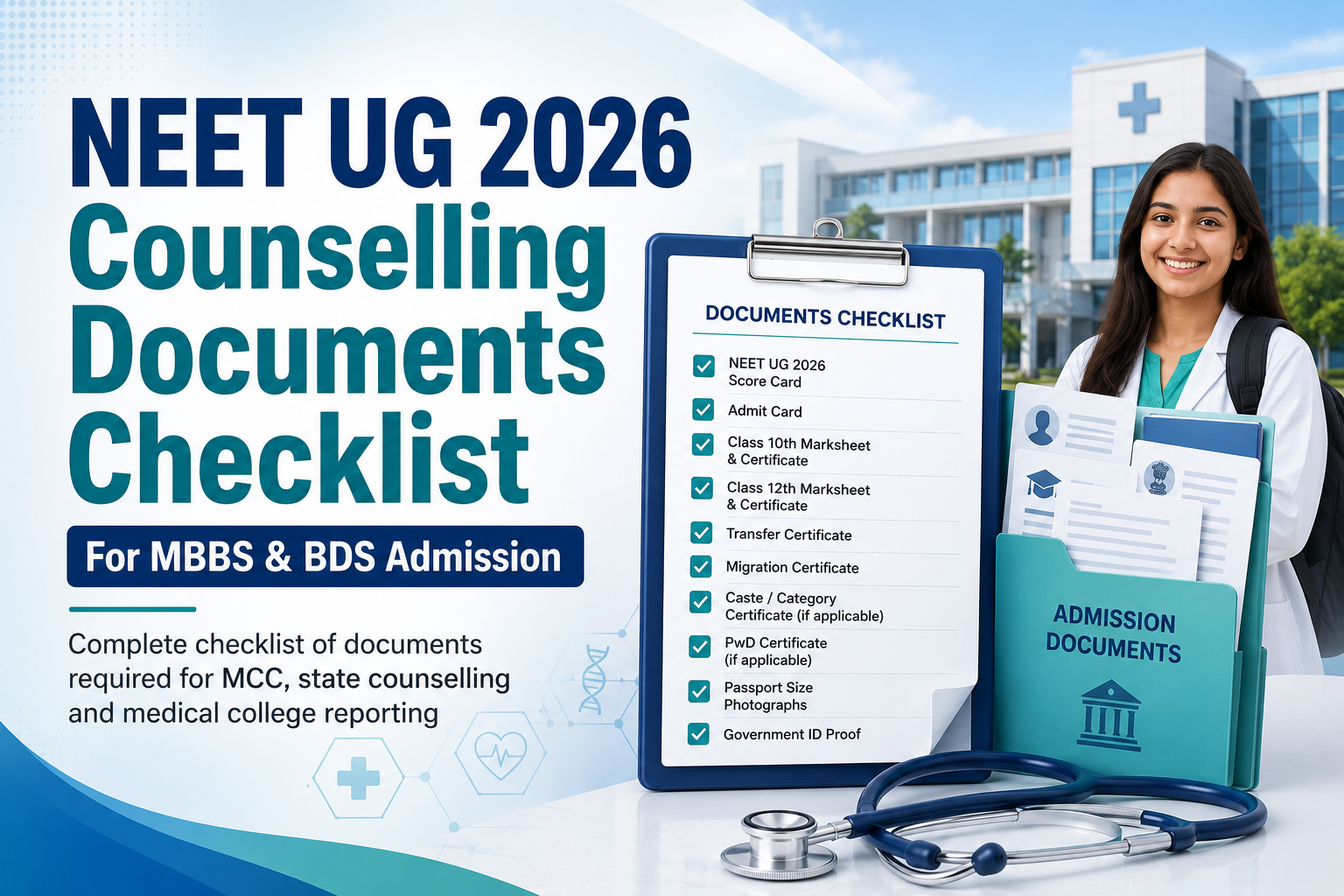
  • NEET UG 2026 Counselling Documents Checklist: Complete List for MBBS and BDS Admission

    NEET UG 2026 Counselling Documents Checklist: Complete List for MBBS and BDS Admission

    The NEET UG 2026 counselling documents checklist is essential for every student seeking admission to an MBBS, BDS or another eligible medical course.

    Securing a good NEET rank and receiving a seat allotment are not enough to confirm admission. Candidates must produce the required original documents during physical reporting and document verification. Missing, expired or incorrect documents may delay admission, affect a reservation claim or result in cancellation of the allotted seat.

    The National Testing Agency published the NEET UG 2026 scorecard on 16 July 2026.

    As of 28 July 2026, the MCC website is operating for the 2026 session, but the current UG notices page displays only the NRI-candidature notice for the 2026–27 academic year. The complete NEET UG 2026 MCC information bulletin and final reporting checklist should therefore be checked once officially published.

    This guide is based on the latest detailed official MCC UG reporting checklist and includes additional documents commonly required by state authorities and individual medical colleges.

    Important: MCC, state counselling authorities and allotted colleges may have different document requirements. Always verify the final list from all three authorities before travelling for admission.


    What Documents Are Required for NEET UG 2026 Counselling?

    Candidates should generally carry their NEET UG admit card, NEET scorecard, seat-allotment letter, Class 10 certificate, Class 12 marksheet and passing certificate, identity proof, passport-size photographs and applicable category certificates. State-quota, NRI, PwD and institutional-quota candidates may need additional documents.

    This short answer can help the article appear for featured-snippet searches such as “documents required for NEET counselling 2026.”


    Quick NEET UG 2026 Counselling Documents Checklist

    DocumentWho needs it?Carry original?
    MCC or state allotment letterAll allotted candidatesPrinted copy
    NEET UG 2026 admit cardAll candidatesYes
    NEET UG 2026 scorecard/rank letterAll candidatesYes
    Class 10 certificateAll candidatesYes
    Date-of-birth certificateWhen DOB is absent from Class 10 certificateYes
    Class 12 marksheetAll candidatesYes
    Class 12 passing certificateAll candidatesYes
    Government photo IDAll candidatesYes
    Eight or more passport photographsAll candidatesPhysical copies
    SC/ST certificateApplicable candidatesYes
    Central OBC-NCL certificateApplicable MCC candidatesYes
    EWS certificateApplicable candidatesYes
    PwD/PwBD certificateApplicable candidatesYes
    Domicile certificateState-quota candidates, where requiredYes
    NRI/OCI/foreign-national documentsApplicable candidatesYes
    Transfer/migration certificateWhen required by collegeYes
    Medical fitness certificateWhen required by collegeYes
    Photocopy setsAll candidates3–5 sets
    Digital document backupAll candidatesRecommended

    The latest detailed MCC checklist requires original documents with attested photocopies during reporting.


    Mandatory Documents for MCC NEET UG Counselling 2026

    1. MCC Seat-Allotment Letter

    Candidates allotted a seat through MCC must download the provisional allotment letter from the MCC counselling portal.

    It generally includes:

    • Candidate’s name and roll number
    • Allotted medical or dental college
    • Course allotted
    • Counselling round
    • Quota and category
    • Reporting period
    • Reporting instructions

    Carry at least two or three clear printouts. Candidates allotted through state counselling must carry the allotment letter issued by the respective state authority.


    2. NEET UG 2026 Admit Card

    Carry the NEET UG 2026 admit card issued by NTA.

    The admit card is used to verify:

    • Candidate’s identity
    • NEET application number
    • Roll number
    • Photograph and signature
    • Examination details

    Keep both printed and digital copies available.


    3. NEET UG 2026 Scorecard or Rank Letter

    Download the official scorecard or result/rank letter issued by NTA.

    The document normally contains:

    • NEET UG score
    • Percentile
    • All India Rank
    • Category rank, where applicable
    • Qualifying status
    • Candidate details

    The MCC reporting checklist specifically includes the result or rank letter issued by NTA.


    4. Class 10 Certificate

    The Class 10 certificate is required to verify the candidate’s:

    • Name
    • Date of birth
    • Parent’s name
    • Educational record
    • Board information

    Check that the spelling of the candidate’s name matches the NEET application, Aadhaar card and Class 12 documents.


    5. Date-of-Birth Certificate

    A separate birth certificate may be required when the Class 10 or matriculation certificate does not mention the candidate’s date of birth.

    Carry:

    • Original birth certificate
    • Self-attested photocopies
    • Certified English or Hindi translation when the original is in another language

    The MCC checklist requires a date-of-birth certificate when the matriculation certificate does not contain the date of birth.


    6. Class 12 Marksheet

    Candidates must carry the original Class 12 marksheet showing their marks in the qualifying examination.

    It should clearly include marks obtained in:

    • Physics
    • Chemistry
    • Biology or Biotechnology
    • English
    • Other subjects studied

    Check that the marksheet is complete, legible and issued by the recognised examination board.


    7. Class 12 Passing Certificate

    The Class 12 passing certificate and Class 12 marksheet may be separate documents.

    The official MCC checklist mentions both documents independently. Therefore, candidates should not assume that the marksheet alone will be accepted.

    Students who have received digital documents through DigiLocker should also check whether their allotted college requires a board-issued physical original.


    8. Passport-Size Photographs

    The latest detailed MCC checklist asks candidates to carry eight passport-size photographs matching the photograph used in the application form.

    For safer preparation, carry:

    • 10–12 passport-size photographs
    • Photographs matching the NEET application photograph
    • Additional photographs for hostel, library and student ID formalities

    Keep the photographs in a protective envelope.


    9. Government-Issued Photo Identity Proof

    Carry an original government-issued photo ID.

    The MCC checklist accepts:

    • Aadhaar card
    • PAN card
    • Driving licence
    • Passport

    Aadhaar should preferably be carried as the primary identity document, with one additional ID as a backup.


    Category Certificates Required for NEET Counselling 2026

    10. SC Certificate

    Candidates claiming Scheduled Caste reservation should carry a valid SC certificate issued by the competent authority.

    The certificate should:

    • Follow the prescribed format
    • Clearly mention the caste or sub-caste
    • Contain the issuing authority’s signature and seal
    • Match the candidate’s name and other personal details

    Where the certificate is issued in a regional language, carry a certified English or Hindi translation along with the original.


    11. ST Certificate

    Scheduled Tribe candidates must carry a valid ST certificate issued by the competent authority.

    Check:

    • Candidate’s correct name
    • Tribe or sub-tribe
    • Issuing authority
    • Certificate number
    • Signature and official seal
    • Prescribed format

    State and Central formats may differ. Follow the format specified by the counselling authority through which the reservation is being claimed.


    12. OBC-NCL Certificate

    Candidates claiming OBC reservation through MCC must generally produce an OBC–Non-Creamy Layer certificate based on the Central OBC List.

    The candidate should verify that:

    • The community is included in the Central OBC List
    • The certificate mentions Non-Creamy Layer status
    • The sub-caste matches the Central List
    • The certificate follows the prescribed format
    • The certificate is valid for the applicable admission session

    A state OBC certificate alone may not establish eligibility for Central OBC-NCL reservation. MCC’s detailed reporting checklist specifically refers to the Central List of OBCs and Non-Creamy Layer status.


    13. EWS Certificate

    Candidates claiming Economically Weaker Section reservation must carry a valid EWS income and asset certificate.

    Verify:

    • Date of issue
    • Applicable financial year
    • Name of issuing authority
    • Official signature and seal
    • Prescribed certificate format
    • Validity for the relevant admission session

    An expired or incorrectly formatted certificate may affect the candidate’s reservation claim.


    14. PwD or PwBD Certificate

    Candidates applying under the Persons with Disability or Persons with Benchmark Disability category should prepare:

    • Valid PwD/PwBD certificate
    • UDID certificate or card, where applicable
    • Certificate from an authorised disability-assessment centre
    • Relevant medical reports
    • Documents required under the applicable MCC and NMC instructions

    The NEET UG 2026 information bulletin includes PwD/PwBD/UDID documentation among the applicable candidate records.

    Candidates must follow the final MCC 2026 notice regarding approved disability-certification centres.


    Documents Required for State-Quota NEET Counselling 2026

    The document requirements for the 85% state quota differ across states. In addition to the standard documents, candidates may need the following.

    15. Domicile or Residence Certificate

    A domicile, residence or permanent-residence certificate may be required to claim state-quota eligibility.

    Eligibility can depend on:

    • Candidate’s permanent residence
    • Parent’s residence
    • Place of schooling
    • Number of years studied in the state
    • Parent’s employment or government-service status
    • Local-area eligibility rules

    Candidates should read the official state counselling brochure carefully because domicile conditions are not identical across India.


    16. Study or Schooling Certificate

    Some states require proof that the candidate studied within the state for a prescribed period.

    The authority may request:

    • Class 6–12 study certificates
    • Class 10 study certificate
    • Class 12 study certificate
    • Bonafide certificate
    • Local-area certificate
    • Rural-area study certificate

    Submit only the documents requested by the concerned state counselling authority.


    17. Transfer Certificate

    The transfer certificate is issued by the school or institution last attended.

    Many medical colleges ask for the original transfer certificate during final admission. Candidates should request it early from their school if it has not already been issued.


    18. Migration Certificate

    A migration certificate may be required when the candidate moves from one:

    • Education board to another
    • University to another
    • State to another
    • Institution to another

    Confirm whether the certificate is required at initial reporting or can be submitted later.


    19. Character or Conduct Certificate

    The allotted college may ask for a recent character or conduct certificate issued by the school or institution last attended.

    Check whether the institution has specified:

    • A particular format
    • A permitted date of issue
    • Signature requirements
    • School stamp requirements

    20. Gap Certificate or Gap-Year Affidavit

    Students who completed Class 12 in an earlier year may be asked to submit a gap certificate or affidavit.

    It generally states:

    • Period of the academic gap
    • Reason for the gap
    • Activities undertaken during the period
    • Candidate’s declaration

    A gap certificate is not a universal MCC document. Prepare it only when required by the state authority or allotted college.


    21. Medical Fitness Certificate

    The allotted medical or dental college may require a medical fitness certificate.

    It may need to be issued by:

    • Registered medical practitioner
    • Government hospital
    • District medical board
    • Medical board of the allotted institution

    Use the college’s prescribed format when one is provided.


    NRI, OCI and Foreign-National Documents

    22. NRI Quota Documents

    NRI-quota requirements may vary between MCC, states, deemed universities and private institutions.

    Candidates may be asked to submit:

    • Candidate’s or sponsor’s passport
    • Valid visa
    • NRI status certificate
    • Overseas employment or residence proof
    • Sponsorship affidavit
    • Proof of relationship between sponsor and candidate
    • Family-tree or relationship certificate
    • Embassy or consulate certificate, where required
    • Financial-support undertaking
    • Candidate and sponsor declarations

    MCC has published a separate notice concerning eligibility for NRI candidature for the 2026–27 academic year, so candidates should follow that notice and subsequent round-specific instructions.


    23. OCI, PIO or Foreign-National Documents

    Applicable candidates should prepare:

    • Valid passport
    • OCI card
    • PIO-related documents, where applicable
    • Citizenship certificate
    • Visa
    • Nationality certificate
    • Other proof requested by MCC or the institution

    The official MCC reporting checklist identifies citizenship or card-number documentation as mandatory for applicable OCI, PIO and foreign-national candidates.


    Additional Documents for MBBS or BDS College Reporting

    The allotted institution may request documents beyond the standard MCC list.

    Candidates should keep the following ready where applicable:

    • MCC or state counselling registration slip
    • Choice-filling printout
    • Locked-choice printout
    • Counselling fee receipt
    • Security-deposit receipt
    • Seat-acceptance or willingness form
    • College fee-payment receipt
    • Online admission letter
    • Relieving letter after seat upgradation
    • Previous admission-cancellation letter
    • Anti-ragging undertaking by student
    • Anti-ragging undertaking by parent
    • Service-bond or rural-service undertaking
    • Hostel admission form
    • Local guardian declaration
    • Parent or guardian identity proof
    • Parent’s passport-size photographs
    • Income certificate
    • Minority certificate
    • Defence or ex-servicemen certificate
    • ESIC-related documents
    • Bank account details
    • Cancelled cheque

    MCC advises candidates to check the allotted college’s information because the institution may ask for additional documents.


    How to Organise NEET UG Counselling Documents

    Folder 1: Original Documents

    Arrange the originals in this order:

    1. Seat-allotment letter
    2. NEET UG 2026 admit card
    3. NEET UG 2026 scorecard
    4. Government photo ID
    5. Class 10 certificate
    6. Birth certificate, if applicable
    7. Class 12 marksheet
    8. Class 12 passing certificate
    9. Category certificate
    10. Domicile or study certificate
    11. Special-quota documents
    12. Transfer and migration certificates

    Folder 2: Photocopy Sets

    Prepare at least three to five photocopy sets.

    Each set should include:

    • NEET documents
    • Academic documents
    • Identity proof
    • Category certificates
    • Domicile documents
    • Allotment letter
    • Special-quota documents

    Self-attest each photocopy where required.

    Folder 3: Counselling Printouts

    Keep together:

    • Registration form
    • Payment receipts
    • Security-deposit receipt
    • Choice-filling printout
    • Locked choices
    • Allotment letter
    • Reporting instructions
    • College admission notice

    Folder 4: Photographs and Affidavits

    Keep:

    • Passport-size photographs
    • Gap affidavit
    • Name-mismatch affidavit
    • Anti-ragging declarations
    • Sponsorship affidavit
    • Parent or guardian declarations

    Create Digital Backups of All Documents

    Scan every document clearly and save copies in:

    • Mobile phone
    • Email
    • Google Drive or another cloud service
    • USB drive
    • Parent or guardian’s phone

    Use descriptive file names:

    • NEET-UG-2026-Admit-Card.pdf
    • NEET-UG-2026-Scorecard.pdf
    • MCC-Seat-Allotment-Letter.pdf
    • Class-10-Certificate.pdf
    • Class-12-Marksheet.pdf
    • OBC-NCL-Certificate.pdf
    • Domicile-Certificate.pdf

    Do not use unclear file names such as IMG001 or Scan123.


    Important NEET Document-Verification Rules

    Original Documents Are Compulsory

    Candidates must report with the required original documents. The latest detailed MCC bulletin states that candidates without original certificates or documents will not be allowed to take admission in the allotted medical or dental college.

    Another Person Cannot Complete Reporting

    MCC requires the allotted candidate to physically report to the college with the original documents. Another person cannot complete admission on the candidate’s behalf.

    Certificates Deposited Elsewhere May Cause Problems

    A letter stating that original certificates are deposited with another college or university may not be accepted as a substitute. Candidates should retrieve their originals before reporting.

    Translate Regional-Language Certificates

    When a certificate is issued in a language other than English or Hindi, carry:

    • Original certificate
    • Attested English or Hindi translation
    • Photocopies of both versions

    MCC’s detailed guidance advises candidates to carry an attested translated copy along with the original certificate.

    Resolve Name Mismatches Before Reporting

    Compare the following documents:

    • Aadhaar card
    • NEET application
    • Admit card
    • Scorecard
    • Class 10 certificate
    • Class 12 documents
    • Category certificate

    When the spelling differs, carry legally acceptable proof, generally an affidavit confirming that the documents relate to the same person.

    Do Not Wait Until the Final Reporting Day

    Some institutions may take two or three days to complete admission formalities. MCC advises candidates to contact the allotted college immediately after the allotment result and states that it cannot extend the joining deadline for an individual candidate.


    Common NEET Counselling Document Mistakes

    Avoid these frequent errors:

    1. Carrying photocopies but not originals
    2. Using an expired OBC-NCL or EWS certificate
    3. Carrying a state OBC certificate for a Central OBC-NCL claim
    4. Ignoring name or date-of-birth differences
    5. Forgetting the Class 12 passing certificate
    6. Carrying too few photographs
    7. Not translating regional-language certificates
    8. Depending only on mobile screenshots
    9. Reporting without checking the college-specific checklist
    10. Waiting until the final day to report
    11. Keeping originals deposited with another institution
    12. Forgetting the relieving letter after an upgraded allotment

    Printable NEET UG 2026 Counselling Checklist

    Essential Documents

    • MCC or state seat-allotment letter
    • NEET UG 2026 admit card
    • NEET UG 2026 scorecard/rank letter
    • Class 10 certificate
    • Birth certificate, if required
    • Class 12 marksheet
    • Class 12 passing certificate
    • Original photo identity proof
    • Eight or more passport-size photographs

    Category and Quota Documents

    • SC certificate, if applicable
    • ST certificate, if applicable
    • Central OBC-NCL certificate, if applicable
    • EWS certificate, if applicable
    • PwD/PwBD/UDID documentation, if applicable
    • Domicile certificate, if applicable
    • Study certificate, if applicable
    • NRI documents, if applicable
    • OCI or foreign-national documents, if applicable

    College Reporting Documents

    • Counselling registration slip
    • Choice-filling and locked-choice printouts
    • Counselling fee receipt
    • Security-deposit receipt
    • Transfer certificate
    • Migration certificate
    • Character certificate
    • Gap affidavit, if required
    • Medical fitness certificate
    • Anti-ragging undertakings
    • College-specific admission forms
    • Three to five photocopy sets
    • Digital backup of every document

    Frequently Asked Questions

    What documents are required for NEET UG 2026 counselling?

    Candidates generally need the NEET UG admit card, scorecard, seat-allotment letter, Class 10 certificate, Class 12 marksheet and passing certificate, identity proof, photographs and applicable category certificates.

    Are original documents compulsory for NEET counselling?

    Yes. Original documents are required during physical reporting. The detailed MCC guidance states that candidates without original certificates or documents will not be allowed to complete admission.

    How many photographs are required for MCC counselling?

    The latest detailed MCC checklist specifies eight passport-size photographs matching the application-form photograph. Carrying 10–12 photographs is safer.

    Is a domicile certificate required for MCC counselling?

    A domicile certificate is generally associated with state-quota or state-specific eligibility. Candidates applying through MCC should check the requirements of the specific quota, institution and allotted college.

    Which OBC certificate is required for MCC counselling?

    Candidates claiming OBC reservation through MCC generally need a valid OBC-NCL certificate corresponding to the Central OBC List and issued in the prescribed format.

    Is a gap certificate compulsory for NEET counselling?

    It is not a universal core MCC document. Some states and colleges may require it from candidates who completed Class 12 in a previous year.

    Can DigiLocker documents be used for NEET counselling?

    Candidates should follow the final counselling and college instructions. Even where digitally issued documents are recognised, candidates should not assume that digital copies will replace every original required during physical verification.

    What should I do if my name differs between documents?

    Arrange an affidavit or another legally accepted document showing that all certificates belong to the same person. Contact the allotted college before reporting.

    Are transfer and migration certificates compulsory?

    These certificates are commonly requested by institutions, but the exact requirements vary. Check the allotted college’s admission notice.

    Can the NEET UG 2026 document checklist change?

    Yes. MCC, state counselling authorities and colleges may publish revised or additional requirements. Check the official notices immediately before reporting.


    Conclusion

    Preparing the NEET UG 2026 counselling documents checklist early can protect candidates from admission delays and document-verification problems.

    Begin with the NEET UG 2026 admit card, scorecard, seat-allotment letter, Class 10 certificate, Class 12 marksheet, Class 12 passing certificate, photo identity proof and passport-size photographs.

    Candidates applying under state quota, OBC-NCL, EWS, SC, ST, PwD, NRI or another special category must also arrange valid category-specific certificates.

    Keep all original documents in a secure folder, prepare multiple photocopy sets and save scanned backups. Most importantly, compare your documents with the final MCC bulletin, state counselling brochure and allotted college’s reporting notice.

    Get Expert NEET UG 2026 Counselling Support

    Education MESD provides personalised assistance for:

    • MCC and state counselling registration
    • MBBS and BDS college selection
    • Choice filling and preference planning
    • Document verification
    • Private and deemed medical college admission
    • Budget-based college planning
    • NRI quota admission guidance
    • International medical admission options

    Contact the Education MESD counselling team for structured guidance based on your NEET rank, category, budget and preferred location.

  • What to Do After NEET UG 2026 Result? Complete Step-by-Step Roadmap for MBBS Admission

    What to Do After NEET UG 2026 Result? Complete Step-by-Step Roadmap for MBBS Admission

    NEET UG 2026 Result Is Out: Your Real Medical Admission Journey Starts Now

    The wait is finally over. After months of preparation, hard work and dedication, lakhs of medical aspirants have received their NEET UG 2026 results.

    But remember:

    Getting your NEET result is not the end of your journey. It is the first step towards securing your dream medical seat.

    Every year, many students qualify NEET but miss better opportunities because they do not understand:

    • How NEET counselling works
    • When to register
    • How to select colleges
    • Which documents are required
    • How to prepare a smart choice list

    The admission process after NEET UG 2026 requires careful planning, timely decisions and accurate information.

    This complete guide explains what to do after NEET UG 2026 result and how to move from your scorecard to your MBBS admission.


    Quick Checklist: What Should You Do After NEET UG 2026 Result?

    Immediately after checking your result:

    ✅ Download your NEET UG 2026 scorecard
    ✅ Check your All India Rank (AIR)
    ✅ Analyse your admission possibilities
    ✅ Prepare counselling documents
    ✅ Register for MCC counselling
    ✅ Register for state counselling
    ✅ Research medical colleges
    ✅ Prepare your preference list
    ✅ Participate in counselling rounds
    ✅ Complete admission formalities


    Step 1: Download and Verify Your NEET UG 2026 Scorecard

    The first thing every candidate should do after the NEET UG 2026 result declaration is download the official scorecard.

    Your NEET scorecard contains:

    • Candidate name
    • Roll number
    • Application number
    • Subject-wise marks
    • Total marks
    • Percentile score
    • All India Rank
    • Category rank
    • Qualification status

    Check These Details Carefully

    Before moving ahead, verify:

    ✔ Name spelling
    ✔ Date of birth
    ✔ Category details
    ✔ Marks obtained
    ✔ Rank information

    If there is any discrepancy, contact the concerned authority immediately.


    Step 2: Understand Your NEET UG 2026 Rank and Admission Chances

    Many students focus only on their marks. However, NEET rank is the most important factor during admission.

    Your medical college options depend on:

    1. All India Rank (AIR)

    AIR determines your position among all NEET candidates.

    A better rank increases your chances of getting:

    • Government medical colleges
    • AIIMS
    • Central universities
    • Lower-fee MBBS colleges

    2. Category Rank

    Category plays an important role in seat allotment.

    Students should check eligibility under:

    • General category
    • OBC-NCL
    • SC
    • ST
    • EWS
    • PwD

    Make sure your category certificate is valid before counselling.


    3. State Quota Advantage

    Every state has its own counselling process.

    A student may have better chances through:

    • State quota seats
    • Domicile benefits
    • Private medical colleges in the state

    Step 3: Understand NEET UG 2026 Counselling Process

    NEET counselling is the gateway to medical admission.

    Qualifying NEET does not automatically provide an MBBS seat.

    Students must participate in counselling conducted by different authorities.


    MCC NEET UG Counselling 2026

    The Medical Counselling Committee (MCC) conducts counselling for:

    • 15% All India Quota seats
    • AIIMS MBBS seats
    • JIPMER seats
    • Central universities
    • Deemed medical universities
    • ESIC medical colleges
    • Other participating institutions

    Who Should Participate?

    Students interested in:

    • National-level medical colleges
    • Deemed universities
    • Central institutions

    should register for MCC counselling.


    State NEET UG Counselling 2026

    Every state conducts separate counselling for:

    • Government medical colleges
    • Private medical colleges
    • State quota seats
    • Management quota seats

    Important Advice

    Do not depend only on MCC counselling.

    A smart candidate participates in:

    ✔ MCC counselling
    ✔ Home state counselling
    ✔ Other eligible counselling processes

    This increases admission opportunities.


    Step 4: NEET UG 2026 Counselling Documents Checklist

    Keep all documents ready before counselling registration.

    Mandatory Documents

    Examination Documents

    ✔ NEET UG 2026 Admit Card
    ✔ NEET UG 2026 Scorecard

    Academic Documents

    ✔ Class 10 Certificate
    ✔ Class 10 Marksheet
    ✔ Class 12 Certificate
    ✔ Class 12 Marksheet

    Identity Documents

    ✔ Aadhaar Card
    ✔ Passport-size photographs
    ✔ Signature

    Category Documents

    ✔ Caste Certificate
    ✔ OBC-NCL Certificate
    ✔ EWS Certificate
    ✔ PwD Certificate (if applicable)

    Other Documents

    ✔ Domicile Certificate
    ✔ Transfer Certificate
    ✔ Migration Certificate
    ✔ Character Certificate
    ✔ Medical Fitness Certificate


    Step 5: How to Select the Right Medical College After NEET UG 2026?

    Choosing a medical college is one of the biggest decisions after NEET.

    Do not select a college only because of:

    ❌ Advertisement
    ❌ Social media popularity
    ❌ Low cut-off
    ❌ Recommendations from others

    Analyse these factors:


    1. NMC Recognition

    Always verify:

    • College approval
    • Course recognition
    • Seat validity

    2. Hospital and Clinical Exposure

    A good MBBS college must provide:

    ✔ Large patient flow
    ✔ Multiple departments
    ✔ Practical clinical exposure
    ✔ Internship opportunities

    Remember:

    MBBS education depends heavily on real hospital experience.


    3. Total Cost of Education

    Before choosing a college, calculate:

    • Tuition fees
    • Hostel charges
    • Food expenses
    • Security deposits
    • Additional university charges

    For private medical colleges, always calculate the complete MBBS cost.


    4. Academic Environment

    Check:

    • Faculty quality
    • Research opportunities
    • Student performance
    • PG preparation environment

    Step 6: NEET UG 2026 Choice Filling Strategy

    Choice filling is one of the most important stages of counselling.

    A wrong preference order can affect your admission.

    Recommended Strategy

    Category 1: Dream Colleges

    Add colleges where admission is competitive.

    Examples:

    • Top government medical colleges
    • AIIMS institutions

    Category 2: Target Colleges

    Colleges where your rank matches previous trends.


    Category 3: Safe Colleges

    Options where your admission possibility is higher.


    Step 7: NEET UG 2026 Counselling Rounds Explained

    NEET counselling generally happens through multiple rounds.

    Round 1

    First seat allotment round.

    Round 2

    Candidates get opportunities for:

    • Upgradation
    • Fresh choices

    Round 3

    Final major counselling opportunity.

    Stray Vacancy Round

    Remaining vacant seats are filled.


    Step 8: What If You Did Not Get Your Expected NEET Rank?

    A lower NEET rank does not mean your medical dream is over.

    Students can explore:

    Courses Through NEET

    • MBBS
    • BDS
    • BAMS
    • BHMS
    • BUMS
    • BSMS
    • Veterinary Sciences
    • Nursing courses

    Other Options

    Students can consider:

    • Private medical colleges
    • Deemed universities
    • MBBS abroad
    • NEET preparation again

    The decision should depend on:

    • Career goals
    • Financial planning
    • Future opportunities

    Step 9: MBBS Abroad After NEET UG 2026

    Some students consider studying medicine abroad.

    Before selecting any foreign university, check:

    ✔ Recognition status
    ✔ University accreditation
    ✔ Hospital facilities
    ✔ Clinical exposure
    ✔ Internship rules
    ✔ Total cost
    ✔ Licensing requirements

    Avoid institutions promising:

    ❌ Guaranteed admission
    ❌ Guaranteed licence
    ❌ Unrealistically low fees

    Always verify before payment.


    Common Mistakes Students Make After NEET Result

    Avoid these mistakes:

    ❌ Waiting until the last date for counselling
    ❌ Registering only for one counselling
    ❌ Filling limited choices
    ❌ Ignoring private college fees
    ❌ Not checking college recognition
    ❌ Following unofficial cut-offs
    ❌ Sharing OTP/password with agents
    ❌ Missing reporting deadlines


    NEET UG 2026 Counselling Tips for Parents

    Parents should help students make practical decisions.

    Discuss Financial Planning

    Understand:

    • Total MBBS cost
    • Hostel expenses
    • Long-term education expenses

    Focus on Quality Education

    The cheapest or nearest college is not always the best option.

    Consider:

    • Clinical exposure
    • Infrastructure
    • Faculty
    • Career opportunities

    Avoid Admission Scams

    Never trust:

    • Guaranteed seat promises
    • Unofficial agents
    • Fake admission letters

    Frequently Asked Questions (FAQs)

    1. What should I do after NEET UG 2026 result?

    Download your scorecard, analyse your rank, prepare documents and register for counselling.


    2. Does qualifying NEET guarantee MBBS admission?

    No. Admission depends on rank, category, counselling choices and seat availability.


    3. Should I register for MCC and state counselling both?

    Yes, eligible students should participate in all applicable counselling processes.


    4. Which is more important: NEET marks or rank?

    Rank is more important because admission depends on your position among candidates.


    5. Can I get MBBS with a low NEET rank?

    Yes, depending on category, state quota, private colleges and available seats.


    Final NEET UG 2026 Admission Checklist

    Before counselling begins:

    ☑ Download scorecard
    ☑ Analyse rank
    ☑ Prepare documents
    ☑ Register for counselling
    ☑ Research colleges
    ☑ Compare fees
    ☑ Prepare choices
    ☑ Track deadlines


    Final Words: Plan Smart After NEET UG 2026 Result

    The NEET UG 2026 result is only the beginning of your medical admission journey.

    A successful medical admission requires:

    • Correct counselling strategy
    • Proper college research
    • Timely registration
    • Smart decision-making

    Do not rush because of pressure or rumours. Take decisions based on facts, affordability and long-term career goals.

    Education MESD helps NEET aspirants and parents with personalised counselling support, medical college selection guidance and MBBS admission assistance in India and abroad.

    Start your medical admission journey with the right information and the right guidance.


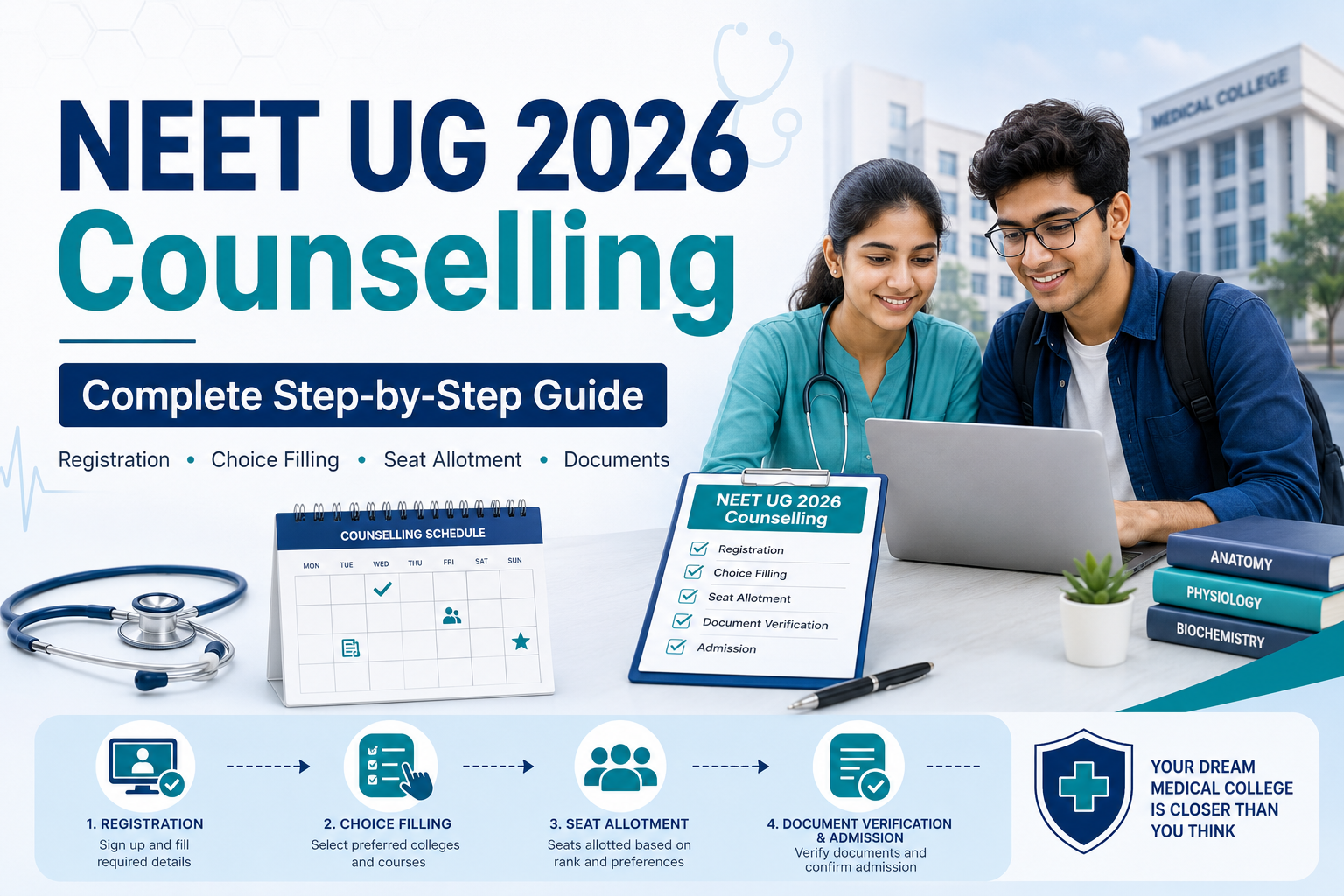
  • NEET UG 2026 Counselling: Complete Step-by-Step Guide

    NEET UG 2026 Counselling: Complete Step-by-Step Guide

    NEET UG 2026 counselling is the admission process through which qualified candidates can secure MBBS, BDS and other notified undergraduate medical seats. The process includes counselling registration, payment of fees, choice filling, seat allotment, document verification and reporting to the allotted college.

    Candidates may need to register for both MCC NEET UG counselling 2026 and the relevant state counselling process. MCC manages the 15% All India Quota and specified central institutions, while state authorities manage state-quota and state-controlled medical seats.

    This complete guide explains the expected NEET UG 2026 counselling dates, eligibility, registration process, fees, documents, choice-filling strategy, counselling rounds and college-reporting requirements.

    NEET UG 2026 Counselling: Quick Answer

    NEET UG 2026 counselling is expected to be conducted through the Medical Counselling Committee and individual state counselling authorities. Candidates must register separately, pay the applicable counselling fee, enter their preferred colleges, lock their choices, check the allotment result and report to the allotted institution with original documents.

    As of 26 July 2026, the NEET UG 2026 scorecard is available through the official NTA portal. The detailed MCC UG 2026 counselling schedule and candidate registration link have not yet been published on the MCC schedule page.

    NEET UG 2026 Counselling Latest Update

    The National Testing Agency published the NEET UG 2026 scorecard on 16 July 2026. Candidates can currently access the scorecard through the official NEET candidate activity section.

    The MCC website has been updated for the 2026 admission session, but its UG schedule section currently displays the 2025 counselling information bulletin and schedules. Candidates should wait for the official MCC 2026 counselling schedule before relying on registration dates circulated by unofficial websites or social-media channels.

    NEET UG 2026 counselling status

    Counselling activityCurrent status
    NEET UG 2026 scorecardAvailable
    MCC UG 2026 registrationNot yet announced
    MCC counselling scheduleNot yet published
    Round 1 choice fillingTo be announced
    Round 1 seat allotmentTo be announced
    State counselling registrationState-specific
    Official seat matrixTo be announced
    College reporting datesTo be announced

    Candidates should check MCC and their respective state counselling portals regularly because central and state registrations may open on different dates.

    Table of Contents

    1. What is NEET UG counselling?
    2. Who conducts NEET UG 2026 counselling?
    3. MCC counselling versus state counselling
    4. NEET UG 2026 counselling dates
    5. Counselling eligibility
    6. Step-by-step registration process
    7. Counselling fees
    8. Choice-filling strategy
    9. Seat-allotment process
    10. Counselling rounds
    11. Documents required
    12. Reservation rules
    13. Common counselling mistakes
    14. Frequently asked questions

    What Is NEET UG 2026 Counselling?

    NEET UG counselling is the centralised admission procedure used to allot undergraduate medical and dental seats to NEET-qualified candidates.

    The counselling authority considers several factors before allotting a seat:

    • NEET UG All India Rank
    • Candidate category
    • Applicable reservation
    • Selected quota
    • Domicile eligibility
    • College and course preferences
    • Availability of seats
    • Institutional eligibility
    • Counselling-round rules

    Qualifying for NEET UG does not automatically provide admission. Candidates must separately register for the relevant counselling process and complete every stage within the notified deadline.

    Who Conducts NEET UG 2026 Counselling?

    NEET UG 2026 counselling is conducted by more than one authority. The correct counselling authority depends on the type of seat the candidate wants.

    1. MCC NEET UG Counselling 2026

    The Medical Counselling Committee conducts online counselling for the 15% All India Quota in undergraduate medical courses. MCC also manages counselling for specified central universities, institutions and other participating quotas.

    MCC counselling generally includes:

    • 15% All India Quota seats
    • AIIMS MBBS seats
    • JIPMER seats
    • Participating deemed-university seats
    • Central university seats
    • Banaras Hindu University seats
    • Aligarh Muslim University seats
    • Applicable Delhi University seats
    • Applicable Jamia Millia Islamia dental seats
    • ESIC Insured Persons Quota seats
    • Armed Forces Medical College registration
    • Other notified central institutions
    • Selected B.Sc. Nursing seats, where applicable

    Candidates interested in these seats must register through the official MCC UG counselling portal.

    2. State NEET UG Counselling 2026

    The respective state or Union Territory authority conducts counselling for seats under its jurisdiction.

    State counselling normally includes:

    • Government medical-college state-quota seats
    • Government dental-college state-quota seats
    • State-controlled private medical-college seats
    • Private dental-college seats
    • Management quota seats
    • State NRI quota seats
    • Minority quota seats
    • Institutional quota seats
    • Other state-notified categories

    State counselling rules can differ substantially. Candidates must check the official state prospectus for domicile, reservation, registration fees, bonds, private-college fees and document requirements.

    3. AYUSH Counselling

    Candidates seeking BAMS, BUMS, BSMS or BHMS admission may need to register through the designated AYUSH counselling authority.

    AYUSH counselling is separate from the MCC MBBS and BDS counselling process. Candidates interested in both medical and AYUSH courses may need to complete separate registrations.

    MCC Counselling vs State Counselling

    Understanding the difference between MCC and state counselling is essential before completing NEET UG 2026 counselling registration.

    ParticularMCC counsellingState counselling
    Main quota15% All India QuotaState quota
    Government college seatsPrimarily 15% AIQGenerally remaining state-quota seats
    AIIMS and JIPMERIncludedNot generally included
    Deemed universitiesIncluded through MCCUsually not included
    Registration websiteMCC UG portalRespective state portal
    Domicile requirementUsually not required for open AIQ seatsFrequently required
    ReservationCentral rules for applicable seatsState reservation policy
    Registration feePrescribed by MCCPrescribed by the state
    Choice fillingMCC portalState portal
    Seat matrixMCC seat matrixState seat matrix

    Candidates can generally register for MCC and state counselling at the same time. However, they must follow the applicable rules regarding seat acceptance, resignation, upgradation and later-round eligibility.

    NEET UG 2026 Counselling Dates

    The official MCC NEET UG 2026 counselling schedule has not yet been published on the MCC UG schedule page as of 26 July 2026.

    The schedule is expected to contain separate deadlines for registration, payment, choice filling, choice locking, seat allotment and college reporting.

    Expected MCC counselling activities

    ActivityNEET UG 2026 date
    MCC counselling notificationTo be announced
    Round 1 registration beginsTo be announced
    Registration closesTo be announced
    Fee-payment deadlineTo be announced
    Choice filling beginsTo be announced
    Choice lockingTo be announced
    Round 1 allotment resultTo be announced
    Round 1 college reportingTo be announced
    Round 2 registrationTo be announced
    Round 3 registrationTo be announced
    Stray Vacancy RoundTo be announced

    Candidates should not confuse the announcement date, registration deadline and choice-locking deadline. These are separate stages and may close at different times.

    NEET UG 2026 Counselling Eligibility

    Candidates must meet the NEET UG and counselling eligibility requirements.

    A candidate should generally:

    1. Qualify for NEET UG 2026.
    2. Obtain the prescribed category-wise qualifying percentile.
    3. Meet the age requirements stated in the official NEET bulletin.
    4. Pass Class 12 or an equivalent examination with the required subjects.
    5. Meet the requirements of the selected quota.
    6. Possess valid category documents, where applicable.
    7. Meet state domicile requirements for applicable seats.
    8. Satisfy the admission conditions of the allotted institution.

    NTA describes NEET UG as the common and uniform entrance examination for admission to undergraduate medical education in Indian medical institutions.

    NEET UG qualifying percentile

    The category-wise qualifying percentile generally used for NEET UG is:

    CategoryMinimum qualifying percentile
    General or General-EWS50th percentile
    OBC-NCL40th percentile
    Scheduled Caste40th percentile
    Scheduled Tribe40th percentile
    General or EWS PwBD45th percentile
    SC, ST or OBC-NCL PwBD40th percentile

    Candidates must check their NEET UG 2026 scorecard and official result notice for the final category-wise qualifying marks.

    Qualifying at the minimum percentile does not guarantee an MBBS seat. Admission depends on rank, category, quota, college choices and seat availability.

    NEET UG 2026 Counselling Registration Process

    The following NEET UG 2026 counselling process explains each stage from scorecard download to final college reporting.

    Step 1: Download the NEET UG 2026 Scorecard

    Download the scorecard from the official NTA NEET portal. The scorecard facility was published on 16 July 2026.

    Check the following details:

    • Candidate’s name
    • Application number
    • Roll number
    • Date of birth
    • Category
    • Marks obtained
    • Percentile
    • All India Rank
    • Category rank, where applicable
    • Qualifying status

    Save the scorecard as a PDF and keep several printed copies.

    Step 2: Identify the Counselling Portals

    Candidates should determine which counselling registrations are relevant to them.

    Depending on eligibility, a candidate may register for:

    • MCC 15% All India Quota counselling
    • AIIMS and JIPMER counselling
    • Deemed-university counselling
    • Home-state counselling
    • Private-college counselling in another state
    • NRI quota counselling
    • Minority quota counselling
    • AYUSH counselling
    • AFMC admission

    NTA examination registration does not automatically register a candidate for MCC or state counselling.

    Step 3: Complete MCC Registration

    When MCC activates the NEET UG 2026 counselling registration link:

    1. Visit the MCC UG counselling portal.
    2. Select the new-registration option.
    3. Enter the NEET UG roll number and application details.
    4. Complete identity and OTP verification.
    5. Create a secure password.
    6. Review the candidate profile.
    7. Select the applicable counselling category.
    8. Submit the application.
    9. Download the registration confirmation.
    10. Save the login details securely.

    Candidates should complete registration personally. Passwords, OTPs and payment details should never be shared with unauthorised admission agents.

    Step 4: Pay the Registration Fee

    MCC counselling generally requires:

    • A non-refundable registration fee
    • A refundable security deposit

    The registration fee confirms participation in counselling. The security deposit may be refunded after the counselling process, subject to the notified rules.

    The deposit may be forfeited when a candidate is allotted a seat in certain rounds but does not join or fails to comply with the counselling conditions.

    Indicative MCC Counselling Fee

    The final NEET UG 2026 counselling fee will be confirmed in the new MCC information bulletin. The following amounts are based on the official MCC UG 2025 bulletin and are provided only for advance planning.

    Counselling categoryRegistration feeRefundable security deposit
    AIQ/Central institutions—General or EWS₹1,000₹10,000
    AIQ/Central institutions—SC, ST, OBC or PwD₹500₹5,000
    Deemed universities—all categories₹5,000₹2,00,000

    Candidates should not make payments through unofficial websites, personal bank accounts or agents.

    Step 5: Check the NEET UG Seat Matrix

    The seat matrix displays the colleges, courses, quotas, categories and number of seats available in a particular counselling round.

    Candidates should review:

    • College name
    • Course
    • Seat category
    • Quota
    • Number of available seats
    • Government, private or deemed status
    • Annual tuition fee
    • Hostel fee
    • Security deposit
    • Service bond
    • Bond penalty
    • Internship stipend
    • College location
    • Hospital facilities

    A seat may be added, removed or converted between categories during later rounds. Candidates should download the seat matrix for every counselling round.

    Step 6: Research Medical Colleges

    Before NEET UG choice filling, compare colleges using practical admission factors.

    Evaluate:

    • Recognition and approval
    • Government or private ownership
    • Total MBBS fee
    • Hospital patient volume
    • Clinical exposure
    • Faculty strength
    • Internship quality
    • Service bond
    • Rural-service conditions
    • Hostel facilities
    • Location
    • Safety
    • Distance from home
    • Previous closing rank

    Do not select a college only because it appears in a popular ranking.

    Step 7: Prepare a Choice-Filling List

    Divide colleges into three groups.

    Dream choices

    These are the highly preferred colleges where admission may be difficult based on previous closing ranks.

    Realistic choices

    These are colleges where the candidate has a reasonable possibility based on rank, category and previous trends.

    Safe choices

    These are acceptable colleges that may have relatively accessible closing ranks.

    All three groups should be combined into one genuine preference order.

    Step 8: Complete Choice Filling

    During the choice-filling period:

    1. Log in to the counselling portal.
    2. Open the available-choice section.
    3. Add preferred courses and colleges.
    4. Arrange them in order of preference.
    5. Save changes regularly.
    6. Review the complete list.
    7. Lock the choices before the deadline.
    8. Download the choice-locking confirmation.

    Does Choice Order Matter in NEET Counselling?

    Yes. Choice order is extremely important.

    The allotment system attempts to assign the highest available preference for which the candidate is eligible. Therefore, the most preferred college should be placed first even when its previous closing rank appears difficult.

    Candidates should not place a less preferred college first merely because they believe it is easier to obtain.

    Step 9: Check the Seat-Allotment Result

    Seat allotment is generally based on:

    • NEET UG rank
    • Category
    • Reservation
    • Applicable quota
    • Eligibility
    • Choice order
    • Available seats
    • Counselling-round rules

    The authority may release a provisional allotment result before the final result. Candidates should act only after checking the final published result.

    Step 10: Download the Allotment Letter

    An allotted candidate should immediately download the official allotment letter.

    Check:

    • Candidate details
    • Course
    • College
    • Category
    • Quota
    • Reporting deadline
    • Reporting instructions
    • Upgrade eligibility
    • Required documents

    Candidates should also check the allotted college’s official admission notice.

    Step 11: Report to the Allotted College

    Candidates must report to the allotted college within the prescribed period.

    The reporting process normally includes:

    • Physical appearance
    • Original-document verification
    • Submission of photocopies
    • Medical-fitness examination
    • College-fee payment
    • Submission of affidavits
    • Execution of applicable bonds
    • Hostel registration
    • Admission confirmation
    • Selection of upgrade willingness, where permitted

    Failure to report within the deadline can lead to cancellation of the allotted seat and possible security-deposit forfeiture.

    NEET UG 2026 Choice-Filling Strategy

    Choice filling can directly affect the final seat allotment. Candidates should use a systematic strategy instead of selecting colleges randomly.

    Fill Every Acceptable Choice

    Candidates should include every college they are genuinely prepared to join. Filling only a few top colleges can substantially reduce the probability of receiving an allotment.

    Use Genuine Preference Order

    Place colleges according to personal preference rather than predicted closing rank.

    A candidate does not lose the opportunity to obtain a lower choice by placing a highly preferred college above it.

    Check the Complete MBBS Cost

    For private and deemed universities, calculate:

    • Tuition fee
    • Hostel fee
    • Mess charges
    • Security deposit
    • Examination fee
    • University fee
    • Miscellaneous charges
    • Bond penalty
    • Annual fee escalation
    • Total expected course cost

    Do not evaluate a college using only its first-year tuition fee.

    Check Service-Bond Conditions

    Some government medical colleges require candidates to complete compulsory service after graduation.

    Check:

    • Duration of compulsory service
    • Location of service
    • Monthly remuneration
    • Bond penalty
    • Rules for postgraduate admission
    • Exemptions, where applicable

    Review Clinical Exposure

    Clinical exposure is an important part of medical training.

    Candidates may examine:

    • Teaching-hospital bed strength
    • Patient footfall
    • Emergency facilities
    • Number of clinical departments
    • Availability of specialists
    • Internship responsibilities
    • Postgraduate departments

    Use Previous Closing Ranks Carefully

    Previous closing ranks can help candidates estimate admission possibilities. They cannot guarantee a 2026 allotment.

    Closing ranks may change because of:

    • Candidate performance
    • Number of qualified candidates
    • New medical colleges
    • Seat increases
    • Fee revisions
    • Changes in candidate preference
    • Reservation changes
    • Counselling-rule changes

    NEET UG 2026 Counselling Rounds

    The official 2026 round-wise rules will be published in the MCC UG 2026 information bulletin.

    The latest available MCC UG framework contains four main online rounds:

    1. Round 1
    2. Round 2
    3. Round 3
    4. Stray Vacancy Round

    The MCC UG schedule page currently provides the 2025 information bulletin and schedules, which should be used only to understand the likely structure—not as the final authority for 2026.

    MCC Round 1

    Round 1 generally includes:

    • New registration
    • Fee payment
    • Choice filling
    • Choice locking
    • Seat allotment
    • Result publication
    • College reporting
    • Upgradation option

    Candidates who do not receive a seat may normally proceed to the next round according to the notified rules.

    MCC Round 2

    Round 2 generally includes:

    • Fresh registration for eligible candidates
    • Fresh choice filling
    • Round 1 upgradation
    • Seat allotment
    • College reporting

    Candidates should not assume that their Round 1 choices will automatically continue. Fresh choice filling may be mandatory.

    MCC Round 3

    Round 3 generally includes:

    • Registration for eligible candidates
    • Fresh choice filling
    • Remaining vacancies
    • Newly added seats
    • Upgradation from Round 2
    • Final reporting

    Exit and resignation conditions generally become stricter in later rounds.

    Stray Vacancy Round

    The Stray Vacancy Round is used to fill seats remaining after Round 3.

    Candidates should participate only when they are fully prepared to join any college included in their choice list. Seat-holding and non-joining rules may make some candidates ineligible.

    Documents Required for NEET UG 2026 Counselling

    Candidates should prepare original certificates, scanned copies and multiple photocopy sets before counselling registration begins.

    Basic Documents

    • NEET UG 2026 scorecard
    • NEET UG 2026 admit card
    • Counselling registration confirmation
    • Seat-allotment letter
    • Class 10 marksheet
    • Class 10 certificate
    • Class 12 marksheet
    • Class 12 certificate
    • Date-of-birth proof
    • Aadhaar card or accepted identity proof
    • Passport-size photographs
    • Medical-fitness certificate
    • Transfer certificate
    • Migration certificate
    • Character certificate

    Category and Quota Documents

    Depending on the candidate’s claim, the following may be required:

    • Scheduled Caste certificate
    • Scheduled Tribe certificate
    • Central OBC-NCL certificate
    • EWS certificate
    • PwBD certificate
    • UDID card
    • Domicile certificate
    • Residence certificate
    • Minority certificate
    • NRI eligibility documents
    • Sponsorship documents
    • Relationship certificate
    • OCI documents
    • ESIC documents
    • CW-category documents
    • Institutional quota documents

    College-Specific Documents

    The allotted institution may additionally require:

    • Gap affidavit
    • Anti-ragging affidavit
    • Service bond
    • Rural-service bond
    • Income certificate
    • Vaccination certificate
    • Local guardian form
    • Hostel application
    • Bank account details
    • PAN card
    • Additional photographs

    Candidates must follow the exact document list issued by the counselling authority and allotted institution.

    NEET UG 2026 Reservation

    Central reservation rules generally apply to eligible All India Quota and central-institution seats.

    CategoryReservation
    Scheduled Caste15%
    Scheduled Tribe7.5%
    OBC-NCL under Central List27%
    Economically Weaker Section10%
    PwBD5% horizontal reservation

    State counselling follows the reservation policy of the respective state or Union Territory.

    A state OBC certificate may not automatically qualify a candidate for Central OBC-NCL reservation. MCC applicants should verify their eligibility under the Central List and use the prescribed certificate format.

    Common NEET UG Counselling Mistakes

    Registering Only for MCC

    MCC registration does not cover state-quota counselling. Candidates interested in state seats must register separately.

    Missing Registration Deadlines

    Candidates should not wait until the last day. OTP delays, payment failure and website congestion can affect registration.

    Filling Too Few Choices

    Candidates who select only a few highly competitive colleges may remain unallotted despite being eligible for other acceptable seats.

    Using the Wrong Preference Order

    The first choice should be the candidate’s most preferred option—not the college considered easiest to obtain.

    Ignoring Private-College Fees

    Candidates should calculate the complete course cost before adding a private or deemed university to their list.

    Ignoring Bond Conditions

    A low-fee government college may carry a substantial compulsory-service bond.

    Using an Invalid Category Certificate

    Category certificates may be rejected because of an incorrect format, expired validity or unauthorised issuing authority.

    Assuming Choices Carry Forward

    Candidates may need to submit fresh choices in later rounds.

    Reporting Without Original Documents

    Final admission generally requires original-document verification.

    Trusting Unauthorised Agents

    No agent can legally guarantee an MCC or state-quota seat. Seat allotment is completed through the official counselling process.

    NEET UG 2026 Counselling Checklist

    Complete this checklist before registration opens:

    • Download the NEET UG 2026 scorecard.
    • Verify the All India Rank.
    • Confirm the category mentioned on the scorecard.
    • Keep the registered mobile number active.
    • Check access to the registered email account.
    • Update category certificates.
    • Obtain the domicile certificate.
    • Scan every document clearly.
    • Prepare several photocopy sets.
    • Compare government medical colleges.
    • Check private and deemed-university fees.
    • Study previous closing ranks.
    • Review service bonds.
    • Prepare a preliminary choice list.
    • Arrange the counselling fee.
    • Arrange the security deposit.
    • Follow MCC updates.
    • Follow the relevant state portal.
    • Save every payment receipt.
    • Download every confirmation page.

    Frequently Asked Questions About NEET UG 2026 Counselling

    When will NEET UG 2026 counselling start?

    The MCC UG 2026 counselling schedule had not been published on the official schedule page as of 26 July 2026. Candidates should wait for the formal MCC notification.

    Has MCC NEET UG 2026 registration started?

    The 2026 candidate registration link was not active on the MCC UG schedule section as of 26 July 2026. The portal currently displays the 2025 information bulletin and schedules.

    Is the NEET UG 2026 scorecard available?

    Yes. NTA published the NEET UG 2026 scorecard on 16 July 2026.

    Is MCC registration automatic after the NEET result?

    No. Candidates must register separately through MCC when the counselling registration window opens.

    Can I participate in MCC and state counselling together?

    Eligible candidates can generally register for both. They must follow the seat-holding, resignation and later-round rules announced by the respective authorities.

    Is domicile required for the 15% All India Quota?

    Domicile is generally not required for open 15% AIQ seats. Institution-specific or internal quotas may have separate eligibility conditions.

    Is domicile required for state counselling?

    Most states require domicile or another specified connection for government state-quota seats. Eligibility for private-college seats can be different.

    How many rounds are conducted in MCC counselling?

    The latest available MCC UG structure has Round 1, Round 2, Round 3 and a Stray Vacancy Round. Candidates must confirm the final 2026 structure through the new MCC bulletin.

    Do Round 1 choices carry forward to Round 2?

    Candidates should not assume that choices will carry forward. The latest MCC framework required fresh choice filling in subsequent rounds.

    Is choice locking compulsory?

    Candidates should lock their choices within the notified period. Locked choices normally cannot be modified after the deadline.

    Does qualifying for NEET guarantee an MBBS seat?

    No. NEET qualification makes a candidate eligible for counselling. Admission depends on rank, category, quota, choices and seat availability.

    Which rank is used in MCC counselling?

    MCC primarily uses the NEET UG All India Rank along with category, reservation, eligibility and candidate preferences.

    Can candidates apply to private medical colleges in another state?

    Some states allow non-domicile candidates to apply for private or management quota seats. Candidates must check the state prospectus before registering.

    Are original documents compulsory during college reporting?

    Original-document verification is generally required to confirm admission. Candidates should carry all documents listed in the allotment letter and college notice.

    Can an agent guarantee an MBBS seat?

    No. Candidates should not trust any person claiming to guarantee a government, AIQ or official counselling seat.

    Final Advice for NEET UG 2026 Candidates

    NEET UG 2026 counselling requires careful preparation. Candidates should begin researching colleges, fees, bonds, quotas and documents before the MCC or state registration window opens.

    Prepare a broad but realistic college list. Arrange choices according to genuine preference. Read the exit and upgradation rules before participating in each round.

    Most importantly, follow only the latest official notices issued by NTA, MCC, state counselling authorities and participating institutions.

    Get NEET UG 2026 Counselling Support

    Choosing the correct medical college requires more than comparing previous cut-offs.

    Education MESD provides personalised support for:

    • MCC counselling registration
    • State counselling registration
    • MBBS college selection
    • Government and private-college comparison
    • Choice-filling strategy
    • Previous cut-off analysis
    • Fee and bond comparison
    • Document verification
    • NRI quota guidance
    • Management quota guidance
    • Seat-allotment assistance
    • College-reporting support

    Contact Education MESD for transparent and personalised NEET UG 2026 counselling guidance.

    Disclaimer: Counselling dates, fees, eligibility, seat matrices, reservation rules and reporting requirements may be revised by MCC, NTA, state authorities or participating institutions. Candidates must verify all admission decisions using the latest official notifications.

  • Perfect Study Gap Explanation for Study Abroad- 2026

    Perfect Study Gap Explanation for Study Abroad- 2026

    A study gap (also called a gap year, academic gap, or education break) is the time between two formal education stages when you were not enrolled—such as after Class 12, after graduation, or between UG and PG. If you have a study gap and you want to study abroad, your application success usually depends on one factor:

    Your gap explanation must be clear, consistent across documents, and supported with evidence.

    Universities and visa authorities see gap years every day. A gap is not automatically a negative. It becomes a red flag only when:

    • your timeline looks incomplete (blank months/years)
    • your SOP, CV, and form answers don’t match
    • your course choice looks unrelated without a logical bridge
    • you provide no proof for long gaps
    • you over-explain emotionally instead of explaining professionally

    This guide is designed to rank well on search and also work in real applications. You will get:

    • a proven framework to justify any gap year
    • gap explanations by duration (6 months, 1 year, 2 years, 3+ years)
    • SOP paragraph templates (copy-paste)
    • LOE format for visas (1 page)
    • CV entries (ATS-friendly)
    • visa interview answers (short, safe, consistent)
    • proof checklist (what to show and how)

    Study gap explanation in one line (featured snippet style)

    A strong study gap explanation is: Reason (cause) + what you did (continuity) + why your program makes sense now (connection) + proof.


    What is a study gap and why do universities/visas ask about it?

    A study gap matters because it helps evaluators confirm:

    • academic readiness (you can return to study successfully)
    • purpose (your course aligns with your career plan)
    • credibility (your timeline and story are consistent)
    • genuine study intent (especially in visa decisions)

    Different countries may evaluate “genuine student” intent in different ways. For example, Australia replaced the earlier GTE approach with the Genuine Student (GS) requirement for Student visa applications lodged on/after 23 March 2024.
    For Canada, IRCC’s document checklist page explicitly says a letter of explanation is recommended and asks applicants to explain why they want to study and that they understand responsibilities.
    For the UK, universities commonly explain that UKVI credibility interviews can be used to assess whether a student’s intentions to study in the UK are genuine.
    For the US, official guidance confirms you must have an appropriate student visa (F/M) to study.

    Practical takeaway: your gap story must look logical and verifiable.


    The best framework to justify gap years: the 3C Method (use in SOP, LOE, interview)

    This is the simplest structure that works across countries and application types.

    1) Cause (Why the gap happened)

    Say the reason in 1–2 lines. Keep it factual.

    Examples:

    • full-time job / internship / freelancing
    • competitive exam prep (UPSC, GATE, CAT, etc.)
    • family responsibilities / financial constraints
    • medical recovery
    • entrepreneurship / family business
    • skill-building / certifications / portfolio development

    2) Continuity (What you did during the gap)

    Show that you stayed productive and progressed:

    • responsibilities and outcomes at work
    • projects, certifications, internships
    • volunteering, research, portfolio
    • exam prep plan + outcomes

    3) Connection (Why your course and why now)

    Tie the gap to your program choice:

    • what you learned during the gap
    • why your chosen course is the next logical step
    • how you are ready now (skills + clarity + plan)

    If your SOP, CV, LOE and interview answers follow 3C, your file looks “clean” and credible.


    How to explain study gaps by duration (what to write + how much proof)

    Gap of 0–6 months

    What to write: 1–2 lines in SOP; include in CV timeline.
    Proof: optional unless asked.

    Gap of 6–12 months

    What to write: short SOP paragraph (60–90 words).
    Proof: recommended if you claim work/exams/courses.

    Gap of 1–2 years

    What to write: SOP paragraph + CV entry + (recommended) 1-page LOE for visa.
    Proof: strongly recommended.

    Gap of 3+ years

    What to write: SOP paragraph + 1-page LOE + strong “academic readiness” evidence.
    Proof: very important—show structured, consistent progress.


    Best reasons for gap year (and exactly how to present them)

    1) Job / internship / freelancing (high acceptance)

    How to present: Role → skills → outcomes → relevance to your program.
    Proof ideas: offer/experience letter, payslips, bank credits, portfolio, LinkedIn.

    Strong phrasing:
    “I worked full-time to gain industry exposure and identify my specialization. That experience shaped my decision to pursue this program.”


    2) Competitive exam preparation (UPSC/GATE/CAT/IELTS/GRE/GMAT)

    How to present: structured prep + what you learned + why you’re choosing higher studies now.
    Proof ideas: registration, coaching proof (optional), score report, mock records, study plan (1 page).

    Strong phrasing:
    “My preparation strengthened my analytical foundation and clarified the academic direction I want to pursue.”


    3) Family responsibility / financial constraint

    How to present: brief, respectful, and show what changed now.
    Proof ideas: minimal; avoid oversharing private details.

    Strong phrasing:
    “I took responsibility at home temporarily; the situation is stable now, and I’m prepared for full-time study.”


    4) Medical gap

    How to present: factual + recovery completed + readiness now.
    Proof ideas: brief medical certificate/summary if needed.

    Strong phrasing:
    “I took time for recovery and I am now medically fit to resume full-time academics.”


    5) Entrepreneurship / family business

    How to present: measurable outcomes (sales, ops, finance, marketing) + skills gained + why you want formal education now.
    Proof ideas: invoices, client emails, portfolio, website, business registration (if applicable).

    Strong phrasing:
    “Running operations gave me practical exposure; now I want structured knowledge to scale in a specialized role.”


    6) Upskilling / reskilling / career transition

    How to present: certifications + projects + outcomes + alignment with the course.
    Proof ideas: certificates, GitHub/portfolio, capstone reports, internship proof.

    Strong phrasing:
    “I used the gap to build a foundation through projects and certifications aligned with my intended specialization.”


    Proof checklist for study gap

    Use this as a “documents ready” list. You may not need to upload all of it, but you should be able to show it if asked.

    If your gap is due to work

    • experience/relieving letter
    • payslips or bank statement credits
    • project/portfolio samples

    If your gap is due to exam prep

    • exam registration/admit card (if applicable)
    • score report (if available)
    • coaching enrollment (optional)
    • one-page prep plan (optional but strong)

    If your gap is due to skill-building

    • certificates
    • project links (GitHub/Drive)
    • internship letter (if any)

    If your gap is due to medical reasons

    • brief medical summary / recovery certificate (only if required)

    If your gap is due to entrepreneurship

    • invoices / client work proof
    • business docs (only if relevant)
    • portfolio / website

    Where to explain the gap year (SOP vs CV vs LOE) for maximum credibility

    1) SOP (Statement of Purpose)

    Keep the gap explanation 80–120 words for most applicants. Use the 3C method.

    2) CV / Resume (ATS-friendly)

    Never leave a blank timeline. Add a professional entry like:

    • Professional Development (Full-Time) | Jun 2023 – Aug 2024
    • Exam Preparation + Skill Building | Month YYYY – Month YYYY
    • Family Responsibility / Career Break | Month YYYY – Month YYYY
    • Entrepreneurship / Freelancing | Month YYYY – Month YYYY

    3) LOE (Letter of Explanation) for visa

    For Canada specifically, IRCC explicitly labels a letter of explanation as “Recommended” and asks you to explain why you want to study and that you understand responsibilities.
    For Australia, the student visa file is assessed under the GS requirement for applications lodged on/after 23 March 2024.
    For the UK, credibility interviews can be used to assess genuine intent.


    Best SOP gap explanation paragraphs

    Template 1: Job + upskilling (most common)

    After completing my degree in [Year], I took a structured break to gain practical exposure and strengthen my foundation for postgraduate study. During [Month–Month], I worked as a [Role] at [Organization], where I developed skills in [Skill 1, Skill 2] and contributed to [Outcome/Result]. Alongside work, I completed focused upskilling in [Tools/Courses] through hands-on projects, which clarified my interest in [Specialization]. This is why I am now applying for [Program], which aligns directly with my goal of becoming a [Target Role].

    Template 2: Exam preparation + decision to study abroad

    Following graduation in [Year], I dedicated time to structured preparation for [Exam/Goal], which strengthened my discipline and analytical foundation. During the same period, I maintained academic engagement by completing [certifications/projects] and building a portfolio aligned with [program domain]. This phase confirmed that advanced study in [Program] is the most effective pathway to achieve my goal of [career goal]. I am now prepared to return to full-time academics with a clear plan and stronger readiness.

    Template 3: Family responsibility + readiness now

    After completing my studies in [Year], I took a temporary break due to family responsibilities. During this period, I remained engaged through [courses/projects] and developed practical skills in [skills]. The situation is now stable, and I am fully prepared to pursue full-time study. This experience increased my maturity and reinforced my motivation to specialize in [Program], aligned with my long-term plan in [Domain/Industry].

    Template 4: Medical gap (safe, minimal)

    After completing my studies in [Year], I experienced a health-related interruption that required focused recovery time. I am now fully recovered and prepared to pursue full-time academic work. During the gap, I stayed engaged through [light courses/reading/projects], which helped me maintain continuity and clarify my interest in [specialization]. I am applying for [Program] because it provides the structured training required for my goal of [career goal].


    1-page Gap Year LOE (visa-friendly format)

    Subject: Letter of Explanation – Study Gap (Month YYYY – Month YYYY)

    To Whom It May Concern,
    I am writing to explain the gap in my education from [Month YYYY] to [Month YYYY].

    Cause:
    During this period, I [worked full-time / prepared for exams / managed family responsibilities / recovered medically / built skills].

    Continuity (productive activities and outcomes):

    • [Activity 1] – [Outcome/Result]
    • [Activity 2] – [Outcome/Result]
    • [Activity 3] – [Outcome/Result]

    Connection (why study now):
    This period strengthened my readiness and clarified my goal of [career goal]. The [program name] aligns with my background in [field] and will help me develop [skills] needed for [target role].

    Supporting documents (as applicable):

    • [Experience letter / certificates / portfolio / score report]

    Sincerely,
    [Full Name] | [Email] | [Phone]

    (If you are applying to Canada, IRCC explicitly marks the LOE as recommended on its study permit document guidance page.)


    CV entries to cover gap years (ATS-friendly examples)

    Professional Development (Full-Time) | [City, Country] | Jun 2023 – Aug 2024

    • Completed certifications in [X, Y, Z] and built [#] projects in [domain]
    • Strengthened academic readiness through structured learning and portfolio development
    • Developed practical skills in [tools/skills] aligned with [program]

    Exam Preparation + Skill Building | [City, Country] | Jan 2022 – Dec 2022

    • Prepared for [exam] with a structured plan and completed [certifications/projects]
    • Built foundation in [subjects/tools] relevant to [program]

    Career Break / Family Responsibility | [City, Country] | Month YYYY – Month YYYY

    • Managed family responsibilities while maintaining engagement through [courses/projects]
    • Developed transferable skills: coordination, time management, problem-solving

    Visa interview answers (short, safe, consistent)

    Q1: Why is there a gap in your studies?

    “I completed my [degree] in [Year] and then spent [duration] on [job/exam/upskilling/family/medical]. During that time, I achieved [two outcomes] and decided to pursue [program] because it directly supports my goal of [career goal].”

    Q2: Why study now after the gap?

    “I am ready now because I built the required foundation through [work/projects/certifications] and I have a clear study plan aligned with my long-term career pathway.”

    Q3: Why this country?

    Use official logic: program fit + career outcomes + credible plan.
    (For example, Australia assesses genuine student intent under GS for applications lodged on/after 23 March 2024, so consistency matters.)

    Q4: Why not study in your home country?

    Answer with curriculum fit, specialization, labs, industry exposure, and outcomes—without insulting local education.


    Country-wise notes (SEO + application clarity)

    Australia

    Australia replaced GTE with the Genuine Student (GS) requirement for Student visas lodged on/after 23 March 2024.
    Implication: your timeline and “why now” must be coherent and supported.

    Canada

    IRCC explicitly says “Write a letter of explanation – Recommended” in the study permit document guidance.
    Implication: a clean LOE is a high-value addition, especially with gaps.

    UK

    UKVI credibility interviews may be used to assess whether a student’s intentions to study are genuine (universities routinely advise students to prepare).
    Implication: your SOP, CV, and answers must match exactly.

    USA

    The US State Department explains you need an appropriate student visa (F/M) to study.
    Practical prep: show program fit, funding clarity, and a credible academic plan.


    Common mistakes that reduce acceptance and visa credibility

    • Writing vague statements: “I was preparing” (preparing what, outcomes?)
    • Contradictions: SOP says job, CV shows nothing; form says exam prep
    • Unrelated course choice with no bridge (“random switch”)
    • Over-explaining personal issues and creating inconsistency
    • No evidence for long gaps
    • Leaving blank timelines in CV (looks suspicious even when genuine)

    FAQs

    Is a 1–2 year study gap acceptable for study abroad?
    Yes, in most cases, if you show productive use of time and keep SOP/CV/LOE consistent.

    Do I need a gap year explanation letter (LOE)?
    If the gap is 12+ months, it is strongly recommended. For Canada, IRCC explicitly labels the LOE as recommended.

    How do I explain a study gap after 12th for study abroad?
    Use the same 3C framework: why the break happened, what you did (exam prep/courses), and why you are ready now.

    How do I explain a gap due to UPSC/CAT/GATE preparation?
    Mention structured prep + what you learned + your decision to pursue specialized education now.

    Will a gap year reduce scholarship chances?
    Not automatically. Strong outcomes during the gap (projects, work impact, leadership, certifications) can strengthen scholarship competitiveness.

  • Perfect SOP for Study Abroad 2026: Format, Best Structure, Examples, Word Limit & Pro Tips

    Perfect SOP for Study Abroad 2026: Format, Best Structure, Examples, Word Limit & Pro Tips

    A strong Statement of Purpose (SOP) for Study Abroad can directly impact your admission and scholarship chances—especially for competitive intakes like Fall 2026 and Spring 2026. Universities use your SOP to evaluate your academic readiness, career clarity, motivation, and program-university fit beyond marks, IELTS/TOEFL scores, and resumes.


    Table of Content

    • What is SOP for study abroad?
    • Why SOP is important for admission and scholarships
    • SOP format for study abroad
    • SOP word limit for UG/MS/MBA/PhD
    • How to write SOP step-by-step
    • SOP examples (opening, projects, why university, closing)
    • Country-specific SOP tips
    • SOP mistakes to avoid
    • FAQs + checklist

    What is an SOP for Study Abroad?

    A Statement of Purpose (SOP) is an essay submitted with your university application that explains:

    • Why you want to study this course/program
    • Why you chose this university/country
    • How your academics, projects, internships, and achievements align
    • What your short-term and long-term career goals are
    • How you will contribute to the university community

    A high-quality SOP answers one question clearly:
    Why you + why this program + why this university + why now.


    Why SOP is Important for Study Abroad Admission (And Scholarships)

    Admissions committees use the SOP to judge:

    • Academic fit: Can you handle the program rigor?
    • Professional readiness: Do you understand the field and its demands?
    • Clarity of purpose: Are your goals realistic and aligned?
    • Motivation: Why abroad, why this course, why this intake?
    • Scholarship suitability: Many funding decisions evaluate SOP quality.

    If your SOP is generic, even strong profiles can get rejected. If your SOP is specific and evidence-led, average profiles can get shortlisted.


    SOP Format for Study Abroad (Best Structure That Works)

    A “perfect SOP” is structured, specific, and proof-based. Use this 8-paragraph SOP format:

    1) Introduction (Hook + Course Goal)

    Start with a focused motivation and clearly mention the program.

    Example:
    “My interest in data-driven decision-making grew through academic projects involving real-world datasets and analytical modeling. To strengthen my expertise in business intelligence and predictive analysis, I plan to pursue a Master’s in Business Analytics.”

    2) Academic Background (Relevant subjects + strengths)

    Mention:

    • Degree and specialization
    • Relevant coursework
    • Certifications
    • Academic achievements

    3) Projects / Research (Evidence)

    Use: Problem → Role → Tools → Result → Learning

    Example (compact):
    “In my project on [Topic], I worked on [problem], applied [tools], and achieved [result]. This improved my ability to handle real-world data and build structured solutions.”

    4) Internship / Work Experience (Industry exposure)

    Mention:

    • Your role and responsibilities
    • Skills gained
    • Outcomes (numbers help)

    5) Why This Course (Curriculum alignment)

    Include:

    • 3–5 course modules/tracks you need
    • Capstone/co-op/thesis interest
    • Skill justification for career goals

    6) Why This University (Specific fit)

    Mention:

    • Labs, centers, faculty research areas
    • Capstone, placements, industry partnerships
    • Innovation ecosystem + student community

    7) Career Goals (Short-term + Long-term)

    • Short-term: job role after graduation
    • Long-term: leadership/research/entrepreneurship/social impact

    8) Conclusion (Confidence + contribution)

    End with:

    • Why you are ready
    • What you will contribute
    • Your fit with the program

    SOP Word Limit for Study Abroad (UG/MS/MBA/PhD)

    If the university doesn’t specify a limit, use these safe standards:

    • UG SOP: 600–900 words
    • MS SOP: 800–1200 words
    • MBA SOP: 900–1200 words
    • PhD SOP: 1200–1500 words

    If a university gives a character limit (1000/2000/4000), prioritize: goal, proof points, fit, and outcomes.


    How to Write SOP for Study Abroad (Step-by-Step)

    Step 1: Write your goal in one line

    Example: “MS in Data Science to build expertise in ML for healthcare analytics.”

    Step 2: Pick 2–4 proof points

    • Projects with measurable results
    • Internships/work impact
    • Awards, papers, competitions
    • Leadership and volunteering

    Step 3: Build your “progression story”

    Admissions committees prefer progression:
    interest → learning → application → result → future plan

    Step 4: Add strong “Why University” details

    Mention:

    • course names
    • labs/centers
    • research groups
    • capstone/co-op opportunities

    Step 5: End with realistic career goals

    Short-term job title + long-term vision + impact.


    SOP Examples for Study Abroad

    SOP Opening Example (MS/PG)

    “My interest in intelligent systems developed through academic projects that required structured problem-solving, data preprocessing, and model evaluation. These experiences motivated me to pursue advanced training in [Program] with a specialization in [Area].”

    Project Paragraph Example (Strong)

    “In my project on [Topic], I addressed [problem] by analyzing [data]. I implemented [tools/methods] and achieved [result]. This experience improved my ability to validate outputs, document decisions, and present insights in a structured format.”

    “Why This University” Example (Best)

    “I am particularly interested in the program’s focus on [course/track], as it aligns directly with my goal of building expertise in [skills]. The opportunity to learn through [capstone/co-op/lab] will help me translate academic learning into real-world implementation in [domain].”

    Closing Example (Professional)

    “I believe my academic foundation, project exposure, and clarity of purpose make me a strong fit for the program. I look forward to contributing through collaborative projects, research-driven learning, and active participation in the university community.”


    Country-Specific SOP Tips (USA, Canada, UK, Australia, Germany)

    SOP for USA

    • Strong fit + projects/research focus
    • Mention faculty/labs if possible

    SOP for Canada

    • Highlight co-op, employability, practical learning
    • Keep post-study goals realistic and structured

    SOP for UK

    • Strong academic motivation and subject-specific clarity
    • Less “resume style,” more course-alignment

    SOP for Australia

    • Skills + industry relevance + outcomes
    • Focus on readiness and professional goals

    SOP for Germany/Europe

    • Technical alignment + research/industry objective
    • Strong academic grounding and long-term plan

    SOP Mistakes That Cause Rejection

    Avoid:

    • Copy-paste templates from the internet
    • Generic praise (“world-class university”)
    • No measurable proof points
    • No course/university fit
    • Overly emotional life story
    • Repeating resume without reflection
    • Long paragraphs and vague goals

    FAQs: SOP for Study Abroad

    1) Can a strong SOP get admission with average marks?

    Yes. A strong SOP can compensate for average grades by proving capability, clarity, and fit.

    2) Is one SOP okay for all universities?

    No. Keep 60–70% common and customize 30–40% per university.

    3) How many drafts should I write?

    Ideally 2–4 drafts. Draft 1 for structure, Draft 2 for clarity, Draft 3 for fit and language.

    4) Can SOP help in scholarships?

    Yes. Many scholarship committees evaluate SOP for leadership, clarity, and potential impact.


    Apply Through Education MESD (SOP + Scholarship + Admission Support)

    If you are planning for Study Abroad 2026 intakes, Education MESD can support you with:

    • SOP writing (university-specific)
    • University shortlisting (country-wise)
    • Scholarship guidance and profile improvement
    • Application documentation strategy

    To get a custom SOP draft, share:

    • Course (UG/MS/MBA/PhD)
    • Country + intake (Fall/Spring 2026)
    • Your background (degree + projects + internship)
    • Target universities (if any)
  • How to Build a Strong Profile for Top Universities with Average Marks (2026 Guide)

    How to Build a Strong Profile for Top Universities with Average Marks (2026 Guide)

    Introduction: Yes, You Can Get Into Top Universities With Average Marks

    If your grades are average, your admission strategy must be intentional. Top universities do not admit only “toppers”—they admit students who demonstrate academic readiness, clear direction, and high potential through projects, research, internships, leadership, and a strong application narrative.

    Your transcript is one signal. Your overall profile is the decision.

    In this guide, you’ll learn exactly how to build a strong profile for top universities with average marks—step-by-step—so your application competes with high-CGPA candidates.


    Table of Contents

    1. What Top Universities Actually Evaluate
    2. How to Offset Average Marks (Without Making Excuses)
    3. Create a “Spike”: The #1 Differentiator in Admissions
    4. High-Impact Projects That Impress Top Programs
    5. Research Profile: How to Start Even Without a Big College Tag
    6. Internships & Work Experience That Strengthen Your Case
    7. SOP Strategy: Turn Your Profile Into a Clear Story
    8. LORs That Can Compensate for Grades
    9. GRE/GMAT: When to Submit and When Not To
    10. University Shortlisting Strategy (Dream/Match/Safe)
    11. 90-Day Profile Building Roadmap
    12. FAQs

    1) What Top Universities Actually Evaluate (Beyond Marks)

    Most top universities follow holistic admissions, meaning your grades are evaluated alongside:

    Key Admission Factors

    • Academic readiness: relevant subjects, course rigor, grade trend
    • Projects/portfolio: proof-of-work, depth, results
    • Research potential: publications, labs, research internships, preprints
    • Internships/work experience: outcomes, ownership, impact
    • SOP: clarity, fit, goals, maturity
    • LORs: strong validation by credible recommenders
    • Standardized tests: GRE/GMAT (if submitted), IELTS/TOEFL/DET
    • Leadership & impact: initiatives, community work, entrepreneurship

    Why this matters for average marks

    If your CGPA is moderate, you must:

    • reduce perceived academic risk, and
    • increase evidence of potential and fit.

    2) How to Offset Average Marks (Without Making Excuses)

    Average marks are not a “rejection guarantee.” But you must handle them strategically.

    A) Highlight academic strengths within the transcript

    Admissions teams look for:

    • strong performance in core/relevant subjects
    • improvement in later semesters (an upward trend)
    • difficulty level (math-heavy, core CS, advanced electives)

    If your overall CGPA is average but core subjects are strong, that is a meaningful signal.

    B) Add external proof of academic ability

    Use high-quality, relevant proof such as:

    • advanced MOOCs (with real projects, not just certificates)
    • research replication reports
    • technical blogs demonstrating conceptual depth
    • a portfolio showcasing applied skills
    • competitions/hackathons with measurable outcomes

    C) If needed, explain marks briefly and professionally

    Only explain marks if there is a real reason (health, financial constraints, family responsibilities). Keep it:

    • factual
    • short (4–6 lines)
    • improvement-focused

    Never make excuses. Show maturity, ownership, and growth.


    3) Create a “Spike”: The #1 Differentiator for Top Admits

    A “spike” is a standout strength that makes you memorable.

    If you have average marks, a spike can become the reason you get admitted.

    Examples of powerful spikes

    • Research spike: strong research internship + paper/preprint + faculty fit
    • Project spike: 2–3 advanced projects with real results + deployment
    • Industry spike: impactful internships/work experience + outcomes
    • Entrepreneurship spike: product built, users, revenue, partnerships
    • Impact spike: measurable community impact + leadership + recognition

    How to choose your spike

    Pick one core domain aligned with your target program:

    • MS CS / AI / DS → projects + GitHub + research exposure
    • MBA / Management → leadership + impact + business outcomes
    • Public policy / sustainability → research + community/field impact + writing

    Rule: A focused profile beats a scattered profile.


    4) High-Impact Projects That Impress Top Universities

    Projects are the fastest way to beat high-CGPA candidates who lack proof-of-work.

    What top universities want to see in projects

    A good project has:

    • a real problem statement
    • technical depth
    • measurable outcomes
    • clean documentation
    • reproducibility (code + dataset references)
    • limitations and future work

    Project types that impress (especially for CS/AI/DS)

    • End-to-end ML system: data → model → evaluation → deployment
    • Research-style project: baseline comparison, ablation, experiments
    • Open-source contribution: PRs, issues, documented commits
    • Real-world project with users: adoption metrics, feedback, iterations
    • Portfolio-based project: strong UI/UX + backend + cloud deploy

    Minimum “top-university” standard

    • 2–3 strong projects > 10 weak projects
    • Each project must include:
      • GitHub repo with README
      • results + screenshots
      • dataset description
      • clear installation instructions
      • learnings and improvements

    If you need, I can convert your existing work into “admissions-ready” project documentation.


    5) Research Profile: How to Start Even Without Elite College Access

    You don’t need a famous institute to build a credible research profile.

    Practical ways to build research credibility

    • Replication study: reproduce a published paper’s results
    • Mini literature review + experiments: topic-focused and well-structured
    • Research internship under a professor: offer deliverables
    • Poster/paper submission: legitimate venues (avoid predatory journals)
    • Preprint/report: a structured technical report can still add value

    What matters most

    Admissions committees value:

    • rigor
    • clear methodology
    • evidence of thinking like a researcher
    • strong alignment to target faculty/labs

    Even one well-executed research deliverable can offset average marks significantly.


    6) Internships & Work Experience: Make Outcomes Measurable

    “Worked on a project” is weak. “Delivered outcomes” is strong.

    Strong internship bullets look like this

    Instead of:

    • “Worked on machine learning model”

    Write:

    • “Built a classification pipeline; improved F1 from 0.72 to 0.83; automated evaluation; reduced manual review time by 25%.”

    What top universities look for in work experience

    • ownership
    • accountability
    • measurable impact
    • communication skills
    • consistency and professionalism

    If you can show impact, your CGPA becomes less central.


    7) SOP Strategy: Your SOP Must Sell Fit + Potential

    A strong SOP is not a motivational story. It’s a logical case for admission.

    High-conversion SOP structure

    1. Your focus area + motivation (short, specific)
    2. Your preparation (projects/research/work with outcomes)
    3. Your academic readiness (relevant subjects, growth, learning plan)
    4. Why this university (faculty + labs + courses + resources)
    5. Your goals (what you will do there, and post-study direction)

    How to handle average marks in SOP

    • mention briefly (if needed)
    • emphasize improvement + preparation
    • shift focus back to achievements and fit

    Important: Over-explaining grades makes them look bigger.


    8) LORs That Can Compensate for Grades

    A strong Letter of Recommendation can neutralize average marks.

    Best recommenders

    • professor who supervised your research/project
    • internship manager who saw your impact
    • HOD or faculty who can compare you to peers with evidence

    What makes a top-tier LOR

    • specific examples
    • performance ranking (top 5–10%)
    • technical and behavioral strengths
    • reliability, integrity, initiative
    • growth mindset

    You should also provide recommenders a brag sheet (project links, outcomes, goals).


    9) GRE/GMAT: When It Helps (and When It Doesn’t)

    If your program is test-optional, a strong score can still help in some cases.

    Submit GRE/GMAT if:

    • your marks are average and your quant/verbal score is strong
    • the program values testing
    • you want an extra academic signal (especially for US programs)

    Skip GRE/GMAT if:

    • your score will be average and your profile spike is strong
    • you can invest time better in projects/research/SOP

    For IELTS/TOEFL: aim high—language readiness reduces risk perception.


    10) University Shortlisting Strategy (Dream/Match/Safe)

    Many students with average marks lose because they shortlist wrongly.

    Best approach

    • Dream (20–30%): top-ranked, high competition
    • Match (40–50%): strong fit + realistic admits
    • Safe (20–30%): good programs with higher acceptance probability

    Shortlist based on:

    • faculty fit
    • program outcomes
    • location and job opportunities
    • course structure
    • alumni outcomes
    • realistic entry requirements

    11) 90-Day Profile Building Roadmap (High Impact)

    Weeks 1–2: Strategy + Positioning

    • choose your spike (domain)
    • shortlist 20–30 programs
    • gap analysis (what is missing?)
    • finalize 2 project ideas aligned to target programs

    Weeks 3–6: Build Project 1 (Admissions-grade)

    • end-to-end build + evaluation
    • GitHub + README + results
    • write 1 technical blog explaining it

    Weeks 7–10: Build Project 2 OR research replication

    • deeper work + baseline comparisons
    • publish report/preprint if possible
    • write 1 more blog or create a demo

    Weeks 11–12: Application packaging

    • SOP finalization
    • LOR briefing
    • resume polishing
    • finalize shortlist and deadlines

    If you follow this, average marks stop being the headline of your profile.


    Conclusion: Average Marks Are a Starting Point, Not a Limit

    If you build:

    • a focused spike,
    • 2–3 high-quality projects/research outputs,
    • a strong SOP and LORs,
    • and a smart shortlist,

    you can absolutely compete for top universities—even with average marks.


    FAQs

    1) Can I get into top universities with average marks?

    Yes—if you show strong projects, research, internships, and fit. Holistic review rewards potential and evidence of readiness.

    2) What matters most if my CGPA is low or average?

    A strong spike (projects/research), SOP clarity, strong LORs, and measurable outcomes.

    3) Should I explain my low marks in SOP?

    Only if necessary. Keep it brief, factual, and improvement-focused.

    4) Do projects really matter more than grades?

    For many tech programs, strong projects can significantly strengthen your profile because they prove skills and readiness.

    5) Is GRE required to compensate for average marks?

    Not always. A strong GRE can help, but quality projects/research often provide better returns.

  • Healthcare & Nursing Courses Abroad (2026): Scholarships, Jobs & PR Pathways for Indian Students

    Healthcare & Nursing Courses Abroad (2026): Scholarships, Jobs & PR Pathways for Indian Students

    If you want a study-abroad pathway with high employability, long-term career stability, and realistic PR potential, healthcare and nursing consistently rank among the strongest options—especially in countries using skilled-immigration systems and actively recruiting regulated health professionals.

    Why Healthcare & Nursing Abroad Is a High-ROI Career Move in 2026

    1) Global demand is structural, not seasonal

    Ageing populations, chronic care needs, and workforce shortages keep healthcare hiring strong across multiple regions.

    2) Nursing is a “direct-to-employment” pathway—but licensing is the gate

    Most countries hire nurses aggressively, but only after you complete regulator requirements (exam + verification + English).

    3) Several countries run skilled-migration programs that explicitly include healthcare categories

    For example, Canada’s Express Entry includes a Healthcare and social services occupations category.


    Best Healthcare & Nursing Courses Abroad (High Job + PR Potential)

    A) Nursing (Clinical, Regulated Pathway)

    Best for: Hospital jobs, stable long-term settlement options (case-dependent)

    Top programs:

    • BSc Nursing / BSN (UG)
    • MSc Nursing / MSN (PG)
    • Specialisation-focused PG programs (varies by country/university)

    Highest-demand nursing specialisations (globally):

    • ICU / Critical Care
    • Emergency Nursing
    • Mental Health / Psychiatric Nursing
    • Aged Care / Gerontology
    • Pediatric Nursing
    • Community / Public Health Nursing

    SEO tip for your readers: If your end goal is “job + PR,” nursing is usually more aligned than generic healthcare programs—because it maps to regulated shortage roles.


    B) Healthcare (Non-Clinical, High-Growth Pathway)

    Best for: Students who want healthcare careers without bedside nursing registration

    Top programs:

    • Master of Public Health (MPH)
    • Health Informatics / Clinical Informatics
    • Healthcare Management / Hospital Administration
    • Health Data Analytics
    • Quality & Patient Safety
    • Global Health / Health Policy

    Best-fit profiles:

    • Bio/health/psych/life-science grads
    • Engineers/IT grads shifting into health informatics & analytics
    • Business graduates targeting hospital operations & management

    Scholarships for Healthcare & Nursing Courses Abroad (What Actually Works)

    Many students waste time searching only “fully funded scholarships.” For healthcare/nursing, scholarships typically come through these five high-conversion buckets:

    1) University merit scholarships (highest probability)

    • Awarded based on academics + SOP + profile fit
    • Often early applicants get better outcomes

    2) School/Faculty scholarships (most “hidden”)

    • Nursing school and public health school funds
    • Sometimes separate forms + short essays

    3) Government scholarships (high value, highly competitive)

    • Strong academics + leadership + clear career plan usually required

    4) Employer/hospital-linked funding (high practicality)

    • Some regions support shortage-area hiring via contracts or training supports (availability varies)

    5) Assistantships (common in MPH/informatics; less common in pure nursing UG)

    • Research/TA roles depend on university structure and intake demand

    Scholarship-winning SOP angle (high success rate):
    Position your goals around national priorities: aged care, mental health, community healthcare, digital health, patient safety—and show measurable intent (skills, certification plan, and long-term contribution).


    Jobs After Studying Healthcare & Nursing Abroad (Role Map)

    Nursing jobs (regulated/licensed)

    • Registered Nurse (RN)
    • ICU nurse, Emergency nurse, Mental health nurse
    • Aged care nurse / community nurse
    • Clinical nurse specialist (after progression)

    Healthcare jobs (often non-licensed)

    • Health data analyst / clinical data coordinator
    • Health informatics specialist
    • Hospital operations executive
    • Public health program officer
    • Quality & patient safety associate

    High-SEO clarity line:
    Nursing has high job demand, but your registration timeline determines how fast you can start work.


    Licensing & Registration (Country-Wise: What You Must Know)

    UK (NMC): CBT + OSCE = Overseas Nursing Registration Path

    The NMC explains the Computer Based Test (CBT) structure (Part A numeracy + Part B clinical), timing, and fees.
    The OSCE is the practical exam; you must complete both CBT and OSCE to continue registration. NHS Employers also confirms overseas nurses must gain NMC registration as part of the UK recruitment pathway.

    Australia (AHPRA / NMBA): English Standard Updated in 2025

    NMBA’s English language skills registration standard (2025) took effect on 18 March 2025.
    AHPRA publishes the English language skills standard resources and implementation information.
    Practical implication: plan IELTS/OET/approved test readiness early, because English compliance is a registration bottleneck.

    New Zealand (NCNZ): IQN Route + 1,800 Hours Requirement

    NCNZ’s IQN pathway references the requirement to verify documents via TruMerit before applying.
    TruMerit/NCNZ credential verification materials clearly reference the minimum 1,800 hours of post-registration experience requirements (and report issuance conditions).
    NCNZ also announced implementation changes for internationally qualified enrolled nurses effective 1 September 2025, including the 1,800-hour requirement.

    Canada (NNAS): Common Credentialing Start Point for IENs

    NNAS describes itself as a credentialing service and “first step towards becoming a nurse in Canada.”
    It also outlines the application steps/timeline for credential review.
    Additionally, the Canadian Nurses Association summarizes that credential assessment/verification is typically a first step for many regulators.

    Germany: Recognition (“Anerkennung”) is Essential for Regulated Nursing

    Germany’s “Make it in Germany” portal explains recognition/equivalence assessment and indicates competent authorities often assess documents within three to four months once complete.
    Germany’s official recognition portal provides similar timelines and process steps.


    PR Pathways for Nursing & Healthcare (Country-by-Country)

    1) Canada PR Pathways (Very PR-Aligned for Healthcare)

    Canada’s IRCC explains Express Entry and category-based selection, including the healthcare category.
    IRCC also outlines Express Entry program eligibility (“Who can apply”) and how rounds of invitations work.

    Practical PR pathway (simplified):
    Study → eligible work (where applicable) → skilled work experience → Express Entry + (sometimes) provincial routes (case-dependent).

    High-SEO note: If your target is Canada, plan both tracks: (1) education/job readiness and (2) licensing readiness (if nursing).


    2) Australia PR Pathways (Skilled Migration + Invitation System)

    Australia’s Department of Home Affairs publishes key visas:

    • Subclass 189 (Skilled Independent)
    • Subclass 190 (Skilled Nominated)
    • Subclass 491 (Skilled Work Regional – Provisional)

    Australia also describes Skill Select and invitation rounds (how invitations are issued).

    Practical implication: Your pathway is typically: skills/registration + EOI in SkillSelect + invitation dynamics.


    3) United Kingdom (Strong Job Route; Keep an Eye on Policy Updates)

    The UK’s Health and Care Worker visa states that after 5 years, you may be able to apply to settle permanently (ILR), subject to eligibility.
    UK ILR guidance for skilled worker routes also provides rules on timing and qualifying periods.

    High-SEO caution (important): the UK has seen active debate and reporting on potential immigration reforms affecting settlement timelines. Always verify the latest government rules at the time you apply.


    4) Germany (Affordable Education + Long-Term Residency, Language Critical)

    Germany’s pathway usually looks like:
    Recognition → language readiness → employment → residence progression.
    Recognition procedure details and timelines are documented by official portals.


    5) New Zealand (Clear Residency Framework for Skilled Migrants)

    New Zealand’s Skilled Migrant Category Resident Visa states you can stay indefinitely and can apply for a Permanent Resident Visa after 2 years (subject to conditions).
    New Zealand also publishes skilled residence pathway details for people with skilled jobs, occupational registration, qualifications, or wage thresholds.

    SEO freshness note: New Zealand has also had recent reporting on upcoming policy reforms—verify rules close to your intake year.


    6) Ireland (Critical Skills Employment Permit)

    Ireland’s government explains that the Critical Skills Employment Permit is designed to attract highly skilled talent and encourage permanent residence.


    Best Countries for Nursing Abroad (Quick Decision Matrix)

    Your PriorityBest-Fit Countries (Typical)Why
    Fast job entry for regulated nursingUKNMC pathway (CBT + OSCE) + care visa route
    PR-aligned skilled migrationCanadaExpress Entry + healthcare category
    High salary + skilled PR optionsAustralia189/190/491 + SkillSelect invitations
    Low tuition + stability (language needed)GermanyRecognition-based pathway
    Structured residence modelNew ZealandResident → PR after 2 years (conditions apply)

    Admissions Requirements (UG/PG) for Indian Students

    Typical requirements vary by country/university, but commonly include:

    • Academic transcripts, degree certificates
    • IELTS/TOEFL/OET (depending on course + regulator)
    • SOP + LORs
    • CV (especially for MPH/management)
    • Nursing pathways may require: clinical documentation, experience letters, registration proofs (often needed during licensing)

    Step-by-Step Roadmap (High-Conversion Plan)

    1. Choose 2–3 countries based on budget, licensing feasibility, and PR goal
    2. Decide track: Nursing (clinical) vs Healthcare (non-clinical)
    3. Shortlist 8–12 universities using a scholarship-first approach
    4. Prepare SOP around shortage priorities + measurable career plan
    5. Apply early intake windows (scholarships are often first-come/limited)
    6. Start licensing documentation early (CBT/OSCE or AHPRA/NMBA or NCNZ/NNAS pathways)
    7. Create a PR-ready profile: language + work experience + compliance documentation

    FAQ

    Is nursing abroad good for PR?

    It can be, especially where healthcare occupations are targeted within skilled immigration systems (e.g., Canada’s healthcare category in Express Entry).

    Can I settle in the UK after the Health and Care Worker visa?

    The UK states you may be able to apply for settlement after 5 years, subject to eligibility and the route’s requirements.

    What is the CBT and OSCE for UK nursing?

    CBT is the computer-based exam; OSCE is the practical clinical exam. You must complete both to proceed with NMC registration.

    Is Australia good for nursing?

    Australia can be strong, but you must meet registration standards, including the updated English language skills standard effective 18 March 2025.

    What are the key requirements for New Zealand nursing registration?

    NCNZ requires document verification (TruMerit) and references minimum practice-hour requirements (1,800 hours) for IQN pathways.

  • Is a Master’s in Computer Science Abroad Worth It? (Fees, Jobs & PR Options – 2026 Guide)

    Is a Master’s in Computer Science Abroad Worth It? (Fees, Jobs & PR Options – 2026 Guide)

    A Master’s in Computer Science abroad can be worth it—financially and strategically—if your destination gives you enough runway to convert study into skilled work, and (where relevant) a credible PR pathway. The degree itself is not the “ROI.” The ROI comes from internships/co-ops, job conversion speed, and immigration timing.

    This guide breaks the decision down into what matters most for 2026 applicants:

    • Total cost (tuition + living + hidden costs)
    • Jobs (where CS hiring is strongest and how to increase conversion)
    • Post-study work visas + PR options (Canada, UK, Germany, Australia, Ireland, USA)

    Quick Verdict: When an MS CS Abroad Is Worth It (The ROI Test)

    Your MS in CS abroad is usually worth it when you can meet most of these conditions:

    1. You can access internships/co-ops or strong campus recruiting in your chosen country/city.
    2. Your post-study work window is long enough to find skilled employment (and recover from delays).
    3. Your specialization matches local hiring demand (not just what sounds trendy).
    4. You can fund the degree safely (avoid a debt plan that collapses if your job takes 6–9 months longer).
    5. If PR is your goal: your destination has a structured and realistic work-to-PR path (not “possible” but probable with your profile).

    Fees: Real Costs of an MS in CS Abroad (Tuition + Living + Hidden Expenses)

    Most students compare tuition and forget the real drivers:

    The 6 cost buckets you must budget

    • Tuition + mandatory university fees
    • Rent + utilities (biggest variable by city)
    • Health insurance (often mandatory)
    • Visa/biometrics + documentation
    • Laptop/software + project costs
    • Buffer fund (recommended: 4–6 months living)

    A useful strategy: calculate All-in Cost = Tuition + (Monthly living × program duration) + insurance + buffer. Then judge ROI against the post-study work runway and likely job conversion speed.


    Jobs After MS CS Abroad: What Actually Determines Hiring Outcomes

    An MS helps you qualify, but hiring outcomes typically depend on execution.

    The top 5 job-conversion levers (high impact in every country)

    1. Internship/co-op pathway (or research/industry projects with outcomes)
    2. Location advantage (tech hubs = more interviews)
    3. Portfolio proof-of-work (2–3 deployable projects with measurable impact)
    4. Interview readiness (DSA + system design + role-specific fundamentals)
    5. Visa-aware targeting (employers experienced with international hiring)

    Most employable specializations for 2026 (global demand patterns)

    • Data Engineering (pipelines, warehousing, Spark, cloud data tools)
    • Cloud/DevOps (AWS/Azure/GCP, Docker/K8s, CI/CD, SRE basics)
    • Cybersecurity (cloud security, IAM, AppSec, SOC tooling)
    • Backend/Distributed Systems (APIs, databases, scalability)
    • ML Engineering (deployment + MLOps; production ML over pure theory)

    Practical rule: choose a specialization where the country’s employers hire interns and entry-level talent at scale.


    Post-Study Work Visa & PR Options (Country-by-Country, 2026)

    Below are the officially stated post-study work durations and how they translate into PR feasibility.


    Canada (PGWP + Express Entry): Strong PR planning, long runway

    Post-study work (PGWP):
    IRCC states PGWP validity can range from 8 months up to 3 years, and explicitly notes that master’s graduates may be eligible for a 3-year PGWP even if the program was less than 2 years, subject to conditions and eligibility.

    PR pathway:
    Express Entry manages programs including the Canadian Experience Class (CEC) for skilled workers with Canadian work experience who want PR.

    Who Canada is best for:
    Students prioritizing PR + stability, and those who want a longer post-study window to secure skilled employment.


    United Kingdom (Graduate Visa): High speed, but timing matters for 2027

    Graduate visa duration:
    The UK government states a Graduate visa lasts 2 years if you apply on/before 31 Dec 2026, and 18 months if you apply on/after 1 Jan 2027 (PhD: 3 years).

    Why this matters for ROI:
    UK master’s programs are often 1 year, so you can enter the job market faster—but the post-study runway becomes tighter from 2027, making early internship/job strategy essential.


    Germany (18-month job search residence): Cost-efficient, structured runway

    After graduation:
    Germany’s official “Make it in Germany” guidance notes non-EU graduates can obtain a residence permit for up to 18 months to look for qualified employment, and during those 18 months they may take any type of job.

    Why Germany can be worth it:

    • Often more cost-efficient tuition structures (program-dependent)
    • Strong engineering ecosystem
    • Clear job-search runway

    Key practical note: language can expand your job market significantly, even if many tech roles are English-friendly.


    Australia (Temporary Graduate visa 485): 2–3 years typically, strong experience runway

    Australia’s Department of Home Affairs indicates the Temporary Graduate visa (subclass 485) is usually between 2 and 3 years, depending on qualification.

    Why Australia can be worth it:
    Good post-study runway to build local experience and pursue longer-term pathways (often points/occupation/region dependent).


    Ireland (Stamp 1G): Clean post-study path, smaller market

    Ireland’s immigration permission stamps page states Stamp 1G is granted for 12 months, and for those who completed a master’s degree, a further 12 months can be granted (subject to conditions).

    Who Ireland is best for:
    Students targeting Ireland’s concentrated tech employer base and who want a clear post-study permission structure, while understanding it’s a smaller market than Canada/USA.


    USA (OPT + STEM OPT): Highest salary ceiling, more immigration complexity

    USCIS states certain F-1 students with eligible STEM degrees may apply for a 24-month STEM OPT extension.

    Why the USA can be worth it:
    If you can convert to strong roles, the salary ceiling is very high. But long-term settlement is generally more employer-dependent and less predictable than Canada.


    Best Country for MS in CS Abroad (Choose Based on Your Goal)

    Use this decision mapping:

    • PR-first planning: Canada (PGWP runway + Express Entry/CEC structure).
    • Fastest degree-to-job entry: UK (especially for 2026 applicants, timing-sensitive).
    • Lowest-cost strategy + EU engineering ecosystem: Germany (18-month job-search permit after graduation).
    • Post-study runway + skilled pathways: Australia (485 usually 2–3 years).
    • Compact market, clear post-study permission: Ireland (Stamp 1G 12+12 for master’s).
    • Highest salary ceiling (but higher uncertainty): USA (STEM OPT extension 24 months).

    ROI Comparison Table (Practical, Decision-Oriented)

    DestinationPost-study work runway (official)Best forMain risk
    CanadaPGWP up to 3 years; master’s may qualify for 3 years even if <2 yearsPR-focused planning, longer runwayHigher total cost in major cities
    UK2 years (apply ≤ 31 Dec 2026); 18 months (apply ≥ 1 Jan 2027)Fast degree + quick market entryTighter runway from 2027
    GermanyUp to 18 months job search residence after graduationCost efficiency + EU ecosystemLanguage/location constraints
    AustraliaUsually between 2 and 3 years (485) Experience runway + pathwaysCosts + points/criteria variability
    IrelandStamp 1G: 12 months + possible further 12 for master’sClear permission structureSmaller job market
    USASTEM OPT extension: 24 months (eligible STEM grads)Highest salary ceilingLonger-term immigration complexity

    Common Reasons MS CS Abroad Becomes “Not Worth It” (Avoid These)

    1. Choosing a program without internships/co-ops or weak career outcomes
    2. Underestimating living costs, especially rent in major cities
    3. Starting job prep late (you should start in month 1)
    4. Selecting a specialization without local demand
    5. Assuming PR is “automatic” instead of mapping realistic timelines

    Step-by-Step Checklist: How to Decide in 30 Minutes

    Step 1: Set your priority (choose one)

    • PR certainty
    • Lowest cost
    • Highest salary
    • Fastest completion
    • Best research/PhD path

    Step 2: Shortlist 2–3 countries

    Use the mapping section above.

    Step 3: Pick universities by outcomes, not ranking

    Check: internships, alumni outcomes, location, industry projects, career services.

    Step 4: Build an “All-in Cost” plan

    Add tuition + living + insurance + buffer.

    Step 5: Build your job-conversion plan (before you fly)

    • 2–3 deployable projects
    • Role-ready resume + LinkedIn
    • Weekly interview practice plan
    • Internship applications timeline

    Apply Through Education MESD

    If you want to maximize ROI (and reduce rejection risk), apply through Education MESD. We can support you end-to-end with:

    • Country + university shortlisting based on budget, job outcomes, and PR runway
    • SOP/LOR strategy aligned to CS specializations and internship goals
    • Scholarship planning and document readiness
    • Visa checklist + credibility building (funds, intent, profile mapping)
    • Pre-departure planning and job-search roadmap (month-by-month)

    If you want, share your intake (Fall 2026 / Spring 2027) and budget range and I will produce a tailored shortlist + ROI plan you can publish as a blog section (high SEO) and use for counselling.


    FAQ

    Is a Master’s in Computer Science abroad worth it for Indian students in 2026?

    It is worth it when your destination provides strong internships and a realistic post-study work runway to secure skilled employment—plus a viable PR pathway if that’s your objective.

    Which country is best for PR after MS in CS?

    Canada is commonly preferred for PR planning because PGWP can be up to 3 years, and Express Entry includes the Canadian Experience Class for skilled workers with Canadian work experience.

    How long can I stay in the UK after MS in 2026?

    The UK Graduate visa is 2 years if you apply on/before 31 Dec 2026, and 18 months if you apply on/after 1 Jan 2027 (PhD: 3 years).

    How long can I stay in Germany after graduation to find a job?

    Germany allows eligible non-EU graduates to stay up to 18 months to look for qualified employment after graduation.

    How long is Australia’s post-study work visa after a master’s?

    Australia’s Temporary Graduate visa (subclass 485) is usually between 2 and 3 years, depending on qualification.

    What is the STEM OPT extension duration in the USA?

    Eligible F-1 STEM graduates may apply for a 24-month STEM OPT extension.

  • MBA Abroad vs MBA in India: Salary, ROI, Scholarships & Admissions Compared (2026)

    MBA Abroad vs MBA in India: Salary, ROI, Scholarships & Admissions Compared (2026)

    Searching “MBA abroad vs MBA in India” usually means one thing: you want the best salary growth, the best ROI, and the best career outcomes for your profile. The right answer depends on where you plan to work after the MBA, how much debt you can safely manage, and whether you can realistically secure a strong post-MBA role in your target country.

    This guide compares MBA in India vs MBA abroad across salary, total cost, ROI, scholarships, and admissions—so you can decide with clarity for 2026 intakes.

    MBA Abroad vs MBA in India: Quick Comparison (2026)

    ParameterMBA in IndiaMBA Abroad
    Total CostUsually lowerUsually higher (tuition + living + currency risk)
    Salary PotentialStrong in India (especially top institutes)Often higher in some markets (not guaranteed)
    ROI / PaybackUsually fasterCan be strong, but depends on job + visa + debt
    ScholarshipsLimited size, availableMore variety (merit/need/diversity) but competitive
    AdmissionsCAT-driven (plus interview)Holistic (GMAT/GRE + essays + leadership)
    Best forIndia placements, lower riskGlobal mobility, international recruiting

    1) Salary After MBA: India vs Abroad (What Matters Most)

    MBA Salary in India (Typical Outcomes)

    Your MBA salary in India depends mainly on:

    • institute tier (top vs mid-tier),
    • role (consulting/product/finance usually higher),
    • your work experience and interview performance.

    High-paying post-MBA roles in India: Consulting, Product Management, Strategy, Finance, Analytics Leadership.

    SEO insight: People searching “MBA in India salary after MBA” should focus on role + institute tier, not a single “average salary” number.

    MBA Salary Abroad (Typical Outcomes)

    MBA abroad salaries can be higher in absolute terms in certain markets, but outcomes vary significantly by:

    • country and city,
    • industry (consulting/tech/finance),
    • work authorization/visa pathway,
    • local recruiting network.

    Important: Your “salary abroad” must be evaluated as net savings after tax, rent, insurance, and loan repayment—not just gross pay.


    2) ROI of MBA: The Best Way to Compare India vs Abroad

    Best ROI Formula (Simple Payback)

    Use a practical payback metric first:

    MBA Payback Period (years)
    = Total MBA Cost ÷ (Post-MBA annual net income − Pre-MBA annual net income)

    What counts in “Total MBA Cost” (Do not miss these)

    • tuition and program fees
    • living expenses during MBA
    • travel/visa/insurance
    • opportunity cost (salary you forgo)
    • loan interest (major ROI factor)

    Most common ROI mistake: comparing tuition only, ignoring living + opportunity cost + interest.


    3) Total Cost: MBA in India vs MBA Abroad (Realistic Breakdown)

    Total Cost of MBA in India

    Generally lower due to:

    • affordable tuition relative to abroad,
    • lower cost of living,
    • smaller loan requirement for many students.

    Total cost components: fees + hostel/living + personal expenses + opportunity cost.

    Total Cost of MBA Abroad

    Generally higher due to:

    • higher tuition in many countries,
    • high rent and living costs in top cities,
    • mandatory insurance and travel,
    • currency exchange risk (INR vs USD/EUR/GBP),
    • larger loans and interest burden.

    SEO phrase to remember: “all-in cost of MBA abroad from India” = tuition + living + opportunity cost.


    4) MBA Scholarships: Abroad vs India (How Indian Students Can Win)

    MBA Scholarships Abroad (Most Common Types)

    1. Merit scholarships (profile + GMAT/GRE + leadership)
    2. Need-based scholarships
    3. Diversity scholarships (women, underrepresented groups, emerging markets)
    4. Industry/impact scholarships (sustainability, tech, social impact)
    5. External scholarships (foundations/government/partners)

    How to maximize scholarship chances (high-SEO actionable):

    • Apply early (scholarship pools can be limited)
    • Build leadership proof (impact, growth, outcomes)
    • Align story with school strengths (“why this MBA, why now, why this school”)
    • Strong recommendation strategy (specific examples, measurable results)

    MBA Scholarships in India

    Scholarships/fee support exist, often through:

    • merit waivers,
    • need-based assistance,
    • institutional scholarships,
    • education loans (very common).

    5) Admissions: GMAT vs CAT (MBA Abroad vs MBA India)

    MBA Admissions in India (CAT-led pathway)

    Admissions are often driven by:

    • CAT (or equivalent exam)
    • academics and profile
    • interview + WAT/GD (school dependent)

    Best for: candidates with high exam performance and India placement goals.

    MBA Admissions Abroad (Holistic evaluation)

    Admissions often focus on:

    • GMAT/GRE (plus IELTS/TOEFL if required)
    • leadership progression and impact
    • essays/SOP and clarity of goals
    • recommendations
    • interviews
    • networking (for certain schools/program types)

    Best for: candidates with strong leadership story, international goals, and consistent career trajectory.


    6) Best Countries for MBA for Indian Students (Outcome-Based Shortlisting)

    Instead of choosing by brand alone, shortlist using:

    • post-MBA job outcomes and recruiting strength,
    • visa/work authorization feasibility,
    • all-in cost and scholarship probability,
    • industry fit (consulting vs tech vs finance),
    • long-term settlement goals (if relevant).

    Common MBA abroad destinations for Indian students: US, UK, Canada, Europe (France/Germany/Netherlands/Spain), Singapore, Australia.
    (Shortlist should be profile-specific; outcomes are not uniform across countries.)


    7) Which Is Better: MBA Abroad or MBA in India?

    Choose MBA Abroad if you want:

    • global roles and international mobility
    • a strong chance to work abroad for 3–5 years post-MBA
    • a realistic plan for visa/work authorization
    • high-fit recruiting industries (consulting/tech/finance)
    • scholarship/financial control (manageable debt)

    Choose MBA in India if you want:

    • faster ROI and lower financial risk
    • strong India placements and network
    • top Indian institutes and structured campus recruiting
    • growth in India consulting/product/finance/leadership roles

    8) Decision Checklist (High-Intent Buyer Section)

    Answer these honestly:

    Career

    • Do I want to work outside India for at least 3 years after MBA?
    • Is my target role stronger abroad than in India?

    Finance

    • Can I manage all-in MBA cost without high-risk debt?
    • Am I applying early enough for scholarship consideration?

    Profile

    • Do I have leadership impact I can prove with outcomes?
    • Is my “why MBA” story clear and credible?

    If you score higher on career mobility + finance readiness, MBA abroad is often justified.
    If you score higher on risk control + fast ROI, MBA in India is often the better choice.


    FAQs

    Is MBA abroad better than MBA in India?

    MBA abroad is better for global mobility and international roles when costs are controlled and post-MBA employment abroad is realistic. MBA in India is better for faster ROI and India placements.

    Which MBA has better ROI: India or abroad?

    Often MBA in India has faster ROI because total cost is lower. MBA abroad can have strong ROI if scholarships reduce cost and you work in a high-paying market long enough.

    Can Indian students get MBA scholarships abroad?

    Yes. Scholarships exist (merit/need/diversity/industry), but they are competitive. Early applications and strong leadership storytelling improve chances.

    GMAT vs CAT: which should I choose?

    Choose CAT if targeting top Indian MBAs. Choose GMAT/GRE if targeting MBA abroad (and some Indian programs that accept GMAT).