Category: NEET UG Counselling

  • MBBS Admission in India 2026: Complete Guide to NEET, Counselling, Fees, Cut-Offs and Colleges

    MBBS Admission in India 2026: Complete Guide to NEET, Counselling, Fees, Cut-Offs and Colleges

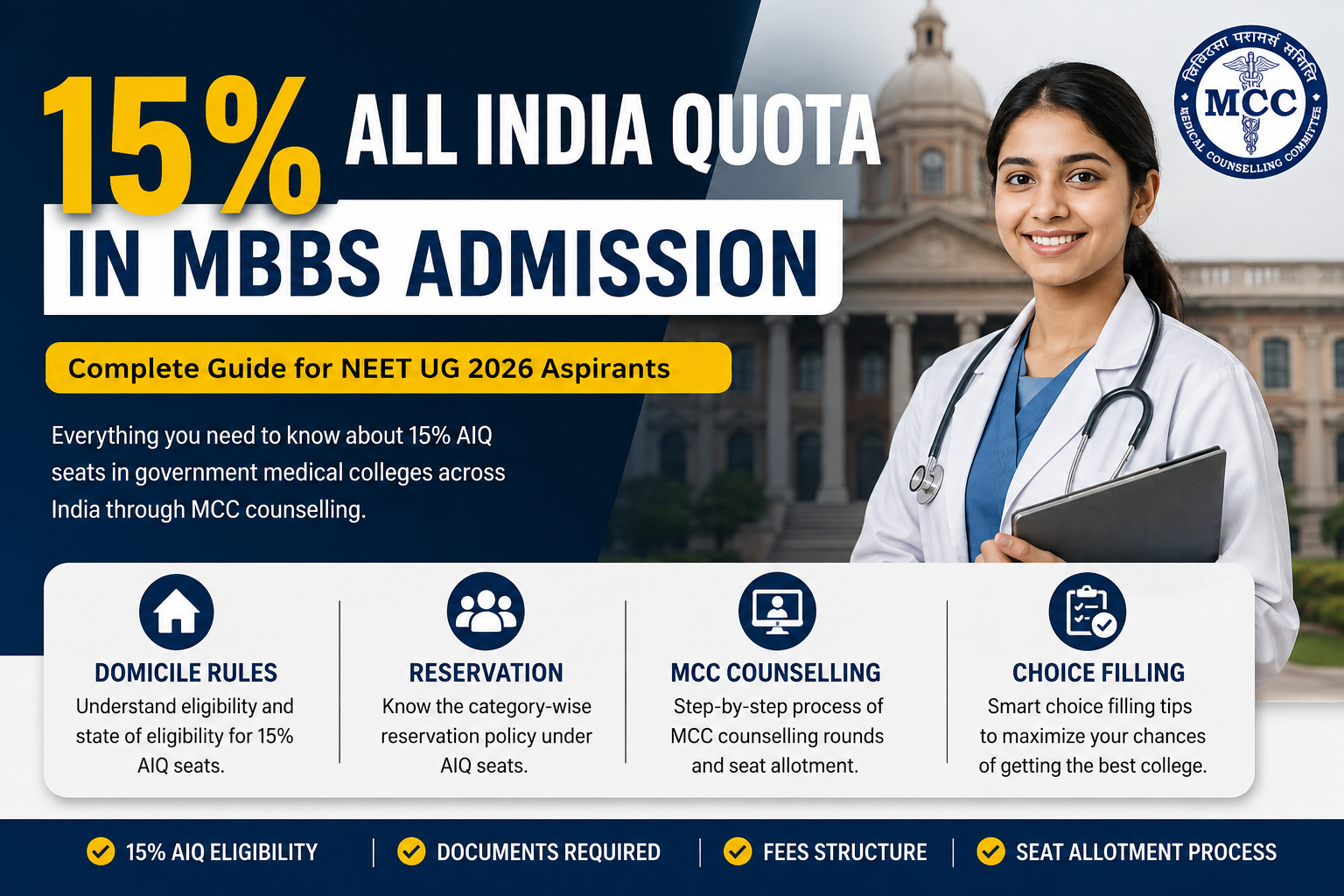
    Planning MBBS admission in India 2026 can feel complicated for both students and parents. Qualifying NEET UG is only the first step. After the NEET result, candidates must understand MCC counselling, state counselling, 15% All India Quota, state quota, MBBS cut-offs, government and private medical college fees, choice filling, documents, security deposits and college selection.

    The good news is that the admission process becomes much easier when it is planned systematically.

    For the 2026 admission session, NEET UG continues to be the common entrance examination for undergraduate medical education in India. The National Testing Agency has already made the NEET UG 2026 Score Card available on its official portal.

    Meanwhile, the Medical Counselling Committee’s UG portal is active for Session 2026. As of August 2026, MCC has published 2026-related notices, while its Candidate Activity Board indicates that further counselling activity will be updated. Students should therefore check the official MCC portal regularly instead of relying on unofficial counselling dates.

    This MBBS Admission in India 2026 guide by EducationMESD explains the complete process step by step so that students and parents can make informed, realistic and financially responsible decisions.


    MBBS Admission in India 2026: Latest Update

    Students preparing for MBBS counselling should know these important points:

    • NEET UG 2026 scorecards are available through the official NTA NEET portal.
    • NEET UG is the common entrance test for undergraduate medical education in India.
    • MCC’s portal is operating under Admission and eCounselling Services for Session 2026.
    • MCC handles counselling for 15% All India Quota MBBS/BDS seats and several other specified institutions and seat categories.
    • State counselling authorities conduct counselling for medical seats falling under their respective jurisdiction.
    • Candidates should monitor official MCC and state counselling websites for registration dates, seat matrices and round-wise schedules.

    The NTA confirms that NEET UG 2026 serves as the common and uniform entrance examination for admission to undergraduate medical education in medical institutions.


    MBBS Admission in India 2026: Quick Overview

    ParticularDetails
    CourseBachelor of Medicine and Bachelor of Surgery
    Common NameMBBS
    Entrance ExaminationNEET UG 2026
    NEET Conducting AuthorityNational Testing Agency
    National Counselling AuthorityMedical Counselling Committee
    State CounsellingRespective State/UT Authorities
    Admission BasisNEET Rank + Eligibility + Counselling
    Minimum AgeAs prescribed under NEET UG eligibility rules
    MBBS Academic StudyApproximately 4.5 years
    Compulsory Internship1 year
    Total Training PeriodApproximately 5.5 years
    Major Seat RoutesAIQ, State Quota, Private, Deemed, Central/Institutional, NRI where applicable
    Main Official SourcesNTA, MCC, NMC and State Counselling Authorities

    What Is MBBS Admission in India?

    MBBS admission in India is the process through which NEET-qualified candidates obtain seats in recognised medical colleges through central or state counselling.

    The basic admission journey is:

    NEET UG → Result → Rank Analysis → Counselling Registration → Choice Filling → Seat Allotment → Reporting → Document Verification → Fee Payment → Final Admission

    However, the actual process is more detailed because candidates may have access to different types of seats depending on their:

    • NEET rank
    • Category
    • State domicile
    • Reservation
    • Budget
    • College preference
    • Quota eligibility
    • Counselling route

    Therefore, preparing a proper MBBS counselling strategy after NEET 2026 is extremely important.


    Is NEET Compulsory for MBBS Admission in India 2026?

    Yes. NEET UG is mandatory for MBBS admission in India.

    The official NTA portal describes NEET UG 2026 as the common and uniform entrance test for admission to undergraduate medical education in medical institutions.

    Therefore, students should be cautious about anyone claiming to offer:

    • MBBS admission without NEET
    • Direct government MBBS admission
    • Guaranteed MBBS seat without counselling
    • Backdoor medical college admission
    • Management quota admission without NEET eligibility
    • Cash-based MBBS admission outside the official process

    A legitimate MBBS admission must follow the applicable NEET and counselling framework.


    MBBS Eligibility Criteria in India 2026

    Candidates planning MBBS admission in India 2026 must satisfy the eligibility conditions prescribed for NEET UG and the concerned counselling authority.

    Academic Qualification

    Candidates generally need to have completed the qualifying examination with the prescribed subjects, including:

    • Physics
    • Chemistry
    • Biology/Biotechnology
    • English

    Students who studied through foreign boards, additional subjects or non-standard academic pathways should verify their eligibility through official regulations before participating in counselling.


    Minimum Age for MBBS Admission

    Candidates must satisfy the minimum age requirement prescribed under the applicable NEET UG rules.

    Students and parents should check the current NEET UG Information Bulletin rather than relying on previous-year eligibility information.


    NEET Qualification

    Candidates must qualify NEET according to the applicable qualifying criteria.

    However, an important distinction exists between:

    NEET qualifying cut-off

    and

    MBBS admission cut-off.

    Qualifying NEET makes a candidate eligible to participate in the admission process subject to applicable conditions.

    It does not automatically guarantee an MBBS seat.


    NEET Qualifying Cut-Off vs MBBS Admission Cut-Off

    This is one of the most misunderstood areas of MBBS admission after NEET.

    NEET Qualifying Cut-Off

    The qualifying cut-off determines whether a student has qualified the examination according to the prescribed percentile or criteria.

    MBBS College Cut-Off

    The admission cut-off represents the rank or score at which admission closes for a particular:

    • Medical college
    • Category
    • Quota
    • State
    • Counselling round
    • Seat category

    For example, two medical colleges may have completely different closing ranks even within the same state.

    Therefore, students should analyse college-wise closing ranks instead of looking only at the NEET qualifying score.


    What NEET Score Is Required for MBBS Admission in 2026?

    There is no universal NEET score that guarantees an MBBS seat.

    The score or rank required depends on several factors:

    • NEET All India Rank
    • Category
    • State
    • Domicile
    • Number of available seats
    • Government or private college
    • All India Quota
    • State quota
    • Reservation
    • Counselling round
    • Candidate preferences
    • College popularity
    • Budget

    Therefore, instead of asking:

    “How many marks are required for MBBS admission?”

    Students should ask:

    “Which MBBS colleges are realistically available for my NEET rank, category, domicile and budget?”

    That question produces a much more useful counselling strategy.


    MBBS Admission Process in India 2026: Step-by-Step

    The following process explains how to get MBBS admission in India after NEET 2026.

    Step 1: Qualify NEET UG 2026

    Candidates must appear for NEET UG and satisfy the applicable qualifying criteria.

    NTA has made the NEET UG 2026 Score Card available on the official portal.


    Step 2: Download the NEET UG 2026 Scorecard

    After obtaining the result, check:

    • Candidate name
    • NEET score
    • All India Rank
    • Category details
    • Qualifying status
    • Other candidate information

    Keep digital and printed copies safely.


    Step 3: Analyse Your NEET Rank

    Do not base your entire admission strategy only on NEET marks.

    For counselling, analyse:

    NEET Rank + Category + Domicile + Quota + Budget + Previous Cut-Offs

    Rank-based analysis is particularly helpful when comparing previous counselling trends.


    Step 4: Identify All Eligible Counselling Options

    Depending on eligibility, candidates may consider:

    • MCC counselling
    • 15% All India Quota
    • State counselling
    • Government medical colleges
    • Private medical colleges
    • Deemed Universities
    • Central institutions
    • NRI quota where applicable
    • Minority quota where applicable
    • Institutional quota where applicable

    Missing a counselling registration deadline can eliminate an entire group of medical colleges from consideration.


    Step 5: Prepare a Medical College Shortlist

    Before choice filling, create a structured college list.

    Include:

    • College name
    • State
    • Government/private/deemed status
    • Previous closing rank
    • Tuition fee
    • Hostel fee
    • Other charges
    • Bond
    • Attached teaching hospital
    • Patient exposure
    • Location
    • Seat category
    • College preference

    This helps prevent random decision-making during counselling.


    Step 6: Register for MCC and State Counselling

    Students should register only through official counselling portals.

    Do not rely solely on links circulated through:

    • WhatsApp
    • Telegram
    • Facebook
    • Instagram
    • YouTube
    • Unverified admission portals

    Always confirm important notices through MCC or the concerned state authority.


    Step 7: Pay Counselling Registration and Security Fees

    Depending on the counselling authority and seat type, candidates may need to pay:

    • Registration fee
    • Counselling fee
    • Refundable security deposit
    • Other prescribed fees

    Before making payment, understand:

    • Refund rules
    • Forfeiture rules
    • Non-reporting consequences
    • Resignation rules
    • Round-wise conditions

    Step 8: Complete Choice Filling

    Choice filling is one of the most important stages of NEET UG counselling 2026.

    Candidates must select and arrange medical colleges according to their genuine preference.

    Do not randomly copy another candidate’s choice list.

    Every student’s:

    • Rank
    • Category
    • Budget
    • Location preference
    • Domicile
    • Career priorities

    can be different.


    Step 9: Lock Your Choices

    Candidates should complete choice locking according to the instructions and deadline issued by the counselling authority.

    Before locking, review:

    • College order
    • Fee structure
    • Seat type
    • Location
    • Bond conditions
    • Eligibility

    Step 10: Check Seat Allotment Result

    Seat allotment is influenced by factors such as:

    NEET Rank + Reservation + Quota + Available Seats + Choice Order + Counselling Rules

    Candidates should download the official allotment letter if a seat is allocated.


    Step 11: Understand Joining and Upgradation Rules

    Depending on the counselling round, candidates may have options regarding:

    • Joining
    • Upgradation
    • Resignation
    • Further round participation
    • Exit

    These rules can change between rounds.

    Always check the current counselling scheme before making a decision.


    Step 12: Report to the Allotted Medical College

    After accepting an allotment, candidates generally need to complete:

    • Physical reporting
    • Original document verification
    • Fee payment
    • Medical examination where required
    • Admission formalities

    Missing the reporting deadline can have serious consequences.


    Who Conducts MBBS Counselling in India?

    There are two major counselling routes.

    1. MCC Counselling

    The Medical Counselling Committee conducts counselling for specified medical seats under its jurisdiction.

    MCC states that DGHS has responsibility for online counselling for 15% All India Quota undergraduate seats. Its UG responsibilities also include specified seats in institutions such as AIIMS, BHU, JIPMER, AMU and other categories described by MCC.


    2. State NEET Counselling

    The respective state or UT counselling authorities handle medical seats falling under their jurisdiction.

    These can include:

    • State government quota seats
    • State government medical colleges
    • Private medical college seats
    • Management quota seats where applicable
    • NRI seats where applicable
    • Minority seats where applicable

    The exact rules differ between states.


    What Is 15% All India Quota in MBBS Admission?

    The 15% All India Quota, commonly called AIQ, allows eligible candidates to compete for specified medical seats through national counselling.

    MCC confirms that it conducts online counselling for 15% AIQ MBBS/BDS seats of states under its jurisdiction.

    AIQ is important because it allows students to consider medical colleges beyond their home state’s regular state quota.

    For many candidates, AIQ should be an important part of their MBBS admission strategy in India.


    What Is 85% State Quota in MBBS Admission?

    Government medical college seats outside the 15% AIQ pool are commonly referred to as the 85% State Quota, subject to applicable state and institutional rules.

    Eligibility can depend on:

    • Domicile
    • Residence
    • Schooling
    • Category
    • Reservation
    • Local status
    • State-specific regulations

    Students should not assume that domicile rules are identical across India.

    Always verify the concerned state’s counselling rules.


    MCC Counselling vs State Counselling: Which Is Better?

    For most eligible students, the better question is not:

    “Should I participate in MCC or state counselling?”

    Instead, ask:

    “Which counselling processes am I eligible for, and how can I use them strategically?”

    Eligible candidates may benefit from participating in both.

    MCC Counselling Can Provide Access To

    • 15% AIQ seats
    • AIIMS seats
    • JIPMER seats
    • BHU and other applicable central institutions
    • Deemed University seats
    • Certain institutional categories

    MCC’s stated undergraduate counselling responsibilities include 15% AIQ seats as well as 100% MBBS seats of AIIMS and specified central institutions.

    State Counselling Can Provide Access To

    • State government quota
    • State government colleges
    • Private medical colleges
    • Management quota where applicable
    • NRI quota where applicable
    • Minority quota where applicable

    Government MBBS Admission in India 2026

    Government medical colleges remain highly sought after because their tuition fees are generally much lower than most private medical colleges.

    However, competition can be intense.

    Government MBBS admission depends on:

    • NEET rank
    • Category
    • AIQ or state quota
    • Reservation
    • College preference
    • Seat availability
    • Counselling round

    Students targeting a government seat should prepare a broad preference list rather than restricting themselves to only a few famous colleges.


    Private Medical College Admission in India 2026

    Private MBBS admission through NEET can be an important option for candidates who do not obtain a preferred government seat.

    However, private medical colleges vary significantly in terms of:

    • Fees
    • Patient load
    • Infrastructure
    • Clinical exposure
    • Hostel quality
    • Teaching hospitals
    • Location
    • Reputation

    Before selecting a private medical college, verify:

    1. College status
    2. Tuition fee
    3. Hostel charges
    4. Additional charges
    5. Attached hospital
    6. Patient exposure
    7. Internship environment
    8. Bond conditions
    9. Location
    10. Total financial commitment

    Never choose a medical college based only on advertisements.


    Deemed University MBBS Admission 2026

    Deemed University MBBS seats falling under MCC’s counselling framework are another option for NEET-qualified candidates.

    MCC identifies Deemed Universities among the institutions for which it conducts counselling.

    Fees can be considerably higher than government medical colleges.

    Therefore, parents should calculate the complete MBBS cost before including Deemed Universities in the choice list.


    Government vs Private Medical Colleges

    Students frequently search for government vs private medical colleges in India.

    The correct choice depends on the individual institution.

    ParameterGovernment Medical CollegePrivate Medical College
    Tuition FeesUsually lowerUsually higher
    CompetitionUsually very highVaries
    NEET RankOften more competitiveVaries
    Patient ExposureOften highInstitution-specific
    InfrastructureInstitution-specificInstitution-specific
    Teaching HospitalUsually availableMust be evaluated
    HostelCollege-specificCollege-specific
    AdmissionNEET + CounsellingNEET + Counselling

    The ownership type alone should not determine your decision.

    Clinical training quality should be a major consideration.


    MBBS Fees in India 2026

    MBBS fees in India can differ dramatically between government, private and deemed medical colleges.

    Parents should calculate the total educational cost rather than only the first-year tuition fee.

    Calculate These Expenses

    • Tuition fees
    • Admission fees
    • University fees
    • Hostel fees
    • Mess charges
    • Security deposit
    • Examination charges
    • Books
    • Equipment
    • Travel
    • Living expenses
    • Miscellaneous institutional charges
    • Bond liabilities where applicable

    Before joining any medical college, request the official fee structure.

    Avoid making major financial decisions based only on verbal assurances.


    How Much Does MBBS Cost in India?

    There is no single answer because costs differ substantially depending on:

    • Government vs private college
    • State
    • Seat category
    • University
    • Hostel
    • NRI quota
    • Deemed University
    • Additional institutional charges

    For this reason, families should determine a maximum affordable MBBS budget before choice filling begins.

    Do not wait until a seat is allotted to begin financial planning.


    Documents Required for MBBS Admission 2026

    Document requirements vary depending on the counselling authority and candidate category.

    Students should generally prepare:

    1. NEET UG 2026 Admit Card
    2. NEET UG 2026 Scorecard
    3. Class 10 Marksheet
    4. Class 10 Certificate
    5. Class 12 Marksheet
    6. Class 12 Certificate
    7. Valid Photo ID
    8. Passport-size photographs
    9. Category certificate if applicable
    10. SC/ST certificate if applicable
    11. OBC-NCL certificate if applicable
    12. EWS certificate if applicable
    13. Domicile certificate where applicable
    14. Residence certificate where applicable
    15. PwBD documents where applicable
    16. Counselling registration proof
    17. Payment receipt
    18. Allotment letter
    19. Migration certificate where required
    20. Transfer certificate where required
    21. Character certificate where required
    22. NRI documents where applicable

    Smart Document Preparation

    Keep:

    • Original documents
    • Several photocopy sets
    • Scanned PDF copies
    • Cloud backup
    • Pen-drive backup

    Do not wait until reporting day to organise documents.


    How to Select the Best Medical College After NEET 2026

    A medical college should not be selected only on the basis of its previous cut-off.

    Evaluate these factors.

    1. Recognition and Regulatory Status

    Verify the college and its current status using official sources.


    2. Teaching Hospital

    The attached teaching hospital is critical to medical education.

    Evaluate:

    • OPD
    • Inpatient departments
    • Emergency
    • ICU
    • Surgery
    • Medicine
    • Obstetrics
    • Paediatrics
    • Other clinical departments

    3. Patient Load

    Strong patient exposure gives students opportunities to observe diverse clinical conditions.

    A beautiful campus cannot replace meaningful clinical exposure.


    4. Clinical Training

    Evaluate how early and effectively students are exposed to:

    • Patient interaction
    • History taking
    • Clinical examination
    • Case discussion
    • Hospital procedures
    • Internship responsibilities

    5. Faculty

    Faculty availability and department stability matter.


    6. Infrastructure

    Check:

    • Laboratories
    • Library
    • Lecture halls
    • Dissection facilities
    • Skills laboratory
    • Simulation facilities
    • Hospital infrastructure
    • Hostel

    7. MBBS Fees

    Check the complete fee structure.

    A difference of several lakh rupees per year can become substantial over the duration of the programme.


    8. Bond Conditions

    Check:

    • Service bond
    • Bond period
    • Penalty
    • Discontinuation conditions

    before accepting the seat.


    9. Location

    Consider:

    • Distance from home
    • Flight/rail connectivity
    • Language
    • Climate
    • Safety
    • Living expenses

    10. Internship Exposure

    The internship is an important stage of clinical training.

    Evaluate whether interns receive sufficient practical exposure at the attached hospital.


    NEET Choice Filling Strategy 2026

    Choice filling can directly influence MBBS seat allotment.

    A good list should generally contain:

    Dream Colleges

    Highly preferred colleges with more competitive historical closing ranks.

    Target Colleges

    Colleges whose previous trends are relatively close to your rank.

    Safe Colleges

    Acceptable options where your rank appears comparatively stronger based on past trends.

    However, the final order should reflect genuine preference.


    Golden Rule of NEET Choice Filling

    Ask:

    “If I were allotted every college on this list, which one would I actually choose?”

    Put that college higher.

    Do not arrange colleges only by:

    • Previous cut-off
    • Reputation
    • Someone else’s list
    • Coaching institute prediction

    Evaluate your personal preferences.


    How to Predict MBBS College From NEET Rank

    A useful NEET college prediction requires more than marks.

    Use this formula:

    NEET Rank + Category + State + Domicile + Quota + Previous Cut-Off + Budget + Counselling Round = Realistic College Possibilities

    Previous closing ranks can help create:

    • Dream choices
    • Target choices
    • Safe choices

    However, previous-year cut-offs should be treated as indicators, not guarantees.


    Why MBBS Cut-Offs Change Every Year

    Medical college closing ranks may change due to:

    • Number of NEET candidates
    • Examination performance
    • Number of MBBS seats
    • New medical colleges
    • Seat increases
    • Category distribution
    • Candidate preferences
    • State policies
    • Counselling rules
    • Round-wise vacancies

    Therefore, never assume that a college will close at exactly the same rank as last year.


    Can I Get MBBS With a Low NEET Score?

    Possibly, depending on the candidate’s complete profile.

    A score considered low for one seat category may create different opportunities under another eligible category.

    Analyse:

    • Rank
    • Category
    • State
    • Domicile
    • Budget
    • Private options
    • Deemed options
    • Eligible quotas
    • Round-wise vacancies

    Avoid making decisions from generic statements such as:

    “Below this score, MBBS is impossible.”

    Personalised rank analysis is more reliable.


    Can I Get Government MBBS With My NEET Rank?

    Government MBBS admission chances depend on:

    • All India Rank
    • Category
    • State domicile
    • AIQ
    • State quota
    • Previous closing ranks
    • Seat availability
    • Reservation

    Compare your rank with several years of college-wise closing ranks where reliable data is available.


    Can I Get Direct MBBS Admission Without NEET?

    No legitimate recognised MBBS admission route should be based on bypassing the prescribed NEET admission framework.

    Be cautious if anyone offers:

    • MBBS without NEET
    • Guaranteed government seat
    • Guaranteed admission through connections
    • Admission outside counselling
    • Cash-only seat
    • Fake allotment
    • Rank manipulation

    NTA has also published a notice concerning fake, altered or AI-generated NEET UG 2026 documents, highlighting the need to verify all documents through official channels.


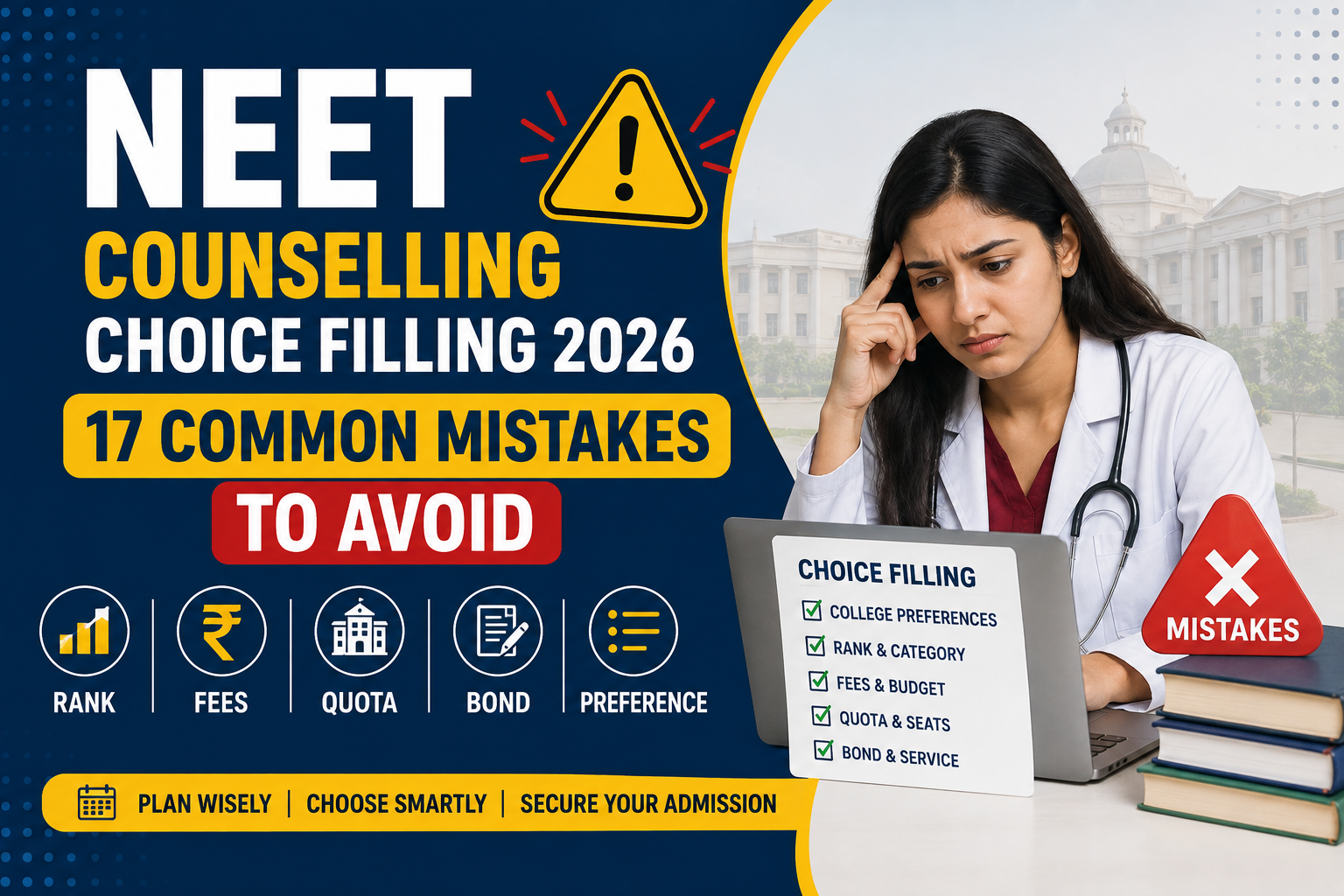
    Common NEET Counselling Mistakes to Avoid in 2026

    1. Missing Registration Deadlines

    Register early whenever possible.


    2. Depending on Unofficial Counselling Dates

    Use MCC and state counselling websites.


    3. Registering Only for One Counselling Route

    Explore every counselling process for which you are eligible.


    4. Incorrect Choice Order

    Arrange colleges according to genuine preference.


    5. Copying Another Student’s Choice List

    Your rank, budget and priorities may be different.


    6. Ignoring Private Colleges Until the Last Moment

    Research backup options before counselling begins.


    7. Ignoring Total MBBS Fees

    Check the complete programme cost.


    8. Not Checking Bond Conditions

    Service bonds can affect future plans.


    9. Depending Only on Last Year’s Cut-Off

    Use multiple years of data where appropriate.


    10. Missing Documents

    Prepare your document folder in advance.


    11. Ignoring Security Deposit Rules

    Understand refund and forfeiture conditions.


    12. Missing College Reporting Deadline

    Failure to report may lead to cancellation according to applicable rules.


    13. Selecting a College Only by Brand Name

    Check clinical exposure and hospital quality.


    14. Selecting a College Only by Infrastructure

    A modern campus does not automatically mean better medical training.


    15. Paying an Agent for a Guaranteed Seat

    Seat allotment should follow the official counselling process.


    MBBS Admission Strategy Based on NEET Rank

    A practical counselling strategy should vary according to the competitiveness of the candidate’s rank.

    Strong Competitive Rank

    Consider:

    • Top government medical colleges
    • AIIMS
    • Strong AIQ preferences
    • Leading state medical colleges

    Moderate Competitive Rank

    Consider:

    • Wider AIQ list
    • State government colleges
    • Less competitive locations
    • Private colleges as backup

    Borderline Government MBBS Rank

    Consider:

    • Extensive state counselling
    • Broad choice filling
    • Multiple rounds
    • Private options within budget
    • Deemed Universities where financially practical

    Rank Unlikely for Government MBBS

    Analyse:

    • Private medical colleges
    • Deemed Universities
    • NRI options if genuinely eligible
    • Other suitable healthcare programmes if MBBS is financially impractical

    Do not allow emotional pressure to create an unsustainable financial decision.


    MBBS Admission Financial Planning for Parents

    For parents, MBBS admission in India 2026 is both an academic and financial decision.

    Before counselling, calculate:

    Total Tuition Fee

    Hostel & Mess

    University Charges

    Books & Equipment

    Travel

    Living Costs

    Other Charges

    Potential Bond Liability

    Ask:

    “Can we comfortably fund the entire MBBS programme?”

    Do not ask only:

    “Can we pay the first-year fee?”


    Role of Parents During NEET Counselling

    Parents can support students by:

    • Monitoring deadlines
    • Organising documents
    • Checking college fees
    • Comparing colleges
    • Planning finances
    • Reviewing bond conditions
    • Verifying information
    • Evaluating hostel and location
    • Preventing panic-driven decisions

    However, students should also participate actively in the final choice because they will spend several years studying at the institution.


    MBBS Admission Checklist 2026

    Before accepting an MBBS seat, confirm:

    ✅ NEET UG qualification
    ✅ Correct NEET rank
    ✅ Candidate category
    ✅ Domicile eligibility
    ✅ AIQ eligibility
    ✅ State counselling eligibility
    ✅ Counselling registration
    ✅ Choice list
    ✅ Allotment letter
    ✅ College status
    ✅ Seat category
    ✅ Tuition fees
    ✅ Hostel fees
    ✅ Additional charges
    ✅ Security deposit
    ✅ Refund rules
    ✅ Bond conditions
    ✅ Teaching hospital
    ✅ Patient load
    ✅ Clinical exposure
    ✅ Internship environment
    ✅ Required documents
    ✅ Reporting deadline


    Best MBBS Counselling Strategy for 2026

    A strong counselling plan can be summarised as:

    1. Analyse Your Rank

    Use rank rather than marks alone.

    2. Determine Eligibility

    Identify AIQ, state and other eligible routes.

    3. Set Your Budget

    Decide the maximum affordable amount before counselling.

    4. Research Colleges

    Compare cut-offs, fees, hospitals and locations.

    5. Prepare a Broad Choice List

    Include dream, target and safe options.

    6. Arrange Colleges by Genuine Preference

    Do not blindly follow cut-offs.

    7. Monitor Every Counselling Round

    Seat movement can create new opportunities.

    8. Verify Before Paying

    Use official sources for major financial and admission decisions.


    Frequently Asked Questions About MBBS Admission in India 2026

    1. How can I get MBBS admission in India in 2026?

    To get MBBS admission in India 2026, candidates must satisfy the applicable eligibility requirements, qualify NEET UG 2026, participate in MCC and/or state counselling, fill college choices, obtain a seat allotment and complete the admission formalities.


    2. Is NEET compulsory for MBBS admission in 2026?

    Yes. NEET UG is the common entrance examination for undergraduate medical admission in India.


    3. Has the NEET UG 2026 result been declared?

    Yes. NTA’s official NEET UG portal currently provides access to the NEET UG 2026 Score Card.


    4. Has MCC counselling 2026 started?

    The MCC portal is active for Session 2026 and has published 2026-related UG notices. At the time of this update, the Candidate Activity Board indicates that further activity will be updated. Candidates should monitor the official MCC website for the latest registration and schedule announcements.


    5. Who conducts 15% AIQ MBBS counselling?

    The Medical Counselling Committee conducts online counselling for the 15% All India Quota undergraduate seats under its jurisdiction.


    6. Who conducts state quota MBBS counselling?

    The designated counselling authority of the respective state or UT conducts counselling for seats falling under its jurisdiction.


    7. Can I participate in both MCC and state counselling?

    Eligible students may participate in multiple counselling processes for which they satisfy the applicable requirements, subject to current counselling rules.


    8. Is qualifying NEET enough for MBBS admission?

    No. Qualifying NEET does not guarantee an MBBS seat. Actual admission depends on rank, category, quota, seat availability and choice filling.


    9. Can I get MBBS without NEET?

    Recognised MBBS admission in India must follow the prescribed NEET-based admission framework.


    10. What rank is required for a government MBBS college?

    There is no single rank applicable to all government colleges. Closing ranks differ by college, state, category, quota and counselling round.


    11. What is the 15% All India Quota?

    The 15% AIQ is a national counselling pool for specified undergraduate medical seats handled by MCC under its jurisdiction.


    12. What is the 85% state quota?

    The remaining government seats outside the AIQ pool are commonly handled through state counselling, subject to applicable state and institutional rules.


    13. Is a private medical college good for MBBS?

    A private medical college can be a suitable option if it provides appropriate clinical exposure, teaching quality, infrastructure and affordability. Evaluate the individual institution rather than ownership alone.


    14. How should I choose an MBBS college?

    Compare:

    • Clinical exposure
    • Teaching hospital
    • Patient load
    • Fees
    • Faculty
    • Infrastructure
    • Location
    • Hostel
    • Internship
    • Bond requirements

    15. How should I prepare my NEET choice list?

    Create dream, target and safe options, but arrange them according to genuine preference.


    16. Can MBBS cut-offs decrease in later rounds?

    Closing ranks can change between rounds depending on vacancies and candidate movement. Previous trends do not guarantee future results.


    17. What documents are needed for MBBS counselling?

    Common documents include the NEET scorecard, admit card, Class 10 and 12 certificates, identity proof, photographs and applicable category, domicile or quota documents.


    18. Which is better: AIQ or state counselling?

    Neither is universally better. Eligible candidates should evaluate both based on rank, domicile, category, college preference and seat availability.


    19. Should I choose government or private MBBS?

    Government colleges are generally more affordable, while private colleges can expand available options. Compare the individual college’s hospital, patient exposure, fees and academic environment.


    20. Where can I check official MBBS counselling updates?

    Candidates should use:

    • NTA NEET
    • Medical Counselling Committee
    • National Medical Commission
    • Respective state counselling authority
    • Official college/university websites

    MBBS Admission in India 2026: Final Advice

    MBBS admission in India 2026 is not just about getting a good NEET score.

    A successful admission strategy depends on:

    NEET Rank + Category + Domicile + Quota + Budget + College Research + Choice Filling + Counselling Decisions

    Students with similar ranks can receive very different outcomes because their counselling strategies are different.

    Therefore, students and parents should begin counselling preparation early.

    Do not make an important medical education decision based only on:

    • Social media predictions
    • WhatsApp messages
    • YouTube videos
    • Unverified agents
    • Previous-year cut-offs
    • College advertisements

    Verify important information through official sources and compare every option carefully.


    Need Help With MBBS Admission 2026?

    Choosing the right medical college requires analysing hundreds of combinations involving NEET rank, category, quota, domicile, fees, previous cut-offs and college preferences.

    EducationMESD helps students and parents understand their available options and prepare a structured medical admission strategy.

    EducationMESD Guidance Includes

    • NEET 2026 Rank Analysis
    • MBBS College Shortlisting
    • 15% All India Quota Guidance
    • State Counselling Guidance
    • Government Medical College Options
    • Private Medical College Options
    • Deemed University Options
    • MBBS Fee Comparison
    • Choice Filling Strategy
    • College Comparison
    • Counselling Documentation
    • Admission Planning

    Make Your MBBS Decision With Better Information

    Right Rank Analysis. Right College Choices. Right Counselling Strategy.

    EducationMESD – Your Trusted Guide for Medical Education and MBBS Admission Planning.


    Disclaimer

    Medical admission regulations, counselling schedules, eligibility requirements, seat matrices, fees, reservation rules, cut-offs, bonds and reporting requirements may change through official notifications.

    Students and parents should always verify the latest information from NTA, MCC, NMC, the concerned state counselling authority and the respective medical college before taking any admission or financial decision.

  • NEET Counselling Security Deposit, Registration Fee and Refund Rules 2026

    NEET Counselling Security Deposit, Registration Fee and Refund Rules 2026

    The NEET counselling security deposit is one of the most important financial components of the MBBS and BDS admission process. While registering for MCC counselling, candidates must pay a non-refundable registration fee and a refundable security deposit.

    However, the word “refundable” often creates confusion. The security deposit is not returned immediately after a counselling round, and it may be forfeited if a candidate does not join a seat allotted in Round 2 or a subsequent round.

    For Deemed University candidates, the financial risk is even higher because the refundable security deposit is ₹2 lakh. Therefore, every candidate must understand the MCC registration fee, round-wise exit rules, forfeiture conditions and refund timeline before filling college choices.

    The Medical Counselling Committee has released the NEET UG Counselling 2026 Information Bulletin dated August 1, 2026, which contains the applicable registration-fee and refund provisions.

    Quick Answer: Is the NEET Counselling Security Deposit Refundable?

    Yes, the NEET counselling security deposit is refundable, provided the candidate does not trigger a forfeiture condition.

    The deposit is generally refunded after all MCC counselling rounds are completed. However, it may be forfeited when a candidate:

    • Receives a seat in Round 2 or a subsequent round but does not join;
    • Resigns from a seat under a forfeiture provision;
    • Fails to report after Round 3 allotment;
    • Provides incorrect registration information;
    • Fails to produce mandatory admission documents;
    • Has the allotted admission cancelled.

    MCC states that the security deposit will be forfeited if a candidate is allotted a seat in the second or a subsequent round and does not join the institution. It may also be forfeited if admission is cancelled because of incorrect information or failure to produce required documents.


    What Is the NEET Counselling Security Deposit?

    The NEET counselling security deposit is an amount collected during MCC registration to ensure that candidates participate responsibly in the seat-allotment process.

    It helps discourage candidates from:

    • Blocking medical or dental seats without intending to join;
    • Filling unwanted colleges casually;
    • Leaving allotted seats after later counselling rounds;
    • Creating avoidable vacancies after seat allotment.

    The amount is called refundable because eligible candidates can receive it back after counselling. Nevertheless, the refund depends on the candidate’s actions during the various counselling rounds.

    The deposit is different from the registration fee, college tuition fee, hostel fee, university fee or institutional caution money.


    NEET Counselling Registration Fee vs Security Deposit

    Candidates must pay two separate components while completing MCC counselling registration.

    Payment componentNatureIs it refundable?
    Registration feeCounselling participation and administrative feeNo
    Security depositDeposit linked to responsible participation and joining rulesYes, subject to refund eligibility
    College tuition feeFee charged by the allotted institutionGoverned by the college
    Hostel and other chargesInstitutional expensesGoverned by the college

    1. Non-refundable registration fee

    The registration fee is charged for participating in MCC NEET UG counselling.

    Once a candidate successfully completes registration, the fee is treated as payment for the counselling service. It is not returned even if:

    • No seat is allotted;
    • The candidate does not fill choices;
    • The candidate stops participating;
    • The candidate receives the security-deposit refund;
    • The candidate chooses another admission route.

    The MCC bulletin identifies the registration component as a non-refundable registration fee.

    2. Refundable security deposit

    The security deposit can be refunded when the candidate remains eligible under the MCC refund policy.

    It is not normally refunded immediately after Round 1, Round 2 or Round 3. MCC processes eligible refunds only after all counselling rounds are completed and the refund list is published.


    MCC NEET Counselling Fees 2026

    The MCC fee depends on whether a candidate is applying for:

    1. AIQ, Central institutions, AIIMS, JIPMER and other applicable government-sector seats; or
    2. Deemed University seats.

    MCC registration fee for AIQ and government-sector seats

    The following fee structure applies to counselling for categories including:

    • 15% All India Quota;
    • Central universities;
    • AIIMS;
    • JIPMER;
    • AFMC registration;
    • ESIC seats;
    • Applicable B.Sc. Nursing seats.
    Candidate categoryNon-refundable registration feeRefundable security depositTotal payable
    UR/General₹1,000₹10,000₹11,000
    EWS₹1,000₹10,000₹11,000
    SC₹500₹5,000₹5,500
    ST₹500₹5,000₹5,500
    OBC₹500₹5,000₹5,500
    PwD₹500₹5,000₹5,500

    Therefore:

    • A UR or EWS candidate pays a total of ₹11,000;
    • An SC, ST, OBC or PwD candidate pays a total of ₹5,500.

    These amounts consist of both the non-refundable registration fee and the refundable security deposit.


    Deemed University NEET counselling fee 2026

    Candidates planning to include Deemed University MBBS, BDS or other eligible seats must pay the higher Deemed University amount.

    Payment componentAmount
    Non-refundable registration fee₹5,000
    Refundable security deposit₹2,00,000
    Total payable₹2,05,000

    The ₹5,000 registration fee applies to all candidates registering for Deemed University counselling, irrespective of category. The refundable security amount is ₹2 lakh.

    Is the ₹2 lakh Deemed University deposit refundable?

    Yes. The ₹2 lakh deposit is refundable when the candidate:

    • Does not trigger a forfeiture condition;
    • Remains eligible under the MCC refund policy;
    • Is included in the eligible-refund list;
    • Keeps the original payment account active.

    However, the entire ₹2 lakh may be forfeited if a candidate receives a Deemed University seat in Round 2 or a subsequent round and does not join it.


    Is the ₹2 lakh security deposit the Deemed University tuition fee?

    No. The ₹2 lakh MCC security deposit should not be confused with the college’s annual MBBS or BDS fee.

    After seat allotment, the candidate may separately have to pay:

    • Annual tuition fee;
    • Hostel and mess charges;
    • University registration fee;
    • Examination fee;
    • Institutional caution money;
    • Miscellaneous charges;
    • NRI fee, where applicable.

    MCC advises candidates to verify the fee structure, bond, stipend and other institutional conditions directly with the concerned college before filling choices. The committee does not accept responsibility for college-specific fee disputes or errors in information supplied by institutions.


    Do candidates pay separate fees for government and Deemed University choices?

    No. A candidate who wants to fill both government-sector and Deemed University choices pays only the higher applicable amount.

    The candidate must pay:

    • ₹5,000 as the non-refundable registration fee;
    • ₹2,00,000 as the refundable security deposit;
    • ₹2,05,000 as the total payment.

    After paying the higher amount, the candidate can fill eligible government, AIQ, Central institution and Deemed University choices.


    NEET Counselling Security Deposit Refund Rules: Round-Wise Guide

    The most important factor affecting the refund is the counselling round in which the seat is allotted.

    MCC conducts four AIQ counselling rounds:

    1. Round 1;
    2. Round 2;
    3. Round 3;
    4. Stray Vacancy Round.

    Upgradation is available up to Round 3, but candidates cannot resign after joining a Round 3 seat.

    Round-wise security deposit refund table

    Candidate’s situationSecurity-deposit result
    Registered but no seat allottedNormally refundable, subject to MCC eligibility
    Round 1 seat allotted but not joinedRefundable under free exit
    Round 1 seat retained for upgradationDeposit continues in counselling
    Round 2 seat allotted but not joinedForfeited
    Round 2 seat resigned under forfeiture rulesForfeited
    Round 3 seat allotted but not reportedForfeited
    Round 3 seat joinedResignation not permitted
    Stray Vacancy seat allotted but not joinedForfeited
    Admission cancelled because of incorrect informationForfeited
    Mandatory documents not producedMay result in cancellation and forfeiture
    Counselling completed without forfeitureRefundable, subject to the eligible list

    Round 1: Free exit without forfeiture

    Round 1 provides a free-exit facility.

    This means that if a candidate receives a seat in Round 1 but does not wish to join it, the candidate can leave the seat without losing the security deposit.

    The Round 1 free-exit provision gives candidates an opportunity to:

    • Participate in the next MCC round;
    • Consider a state-counselling seat;
    • Reassess college preferences;
    • Seek a better seat in Round 2.

    The official MCC 2026 counselling flow chart identifies Round 1 as a free-exit round.

    Round 1 refund example

    A General-category candidate pays:

    • Registration fee: ₹1,000;
    • Security deposit: ₹10,000;
    • Total: ₹11,000.

    The candidate receives a BDS seat in Round 1 but does not join it.

    In this situation:

    • The ₹1,000 registration fee remains non-refundable;
    • The ₹10,000 security deposit remains eligible for refund, provided no later forfeiture event occurs.

    Round 2: Non-joining results in forfeiture

    The Round 2 rules are significantly stricter.

    When a candidate is allotted a seat in Round 2 and does not join the respective institution, the security deposit is forfeited.

    The official bulletin defines “exit with forfeiture” as leaving a seat allotted in Round 2 or a subsequent round while losing the security deposit.

    Round 2 AIQ example

    A UR candidate pays ₹11,000 and is allotted an MBBS seat in Round 2 but fails to join.

    The likely financial effect is:

    • ₹1,000 registration fee: non-refundable;
    • ₹10,000 security deposit: forfeited.

    Round 2 Deemed University example

    A candidate pays ₹2,05,000 and receives an MBBS seat in a Deemed University during Round 2. After allotment, the family discovers that the annual tuition fee is unaffordable and decides not to join.

    The likely financial effect is:

    • ₹5,000 registration fee: non-refundable;
    • ₹2,00,000 security deposit: forfeited.

    This is why candidates must never include an unaffordable Deemed University merely to determine whether they can secure a seat.


    Round 2 resignation and security-deposit forfeiture

    Candidates who resign from a Round 2 seat must carefully follow the notified MCC resignation window and online procedure.

    The 2026 counselling bulletin allows resignation or surrender from Round 1 and Round 2 seats within the period prescribed by MCC. However, Round 2 exit is linked to forfeiture under the counselling scheme. Refund processing takes place only after all rounds are completed.

    Candidates should never leave a college informally or assume that non-attendance automatically completes the resignation process. Admissions and permitted resignations must be recorded through the prescribed online system.


    Round 3: Mandatory joining and no resignation

    Round 3 carries strict joining conditions.

    Candidates receiving a fresh allotment or an upgraded seat in Round 3 must physically report to the allotted institution.

    If a candidate does not join:

    • The security deposit is forfeited;
    • The candidate cannot participate in further MCC rounds;
    • The allotted seat is lost.

    After a candidate joins the Round 3 seat, resignation or surrender is not permitted.

    What happens to the previous Round 2 seat after upgradation?

    When a candidate receives an upgraded seat in Round 3, the earlier seat is no longer available to the candidate.

    Therefore, the Round 3 choice list must include only those colleges that the candidate genuinely prefers over the existing allotment.


    Stray Vacancy Round refund rules

    The Stray Vacancy Round is intended to fill seats that remain vacant after the earlier counselling rounds.

    Candidates should treat every Stray Vacancy choice as a firm willingness to join.

    When a candidate receives a seat in the Stray Vacancy Round but fails to join:

    • The security deposit is forfeited;
    • The candidate loses the allotted seat;
    • Further participation may be restricted under the counselling scheme.

    The MCC rule stating that non-joining after a second or subsequent round leads to forfeiture also applies to later rounds.


    What Does Exit with Forfeiture Mean?

    Exit with forfeiture means leaving an allotted seat while losing the security deposit paid during counselling registration.

    It applies when a candidate receives a seat in Round 2 or a later round but chooses not to join it.

    The possible financial loss is:

    Counselling categorySecurity amount that may be forfeited
    UR/EWS government-sector counselling₹10,000
    SC/ST/OBC/PwD government-sector counselling₹5,000
    Deemed University counselling₹2,00,000

    The registration fee is already non-refundable. Therefore, a Deemed University candidate may lose the entire ₹2,05,000 paid during registration if the seat is allotted under a forfeiture round and the candidate fails to join.


    When Is the MCC Security Deposit Refunded?

    The MCC security deposit refund is processed only after all counselling rounds are completed.

    MCC first publishes a notice confirming the completion of counselling and identifies candidates eligible for refund.

    The refund process generally follows this sequence:

    1. MCC completes all counselling rounds.
    2. MCC publishes the eligible-refund list.
    3. The Financial Custodian initiates eligible refunds.
    4. MCC publishes refund details and transaction information.
    5. The candidate’s bank credits the amount to the original account.

    According to the 2026 bulletin, the Financial Custodian initiates the refund within 15 working days and completes the security-deposit refund within 30 days of publication of the eligible list. The candidate’s bank may take an additional 2 to 15 days to reflect the credit.

    MCC security deposit refund timeline

    Refund stageExpected process
    Completion of counsellingMCC announces completion
    Eligible-refund listPublished on the MCC portal
    Refund initiationWithin 15 working days
    Refund completion by Financial CustodianWithin 30 days
    Bank-credit periodApproximately 2–15 additional days

    Candidates should not expect the security deposit to be refunded immediately after Round 1 or immediately after deciding to stop participating.


    Is a separate application required for the MCC refund?

    Normally, no.

    Candidates do not have to submit a separate refund request when they are eligible under the standard refund process.

    MCC publishes the eligible-candidate list after all counselling rounds are completed, and the Financial Custodian processes the refunds automatically.

    A candidate should contact the Financial Custodian when:

    • Their name appears in the eligible-refund list but the amount is not received;
    • MCC has published the refund details but the transaction fails;
    • A duplicate payment has been made;
    • The original payment account has become inactive;
    • There is a transaction-related discrepancy.

    Where Will the Security Deposit Be Refunded?

    The security deposit is returned only to the same bank account, debit card or credit card used to make the original payment.

    For example:

    • A payment made through net banking is refunded to the same bank account;
    • A payment made through a debit card is returned to the card-linked account;
    • A payment made through a parent’s account is returned to that parent’s account;
    • A candidate cannot ordinarily request transfer to a different account.

    MCC explicitly states that the security deposit is refunded only to the original payment source.

    Can the refund be transferred to another account?

    No. MCC does not ordinarily accept a request to transfer the refund to a different bank account or card.

    Candidates should therefore avoid making payment through:

    • An agent’s account;
    • A counselling centre’s card;
    • An unrelated person’s account;
    • A temporary bank account;
    • An account likely to be closed soon.

    The MCC bulletin advises candidates not to use an unrelated card or bank account for depositing the security amount.


    Keep the original payment account active

    Candidates must keep the original bank account or card active until the refund is completed.

    If the account is closed:

    • The bank may reject the refund;
    • The failed amount may take time to return to the Financial Custodian;
    • A manual refund may require additional documentation;
    • The refund may be substantially delayed.

    MCC and the Financial Custodian do not accept responsibility for delays caused by closure of the original payment account.


    Duplicate NEET Counselling Payment Refund Rules

    Some candidates accidentally pay the MCC registration fee more than once because of:

    • A delayed payment-gateway response;
    • Repeated transaction attempts;
    • Refreshing the payment page;
    • Payment confirmation not appearing immediately;
    • Using multiple payment methods.

    When duplicate payment is made for the same NEET roll number, the candidate can approach the Financial Custodian after 10 days from the closure of the registration window.

    The excess amount may be refunded within 30 days after the registration window closes. The Financial Custodian may deduct 50% of the registration fee or ₹500, whichever is lower, from each excess receipt as an administrative expense.

    Candidates should preserve:

    • MCC registration number;
    • NEET roll number;
    • Payment receipt;
    • Bank transaction number;
    • Bank or card statement;
    • Screenshot of the transaction status;
    • Registered email address.

    Should Candidates Raise a Bank Chargeback?

    No. Candidates should not raise a chargeback through the card-issuing bank for a normal MCC security-deposit refund.

    A chargeback can prevent MCC or the Financial Custodian from issuing the refund directly through the payment gateway.

    The candidate may then have to:

    1. Withdraw the chargeback;
    2. Obtain a no-objection certificate from the issuing bank;
    3. Submit additional supporting documents;
    4. Wait for manual refund processing.

    The MCC bulletin warns that this process may cause a substantial delay and advises candidates not to initiate a chargeback.


    Can the Fee Be Paid from an NRI Account?

    MCC states that the counselling registration fee and security deposit should not be remitted directly from an NRI account because the security deposit cannot be refunded to that account under the stated banking provisions.

    A candidate intending to use NRI funds should:

    1. Transfer the amount from the NRI account to an NRO account;
    2. Make the MCC payment from the NRO account;
    3. Keep the NRO account active for receiving the refund.

    The refund will then be credited to the same NRO account used for the payment.


    Are bank charges refundable?

    No. Any bank or payment-gateway charges incurred while registering for MCC counselling must be paid by the candidate.

    MCC notes that net-banking charges may be lower than card-payment charges.

    Does MCC pay interest on the security deposit?

    No. MCC does not pay interest on the refundable security deposit.

    Eligible candidates receive only the applicable security amount, without interest.


    Who Processes the MCC Security Deposit Refund?

    HLL Lifecare Limited, a Government of India undertaking under the Ministry of Health and Family Welfare, acts as the Financial Custodian for MCC.

    Its responsibilities include:

    • Collecting the non-refundable registration fee;
    • Collecting the refundable security deposit;
    • Processing refunds for eligible candidates;
    • Handling applicable payment and refund queries.

    The 2026 bulletin provides the following contact information:

    Refund-related email: financemcc@lifecarehll.com
    Other payment issues: callcentremcc@lifecarehll.com
    Helpline number: 1800 102 7637

    The Financial Custodian responds to messages sent through the email address registered with MCC. Candidates should contact it only after the waiting period specified in the bulletin.


    MCC Counselling Fee vs State Counselling Fee

    MCC counselling and state NEET counselling are separate admission processes.

    Paying the MCC registration fee does not automatically register a candidate for state counselling.

    MCC counsellingState counselling
    Conducted by the Medical Counselling CommitteeConducted by the respective state authority
    Covers 15% AIQ and specified participating institutionsPrimarily covers state-controlled seats
    Requires MCC registrationRequires separate state registration
    MCC fee and deposit rules applyState-specific fees apply
    MCC refund policy appliesState refund policy applies
    MCC choice filling is separateState choice filling is separate

    MCC conducts counselling for 15% AIQ seats, Deemed Universities, participating Central universities, AIIMS, JIPMER and other specified institutions.

    State registration fees, private-college deposits, management-quota deposits and refund conditions can vary. Candidates must read the official information bulletin issued by the relevant state authority.


    Common Reasons Candidates Lose the Security Deposit

    1. Filling unaffordable Deemed University choices

    A candidate may receive a Deemed University seat and later discover that the annual tuition and hostel fees exceed the family’s budget.

    When this happens after a Round 2 or later allotment, refusal to join may cost the candidate the ₹2 lakh security deposit.

    2. Treating Round 2 like Round 1

    Round 1 offers free exit. Round 2 does not offer the same protection.

    Candidates must understand this difference before submitting fresh choices for Round 2.

    3. Adding unwanted colleges to the choice list

    Every choice should represent a college that the candidate is genuinely willing to join.

    Adding unwanted colleges only to increase the number of choices can lead to an allotment the candidate does not want.

    4. Missing the reporting deadline

    Failure to complete reporting within the notified schedule can be treated as non-joining and may result in forfeiture.

    5. Not arranging mandatory documents

    A seat may be cancelled if the candidate cannot produce valid original documents or if the submitted details do not match the admission claim.

    6. Providing incorrect category information

    A mismatch in category, eligibility, nationality, domicile or certificate details may affect admission and refund eligibility.

    7. Using an unrelated bank account

    The refund returns to the original payment account. Using an agent’s or unrelated person’s account can create serious difficulties.

    8. Closing the original account too early

    An inactive account can cause refund failure and delay manual processing.

    9. Raising a premature chargeback

    A chargeback can block the normal refund process.

    10. Ignoring MCC and state resignation deadlines

    Candidates participating in both MCC and state counselling must compare the resignation, reporting and joining deadlines carefully.


    How to Protect Your NEET Counselling Security Deposit

    Before locking any choice in Round 2, Round 3 or the Stray Vacancy Round, verify:

    • Total annual tuition fee;
    • Full-course financial commitment;
    • Hostel and mess charges;
    • Bond and compulsory-service conditions;
    • College location;
    • NMC recognition and course status;
    • Availability of original documents;
    • Category and eligibility requirements;
    • Reporting dates;
    • Resignation rules;
    • Willingness to join if allotted.

    Candidates should also save copies of:

    • MCC registration form;
    • Payment receipt;
    • Choice list;
    • Locked-choice confirmation;
    • Seat-allotment letter;
    • Admission or resignation acknowledgement;
    • Bank transaction statement.

    NEET Counselling Security Deposit: Practical Examples

    Example 1: No seat allotted

    A General candidate pays ₹11,000 but receives no seat during counselling.

    Provided no forfeiture condition applies and the candidate is included in the eligible-refund list:

    • ₹1,000 registration fee is not refunded;
    • ₹10,000 security deposit is refunded.

    Example 2: Round 1 seat not joined

    A reserved-category candidate pays ₹5,500 and receives a Round 1 seat but does not join.

    Under Round 1 free exit:

    • ₹500 registration fee remains non-refundable;
    • ₹5,000 security deposit remains eligible for refund.

    Example 3: Round 2 seat not joined

    A General candidate receives a Round 2 seat but does not report.

    The likely result is:

    • ₹1,000 registration fee remains non-refundable;
    • ₹10,000 security deposit is forfeited.

    Example 4: Deemed University Round 2 seat not joined

    A candidate pays ₹2,05,000 and receives a Deemed University MBBS seat in Round 2 but does not join.

    The likely result is:

    • ₹5,000 registration fee remains non-refundable;
    • ₹2,00,000 security deposit is forfeited.

    Example 5: Refund account closed

    A candidate is eligible for a refund but closes the bank account used for the MCC payment.

    The refund may fail, and the candidate may face a long manual-refund process involving additional verification.


    Frequently Asked Questions About NEET Counselling Refund Rules

    Is the NEET counselling registration fee refundable?

    No. The MCC registration fee is non-refundable. Only the security deposit can be returned to eligible candidates.

    Is the NEET counselling security deposit refundable?

    Yes. It is refundable when the candidate does not trigger a forfeiture condition and is included in the MCC eligible-refund list.

    Will I get a refund if no seat is allotted?

    Normally, the security deposit remains refundable when no seat is allotted, provided the candidate has not triggered any forfeiture condition. The registration fee is not refunded.

    Will I lose the deposit if I do not join a Round 1 seat?

    No. Round 1 provides free exit, allowing a candidate to leave the seat without security-deposit forfeiture.

    Will I lose the deposit if I do not join a Round 2 seat?

    Yes. Non-joining after Round 2 allotment leads to forfeiture of the security deposit.

    Can I resign from a Round 2 seat?

    Resignation may be allowed within the notified MCC period and prescribed process, but Round 2 exit is linked to forfeiture under the counselling scheme.

    Can I resign after joining a Round 3 seat?

    No. A candidate who joins a Round 3 seat cannot resign or surrender it under the MCC scheme.

    Is the ₹2 lakh Deemed University security deposit refundable?

    Yes, provided the candidate remains eligible and does not fail to join a seat allotted in a forfeiture round.

    When will the MCC security deposit refund be credited?

    Refunds begin after all counselling rounds are completed and MCC publishes the eligible list. The Financial Custodian initiates refunds within 15 working days and completes them within 30 days. The bank may take an additional 2 to 15 days to show the credit.

    Is a separate refund form required?

    Normally, no. MCC publishes the eligible list and the Financial Custodian processes refunds automatically.

    Can the refund be sent to another bank account?

    No. The refund is credited only to the original payment source.

    Can I pay the MCC security deposit using my parent’s account?

    Yes, but the refund will return to the same parent’s account. The account should remain active until the refund is completed.

    Is the MCC security deposit adjusted against the college fee?

    Candidates should not assume automatic adjustment. College tuition and admission charges must be paid according to the allotted institution’s instructions.

    Does MCC pay interest on the refundable deposit?

    No. No interest is paid on the security deposit.

    Is the MCC registration fee valid for state counselling?

    No. MCC and state counselling require separate registration. State-specific fees and deposits may apply.


    Final Advice for NEET UG 2026 Candidates

    Understanding the NEET counselling security deposit, registration fee and refund rules is essential before participating in MCC choice filling.

    The most important points are:

    • The MCC registration fee is non-refundable;
    • The security deposit is refundable only for eligible candidates;
    • Round 1 offers free exit;
    • Round 2 non-joining leads to forfeiture;
    • Round 3 allotment requires mandatory reporting;
    • Resignation is not permitted after joining a Round 3 seat;
    • The refund goes only to the original payment account;
    • Eligible refunds are processed after all counselling rounds are completed;
    • The Deemed University security deposit is ₹2 lakh.

    Candidates should treat every choice filled from Round 2 onwards as a genuine commitment to join the college if allotted.

    Careful choice filling can protect both the candidate’s medical-admission opportunity and the family’s money.


    EducationMESD NEET Counselling Guidance

    NEET counselling involves multiple quotas, thousands of college options, strict reporting deadlines and major differences in tuition fees.

    A single mistake in choice filling can affect:

    • MBBS or BDS seat allotment;
    • College affordability;
    • Eligibility for subsequent rounds;
    • The security-deposit refund;
    • Participation in MCC and state counselling.

    EducationMESD assists NEET candidates and parents with:

    • MCC and state counselling guidance;
    • Government, private and Deemed University comparison;
    • MBBS and BDS college shortlisting;
    • Choice-filling strategy;
    • Fee and budget analysis;
    • Document verification;
    • Round-wise admission planning;
    • College preference-list preparation.

    Disclaimer: This article is based on the MCC NEET UG Counselling 2026 Information Bulletin dated August 1, 2026. MCC or other counselling authorities may amend schedules, procedures or rules through subsequent notices. Candidates must verify the latest official MCC and state notifications before payment, choice filling, reporting, resignation or admission.

  • Government vs Private Medical Colleges in India: Fees, Facilities and Career Opportunities in 2026

    Government vs Private Medical Colleges in India: Fees, Facilities and Career Opportunities in 2026

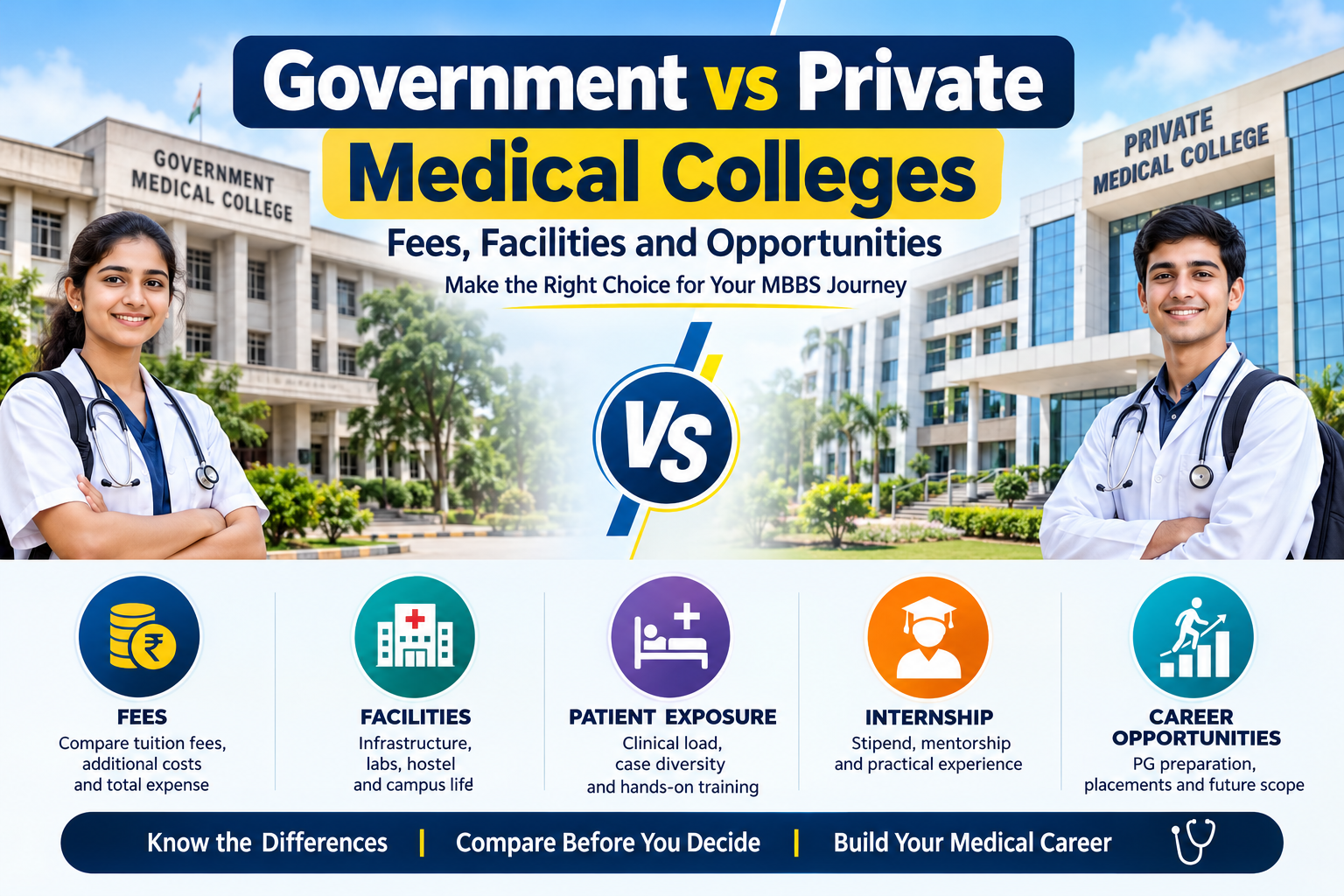
    Choosing between government vs private medical colleges is one of the most important decisions candidates must make during NEET UG counselling. The type of medical college you select can affect your total MBBS expenses, clinical exposure, internship experience, campus life and future career planning.

    Government medical colleges are usually preferred because of their comparatively affordable fees, established teaching hospitals and high patient inflow. Private medical colleges, on the other hand, may provide modern infrastructure, advanced laboratories, structured academic systems and better campus facilities.

    However, a government medical college is not automatically better than every private medical college. Similarly, an attractive private medical college campus does not necessarily guarantee excellent clinical training.

    Before filling and locking choices, candidates should compare:

    • MBBS tuition fees
    • Total course expenses
    • NMC recognition status
    • Teaching-hospital patient flow
    • Faculty availability
    • Clinical exposure
    • Internship stipend
    • Service bond
    • Hostel facilities
    • Location and safety
    • Post-MBBS opportunities

    This detailed guide explains the difference between government and private medical colleges in India and helps NEET UG 2026 candidates make a practical, informed and financially responsible decision.


    Government vs Private Medical Colleges: Quick Comparison

    Comparison factorGovernment medical collegesPrivate medical colleges
    MBBS tuition feesGenerally lower and subsidisedUsually considerably higher
    NEET UG competitionVery highDepends on college and seat category
    Required NEET rankUsually more competitiveWider range depending on quota
    Patient exposureOften high because of large patient inflowVaries according to the attached hospital
    Clinical case diversityUsually broadStrong in established teaching hospitals
    InfrastructureMay be older but functionalOften modern and well maintained
    Simulation laboratoriesAvailable in leading institutionsCommon in many established private colleges
    Hostel expensesUsually lowerGenerally higher
    Faculty experienceStrong in many established collegesVaries considerably between institutions
    Internship workloadOften intensiveDepends on hospital occupancy and patient flow
    Internship stipendGoverned by applicable institutional or state policyAmount and regularity may vary
    Service bondApplicable in several statesMay also apply according to state rules
    Research opportunitiesStrong in leading government institutionsGood in selected private and deemed universities
    Campus amenitiesUsually basic to moderateOften better developed
    Financial burdenComparatively lowerCan be substantial
    Career eligibilityRecognised MBBS graduates can pursue standard career pathwaysSame, subject to recognised qualification and applicable rules

    What Is a Government Medical College?

    A government medical college is established, funded or administered by the central government, a state government, a municipal authority or another government-controlled institution.

    Because a significant portion of the cost is publicly funded, MBBS tuition fees in government medical colleges are generally lower than fees in private medical colleges.

    Government medical colleges are commonly attached to large public hospitals that treat patients from different economic and social backgrounds. This can provide undergraduate students with exposure to a wide range of medical conditions, emergency cases, surgeries, maternal healthcare services and public-health programmes.

    Examples of government-controlled medical institutions include:

    • State government medical colleges
    • Central government institutions
    • All India Institute of Medical Sciences institutions
    • Government autonomous medical colleges
    • Municipal medical colleges
    • Employee State Insurance medical colleges
    • Medical colleges operated by government societies

    Admission to most government MBBS seats is based on NEET UG rank, category, quota, domicile eligibility and counselling rules.


    What Is a Private Medical College?

    A private medical college is operated by a private educational trust, society, university, charitable organisation or private institution.

    Private medical colleges may offer different categories of seats, depending on the state and institution, such as:

    • Government-quota seats
    • State-quota seats
    • Private-quota seats
    • Management-quota seats
    • Minority-quota seats
    • Institutional-quota seats
    • NRI-quota seats

    The fee for each seat category can be different, even within the same medical college.

    Some private medical colleges are affiliated with state health universities, while others are part of deemed-to-be universities. Candidates must understand the applicable counselling authority before registration and choice filling.

    MCC conducts counselling for 15% All India Quota MBBS and BDS seats contributed by participating states, along with specified central institutions and other categories under its jurisdiction. Candidates must follow the relevant state counselling authority for the applicable state-quota and private-college seats.


    Government vs Private Medical Colleges: Detailed Comparison

    1. MBBS Fees in Government vs Private Medical Colleges

    The most significant difference between government and private medical colleges is the cost of MBBS education.

    Government medical college fees

    Government medical college fees are generally subsidised. This makes government colleges financially accessible to students from a wider range of socioeconomic backgrounds.

    However, government medical college fees are not identical across India. The amount may depend on:

    • State fee regulations
    • Type of government institution
    • University charges
    • Candidate category
    • Hostel selection
    • Bond conditions
    • Institutional policies

    Candidates should not assume that every government medical college charges the same annual fee.

    Private medical college fees

    Private medical college fees are normally higher because the institutions receive less direct government funding and bear significant expenditure on faculty, hospitals, laboratories, equipment, infrastructure and campus administration.

    The fee can vary according to:

    • College reputation
    • State fee regulation
    • Government or management quota
    • Minority status
    • Deemed university status
    • NRI quota
    • Hostel type
    • Location
    • Attached hospital facilities

    A government-quota seat in a private medical college may be considerably more affordable than a management or NRI seat in the same college.

    Important rule regarding MBBS tuition duration

    The National Medical Commission has clarified that MBBS course fees should be charged only for the prescribed academic duration of four and a half years. The academic course is followed by compulsory rotating medical internship.

    Candidates should examine any demand for tuition beyond the prescribed academic duration and seek written clarification from the institution and appropriate counselling authority.


    2. Total Cost of MBBS Education

    Candidates frequently compare colleges using only the annual tuition fee. This can lead to serious financial miscalculations.

    The total cost of MBBS in India may include much more than tuition.

    Additional expenses to calculate

    ExpensePoints to verify
    Tuition feeAnnual amount and permitted escalation
    Admission feeOne-time or recurring
    Security depositRefundable or non-refundable
    Hostel feeMandatory or optional
    Mess chargesMonthly or annual
    University registrationOne-time or yearly
    Examination feeUniversity and supplementary examinations
    Laboratory feeIncluded in tuition or separate
    Library feeIncluded or separately charged
    Clinical instrumentsStethoscope, dissection kit and examination tools
    Books and subscriptionsPrinted and digital resources
    TransportHostel-to-hospital or college transport
    Electricity and internetIncluded or separately charged
    Internship-related chargesVerify whether any are applicable
    Service-bond penaltyAmount payable for non-compliance
    Discontinuation penaltyConsequences of leaving the course
    Miscellaneous chargesSports, cultural activities and student services

    Before selecting a private MBBS seat, families should prepare a complete course budget covering at least:

    • Four-and-a-half years of academic study
    • One year of compulsory internship
    • Hostel and living expenses
    • Annual fee increases
    • Travel expenses
    • Emergency financial requirements

    A medical college should be considered affordable only when the family can manage the complete cost—not merely the first-year fee.


    3. NEET Rank and Admission Competition

    Government medical college seats are highly competitive because of their lower fees, established reputation and strong patient exposure.

    Candidates generally require a better NEET rank to obtain:

    • Government medical college seats
    • Popular state-quota colleges
    • All India Quota seats
    • Government colleges in metropolitan cities
    • Established institutions with strong postgraduate departments

    Private medical colleges may remain available at a wider range of NEET ranks, depending on:

    • Seat category
    • State
    • College demand
    • Tuition fee
    • Counselling round
    • Candidate category
    • Domicile rules
    • NRI eligibility

    However, qualifying NEET UG does not guarantee admission to a particular private college or seat category.

    Candidates must participate only through the official counselling process. They should avoid agents or intermediaries who promise:

    • Confirmed admission without counselling
    • Admission without NEET eligibility
    • A seat through cash payment
    • Backdoor admission
    • Guaranteed seat conversion
    • Unofficial management approval

    All medical colleges and approved MBBS seats should be verified through the National Medical Commission’s College and Course Search and the latest applicable seat matrix. NMC’s current search facility includes the institution’s management type, annual intake, recognition status and permission details.


    4. Infrastructure and Campus Facilities

    Infrastructure in government medical colleges

    Established government medical colleges may have:

    • Large teaching hospitals
    • Emergency and trauma departments
    • Operation theatres
    • Intensive care units
    • Blood banks
    • Diagnostic laboratories
    • Community medicine facilities
    • Medical libraries
    • Museums and demonstration rooms
    • Speciality and super-speciality departments
    • Rural and urban health centres

    Some government colleges, particularly older institutions, may have ageing buildings, crowded wards or basic hostel facilities.

    Candidates should not reject a government medical college only because the buildings appear old. A busy teaching hospital with experienced faculty and strong clinical exposure can provide excellent medical education even when the campus is not visually impressive.

    Infrastructure in private medical colleges

    Many private medical colleges invest heavily in:

    • Modern lecture theatres
    • Smart classrooms
    • Digital libraries
    • Clinical skills laboratories
    • Simulation centres
    • Advanced diagnostic equipment
    • Air-conditioned academic blocks
    • Well-maintained hostels
    • Sports facilities
    • Campus security
    • Wi-Fi connectivity
    • Hospital information systems

    These facilities can create a structured and comfortable learning environment.

    However, candidates must verify whether the equipment and laboratories are regularly used for undergraduate teaching. Infrastructure should support medical learning rather than function only as a promotional feature.


    5. Patient Exposure and Clinical Training

    Clinical exposure is one of the most important factors when choosing an MBBS college.

    A medical student must learn how to:

    • Take patient history
    • Perform physical examinations
    • Develop clinical reasoning
    • Interpret laboratory reports
    • Understand radiological findings
    • Observe medical procedures
    • Participate in supervised patient care
    • Communicate with patients and families
    • Respond to emergency situations
    • Work with multidisciplinary healthcare teams

    Patient exposure in government colleges

    Government hospitals often receive a high number of patients because treatment is free or comparatively affordable.

    This may provide exposure to:

    • Common diseases
    • Advanced untreated conditions
    • Emergency cases
    • Trauma
    • Infectious diseases
    • Maternal and child healthcare
    • Surgical cases
    • Chronic illnesses
    • Rural healthcare challenges
    • Public-health programmes

    High patient inflow can be an important advantage, but the quality of learning also depends on faculty supervision, departmental organisation and opportunities for student participation.

    Patient exposure in private colleges

    Patient exposure in private medical colleges varies significantly.

    Established private teaching hospitals may have:

    • High outpatient attendance
    • Strong surgical departments
    • Advanced diagnostic facilities
    • Modern intensive care units
    • Speciality and super-speciality services
    • Organised clinical documentation
    • Experienced consultants

    Newer or poorly located private colleges may have lower patient attendance, which can reduce clinical learning opportunities.

    What candidates should verify

    Before selecting a college, ask about:

    • Average outpatient attendance
    • Hospital bed occupancy
    • Number of functioning beds
    • Emergency patient volume
    • Daily deliveries
    • Major and minor surgeries
    • ICU and NICU facilities
    • Diagnostic workload
    • Blood-bank availability
    • Community health postings
    • Clinical rotations
    • Number of postgraduate departments

    Do not judge clinical exposure only from the number of hospital beds mentioned in the brochure. Actual occupancy and patient turnover are more meaningful.


    6. Faculty Quality and Academic Environment

    Faculty quality depends on experience, availability, stability and involvement in undergraduate teaching.

    Government medical college faculty

    Established government medical colleges may provide:

    • Experienced senior professors
    • Faculty managing complex clinical cases
    • Strong departmental traditions
    • Exposure to postgraduate teaching
    • Government healthcare experience
    • Research guidance
    • Public-health programme exposure
    • Established alumni networks

    Possible limitations may include:

    • Large student batches
    • Heavy patient workload
    • Less individual attention
    • Vacant faculty positions in some newer colleges
    • Administrative delays

    Private medical college faculty

    Good private medical colleges may provide:

    • Structured academic calendars
    • Regular internal assessments
    • Tutorial-based learning
    • Digital learning systems
    • Faculty mentoring
    • Simulation-based teaching
    • Smaller academic groups
    • Research support
    • International collaborations

    However, faculty turnover can affect teaching continuity in some institutions.

    Candidates should speak with current students to understand:

    • Whether regular classes are conducted
    • Whether professors are available
    • How clinical postings are organised
    • Whether internal assessments are fair
    • Whether academic doubts are addressed
    • Whether faculty members remain associated with the college long term

    7. Hostel Facilities and Campus Life

    MBBS is academically demanding, and students often spend five-and-a-half years around the college and hospital. Therefore, hostel conditions can significantly affect health, safety and academic performance.

    Government medical college hostels

    Government hostels are generally more affordable. However, facilities may vary in terms of:

    • Room sharing
    • Cleanliness
    • Washrooms
    • Water supply
    • Internet connectivity
    • Maintenance
    • Mess quality
    • Security
    • Availability during internship

    Private medical college hostels

    Private colleges often provide:

    • Better-maintained rooms
    • Security systems
    • Internet access
    • Recreational facilities
    • Housekeeping
    • Attached washrooms in selected categories
    • Modern mess facilities
    • Campus transport
    • Separate hostel blocks

    These facilities usually come with higher hostel and mess charges.

    Hostel checklist

    Candidates should verify:

    • Is hostel accommodation compulsory?
    • Are hostel fees refundable?
    • Is the hostel available during internship?
    • How many students share one room?
    • Is the campus safe?
    • Is the hospital within walking distance?
    • Are food and drinking water satisfactory?
    • Is internet access available?
    • Are there restrictions or curfew rules?
    • Is electricity charged separately?

    8. Internship Experience and Stipend

    After completing the academic component of MBBS, students must complete compulsory rotating medical internship according to the applicable regulatory framework.

    Internship commonly includes rotations in areas such as:

    • General medicine
    • General surgery
    • Paediatrics
    • Obstetrics and gynaecology
    • Community medicine
    • Emergency medicine
    • Orthopaedics
    • Psychiatry
    • Anaesthesiology
    • Elective or allied departments

    Internship in government medical colleges

    Government-college interns may receive extensive hands-on exposure because of:

    • High patient volume
    • Busy emergency departments
    • Labour-room duties
    • Ward responsibilities
    • Public-health postings
    • Frequent procedures
    • High clinical workload

    The stipend and working conditions depend on the relevant state or institutional policy.

    Internship in private medical colleges

    The quality of internship in private colleges depends on:

    • Hospital patient flow
    • Clinical workload
    • Faculty supervision
    • Institutional policy
    • Availability of postgraduate residents
    • Number of interns
    • Stipend rules

    Some private institutions provide strong, supervised clinical training, while others may offer limited responsibilities or variable stipend arrangements.

    Questions to ask current interns

    1. What is the monthly internship stipend?
    2. Is it paid regularly?
    3. What is the average duty duration?
    4. Are interns allowed to perform procedures under supervision?
    5. How busy are the medicine and surgery departments?
    6. How many deliveries occur in the hospital?
    7. Is hostel accommodation available during internship?
    8. Are interns charged any additional fee?
    9. Is attendance managed transparently?
    10. Are rural or community postings properly organised?

    9. Service Bond and Discontinuation Penalty

    A service bond may require an MBBS graduate to work for a specified period in a government or designated health facility after graduation.

    Bond rules vary by:

    • State
    • Institution
    • Seat category
    • Counselling authority
    • Admission year

    Candidates should verify:

    • Mandatory service duration
    • Rural-service requirement
    • Bond penalty
    • Conditions for exemption
    • Postings after graduation
    • Whether postgraduate admission affects the bond
    • Rules for returning original documents
    • Whether the bond applies to all seat categories

    Students should also examine the discontinuation clause.

    Leaving an MBBS course after admission may lead to:

    • Loss of security deposit
    • Payment of a discontinuation penalty
    • Liability for remaining tuition
    • Delay in returning documents
    • Debarment under applicable counselling rules
    • Forfeiture of counselling security money

    Never accept a seat without reading the official bond and discontinuation conditions.


    10. Research and Academic Opportunities

    Research in government medical colleges

    Leading government institutions may offer:

    • Established research departments
    • Faculty-led clinical studies
    • Community health research
    • Government-funded projects
    • Institutional ethics committees
    • Scientific conferences
    • Case-report opportunities
    • Postgraduate and super-speciality exposure

    Research in private medical colleges

    Selected private and deemed universities may provide:

    • Modern research laboratories
    • Institutional funding
    • Biomedical engineering collaborations
    • Medical simulation research
    • International partnerships
    • Digital health projects
    • Artificial intelligence in healthcare research
    • Dedicated research centres

    Research opportunities depend more on the individual institution than on whether the college is government or private.

    Candidates interested in research should check:

    • Faculty publications
    • Research laboratories
    • Ethics committee activity
    • Student research programmes
    • Conference participation
    • Institutional grants
    • Interdisciplinary collaborations

    11. Career Opportunities After MBBS

    Graduates from recognised government and private medical colleges can pursue the same broad professional pathways, subject to applicable eligibility, registration and recruitment requirements.

    Career options after MBBS

    • Junior residency
    • Postgraduate medical education
    • Government medical officer
    • Private hospital employment
    • Clinical practice
    • Public-health services
    • Medical research
    • Medical teaching
    • Hospital administration
    • Healthcare management
    • Armed forces medical services
    • Clinical informatics
    • Digital health
    • Medical writing
    • Pharmaceutical research
    • Overseas licensing pathways

    The name of the college may influence early networking and exposure, but long-term success generally depends on:

    • Clinical competence
    • Communication skills
    • Professional ethics
    • Academic performance
    • Postgraduate entrance preparation
    • Practical experience
    • Research profile
    • Continuous medical education

    A student from a private medical college is not automatically disadvantaged in postgraduate entrance examinations or government recruitment.

    Similarly, admission to a government college does not guarantee postgraduate success without consistent study and clinical skill development.


    Advantages of Government Medical Colleges

    The major benefits of studying MBBS in a government medical college may include:

    • Comparatively affordable tuition fees
    • Lower overall financial burden
    • High patient inflow in many institutions
    • Exposure to diverse clinical conditions
    • Busy emergency and trauma departments
    • Established faculty in older colleges
    • Affordable hostel facilities
    • Strong alumni networks
    • Exposure to public-health systems
    • Opportunities to understand rural healthcare
    • Competitive academic environment
    • Reduced dependence on educational loans

    Government medical colleges are particularly attractive for candidates who secure a competitive NEET rank and want strong clinical exposure at a manageable cost.


    Disadvantages of Government Medical Colleges

    Possible limitations may include:

    • Extremely high admission competition
    • Older infrastructure in some institutions
    • Crowded hospitals
    • Limited hostel capacity
    • Heavy clinical workload
    • Large student batches
    • Service-bond requirements
    • Rural or remote locations
    • Basic campus amenities
    • Administrative delays
    • Limited individual mentoring in some departments

    These disadvantages are not applicable to every government college. Candidates must assess each institution separately.


    Advantages of Private Medical Colleges

    The potential advantages of private medical colleges include:

    • Modern infrastructure
    • Advanced clinical skills laboratories
    • Simulation-based learning
    • Digitised academic systems
    • Better-maintained hostels
    • Structured internal assessment
    • Campus security
    • Modern diagnostic facilities
    • Organised mentoring in selected colleges
    • Availability across a wider range of NEET ranks
    • Research opportunities in selected universities
    • Better recreational facilities
    • Technology-enabled classrooms

    A well-established private college with a busy teaching hospital can provide excellent medical education and clinical exposure.


    Disadvantages of Private Medical Colleges

    The major concerns include:

    • High tuition fees
    • Expensive hostel and mess charges
    • Financial pressure on families
    • Different fees for different quotas
    • Possibility of annual fee escalation
    • Variable patient inflow
    • Variation in internship stipend
    • Faculty turnover in some institutions
    • Additional institutional charges
    • High discontinuation penalties
    • Dependence on the quality of the attached hospital
    • Risk of selecting a college based only on infrastructure

    Families should avoid taking an unaffordable private MBBS seat without carefully evaluating the long-term financial consequences.


    Government or Private Medical College: Which Is Better?

    There is no universal answer.

    A government medical college may be the better option when:

    • The candidate has a competitive NEET rank.
    • The college has a strong teaching hospital.
    • The family wants to minimise educational expenses.
    • The candidate values high-volume clinical exposure.
    • The bond conditions are acceptable.
    • Hostel and location are manageable.

    A private medical college may be appropriate when:

    • A government seat is not available.
    • The total fee is affordable without creating unmanageable debt.
    • The college is recognised.
    • The attached hospital has sufficient patient flow.
    • Faculty members are stable and experienced.
    • Internship conditions are satisfactory.
    • The fee structure is transparent.
    • Infrastructure genuinely supports clinical education.

    The correct comparison is not simply government college vs private college.

    Candidates should compare:

    One specific government medical college against one specific private medical college.

    A reputed private medical college may be preferable to a newly established government college with limited faculty, inadequate connectivity or an underdeveloped hospital. Conversely, a government college with excellent patient exposure may offer greater educational value than an expensive private institution with limited clinical workload.


    How to Choose the Best Medical College After NEET UG

    Step 1: Verify NMC recognition

    Confirm:

    • College name
    • MBBS course approval
    • Annual seat intake
    • Recognition status
    • Permission status
    • Year of establishment

    NMC’s College and Course Search currently provides filters for government and private institutions and displays annual intake and recognition-related information.

    Step 2: Check the official counselling authority

    Identify whether the seat is offered through:

    • MCC counselling
    • State counselling
    • Central university counselling under MCC
    • Deemed university counselling
    • Institutional category permitted by the authority

    Do not rely only on college representatives or agents.

    Step 3: Calculate the complete MBBS cost

    Include:

    • Tuition
    • Hostel
    • Mess
    • University charges
    • Security deposit
    • Examination fees
    • Travel
    • Instruments
    • Fee escalation
    • Bond implications

    Step 4: Evaluate the teaching hospital

    Check:

    • Outpatient attendance
    • Bed occupancy
    • Emergency services
    • Surgery volume
    • Deliveries
    • ICU facilities
    • Diagnostic services
    • Clinical departments

    Step 5: Examine faculty and academic performance

    Ask about:

    • Faculty stability
    • Class regularity
    • University results
    • Clinical teaching
    • Internal assessment
    • Mentoring
    • Research support

    Step 6: Check internship conditions

    Verify:

    • Monthly stipend
    • Payment regularity
    • Clinical duties
    • Supervision
    • Working hours
    • Accommodation

    Step 7: Understand the service bond

    Read all clauses concerning:

    • Mandatory service
    • Bond duration
    • Penalty
    • Rural postings
    • Document retention
    • Exemptions

    Step 8: Speak with current students

    Speak with students from different batches, particularly:

    • Second- or third-year MBBS students
    • Final-year students
    • Interns
    • Recent graduates

    Do not depend only on one student’s opinion.

    Step 9: Visit the college when possible

    Inspect:

    • Hospital wards
    • OPD
    • Emergency department
    • Hostels
    • Library
    • Laboratories
    • Campus safety
    • Transport
    • Surrounding area

    Step 10: Arrange choices in genuine preference order

    Choice filling should reflect the college you genuinely prefer.

    Do not place an unaffordable college higher merely because it has better buildings or stronger advertising.


    Medical College Selection Scorecard

    Use this 100-point scorecard to compare shortlisted colleges objectively.

    Selection criterionSuggested weight
    Teaching hospital and patient exposure20
    Total MBBS cost15
    NMC approval and seat status15
    Faculty and academic quality10
    Internship experience and stipend10
    Service bond and discontinuation rules10
    Infrastructure and laboratories5
    Hostel and campus safety5
    Location and connectivity5
    Student feedback and academic record5
    Total100

    Score every college independently. This reduces the risk of choosing a college based only on reputation, fees or campus appearance.


    Red Flags to Avoid While Selecting a Medical College

    Be cautious when:

    • The college or approved intake cannot be verified through NMC.
    • The institution refuses to provide the complete fee structure.
    • An agent demands cash for a confirmed seat.
    • Admission is offered outside official counselling.
    • The teaching hospital has very low patient attendance.
    • Major departments are not functional.
    • Students report frequent faculty shortages.
    • Internship stipend information is unclear.
    • Hostel charges are not disclosed.
    • The institution demands tuition beyond the prescribed academic duration.
    • The service bond is not clearly explained.
    • The discontinuation penalty is extremely high.
    • Original documents are retained without transparent rules.
    • The college pressures candidates to make immediate unofficial payments.

    Frequently Asked Questions

    1. Is a government medical college better than a private medical college?

    Government medical colleges are generally preferred because of lower fees and potentially higher patient inflow. However, quality varies. An established private medical college with experienced faculty and a busy teaching hospital may provide better training than a poorly developed or newly established institution.

    2. Why are government medical college fees lower?

    Government colleges receive public funding and subsidies. Therefore, students usually pay a smaller portion of the actual cost of medical education.

    3. Is MBBS from a private medical college valid?

    Yes, provided the medical college and MBBS intake are duly recognised or permitted by the competent authority and the candidate obtains admission through the authorised counselling process.

    4. Do private medical college graduates get government jobs?

    Graduates holding a recognised medical qualification can apply for eligible government recruitment, junior residency and postgraduate programmes according to the applicable rules.

    5. Which type of college offers better patient exposure?

    Government hospitals often receive larger patient volumes, but this is not true in every case. Several established private teaching hospitals also provide excellent clinical exposure. Candidates should evaluate actual patient flow and hospital occupancy.

    6. Are private medical colleges available at lower NEET ranks?

    Some private, management and NRI seats may be available at lower closing ranks than government seats. Availability depends on the state, quota, fees, counselling round and candidate eligibility.

    7. Is the MBBS degree different in government and private colleges?

    The degree pathway is broadly the same when the programme is properly recognised and affiliated. The main differences are generally related to cost, institution, clinical environment, faculty, infrastructure and student experience.

    8. Can an MBBS college charge tuition during internship?

    NMC has clarified that MBBS course fees should be charged only for the prescribed four-and-a-half-year academic duration. Candidates should carefully verify any separately claimed internship-related charge.

    9. Should I take an education loan for a private MBBS seat?

    An education loan should be considered only after evaluating the total course cost, interest burden, repayment period, family income and likely post-MBBS financial position. Avoid taking an unsustainable loan only because a seat is immediately available.

    10. What should I check before choosing a private medical college?

    Check NMC status, total fees, patient exposure, faculty, hospital facilities, internship stipend, hostel conditions, bond rules and feedback from current students.

    11. What is more important: infrastructure or patient exposure?

    Both are important, but patient exposure and supervised clinical training are generally more critical for developing medical competence. Modern infrastructure has limited value if the hospital does not receive sufficient patients.

    12. Can I upgrade from a private college to a government college?

    Upgradation depends on the applicable counselling scheme, round, choice order, seat availability and rules. Candidates should read the official counselling information bulletin carefully before participating.

    13. Is a government-quota seat in a private college a good option?

    It can be a valuable option when the fee is regulated or comparatively affordable and the college has strong clinical exposure, good faculty and satisfactory internship conditions.

    14. Should I prefer an old private college over a new government college?

    Consider patient flow, faculty, fees, location, hospital development and recognition status. An established private college may offer better clinical and academic stability, while the new government college may offer lower fees. The decision should be based on a college-to-college comparison.

    15. How can EducationMESD help during NEET counselling?

    EducationMESD can assist candidates in understanding counselling procedures, quotas, college comparison, fee structures, choice filling, documentation and admission planning.


    Final Verdict: Government vs Private Medical Colleges

    For most NEET UG candidates, a recognised government medical college with good patient exposure is the preferred choice because it combines affordable education with extensive clinical learning.

    However, securing a government MBBS seat requires a competitive rank, and the available college may not always match the candidate’s preferred location, infrastructure or personal circumstances.

    A good private medical college can be a practical alternative when:

    • The total cost is affordable.
    • The college and seats are officially recognised.
    • The attached hospital has adequate patient flow.
    • Faculty members are experienced and stable.
    • Internship training is meaningful.
    • The stipend policy is transparent.
    • Hostel and campus facilities are satisfactory.
    • The family understands all bond and penalty conditions.

    The best medical college is not necessarily the cheapest college, the most expensive college or the college with the most attractive campus.

    The best choice is the institution that offers:

    • Recognised medical education
    • Strong clinical exposure
    • Experienced faculty
    • Transparent fees
    • Financial sustainability
    • Meaningful internship training
    • A safe learning environment
    • Opportunities for professional growth

    Choose carefully, verify every claim and never make an MBBS admission decision under pressure from agents or unofficial representatives.


    Need Help Choosing the Right Medical College?

    Selecting a medical college requires much more than comparing NEET cut-offs.

    EducationMESD supports students and parents with:

    • Government and private medical college comparison
    • MBBS fee analysis
    • All India Quota and state-quota guidance
    • Domicile and category eligibility
    • Choice filling and preference-list preparation
    • Bond and penalty evaluation
    • Counselling documentation
    • College shortlisting
    • MBBS admission guidance

    Make your medical college decision using verified information, realistic financial planning and a properly structured choice list.

    Contact EducationMESD before locking your NEET UG counselling choices.


  • What Is the 15% All India Quota in MBBS Admission? Complete AIQ Guide 2026

    What Is the 15% All India Quota in MBBS Admission? Complete AIQ Guide 2026

    The 15% All India Quota in MBBS admission, commonly called the 15% AIQ, allows NEET-qualified candidates to compete for government medical college seats across India without being restricted to their home state.

    Participating government medical and dental colleges contribute 15% of their seats to the All India Quota pool. The Medical Counselling Committee, or MCC, conducts online counselling for these seats based on the candidate’s NEET UG rank, reservation category, eligibility, submitted preferences and available seats.

    The remaining seats in these colleges are generally filled through the respective state counselling authorities under State Quota rules. However, the exact seat distribution can differ for central universities, AIIMS, JIPMER, ESIC institutions and other special categories.

    For the 2026 admission session, MCC published its UG Information Bulletin on 1 August 2026, and registration for UG counselling is scheduled to begin on 5 August 2026. Candidates should continue checking the official MCC portal because counselling dates and instructions may be revised.

    Quick Answer: What Is the 15% All India Quota?

    The 15% All India Quota in MBBS admission is a national pool of MBBS seats offered by participating government medical colleges.

    These seats are:

    • Open to eligible NEET-qualified candidates from across India
    • Generally free from state-domicile restrictions
    • Allotted through MCC NEET UG counselling
    • Distributed according to NEET merit, reservation and candidate choices
    • Separate from the 85% State Quota counselling process

    A student from West Bengal, for example, can compete for a 15% AIQ seat in a participating government medical college in Maharashtra, Rajasthan, Uttar Pradesh, Karnataka, Gujarat, Assam or another state.

    Latest MCC NEET UG Counselling 2026 Update

    The MCC NEET UG Counselling 2026 Information Bulletin confirms several important points:

    • MCC will conduct online counselling for 15% AIQ MBBS and BDS seats.
    • AIQ counselling will have Round 1, Round 2, Round 3 and the Stray Vacancy Round.
    • Open AIQ seats are domicile-free.
    • Central Government reservation rules apply to the 15% AIQ pool.
    • New Freeze and Float reporting options have been introduced for 2026.
    • Both Freeze and Float candidates must upload the required documents online.
    • Candidates joining a Round 3 seat cannot resign or participate in further counselling rounds.

    What Does 15% AIQ Mean in NEET Counselling?

    The term AIQ stands for All India Quota.

    Under this system, 15% of MBBS and BDS seats in participating state government colleges are placed in a common national counselling pool. Eligible candidates from different states compete for these seats through MCC counselling.

    Example of 15% AIQ seat calculation

    Suppose a government medical college has 200 MBBS seats.

    Seat categoryIllustrative number of seats
    15% All India Quota30
    Remaining State Quota170
    Total MBBS seats200

    This is only a basic example. The actual seat matrix may differ because of:

    • Reservation rosters
    • Institutional quotas
    • Seat increases or withdrawals
    • Central university rules
    • Special categories
    • Court directions
    • Changes issued by MCC or the institution

    Candidates must therefore check the official MCC seat matrix before filling choices.

    Who Conducts the 15% All India Quota Counselling?

    The Medical Counselling Committee of the Directorate General of Health Services, under the Ministry of Health and Family Welfare, conducts counselling for the 15% All India Quota.

    MCC is responsible for:

    1. Publishing the counselling schedule
    2. Opening online registration
    3. Collecting the registration fee and security deposit
    4. Publishing the participating college list
    5. Releasing the AIQ seat matrix
    6. Conducting choice filling and locking
    7. Processing seat allotment
    8. Publishing counselling results
    9. Managing reporting and upgradation
    10. Conducting subsequent counselling rounds

    MCC states that it does not allot seats manually or through nomination. Candidates must register and complete the process through the official MCC portal.

    Is Domicile Required for 15% All India Quota MBBS Seats?

    No. Domicile is generally not required for open 15% AIQ seats.

    The MCC 2026 bulletin specifically describes 15% All India Quota counselling as domicile-free. A candidate can therefore apply for eligible AIQ seats in participating government medical colleges outside their home state.

    However, candidates should not assume that every seat listed on the MCC portal is domicile-free. MCC also conducts counselling for institutional, internal and state quota seats of certain central universities and institutes.

    Before selecting a college, check whether the seat is listed under:

    • 15% All India Quota
    • Open quota
    • State quota
    • Institutional quota
    • Internal quota
    • ESIC Insured Persons quota
    • NRI quota
    • Deemed university quota

    Eligibility can differ between these seat types.

    Who Is Eligible for 15% AIQ MBBS Admission?

    A candidate must satisfy the applicable NEET UG, NMC, MCC and institutional eligibility conditions.

    In general, a candidate must:

    • Qualify NEET UG 2026
    • Be eligible for admission to the MBBS course
    • Register separately for MCC NEET UG counselling
    • Pay the required counselling fee and security deposit
    • Provide accurate personal and category information
    • Complete choice filling and choice locking
    • Upload the prescribed documents
    • Produce original documents during physical reporting
    • Fulfil the allotted college’s eligibility requirements

    Registering for MCC counselling does not create an automatic right to an MBBS seat. Admission depends on merit, category, eligibility, college preference and seat availability.

    Is Separate MCC Registration Required?

    Yes. NEET UG examination registration and MCC counselling registration are separate processes.

    Qualifying NEET UG makes a candidate eligible to participate, but the candidate must register separately on the MCC website to be considered for AIQ seat allotment.

    Candidates should use the mobile number and email address provided during NTA registration because MCC states that counselling OTPs will be sent to those registered contact details.

    15% All India Quota vs 85% State Quota

    One of the most searched questions among NEET candidates is the difference between 15% AIQ and 85% State Quota.

    Particular15% All India Quota85% State Quota
    Counselling authorityMedical Counselling CommitteeRespective state authority
    Candidate poolEligible candidates across IndiaCandidates eligible under state rules
    Domicile requirementGenerally not requiredUsually required
    Reservation policyCentral Government rulesState reservation policy
    Registration portalMCC portalState counselling portal
    Merit considerationNEET UG rank and AIQ rulesNEET rank and state merit rules
    Choice fillingConducted through MCCConducted through state portal
    College coverageAIQ seats of participating institutionsSeats under state authority
    RegistrationSeparate MCC registrationSeparate state registration
    Bond and fee rulesDepend on the allotted college/stateDepend on state and institution

    Candidates may generally participate in both AIQ and State Quota counselling, provided they meet the eligibility criteria and comply with the joining, resignation and seat-holding rules.

    Which Seats Are Included in MCC UG Counselling?

    MCC counselling includes more than the 15% All India Quota.

    The MCC’s undergraduate responsibilities include counselling for:

    • 15% AIQ MBBS and BDS seats of participating states
    • 100% MBBS seats of AIIMS
    • 100% JIPMER seats
    • BHU seats
    • AMU seats
    • Certain Delhi University and IP University seats
    • ESIC seats under applicable categories
    • Faculty of Dentistry, Jamia Millia Islamia
    • Deemed university MBBS and BDS seats
    • AFMC registration
    • Certain central institutes and universities

    However, all these seats should not be described as 15% AIQ seats. For example, MCC conducts counselling for 100% of AIIMS MBBS seats, but AIIMS seats are different from the 15% seats contributed by state government colleges.

    Reservation Policy for 15% AIQ MBBS Seats

    The Central Government reservation policy applies to the 15% All India Quota.

    CategoryReservation under AIQ
    Scheduled Castes15%
    Scheduled Tribes7.5%
    OBC–Non-Creamy Layer27%
    Economically Weaker Section10%
    Persons with Disabilities5% horizontal reservation

    The 5% PwD reservation is horizontal and is applied according to the applicable NMC norms.

    OBC-NCL requirements for AIQ

    Candidates seeking OBC reservation under AIQ should ensure that:

    • Their community is included in the Central OBC List.
    • They belong to the Non-Creamy Layer.
    • Their certificate is issued by a competent authority.
    • The certificate follows the prescribed format.
    • The certificate is valid for the relevant counselling session.

    A caste included only in a state OBC list may not qualify for OBC-NCL reservation under the Central All India Quota.

    EWS certificate requirements

    Candidates claiming EWS reservation must submit a valid EWS certificate in the prescribed Central Government format.

    PwD certificate requirements

    PwD candidates must fulfil the relevant disability and medical eligibility requirements and obtain the required certificate from an authorised assessment centre.

    Incorrect category information or failure to produce valid supporting documents can result in cancellation of the allotted seat.

    How Does 15% AIQ Counselling Work?

    The 15% All India Quota counselling process includes registration, fee payment, choice filling, allotment and reporting.

    Step 1: MCC counselling registration

    Candidates must visit the MCC portal and complete online registration using their NEET UG details.

    All information should be checked carefully before submission. MCC states that the information taken from the NTA record may be used during counselling and may not be changed later.

    Step 2: Pay the registration fee and security deposit

    Candidates must pay:

    • A non-refundable registration fee
    • A refundable security deposit

    Only candidates who complete the required payment can proceed to choice filling.

    Step 3: Check the AIQ seat matrix

    Before filling choices, candidates should check:

    • College name
    • Course
    • Seat category
    • Quota type
    • Number of available seats
    • College fees
    • Hostel charges
    • Service bond
    • Bond penalty
    • Internship stipend
    • Location and connectivity

    Step 4: Fill college choices

    Candidates can select colleges and arrange them in their genuine order of preference.

    The most preferred college should be placed first. Candidates should not arrange colleges only according to predicted closing ranks.

    Step 5: Lock the choices

    Candidates must review and lock their choices within the MCC schedule.

    Once choices are locked, changes may not be permitted. MCC advises candidates to verify fees, bonds and institutional conditions before finalising choices.

    Step 6: Seat allotment

    MCC processes allotment on the basis of:

    • NEET UG rank
    • Reservation category
    • Submitted choices
    • Seat availability
    • Quota eligibility
    • Institutional requirements
    • Counselling rules

    Step 7: Select Freeze or Float

    A candidate receiving an allotment must follow the applicable Freeze or Float procedure.

    Step 8: Upload documents

    Both Freeze and Float candidates must upload clear scanned copies of the prescribed documents within the reporting period.

    Step 9: Complete reporting or upgradation

    Freeze candidates physically report to the allotted college, while eligible Float candidates can complete online document verification and seek upgradation.

    Freeze and Float Options in MCC Counselling 2026

    The MCC 2026 counselling scheme introduces a revised system for candidates who receive a seat.

    Freeze: No upgradation

    A Freeze candidate:

    • Accepts the allotted seat
    • Does not seek a better seat in the next round
    • Uploads the required documents
    • Physically reports to the allotted institution
    • Completes original document verification
    • Pays the institutional admission fee
    • Finalises admission

    Freeze is suitable for candidates who are satisfied with their allotted college.

    Float: Willing to upgrade

    A Float candidate:

    • Provisionally accepts the allotted seat
    • Remains willing to upgrade in the next round
    • Submits willingness online
    • Uploads the required documents
    • Completes online document verification
    • Does not initially need to visit the allotted college physically

    The allotted institute can raise a query when it finds:

    • Blurred documents
    • Missing documents
    • Incorrect certificates
    • Category mismatches
    • Inconsistencies between claims and documents

    The candidate must upload corrected documents within the reporting schedule.

    How Many Rounds Are There in AIQ Counselling?

    MCC conducts four principal rounds for 15% All India Quota seats:

    1. AIQ Round 1
    2. AIQ Round 2
    3. AIQ Round 3
    4. AIQ Stray Vacancy Round

    MCC also states that AIQ seats are not returned to participating states after Round 2 and that upgradation is available up to Round 3.

    AIQ Round 1

    Round 1 normally includes:

    • Registration
    • Fee payment
    • Choice filling
    • Choice locking
    • Seat allotment
    • Freeze or Float selection
    • Document upload
    • Reporting or upgradation

    Round 1 generally permits free exit according to the applicable MCC schedule.

    AIQ Round 2

    Round 2 can include:

    • Fresh registration for eligible candidates
    • Fresh choice filling
    • Seat allotment
    • Joining or upgradation
    • Exit with forfeiture in applicable cases

    A candidate who receives a Round 2 or later seat and does not join may lose the security deposit.

    AIQ Round 3

    Round 3 has stricter rules.

    Candidates should understand that:

    • Non-joining can result in forfeiture of the security deposit.
    • A joined Round 3 seat cannot be resigned.
    • A candidate joining in Round 3 cannot participate in further counselling.
    • Round 3 candidates and retained Float candidates must complete mandatory physical reporting according to MCC instructions.

    AIQ Stray Vacancy Round

    The Stray Vacancy Round fills seats remaining after earlier rounds.

    Candidates may be ineligible when they:

    • Already hold or have joined a medical seat
    • Have been allotted a Round 3 seat
    • Are included in the joined-candidate data shared between MCC and states
    • Fail to fulfil stray-round registration requirements
    • Fall under another MCC ineligibility condition

    Candidates should read the specific Stray Vacancy Round notice before participating.

    MCC Counselling Fees for 15% AIQ Seats in 2026

    The MCC 2026 bulletin specifies the following payment structure for 15% AIQ and specified central institution seats:

    Candidate categoryNon-refundable registration feeRefundable security depositTotal
    UR/EWS₹1,000₹10,000₹11,000
    SC/ST/OBC/PwD₹500₹5,000₹5,500

    The security deposit may be forfeited if a candidate receives a seat in Round 2 or a subsequent round and fails to join, or if admission is cancelled because of incorrect information or invalid documents.

    The refundable security amount is normally returned to the same bank account or payment source from which it was deposited after completion of the counselling process, subject to MCC’s refund conditions.

    Documents Required for 15% AIQ MBBS Admission

    Candidates should keep original documents, scanned copies and photocopies ready.

    Commonly required documents include:

    1. MCC seat allotment letter
    2. NEET UG admit card
    3. NEET UG scorecard or rank letter
    4. Class 10 certificate
    5. Date-of-birth proof
    6. Class 12 certificate
    7. Class 12 marksheet
    8. Valid identity proof
    9. Passport-size photographs
    10. SC certificate, where applicable
    11. ST certificate, where applicable
    12. Central OBC-NCL certificate, where applicable
    13. EWS certificate, where applicable
    14. PwD certificate, where applicable
    15. NRI, OCI or foreign-national documents, where applicable
    16. Additional documents required by the allotted institution

    Candidates should check the MCC bulletin and the allotted college’s reporting notice before admission. Failure to produce the required original documents can result in cancellation.

    What Is the AIQ Cut-Off for MBBS Admission?

    There is no single fixed 15% AIQ MBBS cut-off for all government medical colleges.

    The closing rank changes according to:

    • NEET UG difficulty level
    • Number of qualified candidates
    • Number of available MBBS seats
    • Candidate category
    • College popularity
    • College location
    • Tuition fees
    • Service bond
    • Hospital patient flow
    • Internship stipend
    • Preference trends
    • Counselling round

    NEET qualifying cut-off vs AIQ admission cut-off

    The NEET qualifying cut-off is the minimum score or percentile required to qualify for counselling.

    The AIQ college cut-off is the opening or closing rank at which a particular college and category is allotted.

    Qualifying NEET does not guarantee a government MBBS seat.

    How to Prepare an AIQ Medical College Preference List

    A well-planned preference list can significantly affect the final allotment.

    Check medical college recognition

    Verify the college, permitted seats and course information through official regulatory and institutional sources.

    Compare the total MBBS fee

    Do not examine only the annual tuition fee. Calculate:

    • Tuition fees
    • Admission charges
    • Hostel fees
    • Mess charges
    • University fees
    • Security deposit
    • Examination fees
    • Other institutional charges

    Check the service bond

    Government medical colleges in different states may have different bond conditions.

    Check:

    • Bond duration
    • Bond penalty
    • Compulsory service
    • Rural service
    • Post-MBBS obligations
    • Exemption conditions

    Evaluate hospital patient flow

    A high-volume teaching hospital can provide broader clinical exposure during the clinical years and internship.

    Compare internship conditions

    Candidates should review:

    • Internship stipend
    • Duty conditions
    • Departmental rotations
    • Patient exposure
    • Hostel availability

    Consider location and language

    Studying outside the home state may require adjustment to:

    • Local language
    • Climate
    • Food
    • Travel
    • Cost of living
    • Distance from family

    Arrange choices by genuine preference

    The most desired college should be placed first, followed by the second, third and subsequent preferences.

    Do not place a less-preferred college above a better option merely because the less-preferred college appears more achievable.

    Advantages of the 15% All India Quota

    Access to colleges outside the home state

    Candidates can compete for participating government medical colleges across India.

    More MBBS admission options

    Students can participate in AIQ counselling in addition to eligible State Quota counselling.

    Domicile-free competition

    Open 15% AIQ seats generally do not require domicile of the college’s state.

    Centralised counselling

    Allotment is processed through MCC on the basis of merit, eligibility, reservation and candidate preference.

    Wider college comparison

    Students can compare institutions based on fees, clinical exposure, infrastructure, bonds and location.

    Limitations of the 15% All India Quota

    Nationwide competition

    AIQ seats attract candidates from across India and are often highly competitive.

    Different state bond rules

    An AIQ candidate remains subject to the bond and service conditions of the allotted college or state.

    Relocation expenses

    Candidates studying outside their home state may incur additional hostel, travel and living costs.

    Language challenges

    Students may need to communicate with patients in the local language during clinical training.

    Complex counselling rules

    Candidates must coordinate MCC counselling with State Quota counselling and carefully follow resignation deadlines.

    Common Mistakes in 15% AIQ Counselling

    1. Not completing separate MCC registration

    NEET registration does not automatically enrol a candidate in MCC counselling.

    2. Filling too few choices

    Selecting only a few highly competitive colleges can reduce the chance of allotment.

    3. Ignoring college fees

    Government medical colleges do not necessarily have identical fee structures.

    4. Not checking service bonds

    Bond duration and penalty can affect postgraduate plans and future employment.

    5. Using an incorrect OBC certificate

    AIQ OBC reservation requires compliance with Central OBC-NCL rules.

    6. Arranging choices according to cut-off rather than preference

    Candidates should arrange colleges in the order they genuinely want to join.

    7. Ignoring quota eligibility

    The same institution may display AIQ, institutional, state, NRI or internal seats.

    8. Depending only on previous-year cut-offs

    Past ranks are useful references, but they do not guarantee the current year’s allotment.

    9. Missing document-upload deadlines

    Both Freeze and Float candidates must upload the required documents under the 2026 process.

    10. Participating in Round 3 without understanding the consequences

    Round 3 has strict non-resignation and further-participation restrictions.

    11. Depending on unofficial agents

    Candidates should verify information from MCC, NTA, NMC, state counselling and college websites.

    12. Waiting until the last day

    Technical problems, payment failures or document discrepancies can prevent completion.

    Frequently Asked Questions About 15% All India Quota

    What is the 15% All India Quota in MBBS admission?

    It is a national pool containing 15% of MBBS seats contributed by participating government medical colleges. MCC allots these seats through NEET UG counselling.

    Is domicile required for 15% AIQ seats?

    No. Open 15% All India Quota seats are generally domicile-free.

    Who conducts AIQ MBBS counselling?

    The Medical Counselling Committee under DGHS, Ministry of Health and Family Welfare, conducts AIQ counselling.

    Can I apply for both AIQ and State Quota counselling?

    Yes. Eligible candidates can generally participate in both, but separate registration and choice filling are required.

    Are AIIMS seats part of the 15% AIQ?

    No. MCC conducts counselling for 100% of AIIMS MBBS seats, but AIIMS seats are not the same as the 15% state-contributed AIQ pool.

    Is OBC reservation available under AIQ?

    Yes. Eligible OBC-NCL candidates receive 27% reservation according to the Central OBC List and applicable rules.

    What is the EWS reservation under AIQ?

    EWS candidates receive 10% reservation according to Central Government norms.

    How many rounds are conducted for AIQ counselling?

    MCC conducts Round 1, Round 2, Round 3 and the Stray Vacancy Round.

    What is the Freeze option?

    Freeze means that the candidate accepts the allotted college and does not seek upgradation.

    What is the Float option?

    Float means that the candidate provisionally accepts the allotted seat but remains willing to upgrade in the next round.

    Can I resign from a Round 3 AIQ seat?

    A candidate cannot resign from an allotted and joined Round 3 seat under the MCC 2026 counselling scheme.

    What happens if I do not join a Round 2 seat?

    The candidate’s security deposit may be forfeited.

    Are private medical colleges included in the 15% AIQ?

    The traditional 15% AIQ primarily refers to seats contributed by participating government medical colleges. Private and deemed university seats follow separate quota, fee and counselling structures.

    Is the AIQ cut-off higher than the State Quota cut-off?

    It depends on the college, category, state and counselling year. AIQ involves nationwide competition, but some State Quota seats can also have highly competitive closing ranks.

    How many colleges should I select during AIQ choice filling?

    Candidates should include every college they are genuinely willing and financially able to join, subject to MCC’s choice-filling instructions.

    Conclusion

    The 15% All India Quota in MBBS admission gives NEET-qualified candidates an opportunity to compete for government medical college seats across India without being restricted to their domicile state.

    However, a successful AIQ counselling strategy requires more than qualifying NEET. Candidates must understand MCC registration, reservation rules, counselling rounds, Freeze and Float options, document requirements, fees, service bonds and choice-filling principles.

    For NEET UG 2026, candidates should pay particular attention to the revised online document-verification process and the strict Round 3 rules.

    A carefully prepared AIQ preference list can help a candidate secure the most suitable available medical college according to rank, category, affordability and career priorities.

    EducationMESD provides guidance for NEET UG counselling, AIQ and State Quota planning, MBBS college selection, document preparation and choice filling. Students and parents should verify all final decisions against the latest official MCC and institutional notices.

    Disclaimer: Counselling schedules, seat matrices, fees, eligibility conditions, reservation rules and reporting procedures may be revised by MCC, NTA, NMC, state authorities or participating institutions. Candidates must check the latest official notices before registration, choice locking, payment or admission.

  • NEET Counselling Choice Filling 2026: 17 Common Mistakes to Avoid

    NEET Counselling Choice Filling 2026: 17 Common Mistakes to Avoid

    NEET counselling choice filling 2026 is one of the most important stages of the MBBS and BDS admission process. A candidate may have a competitive NEET rank and valid documents, but an incorrect college preference order can still lead to an unsuitable seat allotment—or no allotment at all.

    During choice filling, candidates select medical colleges, dental colleges and courses and arrange them in their preferred order. The allotment system then considers the candidate’s NEET UG merit, category, eligibility, submitted preferences and available seats.

    A minor mistake during NEET choice filling 2026 can result in:

    • Missing a preferred medical college
    • Receiving an unaffordable private or deemed university seat
    • Selecting a college with a high service bond
    • Losing the refundable security deposit
    • Becoming ineligible for a subsequent counselling round
    • Being allotted a college the candidate does not want to join

    This guide explains the most common NEET counselling choice filling mistakes, how to prepare the right MBBS college preference list and what candidates should verify before locking their choices.

    NEET UG 2026 Choice-Filling Dates

    According to the MCC Round 1 schedule dated 1 August 2026:

    • Choice filling: 6 August to 13 August 2026, up to 11:00 AM
    • Choice locking: 12 August 2026 from 4:00 PM to 13 August 2026 at 11:00 AM
    • Round 1 seat-allotment result: 17 August 2026
    • Reporting and joining: 18 August to 22 August 2026

    Candidates must follow the server time displayed on the MCC portal and regularly check for revised schedules or notices.

    Quick answer: Arrange colleges according to your genuine preference—not according to predicted admission probability. Include all acceptable options, verify fees and bonds, remove colleges you would never join and lock the final list before the deadline.


    What Is Choice Filling in NEET Counselling?

    Choice filling is the online process in which NEET-qualified candidates select their preferred:

    • Medical colleges
    • Dental colleges
    • MBBS, BDS or other participating courses
    • Government, private and deemed institutions
    • Eligible quota and institution combinations

    MCC conducts counselling for 15% All India Quota seats and specified seats in deemed universities, central universities, AIIMS, JIPMER and other participating institutions. Candidates must register on the official counselling portal and submit their college-course preferences online.

    The official 2026 counselling process states that candidates select their preferred courses and institutions, save and lock the choices and then receive allotment based on merit and submitted preferences.

    Simple choice-filling example

    Suppose a student enters the following order:

    1. College A – MBBS
    2. College B – MBBS
    3. College C – MBBS
    4. College D – BDS

    The counselling system considers the higher preference first. When College A is unavailable according to the candidate’s merit, category and seat availability, the system considers College B and then the remaining choices.

    Therefore, the NEET counselling preference order directly affects the final allotment.


    Why Is the Choice-Filling Order Important?

    Many students believe that NEET rank alone determines the allotted medical college. Rank is crucial, but candidates can only be considered for the colleges and courses they submit in their choice list.

    The preference order is important because:

    • The system attempts to allot the highest available eligible choice.
    • A college placed lower in the list receives lower priority.
    • A college omitted from the list cannot normally be allotted.
    • An unwanted college may be allotted when it has been added as a casual backup.
    • Upgradation can cancel the previously held seat when a higher submitted preference is allotted.

    The MCC bulletin advises candidates participating in subsequent rounds to submit only those choices they prefer over their existing allotted seat because, after upgradation, the earlier seat is automatically cancelled and cannot be reclaimed.


    17 Common NEET Counselling Choice Filling Mistakes

    1. Starting Choice Filling Without Researching Colleges

    One of the biggest NEET counselling choice filling mistakes is opening the portal and selecting colleges without preparing an offline list.

    The portal may contain hundreds of college-course combinations. Without prior research, students may:

    • Add colleges randomly
    • Overlook better institutions
    • Confuse similarly named colleges
    • Select the wrong course or quota
    • Arrange preferences incorrectly

    Before beginning online choice filling, prepare a college comparison sheet containing:

    • College name and location
    • Government, private or deemed status
    • Complete fee structure
    • Hostel and mess charges
    • Service bond
    • Discontinuation penalty
    • Previous closing rank
    • Hospital and patient exposure
    • Internship stipend
    • Connectivity and distance from home
    • NMC course and seat status

    Online choice filling should be the final submission stage—not the beginning of college research.


    2. Arranging Colleges According to Cut-Off Probability

    Many students put a less-preferred college first because they think it is easier to obtain.

    This is the wrong strategy.

    Suppose you prefer College A over College B, but College A had a higher previous-year cut-off. You should still place College A above College B.

    A suitable order would be:

    1. College A
    2. College B
    3. College C

    If College A is unavailable, the allotment process can consider College B. However, placing College B first may result in its allotment even when College A could have been available.

    Correct approach

    Arrange colleges according to where you genuinely want to study, considering:

    1. Academic and clinical quality
    2. Affordability
    3. Hospital exposure
    4. Bond conditions
    5. Location
    6. Hostel facilities
    7. Internship experience
    8. Personal willingness to join

    Do not arrange your list merely according to expected cut-offs.


    3. Filling Too Few Choices

    Some candidates select only a few highly competitive government medical colleges.

    This significantly reduces the possibility of receiving an allotment.

    MCC’s 2026 Information Bulletin states that there is no prescribed restriction on the number of choices a candidate may submit. Candidates may enter as many choices as they wish, provided the colleges and courses are arranged in their actual order of preference.

    A balanced preference list may include:

    • Aspirational colleges
    • Target colleges
    • Realistic colleges
    • Safer colleges
    • Affordable private colleges
    • Suitable deemed universities
    • BDS options, when genuinely acceptable

    Adding acceptable lower choices does not reduce the priority of higher choices because the preferences are considered in the submitted order.


    4. Adding a College You Would Never Join

    Some candidates select every available college because they believe more choices always improve admission chances.

    However, adding an unacceptable institution can create serious problems.

    If such a college is allotted, the candidate may face:

    • Security-deposit forfeiture
    • Restricted resignation
    • Loss of eligibility for another round
    • Financial pressure
    • An unwanted relocation
    • Loss of an earlier seat after upgradation

    Under the 2026 MCC scheme, the security deposit may be forfeited when a candidate is allotted a seat in Round 2 or a subsequent round and fails to join. Round 3 seats also carry stricter exit conditions.

    Before selecting any college, ask:

    • Can my family afford the complete course?
    • Am I willing to live in that city?
    • Is the bond acceptable?
    • Is the course genuinely acceptable?
    • Would I join this institution if it became my final seat?

    Never add a college that you are completely unwilling or unable to join.


    5. Checking Only the Annual Tuition Fee

    The advertised annual tuition fee may not represent the actual cost of medical education.

    The total MBBS or BDS expenditure may include:

    • Tuition fee
    • Admission fee
    • University fee
    • Hostel fee
    • Mess charges
    • Examination fee
    • Laboratory charges
    • Development charges
    • Security deposit
    • Clinical or hospital charges
    • Annual fee escalation
    • Bond penalty
    • Course-discontinuation penalty

    This mistake is particularly common while selecting private medical colleges and deemed universities.

    The MCC bulletin advises candidates to verify fees, stipend, bond amount, service conditions and payment requirements directly with the college before filling choices. MCC does not accept responsibility for inaccurate institution-provided fee or bond information.

    Better strategy

    Calculate the approximate total course cost, not merely the first-year fee.


    6. Ignoring the Service Bond and Discontinuation Penalty

    Many government and private medical colleges impose service-related or course-leaving conditions.

    These may include:

    • Compulsory rural service
    • State government service
    • A fixed service duration
    • A penalty for refusing service
    • A penalty for leaving MBBS midway
    • Restrictions on returning original documents

    Before placing a college in your NEET preference list, check:

    FactorWhat to verify
    Service durationNumber of compulsory service years
    Service locationRural, district or state posting
    Bond amountPenalty for avoiding service
    Discontinuation penaltyAmount payable for leaving MBBS
    Internship conditionAny compulsory service linkage
    Document policyRules for original certificates

    A low-fee government college may still carry a significant service obligation.


    7. Ignoring Domicile, Category and Quota Eligibility

    A college appearing on the counselling portal does not automatically mean every candidate is eligible for every available seat.

    Eligibility may depend on:

    • State domicile
    • Category certificate
    • Institutional quota
    • Internal university quota
    • Minority status
    • NRI eligibility
    • ESIC eligibility
    • Defence or CW quota
    • PwBD certification
    • University-specific requirements

    MCC advises candidates to confirm their eligibility and domicile status before selecting institutional or domicile quota seats.

    Selecting an ineligible quota may lead to cancellation during document verification.

    Always match your documents with the exact eligibility requirements of the selected seat.


    8. Depending Only on Previous-Year Closing Ranks

    Previous-year NEET cut-offs are valuable, but they cannot guarantee the current year’s allotment.

    Closing ranks may change because of:

    • Addition of new medical colleges
    • Increase or decrease in seats
    • Fee revisions
    • Changes in candidate preferences
    • Category-wise seat availability
    • Revised reservation distribution
    • College reputation
    • Round-wise resignations and upgrades
    • Changes in the number of qualified candidates

    The MCC bulletin states that previous opening and closing ranks provide only an indicative idea and do not guarantee the current year’s allotment.

    Recommended approach

    Study at least two or three years of:

    • Category-wise closing ranks
    • Quota-wise closing ranks
    • Round-wise allotment trends
    • College fee changes
    • Seat-matrix changes

    Use cut-offs as a planning reference, not as a fixed prediction.


    9. Comparing Your Rank With the Wrong Category or Quota

    A candidate may compare an OBC-NCL state quota rank with the All India Quota general closing rank and reach an incorrect conclusion.

    Closing ranks can vary across:

    • General or open category
    • OBC-NCL
    • EWS
    • SC
    • ST
    • PwBD
    • All India Quota
    • State quota
    • Institutional quota
    • Deemed university seats
    • NRI quota

    Always verify that the cut-off data matches your:

    • Category
    • Quota
    • Course
    • College
    • Counselling authority
    • Counselling round

    Using the wrong data can make your college preference list either unnecessarily narrow or unrealistically ambitious.


    10. Ignoring NMC College and Course Status

    Candidates should verify the college, course and seat-intake information before placing an institution high in their preference list.

    Check:

    • Official college name
    • College location
    • University affiliation
    • MBBS course status
    • Permitted seat intake
    • Current remarks or restrictions
    • Appearance in the official counselling seat matrix

    The National Medical Commission provides an official College and Course Search facility for checking medical institutions and course information.

    Do not depend solely on:

    • Advertisements
    • Admission agents
    • Social-media posts
    • Old brochures
    • Unofficial college-ranking websites

    11. Selecting a College Only Because of Its Campus

    An attractive campus does not automatically indicate strong medical education.

    Medical training depends heavily on:

    • Hospital bed occupancy
    • Daily patient inflow
    • Emergency cases
    • Availability of clinical departments
    • Diagnostic facilities
    • Operation theatre exposure
    • Faculty availability
    • Internship responsibilities
    • Diversity of clinical cases

    A new college may have excellent infrastructure but limited patient exposure. An older government college may have modest buildings but a larger patient load and stronger clinical training.

    Candidates should compare both infrastructure and clinical exposure.


    12. Ignoring Internship Stipend and Working Conditions

    The internship year is a major part of MBBS training.

    Candidates should compare:

    • Monthly stipend
    • Regularity of stipend payment
    • Emergency duty exposure
    • Patient diversity
    • Internship workload
    • Rural or community postings
    • Availability of postgraduate departments
    • Hands-on clinical responsibilities

    A higher stipend is attractive, but it should not be the only factor. Quality of clinical learning, patient exposure and supervision are equally important.


    13. Ignoring Location, Language and Hostel Conditions

    MBBS involves several years of study, hospital postings and internship.

    Before selecting a distant college, evaluate:

    • Distance from home
    • Railway and airport connectivity
    • Local language
    • Climate
    • Food availability
    • Safety
    • Hostel availability
    • Hostel rules
    • Cost of living
    • Local transport

    The local language may also become important when communicating with patients during clinical postings and internship.

    Location should not be the only selection criterion, but it should be considered realistically.


    14. Confusing Saved Choices With Locked Choices

    Saving choices and locking choices are different stages.

    Saved choices may be edited during the permitted choice-filling window. Candidates can add, delete or rearrange them before locking. Once choices are locked, no changes can be made. MCC states that even MCC cannot unlock or modify a candidate’s locked choices.

    Before locking, verify:

    1. College name
    2. Course name
    3. Quota
    4. College code
    5. Preference number
    6. Complete fee structure
    7. Bond conditions
    8. Eligibility
    9. Willingness to join

    After locking, download and save the submitted preference list.


    15. Waiting Until the Final Hour

    Waiting until the last day creates avoidable risks.

    Candidates may experience:

    • Heavy website traffic
    • Slow portal response
    • Session expiry
    • Internet interruption
    • OTP delays
    • Browser problems
    • Power failure
    • Insufficient time for final review

    The MCC bulletin specifically advises candidates not to wait until the last minute to register, lock choices or obtain the choice-list printout.

    Complete the initial list early. Use the final day only to:

    • Check revised seat matrices
    • Review official notices
    • Add newly available seats
    • Remove withdrawn seats
    • Verify the final order
    • Lock the choices

    16. Sharing Passwords and OTPs With Agents

    Candidates should not allow agents, cybercafé operators or unrelated persons to control their counselling account.

    Sharing login credentials can lead to:

    • Unauthorised choice changes
    • Removal of preferred colleges
    • Addition of unsuitable colleges
    • Incorrect locking
    • Account-access problems
    • Misuse of personal information

    MCC advises candidates to fill the application themselves and keep the password and OTP confidential.

    Parents or counsellors may assist with research, but the candidate should personally verify the final preference list.


    17. Assuming Round 1 Choices Continue Automatically

    Candidates should not assume that their first-round list will automatically remain active in later rounds.

    The MCC 2026 counselling process requires fresh choices for Round 2 and Round 3. A candidate who does not submit fresh choices in an applicable round may not be considered for a new allotment in that round.

    Before each counselling round:

    • Check eligibility
    • Review the latest vacancy list
    • Study the revised seat matrix
    • Submit fresh choices
    • Remove unwanted colleges
    • Reorder preferences
    • Lock the new choice list
    • Download the submitted list

    For subsequent-round upgradation, include only those colleges you genuinely prefer over the seat already held.


    Best NEET Counselling Choice Filling Strategy for 2026

    Step 1: Fix Your Total Budget

    Calculate the maximum amount your family can realistically spend for the complete course.

    Include:

    • Tuition
    • Hostel
    • Mess
    • University charges
    • Travel
    • Personal expenditure
    • Fee escalation
    • Security deposits
    • Bond-related risks

    Do not depend solely on the possibility of obtaining an education loan.


    Step 2: Identify Eligible Counselling Categories

    Prepare separate lists for:

    • MCC All India Quota
    • State quota
    • Central universities
    • AIIMS and JIPMER
    • Deemed universities
    • Private medical colleges
    • Institutional quotas
    • Minority seats
    • NRI seats

    This reduces confusion between colleges with different eligibility and fee requirements.


    Step 3: Prepare a Medical College Comparison Sheet

    Use the following columns:

    College-comparison criterionInformation to record
    College nameOfficial institution name
    State and cityLocation
    College typeGovernment, private or deemed
    Tuition feeAnnual and total estimate
    Hostel and messAnnual estimate
    Service bondDuration and penalty
    Discontinuation bondCourse-leaving penalty
    Closing rankCorrect category and quota
    Clinical exposurePatient flow and hospital departments
    Internship stipendMonthly amount
    ConnectivityTravel time from home
    NMC statusCollege, course and seat details
    Final preferenceYour ranking

    Step 4: Divide Colleges Into Four Groups

    Dream colleges

    Highly preferred colleges where admission may be difficult based on previous trends.

    Target colleges

    Colleges whose closing ranks are reasonably close to your rank.

    Safer colleges

    Acceptable institutions where your rank may be comparatively competitive.

    Backup colleges

    Affordable private colleges, deemed universities or BDS options that you are genuinely prepared to join.


    Step 5: Combine the Groups by Genuine Preference

    Do not automatically put every private college below every government college.

    For example, an affordable and clinically strong private college may be preferable to a distant government college with an unacceptable service bond.

    Your final order should reflect:

    • Genuine preference
    • Affordability
    • Clinical quality
    • Bond conditions
    • Location
    • College type
    • Career priorities

    Step 6: Check the Current Seat Matrix

    Before locking, check for:

    • Newly added colleges
    • Increased seat intake
    • Withdrawn seats
    • Revised college codes
    • Category conversions
    • Newly available deemed seats
    • Changes in quota distribution

    Use the latest official seat matrix for the specific counselling round.


    Step 7: Conduct a Final Preference Audit

    For every selected college, answer:

    • Am I eligible?
    • Can I afford it?
    • Do I accept the bond?
    • Would I genuinely join?
    • Is it placed above or below the correct colleges?
    • Have I selected the right course and quota?

    Remove any option for which the answer is uncertain or negative.


    NEET Choice Filling Example

    Assume a candidate has shortlisted five colleges:

    • College A: Excellent government college with a difficult cut-off
    • College B: Good government college with a realistic cut-off
    • College C: Government college located far from home
    • College D: Affordable private medical college
    • College E: Expensive deemed university

    A possible preference order is:

    1. College A
    2. College B
    3. College C
    4. College D
    5. College E

    College A should remain first even when its previous cut-off appears difficult.

    However, College E should be removed completely when the family cannot afford its total fees. It should not be added merely as a backup.


    NEET Counselling Choice Filling Checklist

    Before locking your preferences, confirm that:

    • I have researched every selected college.
    • My colleges are arranged in genuine preference order.
    • I have included enough acceptable choices.
    • I have not included any college I would refuse to join.
    • I have checked the current seat matrix.
    • I meet the quota and domicile conditions.
    • My category certificates are valid.
    • I have checked the complete course cost.
    • I have verified hostel and mess charges.
    • I understand the service bond.
    • I understand the discontinuation penalty.
    • I have checked NMC course and seat information.
    • I have assessed clinical exposure.
    • I have checked location and connectivity.
    • I have used the correct category-wise closing ranks.
    • I have verified the college and course codes.
    • I have read the current round’s rules.
    • I have not shared my password or OTP.
    • I have locked my choices before the deadline.
    • I have downloaded the final submitted list.

    Frequently Asked Questions About NEET Choice Filling 2026

    How many choices can I fill in NEET counselling?

    MCC does not prescribe a fixed maximum number of choices. Candidates may enter as many available choices as they wish, but they should arrange them in their genuine preference order.

    Should I place my dream medical college first?

    Yes. A genuinely preferred college should be placed above a less-preferred college, even when its previous closing rank appears difficult.

    Does filling more choices reduce my chance of receiving my first choice?

    No. Lower choices do not replace higher preferences. They are considered when higher choices are unavailable according to merit, eligibility and seat availability.

    Can I edit choices after locking?

    No. Candidates may add, delete or rearrange choices before locking. Once locked, the choices cannot be changed or unlocked.

    What happens when I save but do not manually lock choices?

    The MCC bulletin states that submitted choices may be automatically locked according to the schedule. However, candidates should manually review, lock and download their preference list instead of depending on automatic locking.

    Is fresh choice filling required for Round 2?

    Yes. Eligible candidates must submit fresh choices for Round 2. Earlier Round 1 choices are not sufficient for a new Round 2 allotment.

    Can I participate in both MCC and state counselling?

    Eligible candidates may participate in both processes, but they must carefully monitor joining, resignation, upgradation and forfeiture rules before accepting or surrendering a seat.

    Are previous-year NEET cut-offs reliable?

    Previous closing ranks are useful for estimating possibilities, but they are only indicative and do not guarantee the current year’s allotment.

    Should I add private medical colleges?

    Add a private medical college only after checking the complete tuition fee, hostel expenses, additional charges, bond conditions and your family’s financial capacity.

    Is clinical exposure important when selecting an MBBS college?

    Yes. Hospital patient flow, emergency exposure, clinical departments and internship responsibilities directly influence practical medical training.


    Conclusion

    NEET counselling choice filling 2026 is not merely an online formality. It is a strategic decision that can determine the college a candidate joins, the amount the family spends and the service or bond obligations accepted for the coming years.

    The most common mistakes include:

    • Selecting too few colleges
    • Arranging choices according to cut-off probability
    • Ignoring complete fees
    • Overlooking service bonds
    • Choosing ineligible quotas
    • Depending only on previous ranks
    • Locking choices without reviewing them

    The best strategy is to research every institution, prepare a broad but acceptable choice list and arrange colleges in genuine preference order.

    A good NEET rank creates the admission opportunity. A carefully prepared preference list helps convert that opportunity into the best available medical seat.


    Get NEET Counselling Support From Education MESD

    Preparing the correct MBBS college preference order can be difficult because students must compare ranks, quotas, fees, bonds, clinical exposure and multiple counselling rounds.

    Education MESD provides personalised NEET UG counselling guidance to help students and parents make informed admission decisions.

    Counselling support may include:

    • Rank-based medical college shortlisting
    • MCC and state counselling guidance
    • Government medical college comparison
    • Private and deemed university comparison
    • Fee and bond analysis
    • Category and quota-based planning
    • Choice-filling preference preparation
    • Round-wise counselling support

    Disclaimer: Admission depends on NEET merit, category, eligibility, seat availability, submitted choices and the rules of the respective counselling authority. No counsellor, institution or admission service can guarantee a particular medical college.

  • NEET 2026 College Predictor: Factors Students Must Consider Before Choosing a Medical College

    NEET 2026 College Predictor: Factors Students Must Consider Before Choosing a Medical College

    The NEET UG 2026 result and scorecard were released on July 16, 2026, and students are now entering one of the most important stages of the medical admission process: identifying the colleges they may receive through counselling.

    Questions such as these are common among students and parents:

    • Which medical college can I get with my NEET 2026 rank?
    • Can I get a government MBBS college?
    • Which states should I consider during counselling?
    • Should I choose a private medical college or a deemed university?
    • Is a NEET college predictor accurate?
    • How should I arrange my choices during counselling?

    A NEET 2026 college predictor can help answer some of these questions by comparing a student’s rank, category, domicile, quota and preferences with previous counselling data.

    However, a predicted college is not necessarily the right college. Students must also consider fees, recognition, clinical exposure, service bonds, hostel facilities, internship conditions and location before finalising their MBBS or BDS choices.

    This comprehensive guide explains how to use a NEET college predictor 2026 correctly and the most important factors students must evaluate before selecting a medical college.


    What Is a NEET 2026 College Predictor?

    A NEET 2026 college predictor is an online admission-support tool that estimates the medical colleges a student may receive based on their NEET UG rank and counselling details.

    Most college predictor tools require information such as:

    • NEET UG 2026 All India Rank
    • NEET 2026 score
    • Candidate category
    • Domicile state
    • Preferred course
    • Preferred college type
    • All India Quota or state quota
    • Gender, where applicable
    • Previous years’ opening and closing ranks
    • Preferred location
    • Estimated fee range

    The predictor compares these details with previous counselling trends and generates a list of possible medical colleges.

    The result may classify colleges as:

    Prediction categoryMeaning
    High chanceThe student’s rank is comfortably within previous closing-rank trends
    Moderate chanceAdmission may be possible depending on the counselling round and seat movement
    Low chanceAdmission is less likely but may become possible if cut-offs change
    Ambitious choiceThe college is highly competitive compared with the student’s present rank
    Safe choicePrevious closing ranks indicate a comparatively stronger admission possibility

    These classifications are estimates. Only an allotment result issued by the authorised counselling authority confirms admission.


    How Does a NEET College Predictor Work?

    A medical college predictor based on NEET rank generally uses historical counselling data.

    The tool compares the candidate’s profile with:

    • Previous opening ranks
    • Previous closing ranks
    • Category-wise cut-offs
    • Quota-wise cut-offs
    • State counselling data
    • Round-wise seat allotment results
    • College type
    • Course preference
    • Available seat information

    For example, suppose a medical college closed at approximately Rank 25,000 for a particular category and quota in a previous admission round. A student with a similar rank may see that college listed as a realistic or moderate-chance option.

    However, the closing rank may change in 2026 because of:

    • Number of participating candidates
    • Difficulty level of the examination
    • Overall candidate performance
    • Changes in available seats
    • Addition of new medical colleges
    • Revised reservation policies
    • Fee changes
    • Bond conditions
    • Candidate preference patterns
    • Upgradation and withdrawal during counselling

    Therefore, previous cut-offs should be treated as reference data rather than guaranteed admission limits.


    Why Should Students Use a NEET 2026 College Predictor?

    A college predictor can help students prepare for counselling in a more systematic manner.

    Students can use it to:

    • Estimate government MBBS college admission chances
    • Identify possible private medical colleges
    • Compare All India Quota and state quota options
    • Shortlist colleges according to rank
    • Explore medical colleges in different states
    • Compare previous years’ cut-offs
    • Create a balanced choice-filling list
    • Identify ambitious, realistic and safe colleges
    • Find backup options
    • Reduce confusion during counselling
    • Avoid depending on only one or two preferred colleges

    A good predictor can simplify college shortlisting. Nevertheless, students must independently verify every predicted college before including it in their final preference list.


    NEET 2026 College Predictor: Important Factors Students Must Consider

    1. NEET UG 2026 All India Rank

    The NEET 2026 All India Rank, commonly called AIR, is one of the most important factors used by a college predictor.

    Students sometimes focus only on their NEET score. However, rank is usually more useful for college prediction because the relationship between marks and rank can change every year.

    The same NEET score may produce different ranks in different years depending on:

    • Number of candidates
    • Difficulty level of the question paper
    • Overall performance of candidates
    • Number of high-scoring students
    • Tie-breaking rules
    • Score distribution

    Students should use the official rank mentioned on their NEET UG 2026 scorecard rather than an estimated rank calculated before the result.

    SEO takeaway

    For a more accurate NEET college prediction by rank, enter your official All India Rank and not only your NEET marks.


    2. Candidate Category

    Medical admission cut-offs differ across categories.

    Common categories include:

    • General or Unreserved
    • Economically Weaker Section
    • Other Backward Classes–Non-Creamy Layer
    • Scheduled Caste
    • Scheduled Tribe
    • Persons with Benchmark Disabilities

    Students must choose the correct category while using a NEET UG 2026 college predictor.

    Selecting the wrong category may produce an inaccurate list of colleges because category-wise closing ranks can vary significantly.

    Candidates should also verify:

    • Whether the category certificate is valid
    • Whether it follows the required format
    • Whether it was issued by the appropriate authority
    • Whether a central or state-specific certificate is required
    • Whether the certificate satisfies the relevant counselling rules

    A category benefit available under one counselling system may not automatically apply in the same way under another state’s rules.


    3. All India Quota and State Quota

    Students should not generate one common prediction for every counselling route.

    The Medical Counselling Committee conducts undergraduate counselling for categories including 15% All India Quota MBBS and BDS seats, along with seats in AIIMS, JIPMER, BHU and other institutions covered under the MCC counselling framework.

    State counselling authorities manage seats that fall under their respective state counselling systems, subject to applicable eligibility, reservation and domicile rules.

    Students may need separate predictions for:

    • 15% All India Quota seats
    • State quota seats
    • Central universities
    • AIIMS
    • JIPMER
    • Deemed universities
    • Employees’ State Insurance Corporation institutions
    • Armed Forces Medical College, subject to its admission process
    • Management quota seats
    • NRI quota seats
    • Institutional or internal quota seats

    Why quota selection matters

    The same college may have different closing ranks for:

    • All India Quota
    • State quota
    • Management quota
    • NRI quota
    • Different reservation categories

    Students should therefore select the exact counselling quota for which they are eligible.


    4. Domicile and State Eligibility Rules

    Domicile is a critical factor in state medical counselling.

    A NEET 2026 college predictor may show a state medical college based on the student’s rank, but the student may not be eligible for its state quota seats.

    State eligibility rules may consider:

    • Permanent residence
    • Place of schooling
    • Parents’ residence
    • Parents’ employment
    • Domicile certificate
    • State-specific category certificate
    • Number of years studied in the state
    • Institutional preference
    • Special regional eligibility

    These conditions are not identical across India.

    Before adding a state medical college to the preference list, students should read the official information bulletin issued by that state’s counselling authority.

    Important point

    A favourable predicted cut-off does not override domicile or eligibility requirements.


    5. Previous Years’ Opening and Closing Ranks

    Most NEET college predictor tools use previous counselling cut-offs.

    Students should compare at least two or three recent admission cycles rather than relying on a single year.

    They should check:

    • Opening rank
    • Closing rank
    • Candidate category
    • Counselling quota
    • College type
    • Course
    • Counselling round

    Previous closing ranks can change because of:

    • Seat increases or reductions
    • New medical colleges
    • Revised fees
    • Changes in bond requirements
    • Candidate preferences
    • Reservation changes
    • Upgradation between rounds
    • Changes in college reputation
    • Location and hostel conditions
    • Institutional recognition or approval status

    For example, a college that closed at Rank 40,000 in one year may close earlier or later in 2026.

    Best practice

    Use previous cut-offs as a probability indicator, not as a fixed NEET 2026 admission cut-off.


    6. Counselling Round

    Medical college closing ranks may differ across counselling rounds.

    Depending on the applicable counselling schedule, students may encounter stages such as:

    • Round 1
    • Round 2
    • Round 3
    • Stray vacancy round
    • Special stray vacancy round, where announced

    A college available at a particular rank in a later round may not have been available at the same rank in Round 1.

    Seat movement can happen when students:

    • Upgrade to another college
    • Join through another counselling authority
    • Withdraw from the allotted seat
    • Fail to report
    • Become ineligible
    • Choose another course
    • Leave a seat for financial or personal reasons

    Students should compare round-wise NEET closing ranks instead of using only the final cut-off.

    They must also understand the applicable rules related to:

    • Free exit
    • Seat acceptance
    • Upgradation
    • Resignation
    • Reporting
    • Security deposit
    • Forfeiture
    • Eligibility for subsequent rounds

    These conditions should be verified from the official counselling bulletin before participation.


    7. Official Seat Matrix for 2026

    The number of seats available in a college directly affects admission probability.

    A predictor that relies only on historical data may not reflect the final NEET 2026 seat matrix.

    Seat availability can change due to:

    • New medical colleges
    • Increased MBBS intake
    • Reduced intake
    • New seats added during counselling
    • Seat withdrawal
    • Category conversion
    • Revised institutional participation
    • Regulatory decisions

    Students should compare predictor results with the official seat matrix released by the relevant counselling authority.

    The seat matrix should also be checked before each round because the number or classification of available seats may change.


    8. NMC Recognition and Approved Intake

    A predicted college should never be selected without checking its regulatory status.

    The National Medical Commission provides information for students, including the list of colleges teaching MBBS, college and course details, approved intake and information relating to undergraduate internship stipends.

    Students should verify:

    • Name of the medical college
    • Location
    • Course offered
    • University affiliation
    • Management type
    • Year of establishment
    • Approved annual intake
    • Recognition status
    • Permission or approval details
    • Any relevant remarks

    Do not depend only on:

    • College advertisements
    • Social media claims
    • Promotional brochures
    • Unofficial education portals
    • Verbal assurances from agents

    Recognition and approved intake should be verified using official records.


    9. Government, Private or Deemed Medical College

    The type of medical college affects competition, fees and admission routes.

    Government medical colleges

    Government medical colleges generally attract high competition because their tuition fees are usually lower than those of private institutions.

    Students should compare:

    • State quota cut-off
    • All India Quota cut-off
    • Bond conditions
    • Hostel availability
    • Internship stipend
    • Patient flow

    Private medical colleges

    Private colleges may offer different seat categories, such as:

    • Government quota
    • State merit quota
    • Management quota
    • Institutional quota
    • NRI quota

    Fees and closing ranks may differ substantially across these categories.

    Deemed universities

    Deemed university seats covered by MCC counselling may have a separate fee structure and admission pattern. Students should examine the entire cost before placing these colleges high in their preference list. MCC’s official counselling framework includes deemed university seats and specified central institutions.


    10. Complete MBBS Fee Structure

    Students must consider the total cost of medical education, not only the first-year tuition fee.

    The complete cost may include:

    • Annual tuition fee
    • Admission fee
    • Hostel fee
    • Mess charges
    • Examination fee
    • University charges
    • Laboratory fee
    • Library fee
    • Security deposit
    • Transport charges
    • Student activity charges
    • Clinical or equipment charges
    • Annual fee escalation
    • Internship-related expenses
    • Miscellaneous institutional charges

    Before selecting a college, calculate the expected expenditure for the entire course and internship period.

    Questions students should ask

    • Is the fee fixed for the complete programme?
    • Can the college increase the fee annually?
    • Is hostel accommodation compulsory?
    • Is the hostel fee included in the quoted amount?
    • Is the security deposit refundable?
    • Are there additional university or examination charges?
    • What is the management or NRI quota fee?
    • Is a bank guarantee required?

    A college that appears affordable initially may become expensive after all compulsory charges are included.


    11. Service Bond and Discontinuation Penalty

    Some states or institutions may require students to complete a service obligation after graduation or internship.

    Students should verify:

    • Duration of compulsory service
    • Rural service requirement
    • Government service requirement
    • Bond amount
    • Conditions for exemption
    • Penalty for breaking the bond
    • Course discontinuation penalty
    • Rules for returning original documents
    • Conditions linked to postgraduate admission

    A low-fee college may carry a significant service bond. This should be evaluated before accepting the seat.

    The bond policy should be checked from the current official state or institutional document because previous years’ rules may not apply unchanged in 2026.


    12. Clinical Exposure and Patient Flow

    MBBS education depends heavily on practical clinical learning.

    A medical college with strong patient flow can provide students with exposure to a wider range of medical conditions.

    Students should examine:

    • Number of teaching hospital beds
    • Daily outpatient attendance
    • Inpatient occupancy
    • Emergency department activity
    • Availability of clinical departments
    • Number and variety of surgeries
    • Diagnostic facilities
    • Intensive care units
    • Community medicine exposure
    • Rural health centre postings
    • Faculty supervision
    • Hands-on learning opportunities

    Do not judge clinical exposure only from the size of the campus or hospital building.

    A visually impressive hospital may not necessarily have adequate patient numbers. Students should compare official information, current student feedback and direct observations wherever possible.


    13. Faculty and Academic Environment

    The quality of the academic environment can significantly influence a student’s medical education.

    Important factors include:

    • Availability of qualified faculty
    • Regularity of classes
    • Practical laboratory sessions
    • Cadaver and anatomy laboratory facilities
    • Clinical demonstrations
    • Internal assessment system
    • Mentoring support
    • Library resources
    • Digital learning facilities
    • Research opportunities
    • Academic conferences
    • Student support mechanisms

    Students should also check whether the institution provides a disciplined but supportive learning environment.

    College age alone should not determine preference. A relatively new college with good faculty, facilities and patient flow may be preferable to an older institution with weak academic systems.


    14. Internship Stipend and Working Conditions

    Internship is a crucial part of undergraduate medical training.

    The NMC provides a dedicated area for information relating to stipends paid by medical colleges for the undergraduate MBBS course.

    Students should compare:

    • Monthly internship stipend
    • Regularity of payment
    • Duty hours
    • Emergency duties
    • Departmental rotations
    • Accommodation during internship
    • Leave policy
    • Clinical responsibilities
    • Bond obligations after internship

    Stipend amounts may differ between government, private and deemed institutions. Students should verify the latest applicable amount instead of relying on old online discussions.


    15. Hostel, Campus and Student Safety

    Most MBBS students spend several years on or near the campus.

    Students and parents should assess:

    • Availability of separate hostels
    • Distance between hostel and hospital
    • Room occupancy
    • Hostel security
    • Anti-ragging mechanisms
    • Mess quality
    • Drinking water
    • Internet connectivity
    • Electricity backup
    • Library access
    • Sports facilities
    • Medical support
    • Psychological counselling
    • Local transportation
    • Campus rules and restrictions

    Students should also confirm whether hostel accommodation is compulsory and whether the quoted hostel charges apply for the entire academic year.


    16. Location and Connectivity

    The location of a medical college can affect travel, living expenses and personal comfort.

    Students should consider:

    • Distance from home
    • Nearest railway station
    • Nearest airport
    • Road connectivity
    • Availability of public transport
    • Climate
    • Local cost of living
    • Safety of the area
    • Access to essential services
    • Language used by patients
    • Travel expenses during holidays
    • Accessibility during emergencies

    A college should not be rejected only because it is far from home. However, the practical and financial impact of the location should be understood before admission.


    17. Local Language and Patient Communication

    Although classroom teaching may largely use English, students often need to communicate with patients in the local or regional language.

    This becomes important during:

    • History taking
    • Clinical examination
    • Community postings
    • Emergency duties
    • Internship
    • Rural health centre visits

    Students joining a college in another state should be willing to learn basic patient-communication terms in the local language.

    Language should not automatically prevent a student from choosing a good college, but the student’s adaptability must be considered.


    18. Personal Priorities

    There is no single “best medical college” for every NEET aspirant.

    One student may prioritise low fees, while another may prioritise proximity to home or stronger clinical exposure.

    Common priorities include:

    • Government college
    • Lower tuition fee
    • No service bond
    • Better patient flow
    • Higher internship stipend
    • Good hostel
    • Urban location
    • Proximity to home
    • Established college
    • Research opportunities
    • Safe campus
    • Better transportation

    Students should define their top priorities before using a NEET college predictor 2026.

    Without clear priorities, the predictor may generate a long list that does not help with the final decision.


    How to Use the NEET 2026 College Predictor Correctly

    Step 1: Enter Your Official NEET 2026 Details

    Use the exact information provided on your official scorecard:

    • NEET score
    • All India Rank
    • Category rank, where applicable
    • Category
    • Candidate details

    Avoid using an estimated rank after the official result has been released.


    Step 2: Select the Correct Category and Domicile

    Enter the category under which you are legally eligible to participate.

    Select the correct domicile state and verify whether you satisfy that state’s counselling conditions.


    Step 3: Generate Separate Predictions for Each Quota

    Run separate predictions for:

    • All India Quota
    • Home-state quota
    • Other eligible state counselling
    • Deemed universities
    • Private colleges
    • Management quota
    • NRI quota, where applicable

    Combining different quotas may create misleading results.


    Step 4: Compare Multiple Years and Rounds

    Review:

    • Recent opening ranks
    • Recent closing ranks
    • Round 1 cut-offs
    • Round 2 cut-offs
    • Round 3 cut-offs
    • Stray vacancy trends
    • Category-wise movement
    • Quota-wise movement

    Do not make a decision based on a single cut-off figure.


    Step 5: Categorise Colleges

    Divide your options into three main groups.

    Ambitious colleges

    These are highly preferred colleges where your rank is less competitive than previous closing-rank trends.

    Realistic colleges

    These are colleges where your rank is close to recent cut-off trends.

    Safer colleges

    These are colleges where your rank appears comfortably within previous closing-rank ranges.

    A balanced preference list should contain colleges from all three groups.


    Step 6: Verify Every Predicted College

    For every shortlisted college, verify:

    • NMC status
    • Approved intake
    • University affiliation
    • Current fee structure
    • Hostel charges
    • Service bond
    • Discontinuation penalty
    • Clinical exposure
    • Internship stipend
    • Location
    • Counselling eligibility

    Remove any college that does not meet your academic, financial or personal requirements.


    Step 7: Arrange Choices by Genuine Preference

    Students should generally arrange eligible choices in the order in which they genuinely prefer them.

    Do not place a less-preferred college above a better option merely because its admission probability appears higher.

    A sensible preference order may consider:

    1. College quality
    2. Clinical exposure
    3. Total fee
    4. Bond conditions
    5. Location
    6. Hostel and safety
    7. Personal preference

    Choice filling should not be based only on predicted probability.


    Step 8: Review Before Locking

    Before final submission, check:

    • College name
    • College code
    • Course
    • Quota
    • Category
    • Preference order
    • Fee structure
    • Location
    • Eligibility
    • Bond conditions

    A small mistake in college code or preference order can affect the final allotment.


    NEET 2026 College Selection Comparison Table

    FactorWhy it mattersWhat students should verify
    NEET rankDetermines competitivenessOfficial AIR and category
    CategoryAffects closing ranksValid certificate and eligibility
    QuotaChanges admission cut-offAIQ, state, management or NRI
    DomicileDetermines state eligibilityCurrent state counselling rules
    Previous cut-offIndicates admission trendMultiple years and rounds
    Seat matrixAffects admission chancesOfficial 2026 seat availability
    NMC statusConfirms regulatory positionCollege, course and intake
    Total feeDetermines affordabilityComplete programme expenditure
    Service bondCreates future obligationDuration, amount and penalty
    Patient flowInfluences clinical learningOPD, beds and hospital exposure
    Internship stipendAffects internship financesAmount and payment regularity
    HostelAffects student lifeAvailability, safety and charges
    LocationAffects travel and adjustmentConnectivity, language and cost
    Academic environmentInfluences learning qualityFaculty, laboratories and mentoring

    Common Mistakes While Using a NEET College Predictor

    Students should avoid these common errors:

    1. Entering an estimated rank instead of the official rank
    2. Selecting the wrong category
    3. Ignoring domicile requirements
    4. Using only marks for college prediction
    5. Comparing only one year’s cut-off
    6. Ignoring counselling-round differences
    7. Treating the prediction as guaranteed admission
    8. Selecting only highly competitive colleges
    9. Ignoring the official seat matrix
    10. Failing to verify NMC information
    11. Comparing only tuition fees
    12. Overlooking service bonds
    13. Ignoring hostel and living expenses
    14. Copying another student’s preference list
    15. Depending entirely on social media reviews
    16. Missing counselling deadlines
    17. Choosing a college only because it is close to home
    18. Locking choices without reviewing college codes

    Avoiding these mistakes can make the counselling process more organised and reduce the risk of poor college selection.


    How Accurate Is a NEET 2026 College Predictor?

    No NEET college predictor can guarantee 100% accuracy.

    Its reliability depends on:

    • Accuracy of student information
    • Quality of previous counselling data
    • Updated seat matrix
    • Correct category mapping
    • Correct quota mapping
    • Changes in reservation policies
    • Candidate choice-filling behaviour
    • Seat additions or withdrawals
    • Movement between counselling rounds
    • Changes in college fees and preferences

    A college predictor should be used as a decision-support and shortlisting tool.

    It cannot replace:

    • Official counselling registration
    • Official choice filling
    • Official seat allotment result
    • Verification of documents
    • Reporting at the allotted college

    NEET 2026 College Predictor Checklist

    Before adding a college to your final preference list, ask:

    • Is the college listed in the relevant official records?
    • Is the MBBS intake approved?
    • Am I eligible under the selected quota?
    • Do I satisfy the domicile conditions?
    • Is my category certificate valid?
    • What were the recent round-wise closing ranks?
    • How many seats are available in 2026?
    • What is the complete programme fee?
    • Can my family afford the entire course?
    • Is hostel accommodation compulsory?
    • Is there a service bond?
    • What is the discontinuation penalty?
    • How strong is the patient flow?
    • What internship stipend is provided?
    • Is the location suitable?
    • Have I checked current student feedback?
    • Have I read the official counselling bulletin?
    • Have I created ambitious, realistic and safe choices?

    A college should remain on the final list only when the answer to these questions is satisfactory.


    Frequently Asked Questions About the NEET 2026 College Predictor

    1. What is the best NEET 2026 college predictor?

    The best NEET college predictor is one that uses recent round-wise counselling data and allows students to filter results by rank, category, quota, domicile, course, college type and budget. Students should still verify every prediction through official sources.

    2. Is the NEET 2026 college predictor accurate?

    A college predictor can provide a useful estimate, but it cannot guarantee admission. Actual allotment depends on the official seat matrix, candidate preferences, category, quota, counselling round and seat availability.

    3. Which medical college can I get with my NEET 2026 rank?

    Possible colleges depend on your All India Rank, category, domicile, quota, preferred state, budget and counselling round. A predictor can generate an initial shortlist, but every option must be verified before choice filling.

    4. Should I use NEET marks or rank for college prediction?

    The official All India Rank is generally more useful because marks-to-rank patterns may change every year. Enter both where the tool requires them, but give greater importance to rank-based comparisons.

    5. Can a NEET college predictor predict government MBBS colleges?

    Yes. It can estimate possible government colleges using previous category-wise and quota-wise cut-offs. The result remains an estimate and not a confirmed seat allotment.

    6. Can a college predictor estimate AIIMS admission chances?

    A predictor may estimate possible AIIMS options when it includes recent institution-wise counselling data. MCC conducts counselling for AIIMS undergraduate medical seats under its counselling framework.

    7. Can I use the same prediction for AIQ and state counselling?

    No. All India Quota and state counselling may have different eligibility rules, reservations, seat matrices and closing ranks. Generate separate predictions for each counselling route.

    8. Does qualifying NEET guarantee an MBBS seat?

    No. Qualification alone does not guarantee admission. Seat allotment depends on rank, category, quota, eligibility, seat availability and counselling choices.

    9. How many previous years’ cut-offs should I compare?

    Students should ideally compare at least two or three recent counselling cycles, including category-wise, quota-wise and round-wise closing ranks.

    10. Can NEET cut-offs change in later counselling rounds?

    Yes. Closing ranks may move because of upgrades, withdrawals, non-reporting, newly added seats and changes in candidate preferences. However, favourable movement cannot be guaranteed.

    11. Should I select only high-chance colleges?

    No. Students should create a balanced list containing ambitious, realistic and safer colleges. The choices should then be arranged according to genuine preference.

    12. Where can I verify a medical college’s status?

    Students should verify medical college and course information using the National Medical Commission’s official student and college-information resources.

    13. Does a college predictor include private medical college fees?

    Some predictors include estimated fee information, but students should confirm the latest fee structure through official counselling notices, state fee orders and institutional documents.

    14. Is domicile necessary for medical admission?

    Domicile is particularly important for many state quota seats. The exact conditions depend on the state counselling authority and must be checked separately.

    15. Is a predicted college guaranteed in the stray vacancy round?

    No. Stray-round admission depends on vacancies, eligibility, applicable rules and candidate participation. A previous stray-round closing rank does not guarantee the same result in 2026.


    Final Words

    A NEET 2026 college predictor is a valuable tool for identifying possible MBBS and BDS colleges, but it should not be the only basis for making an admission decision.

    Students must consider:

    • NEET 2026 rank
    • Candidate category
    • Counselling quota
    • Domicile eligibility
    • Previous closing ranks
    • Counselling rounds
    • Official seat matrix
    • NMC information
    • Total MBBS fees
    • Service bond
    • Clinical exposure
    • Internship stipend
    • Hostel facilities
    • Location
    • Personal priorities

    The most effective approach is to use the predictor to create a broad shortlist and then verify every college carefully.

    A well-planned choice list should contain:

    • Ambitious colleges
    • Realistic colleges
    • Safer colleges
    • Financially affordable options
    • Academically suitable institutions
    • Colleges the student is genuinely willing to join

    Do not select a college only because a predictor shows a high admission probability. Select it only after confirming that the institution meets your academic, financial, clinical and personal requirements.


    Get Expert NEET 2026 Counselling Support from EducationMESD

    NEET counselling involves thousands of combinations involving rank, category, quota, domicile, fees, bonds and college preferences.

    A small mistake in shortlisting or choice filling may affect the final allotment.

    EducationMESD supports students and parents with:

    • NEET 2026 college shortlisting
    • Rank-based college analysis
    • All India Quota guidance
    • State counselling guidance
    • Government and private college comparison
    • MBBS abroad options
    • Fee and budget analysis
    • Choice-filling strategy
    • Counselling document verification
    • Personalised admission guidance

    Make your medical college decision using verified information, realistic expectations and a carefully planned counselling strategy.

    Start your NEET 2026 college analysis with EducationMESD today.